Asset Pipelines for Small Teams

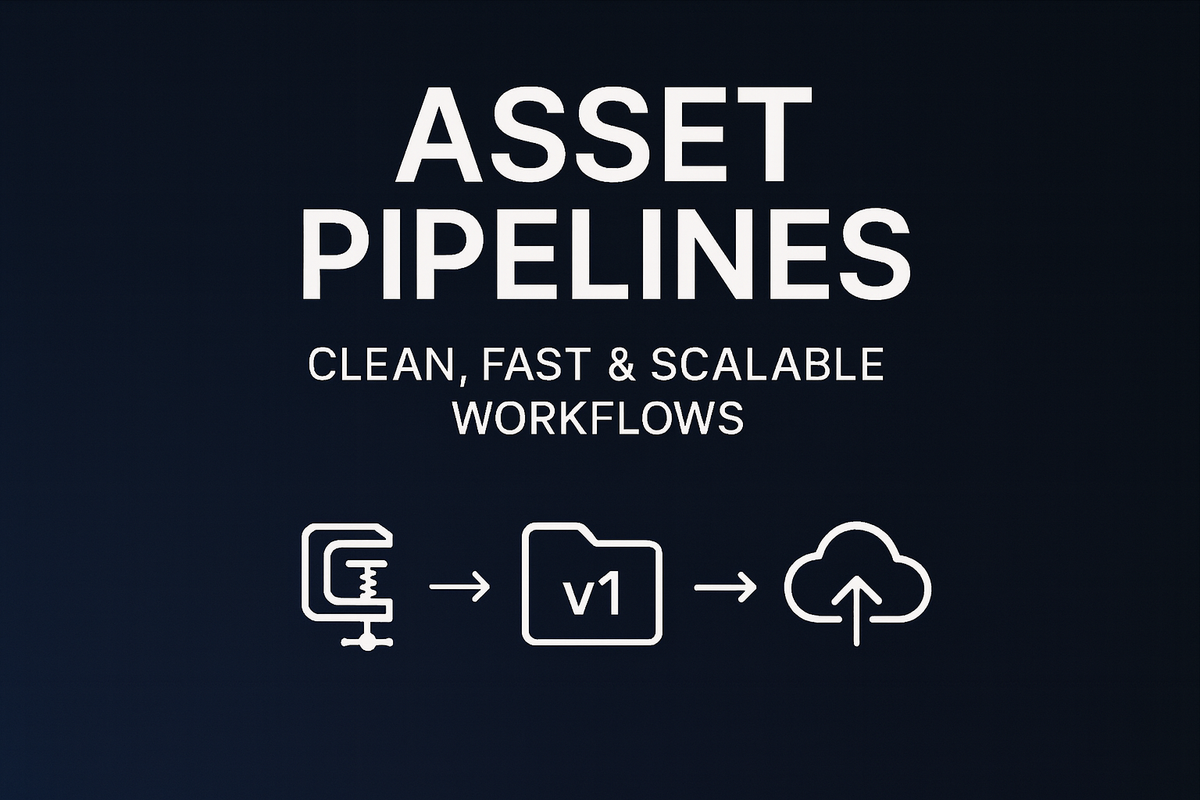
How to Build a Clean, Fast & Scalable Workflow Without a DevOps Team
Introduction
Whether you're building a Shopify storefront, a Flutter mobile app, a static website, or a serverless backend, one thing remains constant:
Your product lives or dies by the quality of your asset pipeline.
Assets — images, videos, SVG icons, fonts, Lottie animations, JavaScript bundles, CSS, PDFs — define how your product loads, feels, and performs. In large organizations, there are dedicated teams for this: Performance Engineering → DevOps → Front-End Platform → QA → Release Engineering.
But small teams don't have this luxury.
You might have:
- Small team
- constant shipping pressure
- multiple platforms (Web + Shopify + Flutter)
Without a proper asset pipeline, things break down quickly: slow websites, bloated apps, stale assets due to caching, large image uploads, unusable folder structures, broken themes, and inconsistent branding.
This blog is a complete guide to building a lightweight, scalable asset pipeline that ANY small team can maintain — without needing a large engineering department.
1. What Exactly Is an "Asset Pipeline"?
An asset pipeline is the end-to-end workflow that defines:
- ✔ How assets are created
- ✔ How assets are optimized
- ✔ How assets are named
- ✔ How assets are versioned
- ✔ How assets are uploaded
- ✔ How assets are served via CDN
- ✔ How assets are referenced in apps, Shopify themes, blogs, etc.
- ✔ How updates roll out without breaking production
It's the system that ensures consistency, performance, and reliability.
2. Why Small Teams Need an Asset Pipeline Even More Than Big Teams
Most problems small teams face can be traced back to bad asset workflows:
❌ Huge uncompressed images → slow website
Shopify PDP hero images > 5MB = instant SEO and conversion disaster.
❌ Flutter app bundle size grows uncontrollably
Large PNGs and Lottie files inflate APK/IPA size massively.
❌ CDN caching issues
Replacing a file doesn't work — customers still see old assets.
❌ Random naming & folder chaos
Files like:
- banner-final-FINAL.png
- banner-latest-v4-final.png
- copy-of-new-banner_3.png
…create total madness.
❌ Duplicate assets across environments
Dev theme, staging theme, live theme — all drifting.
❌ Marketing uploads raw files into Shopify
A 4k PNG uploaded into a homepage slideshow.
❌ Wasted engineering time
Engineers repeatedly resize, re-upload, compress, and fix assets manually.
Small teams don't need bigger pipelines — they need cleaner pipelines, because they have fewer people to fix things.
3. The Ideal Asset Pipeline for Small Teams (Simple + Powerful)
A strong pipeline does 4 things really well:
Before diving into the specifics, let's establish what "good" looks like. A well-designed asset pipeline should be:
- Predictable: Anyone on the team knows exactly where assets go and how they're named
- Fast: Assets load quickly for end users, and the team can ship updates rapidly
- Resilient: Cache invalidation works, rollbacks are easy, nothing breaks in production
- Maintainable: New team members can understand it in under an hour
- Cost-effective: Optimized assets mean lower CDN costs and better performance
The following sections break down each component:
3.1 Local Optimization Pipeline (Designers → Engineers)
Most performance problems can be prevented before assets enter the repo.
✔ Optimize every image before upload
Use:
- Squoosh.app
- TinyPNG / TinyJPG
- ImageOptim
- SVGO
- Lottie Compressors
- FontTools (subset fonts)
Designer Rules:
- WebP for everything (unless transparency needed)
- No hero/banner > 300 KB
- Export at 2× for mobile
- No PNG unless required
- SVGs for all icons/logos
This reduces asset size by 40–70% instantly.
Pro tip: Create a shared Figma/Design file that includes export presets with these optimization rules baked in. This ensures every designer exports consistently without thinking about it.
Practical Example:
Original PNG: product-hero.png (3.2 MB)
After WebP conversion: product-hero.webp (420 KB)
Savings: 87% reduction
Load time improvement
3.2 Folder Structure & Naming Discipline
Small teams fall apart without structure.
Recommended Structure:
assets/
  images/
    homepage/
    product/
    blog/
    icons/
  fonts/
  scripts/
  lottie/
  uploads/
Naming Convention:
hero-main.webp
hero-main-mobile.webp
collection-summer-2025.webp
product-bowl-grey.webp
icon-dog.svg
Rules:
- lowercase
- hyphens only
- no spaces
- no version numbers in the name (version folders solve that)
3.3 Cloud Asset Pipeline (S3 + CloudFront)
Do not store large media inside:
- The Shopify theme
- The Flutter app bundle
- Git repo
- CMS uploads
Use S3 → CloudFront for everything heavy:
- Blog hero images
- Pet tag generated images
- PDFs
- High-res content
- Shared app/web assets
Versioned structure:
s3://company-assets/
  hero/
    v1/hero.webp
    v2/hero.webp
  tags/
    {petId}/v3/tag.webp
This way:
- No cache issues
- Easy rollback
- Controlled updates
- Immutable assets for SEO
3.4 Cache-Busting & CDN Strategy
Set:
Cache-Control: public, max-age=31536000, immutable
When you update:
/hero/v1/hero.webp → /hero/v2/hero.webp
Never overwrite old assets. Always bump versions.
This completely eliminates caching bugs.
Deep Dive: Why Versioning Matters
Imagine this scenario: You update hero-banner.webp on your CDN. Your CloudFront distribution has a 24-hour cache. Some users get the new version immediately. Others see the old version for another day. Mobile apps cache even longer. Now you have inconsistent branding across your entire customer base.
With versioned URLs:
/hero/v1/hero.webpnever changes/hero/v2/hero.webpis the new version- Update references in code from v1 → v2
- Deploy happens atomically
- Zero cache confusion
Bonus: You can A/B test easily by serving v1 to 50% of users and v2 to the other 50%.
3.5 Lightweight Automation Layer
You don't need a giant CI/CD pipeline.
Just create a simple GitHub Action that:
- compresses images
- validates size limits
- warns if file > 400KB
- optimizes SVGs
- uploads assets automatically to S3
- runs Shopify Theme Check
Example rule:
❗ hero-banner.png is 2.7MB — must compress before merging.
This builds automatic discipline.
Sample GitHub Action (Basic Version):
name: Asset Pipeline Check
on: [pull_request]

jobs:
  validate-assets:
    runs-on: ubuntu-latest
    steps:
      - uses: actions/checkout@v3

      - name: Check image sizes
        run: |
          find assets/images -type f -size +500k -exec echo "⚠️ Large file: {}" \;

      - name: Optimize SVGs
        run: npx svgo -f assets/icons/

      - name: Validate naming
        run: |
          if find assets -name "* *" | grep .; then
            echo "❌ Files with spaces found"
            exit 1
          fi
This simple automation catches 80% of asset mistakes before they reach production.
4. Asset Pipelines Inside Shopify
Shopify is extremely sensitive to asset mistakes:
Common Failures:
- Designers uploading 3MB PNGs to the theme editor
- Unoptimized collection banners
- Uncompressed product images
- Theme bloat from unused assets
- Incorrect aspect ratios
Use This Strategy:
- ✔ Store heavy images on S3
- ✔ Use WebP everywhere
- ✔ Compress all theme assets
- ✔ Keep theme under 5MB
- ✔ Avoid storing campaign images inside the theme
- ✔ Let JSON templates load images dynamically
- ✔ Only icons + small CSS in Shopify assets folder
This keeps Shopify fast, clean, and easy to maintain.
Real-World Shopify Optimization Case Study:
A Shopify store we worked with had:
- Theme size: 18MB
- Homepage load time: 6.2s
- Bounce rate: 68%
After implementing this pipeline:
- Theme size: 3.8MB (79% reduction)
- Homepage load time: 1.9s (69% faster)
- Bounce rate: 41% (27 point improvement)
- Conversion rate: +12%
The changes took 3 days to implement. The performance improvement was permanent.
5. Asset Pipelines for Flutter Apps
Flutter bundles everything. Bad assets = huge app.
Best Practices:
- convert PNG → WebP
- use SVG icons (flutter_svg)
- compress Lottie JSON
- Avoid large images in the bundle
- load dynamic images from S3 via CloudFront
- Organize assets clearly
Recommended Structure:
assets/
  icons/
  illustrations/
  backgrounds/
  lottie/
Apps become smaller and faster immediately.
Flutter Asset Size Comparison:
Before optimization:
- 45 PNG images: 12.3 MB
- 3 Lottie files: 890 KB
- Total app size: 28.7 MB

After optimization:
- 45 WebP images: 2.1 MB (83% reduction)
- 3 compressed Lottie: 340 KB (62% reduction)
- Total app size: 16.4 MB (43% smaller)

Result:
- 35% fewer users abandoning download
- 22% faster app startup
- Better Play Store / App Store ranking
Advanced tip: Use Flutter's asset variants to serve different resolutions:
assets/
  images/
    2.0x/hero.webp
    3.0x/hero.webp
Flutter automatically picks the right one based on device pixel density.
6. Real Example: Dynamic Image Pipeline (Pet Tags)
This example connects everything together.
Pipeline:
- Python (Pillow) generates a personalized tag
- CloudFront caches aggressively
- Zero downtime, zero breaking
Upload to:
pet-tags/{petId}/tag.webp
This is exactly how small teams can achieve big-company quality.
Scaling This Pattern:
This same versioning strategy works for:
- User-generated content: Profile pictures, uploads
- Marketing campaigns: Seasonal banners, promotional graphics
- Product catalogs: Dynamically generated product images
- Email templates: Images that need to stay consistent
- Documentation: Screenshots, diagrams, tutorial images
The key is treating every image as immutable once published. Never edit in place—always create a new version.
7. The Hidden Cost of Bad Asset Practices (Real Impact)
⚠ 1. Slower load → lower conversion
Shopify: +1s load time → –7% conversion
Mobile apps: higher drop-off → lower installs
⚠ 2. Higher infrastructure costs
Large uncompressed assets increase CDN egress.
⚠ 3. Stale content issues
Non-versioned assets cause UI inconsistencies.
⚠ 4. Developer time wasted
Manual compression, reuploads, debugging = lost hours.
⚠ 5. App bloat
Large binaries → slower releases + uninstall risk.
A good pipeline solves these structurally.
8. Asset Governance: Simple Rules for Small Teams
You don't need a committee — just 4 rules:
Rule 1: Only optimized assets enter the repo
No raw files.
Rule 2: Every folder has an owner
Someone is accountable.
Rule 3: No asset without a feature or ticket
No random uploads.
Rule 4: Quarterly cleanup
Remove duplicates, old versions, and unused assets.
Super lightweight. Extremely effective.
Implementation Timeline:
- Week 1: Audit current assets, document the mess
- Week 2: Set up S3 + CloudFront, create folder structure
- Week 3: Migrate high-impact assets (homepage, top products)
- Week 4: Set up automation, train team, document process
Most teams see measurable improvement by day 10.
9. Asset Versioning: Three Models That Work
1. Semantic (v1.0 → v1.1 → v2.0)
Great for campaigns and designs.
2. Environment-based (dev/staging/prod)
Good for multi-theme shops.
3. Hash-based (9ac83e12/hero.webp)
Perfect for dynamic images or automation.
For small teams:
👉 Stick to v1, v2, v3 — simple, predictable, clean.
When to Use Each Model:
Semantic versioning is best when:
- You're managing design system assets
- Breaking changes need clear communication
- Multiple teams consume the same assets
Environment-based works when:
- You have distinct staging/production environments
- You need perfect isolation between environments
- You're managing Shopify multi-store setups
Hash-based shines when:
- Assets are generated programmatically
- You have high-frequency updates
- You need guaranteed uniqueness
- Build tools handle references automatically
For 90% of small teams, simple folder versioning (v1, v2, v3) is the sweet spot.
10. Bonus: Asset Pipeline Template You Can Put in README
# Asset Pipeline Rules

## 1. Optimization
- Compress using Squoosh / TinyPNG
- SVGs must be optimized with SVGO
- No file > 500KB without approval

## 2. Naming & Structure
- lower-case-hyphens
- assets/images/<category>/
- no "final-final-v2" naming

## 3. Versioning
Use folder versioning:
images/homepage/v1/hero.webp

## 4. S3 Uploads
Upload assets to:
s3://company-assets/<type>/<version>/

## 5. CDN Cache
Cache-Control: public, max-age=31536000, immutable

## 6. Cleanup
Quarterly deletion of unused assets
This makes the pipeline self-documenting.
Bonus: Asset Health Dashboard
Track these metrics monthly:
# Asset Health Report - January 2025

## Pipeline Metrics
- Total assets: 847
- Average asset size: 156 KB
- Assets > 500KB: 12 (↓ from 34 last month)
- Unoptimized assets: 3
- Orphaned assets: 18

## Performance Impact
- Avg page load: 1.8s (↓0.4s)
- CDN bandwidth: 840 GB (↓12%)
- CDN cost: $126 (↓$18)

## Actions Needed
- [ ] Optimize 12 large assets
- [ ] Remove 18 orphaned assets
- [ ] Update 3 unoptimized PNGs to WebP
Review this quarterly with the team. Celebrate wins. Fix problems early.
11. Conclusion
Asset pipelines are not something "only big companies need." Small teams actually need them more, because:
- They release faster
- Mistakes cost more
- They don't have time to manually fix issues
- Assets touch every part of the system
- Performance directly impacts conversion
With a simple setup — local compression → structure → S3 + CloudFront → versioning → automation — you can build a pipeline that feels enterprise-grade without the complexity.
This is one of the highest ROI engineering systems a small team can implement.
The Compound Effect:
What makes asset pipelines special is that they improve everything:
- Designers work faster (clear export rules, no back-and-forth)
- Engineers ship faster (no manual optimization, clear structure)
- Marketing moves faster (self-service asset uploads, no bottlenecks)
- Customers get better experiences (faster loads, consistent branding)
- Business saves money (lower infrastructure costs, higher conversion)
Unlike many engineering investments that help one area, asset pipelines create a flywheel effect that accelerates your entire team.