Building The Everbowl: Hybrid Manufacturing at Small Scale
Manufacturing the first 25 complete units of a hardware product is its own kind of challenge. You're well past rough prototyping but not yet ready for the cost and rigidity of mass production. At this stage, success comes down to choosing manufacturing processes that deliver repeatability, functional reliability, and visual quality, without locking the design in too early.
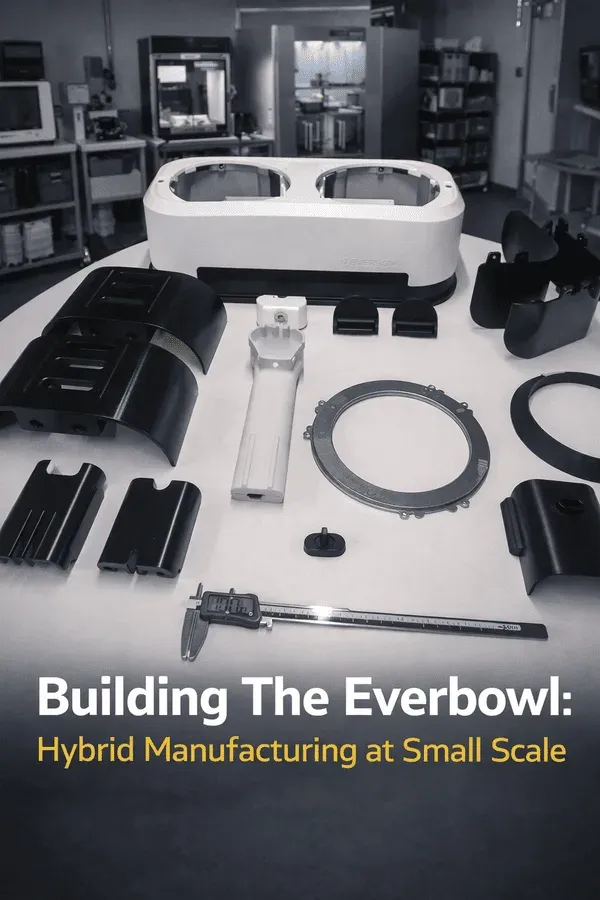
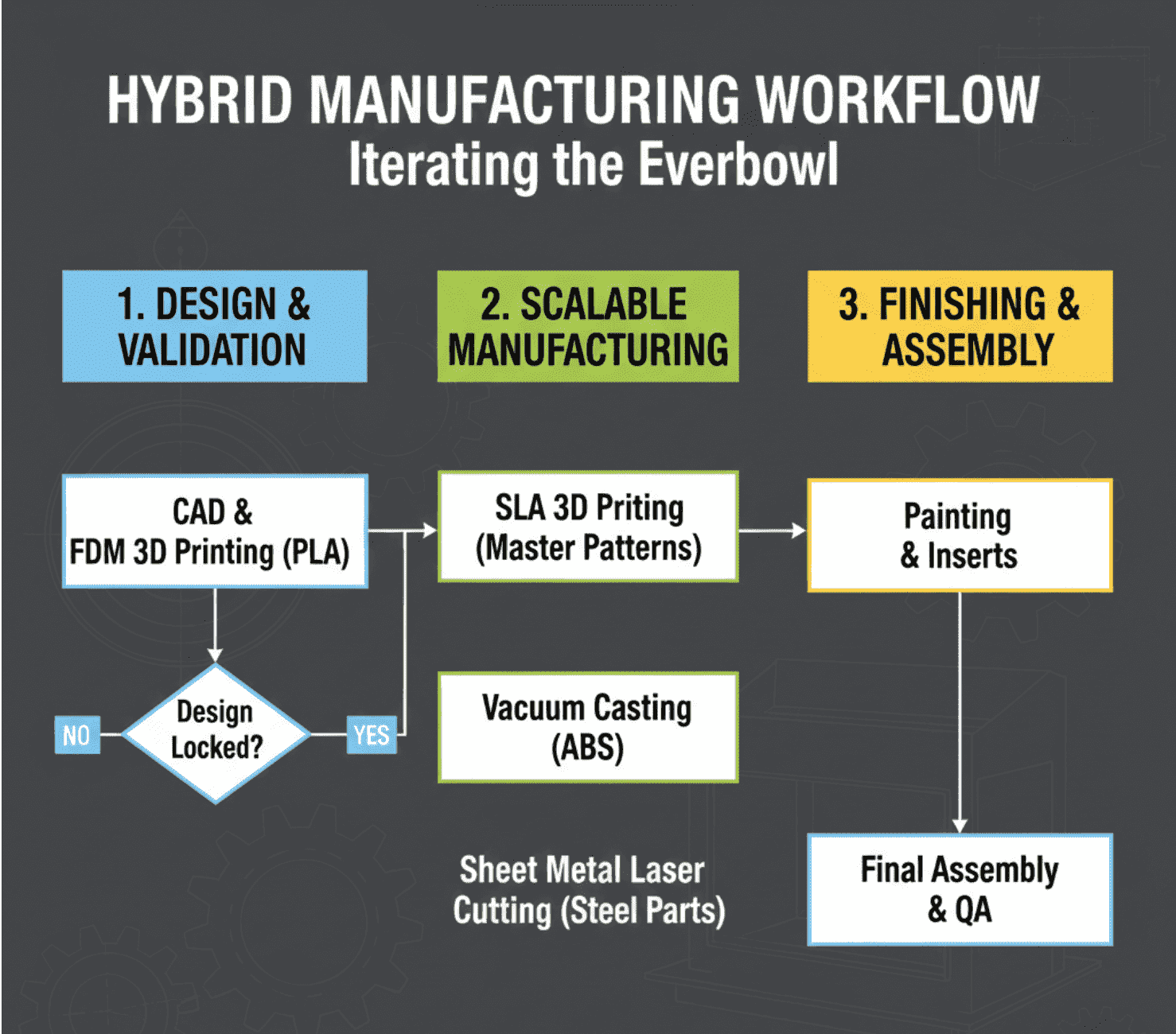
For Everbowl, that meant combining vacuum casting, FDM, SLA, and sheet metal laser cutting, followed by inserts and painting. The device integrates aluminum load-bearing rings, load cells, and plastic housings, all needing tight mechanical alignment and consistent assembly across every unit. This post walks through how we built 25 Everbowl devices with a hybrid manufacturing strategy, why we chose each process, and what we learned by actually assembling and testing real units rather than just designing them.
What Everbowl needed
Everbowl isn't just an enclosure, it's a measurement system, which meant the manufacturing approach had to satisfy several constraints at once: rigidity for accurate load sensing, tight tolerances between metal and plastic parts, durable and repeatable screw joints, and a finish suitable for both real-world use and demos. No single process handled all of that well, so the answer was intentional hybridity.
Why a hybrid approach was necessary
For a 25-unit build, the standard options all fall short somewhere. Injection molding is too expensive and inflexible at this volume. Pure 3D printing gives inconsistent finish and mechanical behavior. Full CNC machining is costly and slow for complex plastic parts.
Instead, we mapped each part of Everbowl to whichever process suited its role best: FDM and SLA for iteration and precision, vacuum casting for repeatable plastic parts, sheet metal laser cutting for structural accuracy, and inserts plus paint for durability and perceived quality. That let us scale just enough without overcommitting to any one process too early.
FDM printing: fast iteration and structural validation
We started with FDM for early and mid-stage plastic components. Even at this scale, FDM was genuinely useful for validating enclosure geometry, checking clearances around electronics and fasteners, testing assembly order, and creating master patterns for casting later. It gave us the confidence to lock down geometry before scaling it across multiple units.
We used PLA and ABS strategically rather than interchangeably. PLA gave us excellent dimensional stability and was quick and easy to print, ideal for early validation and non-structural parts. ABS offered better heat resistance and higher impact strength, closer to what the final production plastics would actually be. Using both let us balance speed with realism.
SLA printing: precision where it mattered most
For components needing high accuracy and fine detail, we used SLA. It was the right call for parts with tight tolerances, features interacting directly with sensors or electronics, and small components where surface finish affected fit. Compared with FDM, SLA gave us smoother surfaces, higher dimensional accuracy, and better feature resolution. These parts often served as interfaces, where a small error could cascade into a system-level issue, which is why we used SLA specifically for the main wand head housing our core sensing equipment.
Vacuum casting: consistency across 25 units
Once designs stabilized, we moved key plastic parts to vacuum casting. It gave us injection-mold-like surface quality, uniform material behavior, economical production at small batch sizes, and reliable repeatability across all 25 sets. For Everbowl, vacuum casting was really the bridge between prototype and production.
The workflow ran in a set order: print master parts with SLA, sand and seal the surfaces, build silicone molds from them, then cast ABS-like resins under vacuum. Since the quality of the master part defined the quality of every part cast from it, that step got treated with real care.
Sheet metal laser cutting: the backbone of measurement
The most critical mechanical elements in Everbowl are the aluminum sheet metal rings that interface with the load cells. The bottom ring is laser-cut aluminum, fixed rigidly to the plastic body, providing a stable reference. The top ring is also laser-cut aluminum, supports the dog food bowl, and moves slightly under load. The load cell sits sandwiched between the two, measuring the weight change as the dog eats. This architecture needs high stiffness, precise alignment, and minimal flex anywhere outside the load cell path.
We used 2 mm aluminum for lighter, non-critical elements and 2.5 mm aluminum for load-bearing and alignment-sensitive rings, a balance between structural rigidity, weight, and ease of laser cutting and handling. Laser cutting also ensured every ring came out dimensionally identical, which mattered a lot for consistent sensor behavior across units.
Threaded inserts: designing for repeated assembly
Repeated assembly was unavoidable across testing, painting, servicing, and iteration. Self-tapping screws would have degraded the plastic over time, introduced torque variability, and reduced long-term reliability, so we designed all critical joints around threaded inserts instead. That gave us consistent clamping force, reliable disassembly and reassembly, better perceived quality, and improved load distribution. We used inserts across vacuum-cast plastic parts, ABS FDM components, and interfaces with the aluminum structures.
Painting: making the device feel real
The moment a device is seen, it starts explaining itself. Exposed raw materials tell a story of experimentation; finished surfaces tell a story of intent. We didn't paint Everbowl to make it look better, we painted it to make it feel finished. It unified the different materials, softened the rough edges of early manufacturing, and marked the shift from exploration to execution. That single step changed how the device came across in demos, how early users interacted with it, and how confidently it stood on its own as a product rather than a prototype.
Assembly at 25 units: a reality check
Building one unit proves feasibility. Building 25 proves repeatability. Assembly at this scale validated tolerance stack-ups, insert placement accuracy, load cell alignment consistency, and structural rigidity under real use. Issues that were invisible building a single unit became obvious, and fixable, once we hit 25.
What this manufacturing strategy enabled
Combining FDM, SLA, vacuum casting, sheet metal laser cutting, inserts, and painting got us production-like quality without any tooling investment, consistent sensor performance across units, reliable mechanical assemblies, and enough confidence to move toward larger-scale production. More than anything, it gave us real data on how Everbowl actually behaves as a physical system.
Hoomanely
At Hoomanely, the goal is building technology that works with humans, and animals, in the real world, and Everbowl's manufacturing journey reflects that. Choosing flexible, human-centered manufacturing methods let the design evolve through real interaction instead of assumptions. The hybrid approach meant what we built could actually be assembled, used, serviced, and trusted, strengthening our broader technology stack and reinforcing something we believe in: good systems get shaped by reality, not abstraction. Everbowl's journey is a good example that scaling thoughtfully beats scaling quickly, especially when precision, reliability, and trust are what's actually at stake.