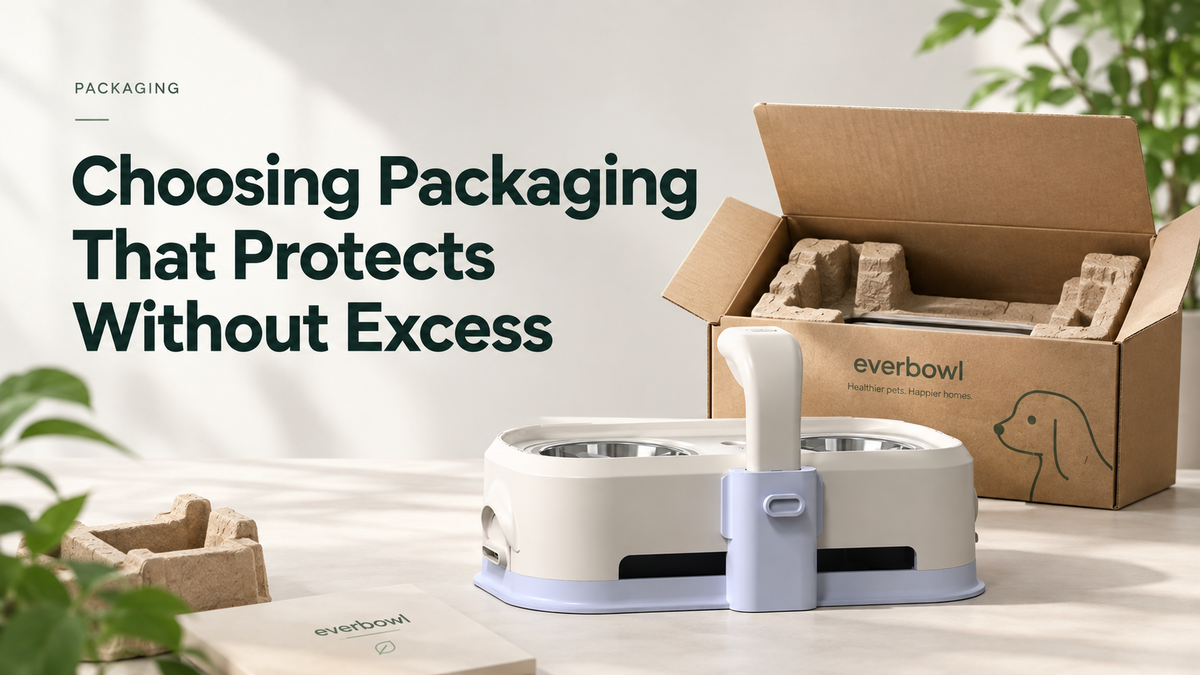
Choosing Packaging That Protects Without Excess
How we approached packaging as an engineering problem rather than simply adding more material.
Introduction
Packaging is easy to treat as the last step in product development. The product gets designed, the manufacturing process gets defined, and then the question becomes: how do we put it in a box and ship it? With Everbowl, that approach turned out to create its own problem. A product can be mechanically solid in normal use and still be vulnerable in transit. It can also get protected so aggressively that the packaging ends up oversized, expensive, hard to assemble, and heavy on material.
The real challenge was never making the packaging stronger. It was finding the minimum packaging system that could reliably protect the product through the actual realities of shipping and handling.
Packaging is part of the product system
Once a product leaves the factory, we don't control how it gets handled anymore. It can get dropped, compressed under stacked packages, vibrated during transport, roughly loaded and unloaded, flipped through multiple orientations, exposed to temperature and humidity swings, and knocked on corners and edges.
That mattered for Everbowl because the product has components that don't all respond the same way to those conditions. The outer housing might shrug off an impact that sends a much higher local acceleration into an internal assembly. A cosmetic surface might survive the mechanical load but still pick up visible marks. A structurally strong component can still shift around if the packaging gives it too much room to move. So we started thinking about packaging the same way we'd think about the product itself: in terms of load paths and energy management.
The first question wasn't "how much foam do we need?"
The instinctive answer to packaging is always more cushioning. But cushioning only solves part of the problem. The real first question is: what actually needs protecting, and what's the failure mechanism we're protecting it from?
For Everbowl, that meant separating out the different risks. Impact: could a drop generate enough acceleration to damage a component or joint? Movement: could the product shift inside the box and repeatedly hit the packaging? Compression: could stacking loads deform the package or push force into sensitive areas? Cosmetic damage: could the product rub against the packaging in transit? Assembly damage: could an external force find a load path into something mechanically sensitive inside?
Each of those needs a slightly different response, which made it obvious pretty quickly that just wrapping the whole product in thick foam wasn't necessarily the right answer.
Designing the load path
A useful way to think about packaging is asking where the transportation force actually goes. Picture the box getting dropped: the force enters through the packaging, transfers through the cushioning, reaches the product at specific contact points, and travels from there through the product's own structure. If those contact points happen to sit right over a fragile component, the packaging can end up protecting the outside of the product while funneling a concentrated load straight into the inside. That's a packaging failure, even if the box looks fine.
The goal is a controlled load path: impact into packaging, into energy absorption, into the robust part of the product structure, rather than impact into packaging and straight into a sensitive component. That mattered a lot for Everbowl, since its mechanical architecture includes sensing and structural elements that depend on holding a controlled geometry.
Holding the product is as important as cushioning it
Packaging doesn't just need to absorb energy. It needs to control movement. A product sitting inside a box with a few millimeters of clearance can actually accelerate during a drop before it reaches the packaging, and the resulting impact can be a lot worse than if the product had been held in place from the start.
That creates two separate requirements: constraint, to stop unnecessary movement, and cushioning, to manage the energy once movement or impact does happen. Getting only one right isn't enough. Too much constraint introduces concentrated forces of its own. Too little lets the product build up real impact velocity before it hits anything. Packaging geometry ends up being a balance between retention and compliance.
Why "more material" wasn't automatically better
The easiest way to add protection is to add material: more foam, more corrugate, more inserts, more wrapping, more layers. But every added layer has its own cost. More material means higher cost per shipped unit. A bigger package needs more storage and transport space. More inserts mean more assembly operations. Too much packaging makes unboxing annoying for the customer. And more material overall means more to manufacture, transport, and eventually dispose of.
That reframed the actual engineering question: can we improve protection while cutting unnecessary material, rather than just chasing the strongest possible package?
Designing around the actual product geometry
The product itself gave us options here. Instead of treating Everbowl as a generic rectangular box, we could use its actual geometry to decide where packaging should make contact. Strong structural regions became support points. Sensitive surfaces stayed away from direct contact. Open spaces became clearance zones. Edges got protected specifically where they were most vulnerable.
It's the same logic as mechanical fixture design. You don't clamp a precision component wherever's convenient. You find the surfaces that can actually take force and use those on purpose. Packaging works the same way.
Cosmetic protection is a different engineering problem
Functional damage and cosmetic damage don't share the same threshold. A product can come through an impact completely functional and still be unacceptable to a customer because of scratches, scuff marks, surface impressions, cracked coatings, deformation, or abrasion.
That matters for something meant to live in a home. Everbowl's outer surfaces are part of the actual product experience, so a packaging solution that prevents structural damage but still lets surfaces rub against rough packaging in transit is only half the job. The simple rule we landed on: the product shouldn't be allowed to repeatedly move against an uncontrolled surface. The fix isn't always more padding. Sometimes it's just controlling the interface better.
From prototype packaging to engineered packaging
Early packaging prototypes are great for surfacing obvious problems, but they can also hide important variables. A prototype gets assembled carefully by an engineer who already knows how it's supposed to go together. A production package gets assembled repeatedly, by different people, at speed, with normal manufacturing variation thrown in.
That means the packaging itself has to be designed for assembly. We asked whether the product could only be inserted one obvious way, whether an insert could accidentally go in backwards, whether the packaging needed excessive force to close, whether there were unnecessary steps, whether protective elements could fall out during handling, whether the package closed reliably, and whether the product could shift after it was closed. A packaging design that protects beautifully but takes several minutes of careful fiddling to assemble isn't practical once you're doing it at production scale.
Testing the package, not just the product
Product validation and packaging validation answer different questions. A product test asks whether the product can survive a defined mechanical load. A packaging test asks whether the whole packaged system can survive actual transportation while keeping the product within its acceptable limits. Those aren't the same test.
A solid packaging validation program includes drop testing across representative orientations and heights, compression testing to see how the package handles stacking or external load, vibration testing to catch movement, abrasion, loosening, and cumulative damage, repeated handling tests to check that packaging components stay correctly positioned, and environmental exposure testing where temperature or humidity could affect the materials. The important thing throughout is measuring what actually happened to the product, not just whether the box looks intact from the outside.
Measuring the trade-off
Two metrics turned out to be genuinely useful here.
Damage-in-transit rate tells you whether the packaging is actually doing its job: damaged units divided by shipped units, times 100. The goal isn't driving that number to zero by piling on material indefinitely. It's reducing damage while keeping the other packaging variables in check.
Packaging material reduction is baseline packaging mass minus new packaging mass, divided by baseline mass, times 100. That gives an objective way to compare packaging revisions. If a new design cuts mass while holding or improving the damage rate, that's a change with a real engineering case behind it.
What we learned from the trade-off
Packaging performance was never a single-variable problem. We were balancing protection against material, against cost, against assembly, against package volume, against customer experience, and improving one usually cost you somewhere else. A very rigid package protects against impact but can transfer higher loads into the product. A very soft package absorbs energy but allows too much movement. A tightly constrained package protects the product but adds assembly steps. A minimal package looks efficient on paper but can leave sensitive areas exposed.
The best solution was never the package with the most protection overall. It's the one where the protection actually sits where it matters.
Engineering insight: Good packaging doesn't make a product immune to the shipping environment. It manages how that environment actually reaches the product. That reframing matters, because instead of just adding material everywhere, you can ask where the energy enters, where it should get absorbed, where the product should be constrained, which surfaces can take load, which surfaces need to stay isolated, and how much movement is genuinely acceptable. Those questions lead to an actual packaging architecture instead of a pile of protective materials.
Packaging also became part of the sustainability discussion
Sustainable packaging often gets framed as a simple material-selection problem: use less plastic. But the real engineering problem is bigger than that. If cutting packaging material increases product damage, the system hasn't actually improved, because a damaged product means replacement manufacturing, more transportation, more packaging, and disposing of whatever got damaged.
So the goal was never simply minimum packaging material. It's closer to minimum packaging required to reliably deliver an undamaged product, and that framing made the sustainability conversation a lot more useful from an engineering standpoint.
The final packaging is a compromise, deliberately
There's rarely a perfect packaging solution. The final design is a set of decisions about what matters most. For Everbowl, the goal was avoiding both extremes: treating packaging as an afterthought, and over-engineering it into something bloated. The package needed to protect the product, control movement, protect critical and cosmetic surfaces, survive real transportation conditions, stay practical to assemble, and avoid unnecessary material. That meant designing it around the actual product architecture and the actual failure modes, not a generic worst case.
How this shows up at Hoomanely
At Hoomanely, we treat hardware as a complete system rather than a pile of individual components, and packaging is part of that system. The product doesn't stop existing the moment it leaves the assembly line. It still has to survive transportation, arrive in the condition it's supposed to, and make the jump from a factory environment into someone's actual home.
For Everbowl, that meant extending the same engineering thinking we use for the mechanical and sensing systems into the box the product ships in. The goal was never just shipping it safely. It was designing packaging that's protective without being excessive.
Key takeaways
- Packaging is an engineering system, not just a protective layer wrapped around the product.
- Start from the failure mechanism, not from how much material feels safe.
- Control both movement and impact energy, not just one or the other.
- Use the product's own strong geometry as intentional packaging contact points.
- Treat cosmetic damage and functional damage as separate failure modes.
- Validate the complete packaged product, not just the empty package on its own.
- Track damage-in-transit rate and packaging material reduction to make trade-offs measurable.
- Reducing material only helps if the product stays adequately protected.
- The best packaging doesn't eliminate transportation forces. It controls how those forces reach the product.
Good packaging is easy to overlook, since customers rarely think about the engineering hiding inside the box. But every delivery that arrives intact is evidence that a whole set of mechanical decisions worked together: the product structure, the packaging geometry, the cushioning, the restraints, the materials, and the assembly process. The goal was never building the most protective package possible. It was building just enough packaging to get the product through the journey reliably.