Closing the Observability Gap Between "Sent" and "Delivered"
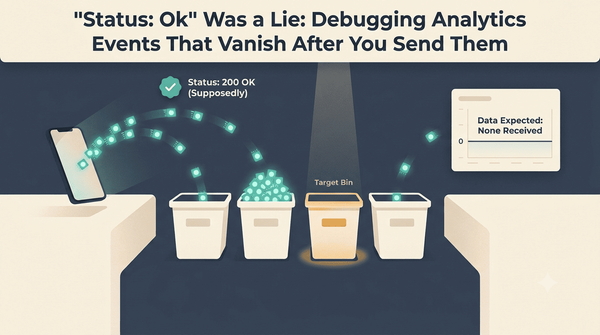
Every system I have run at scale has taught me the same lesson in a different costume: failures don't hide in the components you own — they hide in the seams between them. This is the story of one such seam. Our notification pipeline had a monitored backend on one side and a reputable delivery vendor on the other, and between them, a blind spot large enough to swallow months of silent failure: the majority of our push notifications dying on stale device tokens, and a critical tracking signal switched off for days without a single alert.
The remediation was not a rewrite. It was two hours of deliberate configuration — wiring Customer.io's reporting events and metadata into PostHog — guided by one architectural decision about where measurement should live. The specifics are ours; the pattern applies to any team whose only view of a delivery vendor is the vendor's own dashboard.
The Problem: A System Boundary Nobody Owned
Our backend emits events to Customer.io's Track API; Customer.io runs the campaigns and delivers through FCM and APNs. The division of labor was sound. What we had failed to assign was ownership of the question: what happened after we handed the message over?
When we audited the live campaign metrics through Customer.io's API — prompted by suspicion, not by any alert, which is itself the indictment — three findings surfaced:
1. Delivery had quietly collapsed. Our primary notification flow was reaching ~21% of its audience, consistently. In one week, undeliverable events (6,733) exceeded sends (6,153) — we were burning multiple dead device tokens per person. A sibling campaign on identical infrastructure delivered at 82%, which localized the fault: the platform was healthy, our audience data was not. The root cause was a lifecycle omission — device tokens were registered but never retired. Entropy did the rest.
2. A signal had gone dark without a sound. Our uninstall detection relies on a silent push to every user; the undeliverable responses are the signal. A routine filter edit zeroed that campaign's audience, and uninstall tracking went dark for three-plus days. No alarm fired because no alarm could fire — the data never left the vendor.
3. Engagement had no denominator. Mainline flows sat near 1% open-of-delivered, while one notification — our streak reminder — was achieving 12.5% opens and 15% conversions. A meaningful content insight, invisible for want of a funnel.
Three distinct symptoms, one structural cause: the feedback path from vendor to our systems existed on paper — PostHog had a registered webhook endpoint covering 54 Customer.io event types — but sat disabled, awaiting a signing secret. The capability had been provisioned; the loop had never been closed.
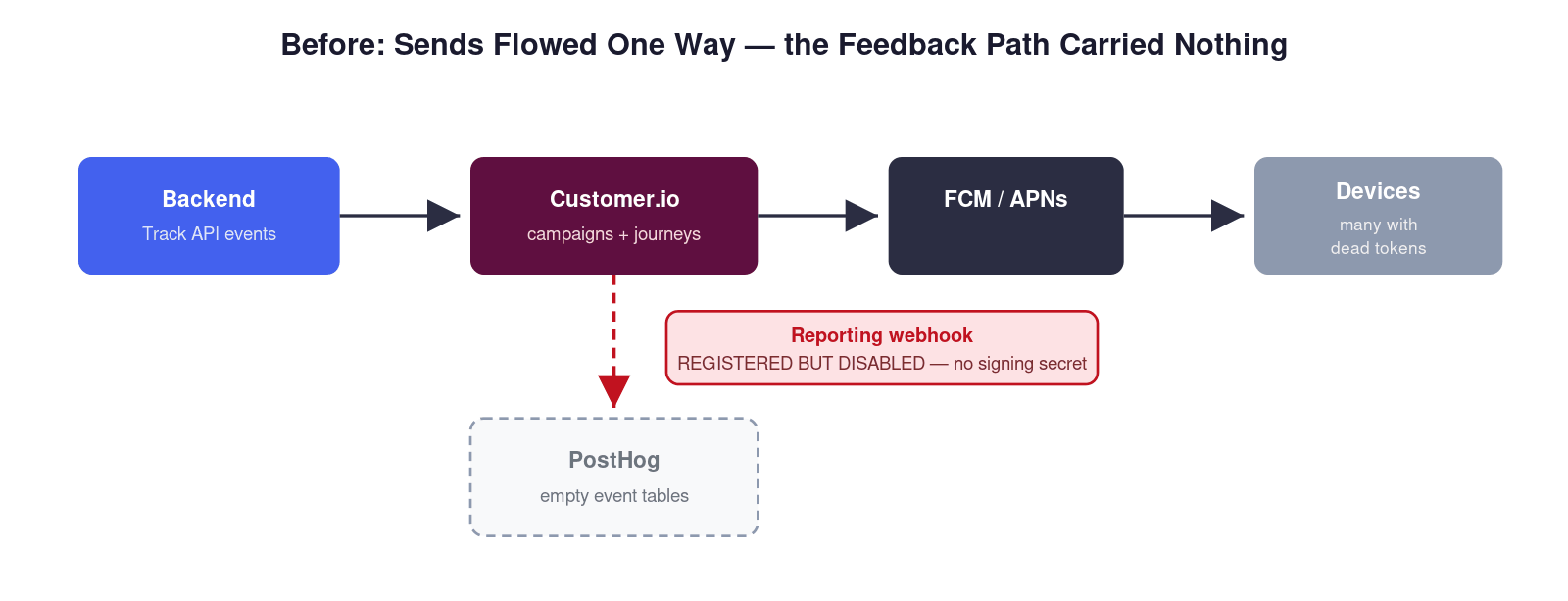
The Decision: Measurement Is a Plane, Not a Feature
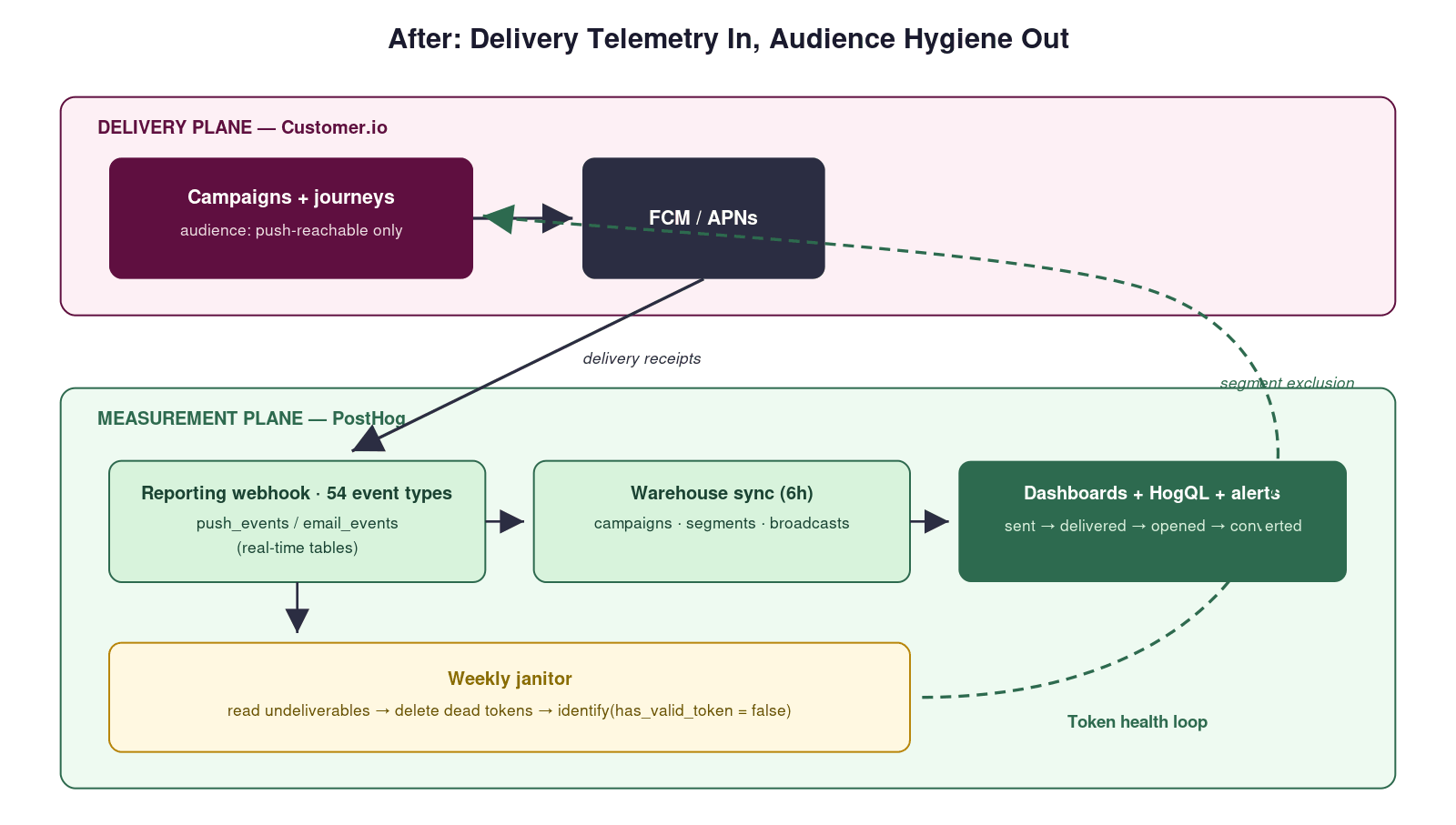
The tempting response to an incident like this is to build something — a reconciliation service, a delivery tracker. We declined. The principle we applied instead: each concern gets exactly one home. Detection logic lives in our domain modules. Delivery lives in Customer.io. Measurement lives in PostHog — because it already held our product analytics, and because it offers the three capabilities a measurement plane needs in one place: a warehouse that syncs vendor objects as queryable tables, webhook-fed event tables for real-time telemetry, and SQL, dashboards, and alerting across both.
New services are a liability you staff forever. Configuration that closes an existing loop is leverage.
The Execution: Three Moves
Move 1 — Vendor metadata into the warehouse
Customer.io connected as a PostHog data warehouse source; six metadata tables (campaigns, broadcasts, newsletters, segments, sender_identities, transactional) now sync every six hours. This is what allows an alert to say which campaign flatlined by name — and what makes a watchdog on campaign edits possible at all.
Move 2 — Enable the reporting webhook
The unglamorous heart of the fix: paste the signing secret, enable the webhook. All 54 reporting event types now stream into per-channel tables — push_events, email_events — each row carrying delivery ID, campaign ID, customer identifiers, and timestamp. The full journey of any single notification is reconstructable:
sql
SELECT metric AS event_type, count() AS events
FROM `customerio.customerio.push_events`
WHERE timestamp >= now() - INTERVAL 7 DAY
GROUP BY metric
ORDER BY events DESC
Move 3 — Convert visibility into invariants
Data alone changes nothing; the value came from encoding what we learned as enforced invariants:
- The uninstall pulse got a heartbeat. Audience restored, plus a standing PostHog alert on
entries = 0for any running campaign whose silence is meaningful. - Audiences were gated to reachability. Campaigns now target push-reachable users only; delivery moved from ~20% of sends to ~100% of eligible recipients, because dead tokens stopped counting as audience.
- Token lifecycle was closed.
push_undeliverableevents feed a weekly janitor that retires dead tokens via the Track API and flags usershas_valid_token = false, which segments then exclude. The root cause — registration without retirement — no longer exists as a class.
The Results: What a Week of Truth Looks Like
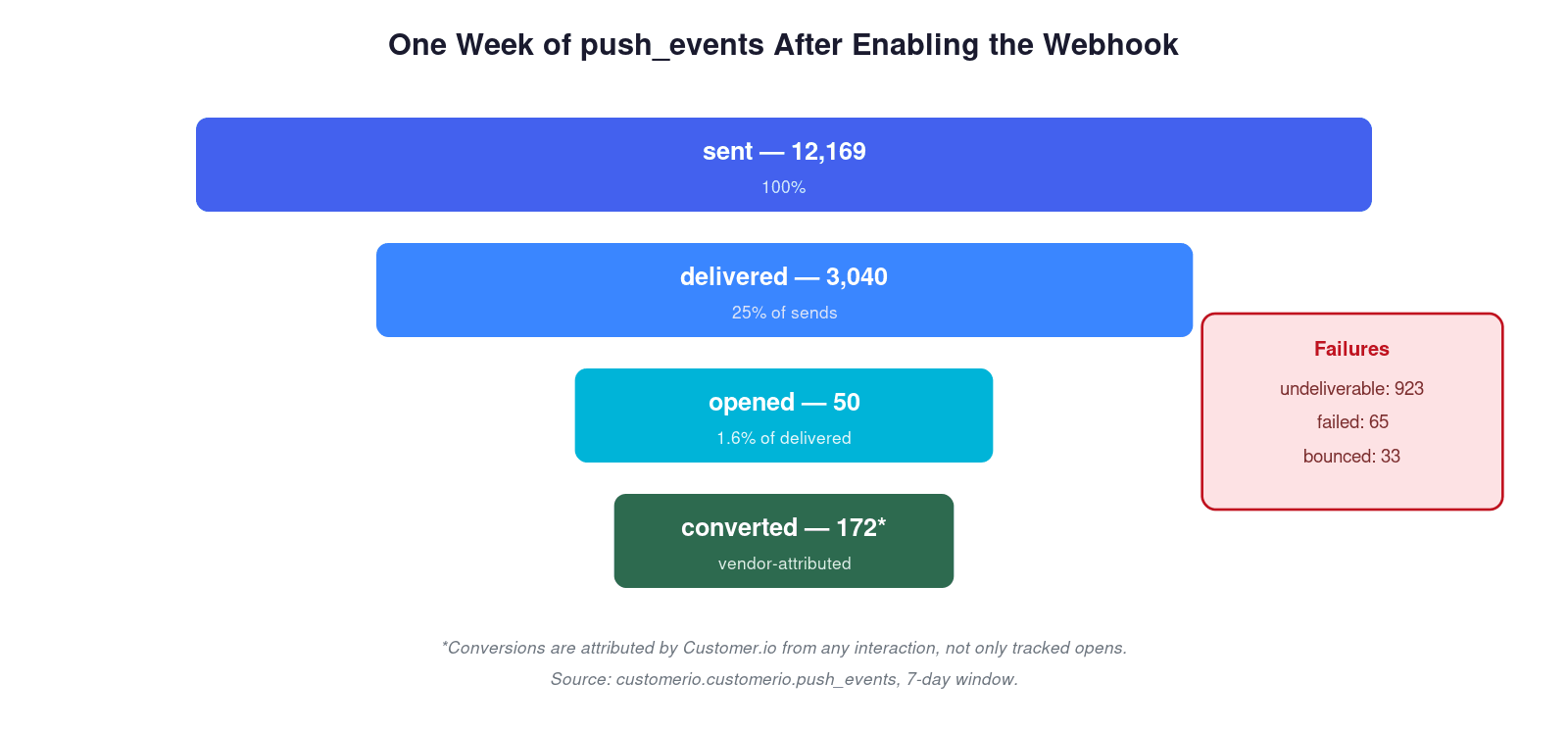
(*Conversions are vendor-attributed from any interaction, not only tracked opens — the kind of nuance you only learn once you own the raw events.)
The counts matter less than what they made possible:
- Silent failure is now a contradiction in terms. The class of incident that hid our uninstall tracking for three days now pages us within one. Delivery drops, flatlines, and edit-induced audience wipes are HogQL alerts on real-time tables.
- Delivery rate regained meaning. Against an audience full of dead tokens, delivery rate is noise; against a reachability-gated audience, a drop is a genuine signal — and therefore worth alarming on.
- Content decisions acquired a denominator. The streak reminder's 12.5% open / 15% convert against ~1% for broadcast-style pushes is now a standing per-campaign dashboard. Our operating rule: any recurring notification that cannot clear 2% opens after four weeks is rewritten or retired. Judgment, informed by data — not vibes.
Principles Worth Keeping
- A vendor's dashboard is a courtesy, not observability. It aggregates what the vendor chooses, on the vendor's timescale, with no alerting on your invariants. Raw events belong in a system you control.
- Close the loop before you optimize anything inside it. Two hours of configuration surfaced every problem in this post and made each fix verifiable. Everything else was follow-through.
- Lifecycles fail at retirement, not registration. Anything your system creates — tokens, sessions, subscriptions — decays into noise unless something is accountable for removing it.
- If silence is a signal, instrument the silence. Any pipeline whose absence of output carries meaning needs an explicit zero-output alarm, or it will fail during routine maintenance — quietly, and at the worst possible time.
- Own the seams. Our backend was monitored and our vendor was reputable; the hand-off between them belonged to no one. Assigning ownership of that boundary was the real fix — the webhook was merely its implementation.
At Hoomanely, we build connected products — the smart bowl, the EverWiz companion app — that help pet parents understand and care for their pets. A notification is frequently the moment our work reaches a human: a feeding insight, a health nudge, a streak kept alive. A push that dies silently on a dead token is a moment of care that never happens. Extending end-to-end observability to the notification pipeline holds it to the same standard we apply to our device telemetry: if it matters to a pet, it gets measured.