Creep in plastics: why screws lose clamp load over months
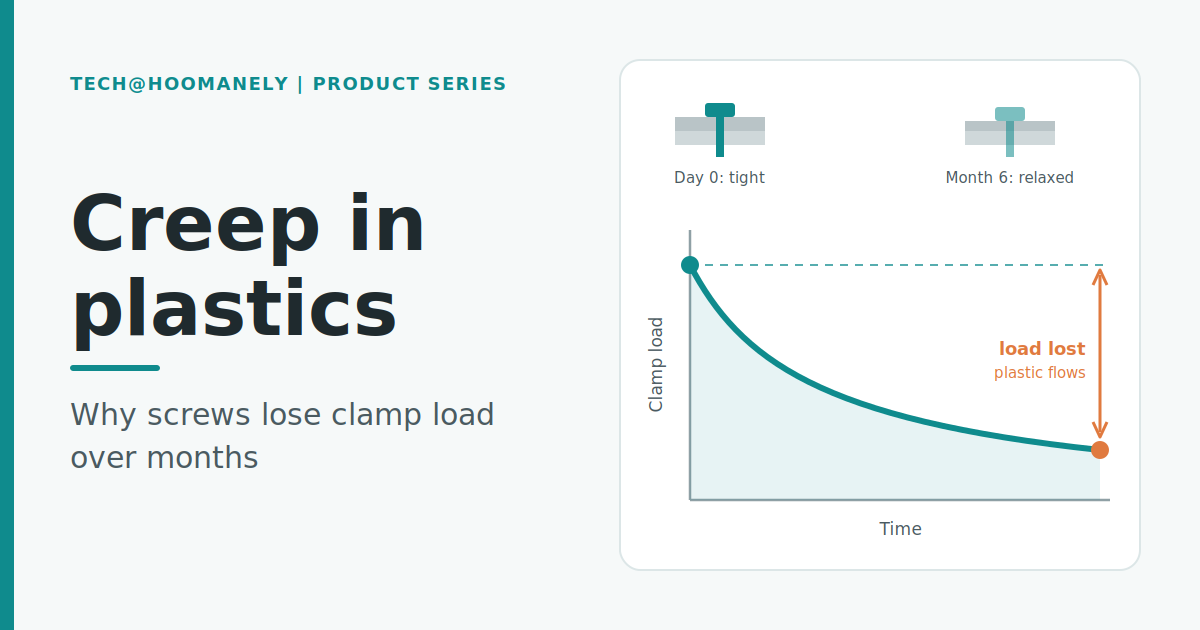
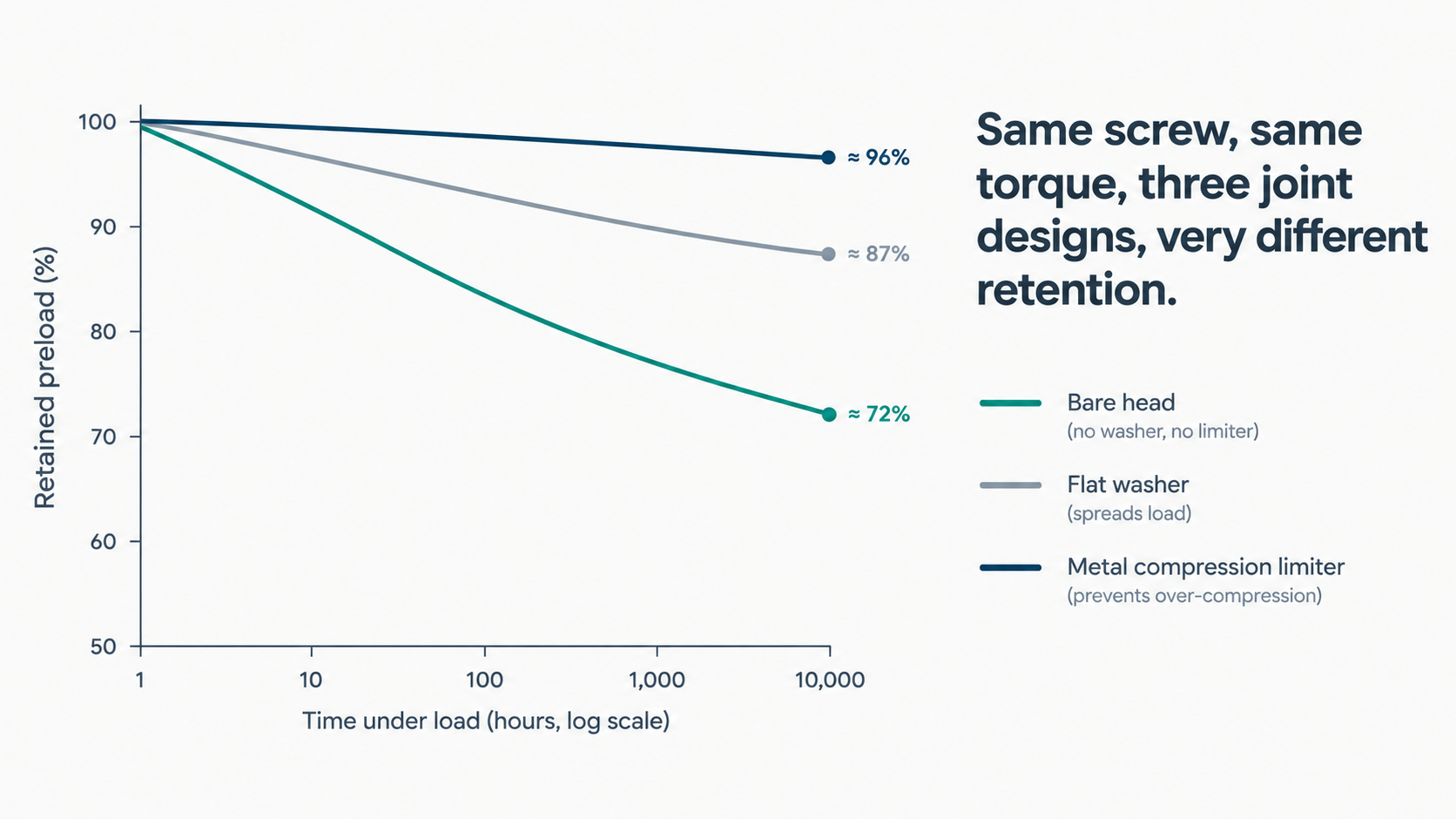
A screw in a plastic joint loses clamp load through stress relaxation, and in our illustrative model (hypothetical values) a bare M4 screw head on unfilled plastic keeps only 76 percent of its torque after 1,000 hours. Spreading the load with a flat washer lifts that to 86 percent, and a metal compression limiter lifts it to 95 percent. The plastic does not crack or fail. It slowly flows away from under the load, and the screw is left holding less than you installed.
This post covers why a screw joint is a relaxation problem, what failed in our early builds, how preload falls with time, and how we measure it with torque retention and creep strain. It ends with a comparison of joint designs and what this work lets EverBowl do.
The short version
- A bare M4 screw head on unfilled plastic loses about 8 points of preload for every tenfold increase in time, leaving 76 percent torque retention at 1,000 hours.
- A 10 mm flat washer cuts head bearing stress from about 28 MPa to about 10 MPa, and torque retention at 1,000 hours rises to 86 percent.
- A metal compression limiter carries the clamp load instead of the plastic and holds 95 percent torque retention at 1,000 hours.
- A 3.0 mm wall that thins by 0.045 mm is 1.5 percent creep strain, enough to cut the compression of a 2.0 mm gasket by about 2 points.
Why a screw joint is a stress relaxation problem
Plastics are viscoelastic, so they act partly like a spring and partly like a very thick fluid. Under sustained stress, polymer chains slowly slide past each other and settle into a new shape.
Two terms describe this. Creep is growing deformation under constant load. Stress relaxation is falling load under constant deformation.
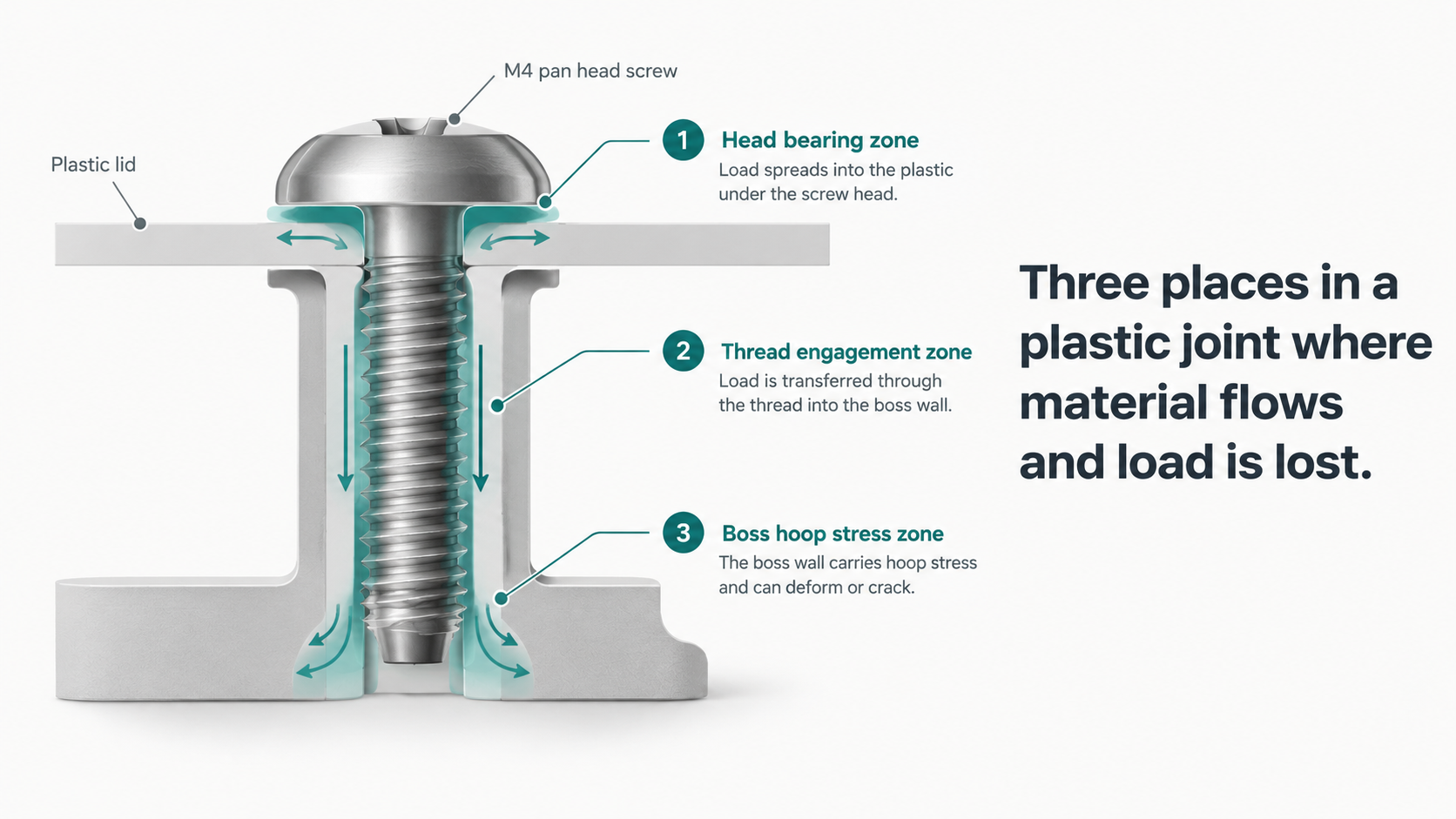
A tightened screw fixes the deformation, because the screw barely stretches further. The plastic under the head and around the threads relaxes, the squeeze shrinks, and clamp load drops. That is why a joint that felt solid at assembly can be loose months later with no one touching it.
What failed first
Our early prototypes were torqued to a number that felt right. They passed assembly checks and loosened within weeks. Three causes showed up again and again.
- Bare screw head on plastic. A small head area puts high bearing stress on the plastic, and it creeps out from under the head.
- Over-torque. More torque means more stress, which means faster relaxation. Tighter made it worse.
- Self-tapping screws in thin bosses. The thread pushes the boss wall outward, and that hoop stress relaxes over time.
The numbers show why. Take an M4 screw at 0.5 N·m. Using T = K × d × F with K of 0.2, preload is about 625 N. A 7 mm head on a 4.5 mm hole bears on about 22.6 mm², which is roughly 28 MPa of sustained stress. That is too high for most unfilled plastics over months.
How preload falls with time
Relaxation follows roughly the log of time, so each tenfold increase in time costs a similar slice of preload. The first hours hurt most.
In our illustrative model, a bare head on ABS keeps 100 percent at 1 hour, then 92 percent at 10 hours, 84 percent at 100 hours and 76 percent at 1,000 hours. That is about 8 points per decade. A thousand hours is roughly six weeks of service, and the same slope keeps going after that.
This is why a day-one torque check proves little. A joint can pass it and still be marginal at month six.
What changes the slope
Every plastic relaxes, but some relax far slower.
- ABS: moderate creep that rises fast with heat.
- PC: better resistance, but prone to stress cracking from solvents and thread lockers.
- PETG: softens near 80 C, so hot wash water and a sun-warmed housing matter.
- PA66 with glass fill: strong when dry, but absorbed moisture acts as a plasticizer and speeds relaxation.
- POM: low creep, though it bonds poorly and offers few finishes.
Glass or mineral fill lowers creep a lot, but mainly along the fiber direction. A boss molded with fibers aligned across the load path can still relax.
Heat is a multiplier. Warmer plastic lets chains move faster, so the same relaxation arrives sooner. Thermal cycling adds a second loss, because plastic and steel expand at different rates and each swing reloads the joint. Read the supplier's isochronous stress-strain curves at the target time and temperature, not only the short-term yield value.
Two metrics we track
Torque retention
Torque Retention (%) = (Residual torque ÷ Installed torque) × 100
We measure it with a break-loose or re-torque check at set intervals on identical joints, and report the average and the lowest unit.
Creep strain
Creep Strain (%) = ((Wall thickness at time t − Initial wall thickness) ÷ Initial wall thickness) × 100
We measure thickness under the head with a gauge before loading and at each interval. A 3.0 mm wall that thins by 0.045 mm after 1,000 hours is 1.5 percent creep strain. On a 2.0 mm gasket that thickness loss alone cuts compression by about 2 points, before the gasket relaxes itself.
Design fixes
Every fix does one of two things. It lowers the stress on the plastic, or it moves the load onto metal.
Step 1: Spread the load
A flat washer with a larger outer diameter cuts bearing stress. A 10 mm washer on the same M4 screw bears on about 62.6 mm², which brings the stress down to about 10 MPa.
Step 2: Move the load to metal
A compression limiter is a metal sleeve through the boss. It carries the clamp load, so the plastic is never squeezed hard. Heat-set or molded-in inserts do the same job for the threads and remove the hoop stress.
Step 3: Let geometry set the squeeze
A hard stop sets compression by geometry, not by how tight the screw is. Torque should close the joint and nothing more. Use a fixed-torque driver, and retorque once after the first 24 hours to recover the fast early loss.
Step 4: Store spring energy
A conical or wave washer stores elastic energy and covers some of the thickness the plastic gives up.
Stage by stage
| Joint design | What it does | Head bearing stress | Torque retention at 1,000 hours |
|---|---|---|---|
| Bare screw head | Plastic carries all of the load | About 28 MPa | 76 percent |
| Flat washer, 10 mm | Spreads the load over more plastic | About 10 MPa | 86 percent |
| Metal compression limiter | Metal carries the clamp load | Load sits on metal | 95 percent |
What this lets EverBowl do
EverBowl™ learns which pet is at the bowl, and that record depends on the housing staying closed and aligned for months. The screwed joints hold the sealed housing, the camera position and the load cell ring in place, so clamp load that drifts can move the seal and the optics with it. Measuring torque retention and creep strain on those joints is how we catch drift early.
The honest limit is that every number in this post is an illustrative model, not a measured result, and joint retention testing on EverBowl housing parts is still ahead. Plastic grade, fill and wall design in the product will move the real values. EverBowl does not diagnose; the value is the record.
Conclusion
Creep is not a defect. It is how plastic behaves under sustained load. Design for the preload left at month six, not the torque at assembly. Spread the load, let metal carry it where it counts, and measure retention before a customer does. More of our mechanical design work is in the product category page for this series.
Note for review: all numbers are hypothetical. Replace with measured values from our own joint tests before publishing. Still needed: reviewer name, 3 to 6 body links to live posts, category link, hoomanely.com link, references with deep links, 4 to 6 FAQs (the playbook asks for them, the sample post has none).