Debugging STM32CubeProgrammer .stldr Parsing Issues: A Deep Dive into External Memory Loaders
When working with STM32 microcontrollers and external memory configurations, few things are more frustrating than STM32CubeProgrammer failing to recognize your carefully crafted external memory loader. We encountered exactly this issue—and the solution revealed fascinating insights into how STM32's toolchain parses external memory loader files.
This post chronicles the debugging journey and provides a comprehensive guide for resolving similar parsing issues that can plague embedded developers working with external memory systems.
When Tools Refuse to Cooperate
The issue manifested during the development of an STM32N6-based system requiring external flash memory programming. Despite successfully building the external memory loader project, STM32CubeProgrammer consistently failed with parsing errors when attempting to load the generated .stldr file.
Error symptoms:
- STM32CubeProgrammer unable to parse
.stldrfile - Missing
storage_infostructure during external memory detection - Successful build but non-functional external memory loader
The external memory loader is critical for programming firmware to external flash memory—without it, the entire development and deployment workflow grinds to a halt.
Understanding External Memory Loaders
Before diving into the solution, let's understand what external memory loaders do and why they're essential.
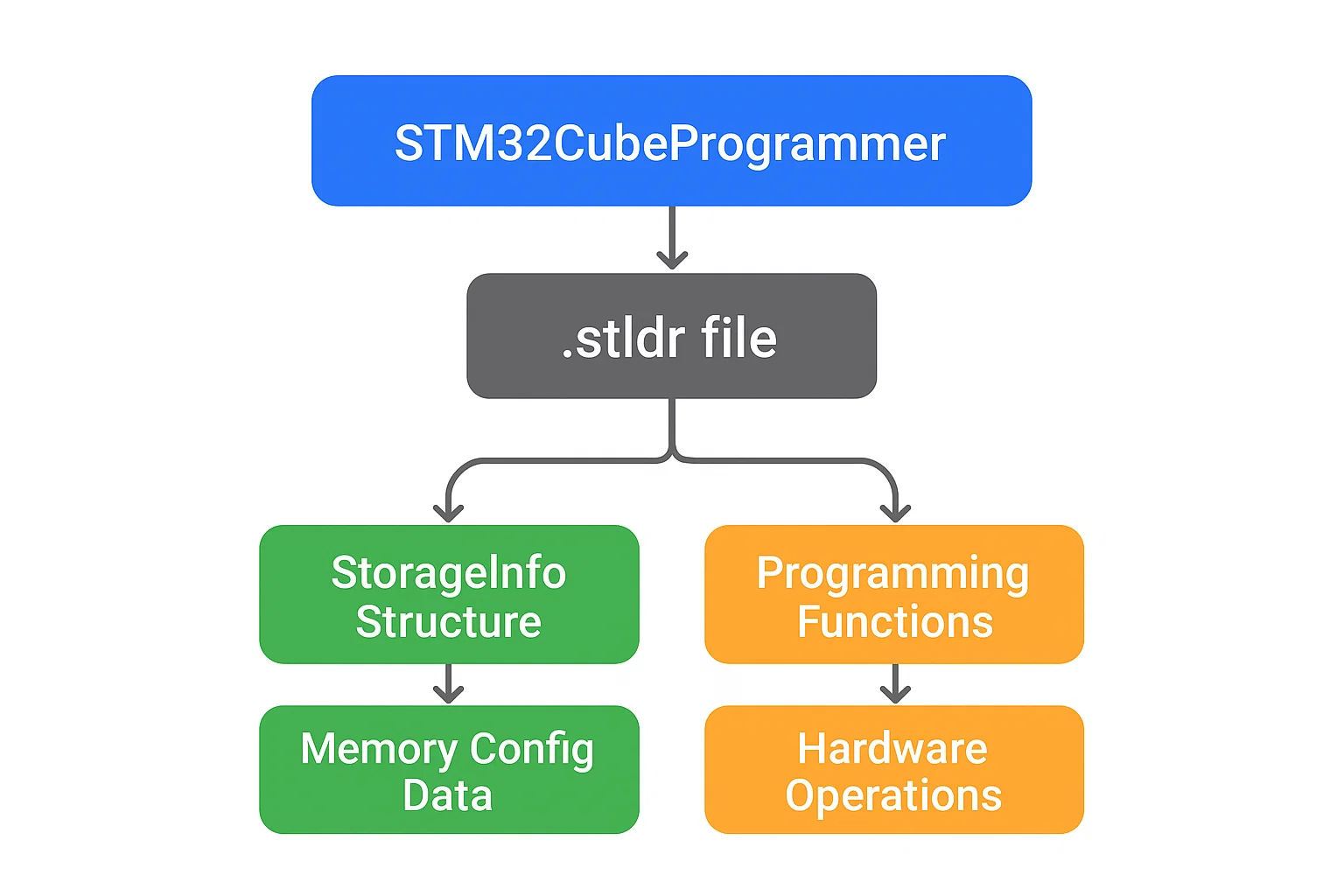
External Memory Loader Purpose:
- Enables STM32CubeProgrammer to program external flash/memory devices
- Contains device-specific configuration and programming algorithms
- Bridges between STM32CubeProgrammer and external memory hardware
Key Components:
- StorageInfo Structure: 200-byte structure containing memory configuration
- Programming Functions: Read, write, erase operations for the specific memory
- Initialization Code: Sets up GPIO, clocks, and peripheral configurations
The .stldr file format is essentially an ELF executable that STM32CubeProgrammer loads and executes on the target MCU to handle external memory operations.
The Investigation Process
Step 1: Analyzing the Build Output
The first step involved examining the generated .stldr file to verify its structure:
# Check if .stldr file was generated successfully
arm-none-eabi-objdump -h ExtMemLoader.stldr

# Look for the storage_info section
arm-none-eabi-nm ExtMemLoader.stldr | grep StorageInfo
Initial findings:
- Build completed without errors
.stldrfile was generated with correct size- However, STM32CubeProgrammer couldn't locate the
StorageInfosymbol
Step 2: Dissecting the StorageInfo Structure
The StorageInfo structure is the heart of external memory loader configuration. It must be exactly 200 bytes and contain specific memory parameters:
typedef struct {
   uint8_t  DeviceName[100];          // Device name and description
   uint16_t DeviceType;               // NOR_FLASH, NAND_FLASH, etc.
   uint32_t DeviceStartAddress;       // Memory start address
   uint32_t DeviceSize;               // Total device size
   uint32_t PageSize;                 // Programming page size
   uint8_t  EraseValue;               // Erased memory content (0xFF)
   DeviceSectors Sectors[10];         // Sector configuration
   uint32_t padding[16];              // Ensure exactly 200 bytes
} sStorageInfo;
Critical requirement: This structure must be placed in a specific memory section that STM32CubeProgrammer can locate and parse.
Step 3: Linker Script Analysis
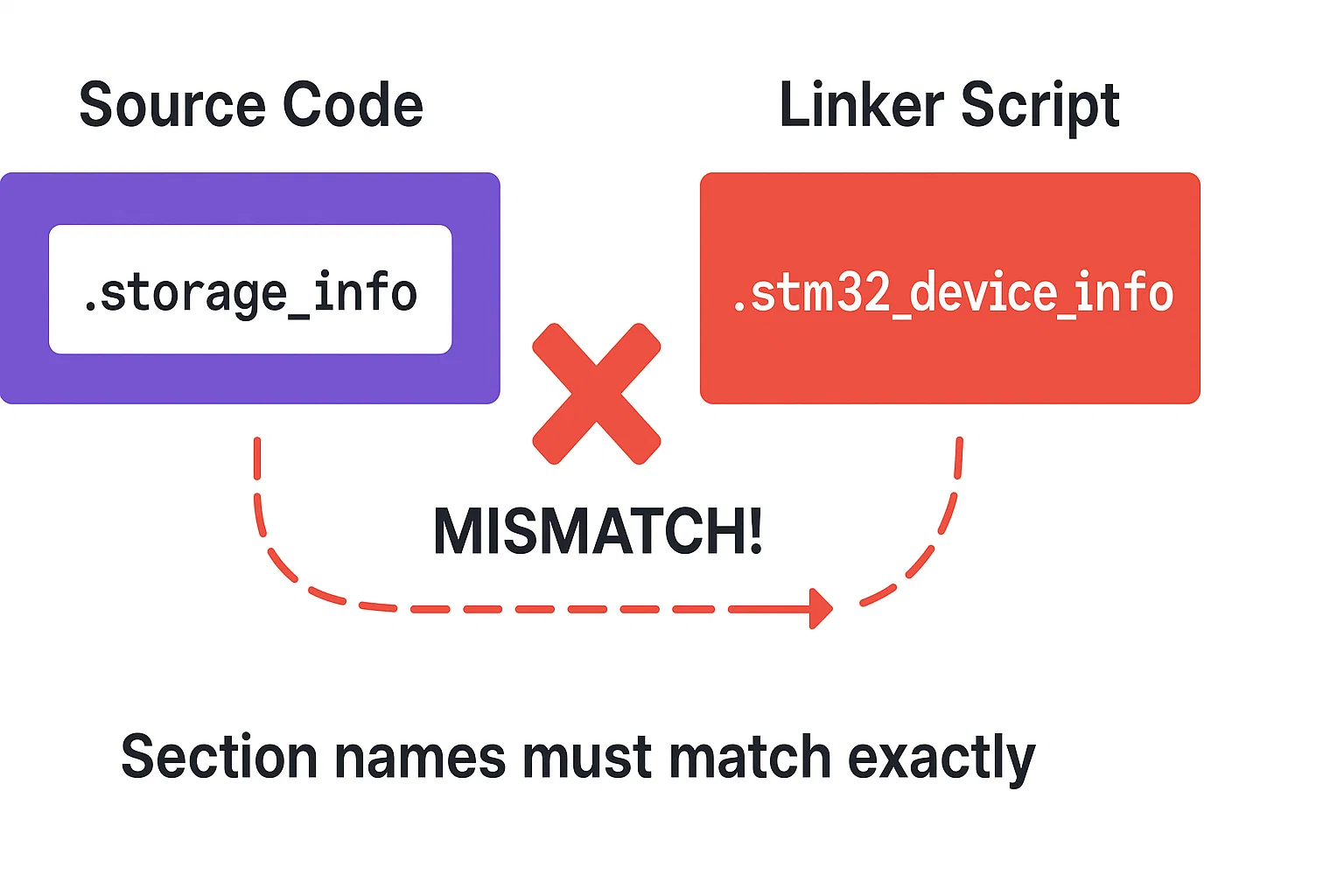
The breakthrough came when examining the linker script configuration. The investigation revealed a critical mismatch between the structure placement and linker script expectations.
In the source code (stm32_device_info.c):
#if defined(__ICCARM__)
__root sStorageInfo const StorageInfo __attribute__((section(".storage_info"))) =
#else
__attribute__((used)) __attribute__((section(".storage_info"))) sStorageInfo const StorageInfo =
#endif
{
    // StorageInfo configuration...
};
In the original linker script (STM32N657XX_XIP.ld):
/* This was WRONG - looking for wrong section name */
.stm32_device_info :
{
  KEEP(*(.stm32_device_info))
}:SgInfo
The Solution: Aligning Section Names
The root cause was a section name mismatch. The StorageInfo structure was placed in the .storage_info section, but the linker script was looking for .stm32_device_info.
Fixed linker script:
/* Storage info section for STM32 External Memory Loader */
.storage_info :
{
    . = ALIGN(4);
    KEEP(*(.storage_info*))
    . = ALIGN(4);
} >ROM
Key corrections:
- Correct section name: Changed from
.stm32_device_infoto.storage_info - Proper alignment: Added 4-byte alignment for ARM architecture
- Wildcard matching: Used
.storage_info*to catch variations - Memory region: Placed in ROM region for external memory loaders
Verification and Testing
After applying the fix, several verification steps confirmed the solution:
1. Build Verification
# Verify section exists in final binary
arm-none-eabi-objdump -h ExtMemLoader.stldr
# Output should show:
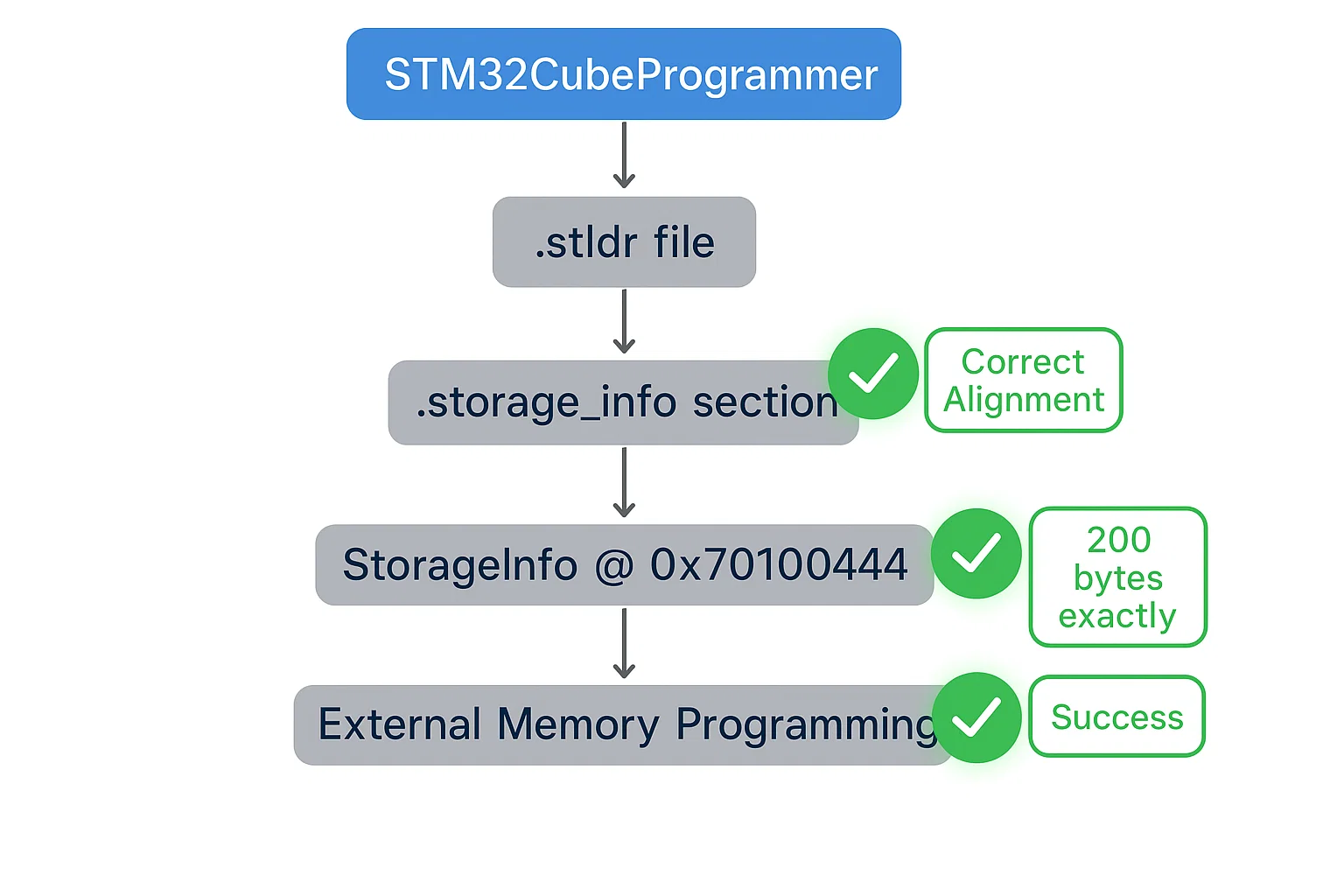
# 7 .storage_info 000000c8  70100444  70100444  00000444  2**2
2. Symbol Verification
# Check StorageInfo symbol placement
arm-none-eabi-nm ExtMemLoader.stldr | grep StorageInfo
# Output should show:
# 70100444 R StorageInfo
3. STM32CubeProgrammer Testing
With the corrected linker script, STM32CubeProgrammer successfully:
- Parsed the
.stldrfile without errors - Extracted the
StorageInfostructure - Recognized the external memory configuration
- Enabled external memory programming operations
StorageInfo Configuration Details
For reference, here's the complete StorageInfo configuration that was successfully parsed:
sStorageInfo const StorageInfo = {
    "External_NOR_Flash_Loader",     // Device Name
    NOR_FLASH,                       // Device Type (3)
    0x70000000,                      // Start Address
    0x02000000,                      // Device Size (32MB)
    0x100,                          // Page Size (256 bytes)
    0xFF,                           // Erase Value
    {
        {8192, 4096},               // 8192 sectors of 4KB each
        {0x00000000, 0x00000000}    // Terminator
    },
    {0}                             // Padding array
};
Memory layout considerations:
- Start address:
0x70000000(external memory region) - Size: 32MB total external flash
- Sector size: 4KB sectors for optimal erase operations
- Page size: 256 bytes for programming operations
Best Practices and Lessons Learned
1. Always Verify Section Placement
When working with custom linker scripts, always verify that sections are correctly defined and aligned:
# Essential verification commands
arm-none-eabi-objdump -h <your_file>.stldr
arm-none-eabi-nm <your_file>.stldr
arm-none-eabi-size <your_file>.stldr
2. Understand Toolchain Expectations
STM32CubeProgrammer has specific requirements for external memory loaders:
- Exact 200-byte
StorageInfostructure - Proper section alignment (4-byte minimum)
- Correct symbol visibility (use
__attribute__((used)))
3. Version Control for Linker Scripts
Linker scripts are often overlooked in version control but are critical:
- Track changes to memory layouts
- Document section purposes
- Test with actual hardware after modifications
4. Documentation Is Critical
Create clear documentation for custom configurations:
- Memory map diagrams
- Section purpose explanations
- Build verification procedures
Impact on Development Workflow
This fix had significant impact on the development process:
Before the fix:
- External memory programming impossible
- Manual programming workarounds required
- Delayed firmware testing and deployment
After the fix:
- Seamless external memory programming
- Full integration with STM32CubeProgrammer
- Automated programming in production workflows
At Hoomanely, we're building advanced embedded systems that push the boundaries of IoT and sensor integration. This debugging experience exemplifies the deep technical challenges we tackle daily—from optimizing memory architectures to ensuring robust toolchain integration.
External memory management is crucial for our multi-sensor platforms that process thermal imaging, camera data, and proximity sensing in real-time. The reliability of our external memory loaders directly impacts our ability to deploy firmware updates to field devices, maintain data integrity, and support complex sensor fusion algorithms.
This type of low-level debugging and optimization strengthens Hoomanely's technology foundation, ensuring our embedded systems can handle the demanding requirements of modern IoT applications while maintaining the reliability our customers depend on.
Key Takeaways
- Section name alignment is critical for STM32 external memory loaders
- Linker script verification should be part of every build process
- Tool-specific requirements must be understood and documented
- Systematic debugging saves time when toolchain issues arise
- Documentation and testing prevent future regressions
External memory loader development requires attention to low-level details that can make or break deployment workflows. By understanding the relationship between source code section attributes, linker scripts, and tool expectations, embedded developers can avoid similar pitfalls and build more robust external memory systems.
The next time STM32CubeProgrammer refuses to parse your external memory loader, start with the basics: verify your section names, check your alignment, and ensure your linker script matches your code's expectations.
This debugging session consumed several hours of development time, but the systematic approach and thorough documentation will save countless hours for future projects. Sometimes the most valuable learning comes from the most frustrating bugs.