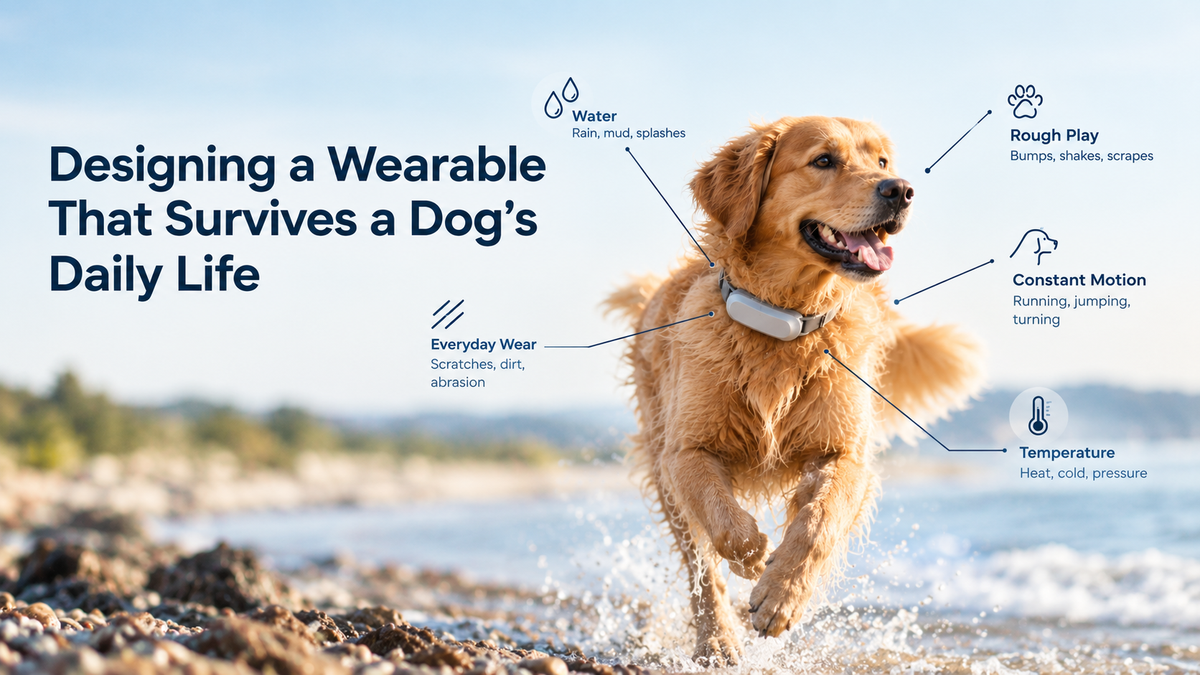
Designing a Wearable That Survives a Dog's Daily Life
Durability choices for the Tracker against water, mud, impacts, and chewing.
A wearable designed for a dog has a very different durability problem than one designed for a person. A human takes a device off before showering, avoids dropping it, and notices when something starts to loosen. A dog does none of that. The Tracker has to survive whatever an ordinary day throws at it: rain, wet grass, mud, accidental drops, rubbing against furniture, sudden impacts, and occasionally a dog deciding the device itself looks chewable.
That changes what durability actually has to mean. For the Tracker, mechanical reliability couldn't just mean the enclosure is strong enough. The design had to account for the whole chain of exposure, water ingress, impact, contamination, repeated handling, attachment loads, and animal interaction, and turn all of that into concrete mechanical requirements.
The real environment is the dog's environment
Early mechanical design usually leans on controlled assumptions: the product stays within a defined orientation, loads come from predictable directions, the user handles it carefully, water exposure is limited, drops happen only occasionally. A dog erases most of those assumptions. The Tracker can flip orientation mid-motion, hit the ground, brush against furniture, get covered in mud, or get rained on right after being cleaned.
The real shift was going from "how strong does the Tracker need to be?" to "what does the Tracker actually experience during a dog's daily life?" That question produces a far more useful durability spec.
Water protection starts with the mechanical architecture
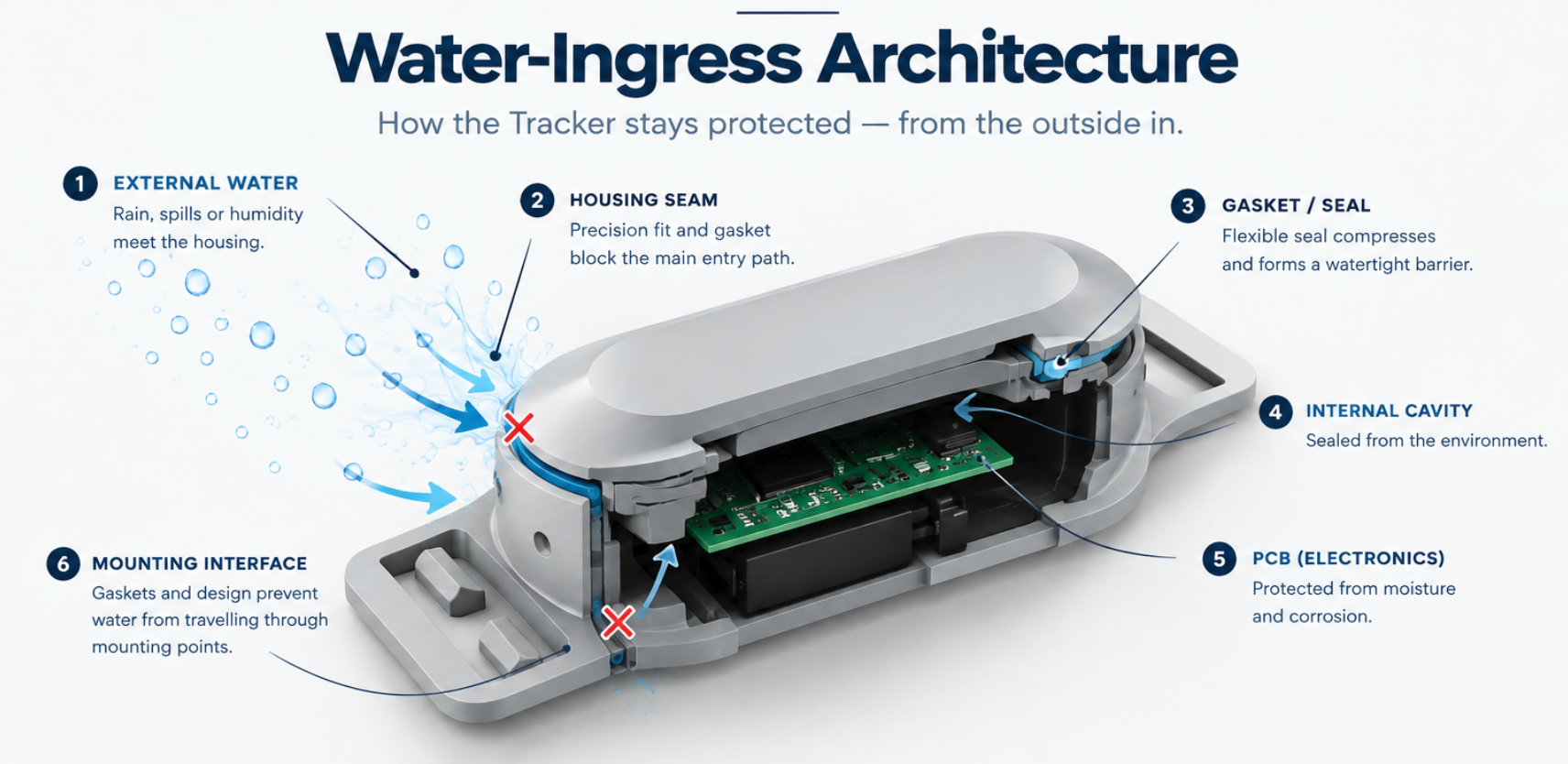
Water resistance isn't something you bolt on at the end with a gasket. Every opening in an enclosure is a potential ingress path: USB or charging interfaces, buttons, seams between housing components, sensor windows, cable exits, mechanical joints, speaker or microphone openings, attachment interfaces. Most of those openings exist for good functional reasons, so you can't just remove them to improve sealing without making the product harder to manufacture, service, or use.
The mechanical design has to control where water can get in and what happens once it does. It helps to think of the enclosure as a series of barriers rather than one waterproof shell: outer housing, then interface or seal, then internal cavity, then the sensitive electronics. Each layer should cut the odds of water actually reaching the electronics.
The IP rating became a design requirement, not just a test result
An IP rating is useful because it compresses a broad durability requirement into a standard classification, but it shouldn't be the starting point. The better order runs from real-world exposure to required protection, to enclosure architecture, to sealing design, and only then to the verification test. If the Tracker is expected to meet rain, splashing water, wet grass, or cleaning, those conditions need translating into an actual ingress-protection target first.
That target then shapes gasket geometry, seam design, fastener placement, wall thickness, connector selection, vent design, assembly sequence, and tolerance stack-up. This is where mechanical design and manufacturing become inseparable: a seal that's perfect in CAD can fail in production if compression varies too much from dimensional drift, and an enclosure that passes a lab test can still fail if assembly leaves a small gap at the seam. The IP rating is really the outcome of several decisions working together, documented as a required target and then verified on production-intent assemblies, not inferred from component specs alone.
Mud is a different problem from water
Water is relatively easy to reason about. Mud isn't. It combines water with particles that get into small gaps, build up around seams, interfere with moving interfaces, dry and harden, increase friction, and lodge around attachment features. That means an enclosure can be perfectly sealed against water and still develop mechanical problems from contamination alone.
That shaped how exposed interfaces got designed. Sharp pockets and narrow recesses look harmless in CAD but become dirt traps in practice. It helps to think about how the product gets cleaned after exposure, not just how it performs right after getting dirty: avoid unnecessary traps, give it surfaces that can be wiped or rinsed, minimize exposed mechanical interfaces, avoid very narrow unsupported gaps, and keep sensitive interfaces tucked behind the primary enclosure. That matters more for a wearable than for something sitting safely on a desk, since it's repeatedly exposed rather than occasionally.
Impact loads are rarely as simple as "drop from one metre"
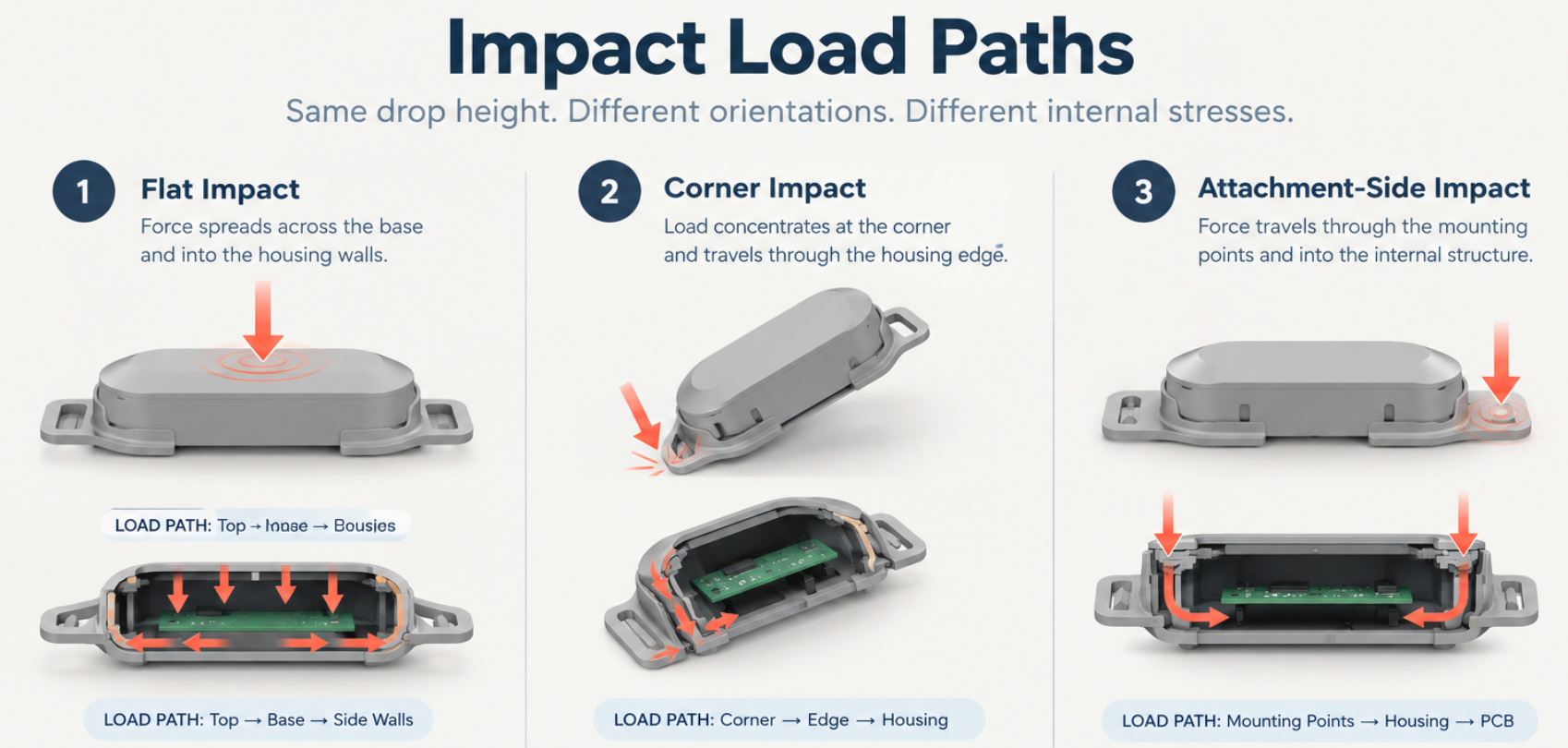
Drop testing is useful because it's repeatable. Real impacts aren't nearly that controlled. A Tracker on a dog can hit a floor, a wall, furniture, a doorway, the inside of a car, another object, or the ground at some arbitrary angle, and the direction of impact changes the resulting stress distribution entirely. A drop landing flat on a broad housing surface behaves very differently from one landing on a corner, a protrusion, or an attachment feature. That makes the impact path matter more than simply making the housing thicker everywhere.
Strength and durability are not the same thing
One of the more important distinctions here is between ultimate strength and repeated-use durability. A part can survive one big impact and still fail after hundreds or thousands of smaller loading events. For a wearable, those repeated loads come from attachment and removal, leash or collar movement, vibration, rubbing, repeated small impacts, enclosure flexing, temperature swings, and repeated cleaning.
That's why just checking whether something exceeds its yield strength isn't enough. The real question is what happens repeatedly. A thin plastic clip might survive one aggressive pull and still gradually crack after enough repeated cycles. The same goes for screw bosses, snap fits, mounting tabs, and other attachment features.
Chewing changes the design problem completely
Chewing is one of the hardest things to model, because it's neither a conventional impact nor a conventional static load. A dog can apply compression, bending, localized contact pressure, repeated cyclic loading, abrasion, and plenty of saliva and moisture, and unlike a human, it has no reason to avoid vulnerable features.
That led to a simple rule: if a feature looks like something a dog could grab, treat it as a potential load-bearing feature. Protruding corners, exposed edges, small tabs, or accessible attachment components need evaluating not just for their intended function but for what happens if a dog decides to interact with them directly. That shapes edge radii, wall thickness, feature height, material choice, fastener accessibility, housing geometry, and even where the wearable sits on the animal. The goal was never making the Tracker indestructible. It's making the likely failure modes genuinely hard to trigger through normal interaction.
The attachment system is part of the durability system
A common mistake is treating the Tracker's enclosure and its attachment mechanism as two separate problems. They aren't. The attachment feeds external loads straight into the housing: attachment feature, then housing, then internal supports, then the PCB and components. The mechanical design has to control that whole path. A strong attachment feature bolted to a weak housing wall doesn't make a strong system, and an enclosure that survives a drop just fine can still lose the attachment if that load gets concentrated at one small interface.
Engineering insight: Design the load path before designing the local feature. Instead of asking "can this clip survive the required load?", ask where the force actually goes once the clip is loaded, then reinforce the whole path, not just the clip itself.
Designing around sealing and tolerances
Water protection brings its own manufacturing problem: tolerance stack-up. A gasket needs a specific compression range to work, and if the surrounding components carry their own dimensional variation, actual compression shifts from unit to unit. Housing dimension tolerance, cover dimension tolerance, and gasket thickness tolerance all stack together into the actual seal compression. The nominal CAD model can show perfect compression while the worst-case assembly ends up with either too little (risking leakage) or too much (risking assembly trouble, deformation, or a damaged gasket).
That's why sealing features need manufacturing tolerance baked in from the start. A reliable wearable isn't just a good CAD model. It's a tolerance-controlled physical system.
Verification has to represent real use
The real question isn't whether the Tracker survives one lab test. It's whether the test program actually represents what the product will go through in the real world:
| Test condition | What it validates |
|---|---|
| Water ingress | Enclosure and sealing |
| Dust/mud exposure | Contamination resistance |
| Drop/impact | Structural robustness |
| Attachment pull | Mechanical interface strength |
| Repeated attachment cycles | Wear and fatigue |
| Chewing/contact simulation | Localized mechanical abuse |
| Temperature/humidity exposure | Material and seal stability |
| Combined environmental testing | System-level durability |
The important metric isn't just pass or fail. It's the failure mode. A failed test should tell you what physically failed, why it failed, and which design feature let that failure happen, and that information becomes the input for the next iteration.
Measuring the outcome
Two metrics turned out to be straightforward and genuinely useful here.
IP rating achieved: target [IPXX], validated result [IPXX]. What matters is reporting the actual validated configuration rather than assuming the rating from individual component specs.
Drop/impact pass rate: successful units divided by tested units, times 100. If 20 production-intent units go through the full test sequence and 19 come through without a functional failure, that's a 95% pass rate. That number should come from the actual test program, not an estimate, and cosmetic damage needs tracking separately from functional failure. A visible scratch is not the same thing as losing tracking function.
What changed in our thinking
The biggest shift was moving from component durability to system durability. A housing can be strong but poorly sealed. A gasket can be effective but poorly compressed. An attachment can be strong but still dump too much force into the enclosure. A PCB can survive an impact while its connector goes intermittent. A product can pass a lab test and still run into problems once it meets the repetitive, unpredictable reality of daily life with a dog.
Water protection, impact resistance, contamination resistance, attachment strength, material selection, tolerances, and animal interaction all had to work together, because the Tracker only ever gets treated as one complete system by the dog wearing it.
How this shows up at Hoomanely
At Hoomanely, the goal is building technology that fits naturally into everyday life instead of asking people to adapt around it. For a dog wearable, that matters even more, since the product operates in an environment that's uncontrolled, physical, and constantly changing. Designing for water, mud, impact, and chewing isn't just a durability exercise. It's part of what makes the technology dependable enough to disappear into someone's daily routine.
Key takeaways
- Design for the real user environment. A dog's daily life is far less controlled than a standard consumer-product test condition.
- Treat IP protection as an architectural requirement, not something added through a gasket at the end.
- Design the load path, especially around attachment features and impact-prone regions.
- Consider mud and contamination separately from water.
- Evaluate repeated loading, not just one-time strength.
- Accessible features can become unintended load points once the user is a dog.
- Tolerance stack-up directly affects sealing performance.
- Test production-intent assemblies, since nominal CAD geometry doesn't capture manufacturing variation.
- Track failure modes, not just pass/fail results.
A wearable doesn't get to choose its environment. It gets wet because it rains, dirty because the dog runs through mud, dropped because the dog moves the way dogs move, and pulled, rubbed, bumped, and occasionally chewed along the way. Good mechanical design starts by accepting that reality instead of designing around an idealized user. The goal was never making a Tracker that survives a perfect test. It's making one that keeps working once real life stops being perfect.