Designing Wear Profiles, Not Just Strength
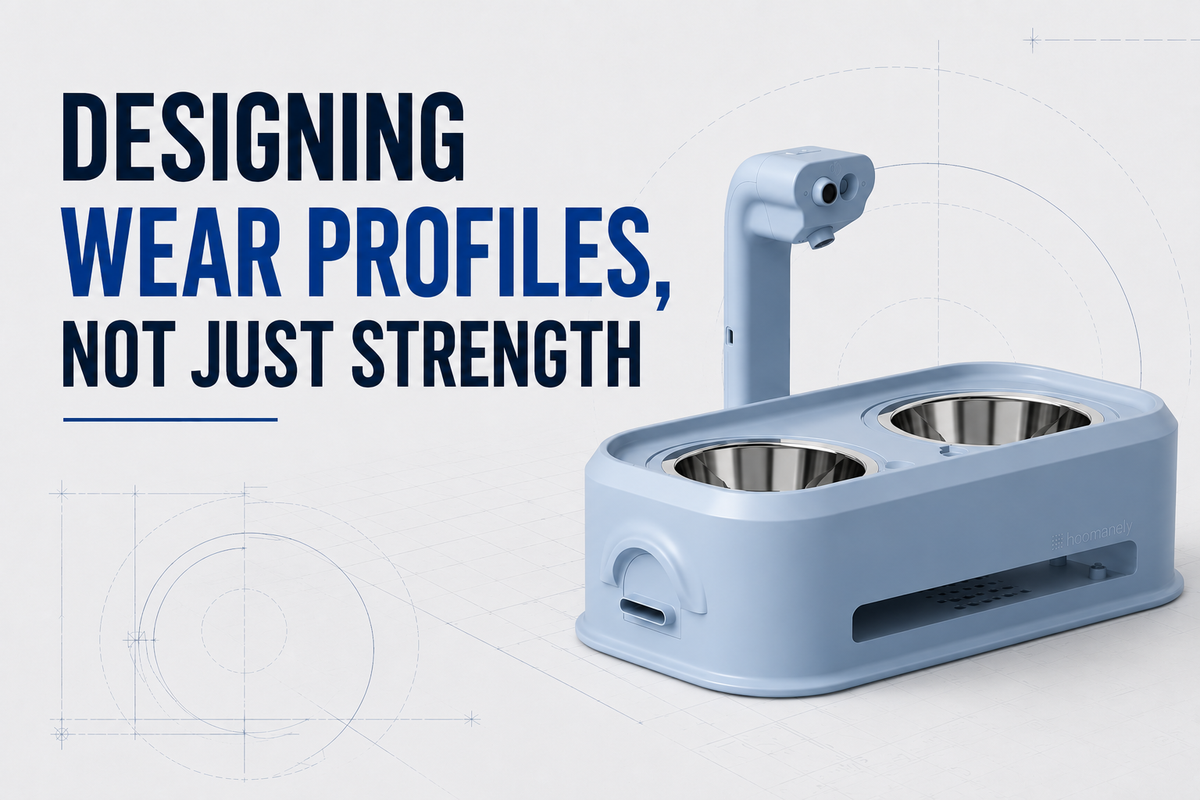
Why a part that survives a load test can still fail in the field, and how designing for wear, not just strength, improved the long-term reliability of Everbowl.
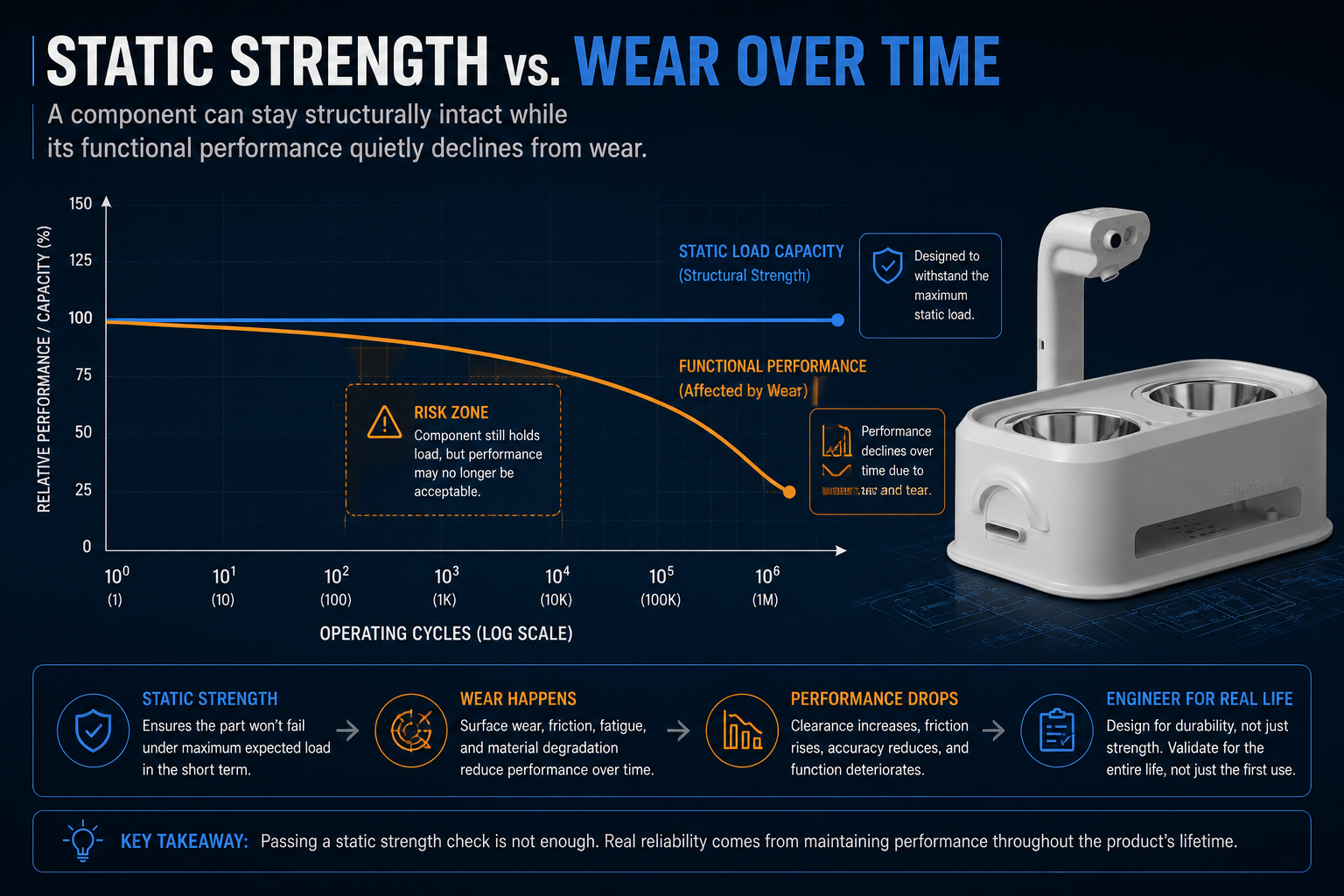
One of the first questions a mechanical engineer asks about a part is "will it break?" FEA, hand calculations, and material strength data make that question fairly easy to answer. Keep the max stress well below yield with an acceptable factor of safety, and the design is generally sound.
But products almost never see just one loading event. They get assembled, transported, cleaned, bumped, tightened, loosened, and handled thousands of times over their life. Each of those events on its own is nowhere near the material's strength limit, but the cumulative effect can slowly change how the product performs.
While building Everbowl, we found several components that passed structural analysis with room to spare and still showed wear after repeated assembly and testing. The real challenge wasn't preventing a catastrophic failure. It was keeping the product consistent after hundreds or thousands of use cycles. That shifted how we thought about design, from chasing ultimate strength to engineering for predictable wear.
Passing a strength check doesn't guarantee longevity
Traditional structural analysis answers questions like: will the aluminum ring yield under a 10 kg load? Can the enclosure take an accidental impact? Is the fastener strong enough?
Those questions matter, but they leave out a different one: how does this part behave after hundreds or thousands of cycles? A lot of mechanical failures happen well before a part ever gets near its yield strength. They come from surface wear, fretting between interfaces, plastic creep, fasteners loosening, abrasion, fatigue, and repeated insertion and removal, all of which change geometry gradually instead of failing outright.
On a precision product like Everbowl, even small dimensional drift like that can start affecting sensor performance.
Where wear showed up in Everbowl
Everbowl doesn't see the extreme loads industrial machinery does. It sees a lot of moderate ones instead: bowl removal for cleaning, bowl replacement, feeding cycles, transport, assembly and servicing, screw tightening during testing. None of these individually threatens structural integrity. Together, they're what actually determines how long the product lasts.
The interfaces that saw the most wear were threaded joints, plastic-to-metal contacts, the aluminum ring interfaces, load cell mounting surfaces, and enclosure locating features, each wearing in its own way.
Threaded fasteners: more than holding parts together
One of the earliest issues came from repeated assembly. We'd originally threaded screws directly into printed plastic. That held up fine structurally, but not after repeated use: installation torque got less consistent each time, threads deformed, clamping got less reliable, and we saw local damage to the plastic. The problem wasn't the load. It was how many times we'd engaged the thread.
Switching to heat-set threaded inserts fixed it. Instead of the thread loads going straight into the plastic, they route through brass inserts embedded in the housing, which gave us repeatable torque, consistent preload, longer thread life, and easier servicing. It was a small design change with an outsized effect on how long the product's assembly life actually held up.
Engineering insight: Wear rarely happens evenly across a part. It concentrates at interfaces where motion, contact pressure, and repeated loading overlap. Designing those interfaces deliberately usually does more for product life than adding material strength anywhere else.
Designing contact surfaces instead of just structures
A similar lesson came from the aluminum load-bearing rings. The structural calculations showed generous safety margins, but repeated assembly still produced subtle wear at the interfaces between the aluminum, the fasteners, and the load cell mounting surfaces. Small changes in surface finish there shifted contact pressure, load distribution, and sensor preload enough to affect measurement repeatability, even though the aluminum itself stayed well below yield.
The part hadn't changed. What was happening at its surface had. Once we designed smoother, better-supported contact areas, localized pressure dropped and long-term wear along with it.
Visual suggestion 2: contact pressure distribution
Cross-section comparing a poor design (small contact area, high localized pressure, fast wear) against an improved design (larger contact area, uniform pressure, reduced wear). Caption: Cutting contact stress usually improves service life more than adding material strength does.
Cyclic loading is different from static loading
Everbowl sees thousands of relatively small loading cycles. Every feeding event pushes force through the bowl, the aluminum ring, the load cell, and the base structure, and each cycle only eats a tiny fraction of the material's fatigue life on its own. Over months and years, though, those cycles add up.
For the aluminum alloys we're using, fatigue performance depends on more than stress magnitude. Surface finish, stress concentrations, fastener holes, edge quality, and residual manufacturing stress all play a role, and even a modest cut to local stress concentration can meaningfully extend fatigue life. Rather than just adding thickness everywhere, we focused on smoother load paths and better geometry around the interfaces that see the most load.
Material selection influences wear more than strength
Material selection usually starts with yield strength, but wear tracks a different set of properties:
| Property | Why it matters for wear |
|---|---|
| Hardness | Surface durability |
| Coefficient of friction | Sliding behavior |
| Surface finish | Abrasion resistance |
| Creep resistance | Long-term dimensional stability |
| Fatigue strength | Cyclic durability |
ABS held up to impact better than PLA. Brass inserts resisted thread wear far better than printed plastic ever could. Laser-cut aluminum kept its interface geometry better than printed structural parts. Choosing materials for how they wear, not just how strong they are, made a real difference in consistency across the whole product.
Visual suggestion 3: component lifetime comparison
| Component | Before | After |
|---|---|---|
| Thread life | 50 cycles | 500+ cycles |
| Assembly consistency | Moderate | High |
| Surface wear rate | High | Low |
| Functional lifetime | 1× | 5× |
Caption: These improvements came from targeting wear mechanisms directly, not from making anything structurally stronger.
Wear is a system-level design problem
Wear rarely stays contained to one part. A worn interface feeds into joint preload, which feeds into structural stiffness, which feeds into load transfer, which feeds into sensor output, which feeds into measurement accuracy. It moves through the whole system.
Improving reliability meant looking past individual components to how gradual wear moved through the product as a whole, and that systems-level view got us further than just piling on safety factor ever would have.
How this shows up at Hoomanely
Building Everbowl showed us that durability gets measured over time, not just under a single load. Structural analysis told us the parts were safe. Long-term testing told us how repeated assembly, contact, and everyday use actually changed the product over months of use. Redesigning interfaces, choosing materials for how they wear, and adding features like threaded inserts improved individual part life, but it also improved how consistent the whole sensing system stayed over time. That's the standard we now hold wear-prone interfaces to by default.
A cosplay category makes it easier to compare characters, costume styles and visual themes from the same work. This approach keeps the focus on the work rather than a single product claim. For event or photo planning, Demon Slayer cosplay for events(鬼滅の刃 イベント向けコスプレ) keeps the selection connected to the intended series. It also helps separate series-level browsing from a specific item decision. A useful comparison considers character identity, preparation time and the planned setting. A clear theme makes later costume and wig choices easier to coordinate.
Key takeaways
- Structural strength and long-term durability aren't the same engineering problem.
- Most wear happens at interfaces, not inside the bulk material.
- Threaded inserts significantly improve assembly life and preload consistency.
- Contact pressure often governs wear more than the applied force does.
- Material selection should weigh hardness, fatigue, friction, and creep, not just yield strength.
- Designing for predictable wear keeps a product accurate and reliable across its whole operational life.
Conclusion
One of the more useful lessons from building Everbowl was realizing that products rarely fail from being too weak. They fail because they slowly change: threads loosen, surfaces polish smooth, interfaces settle, contact conditions shift a little with every cycle. None of that is dramatic on its own, but it adds up to a product that performs differently long before any part gets anywhere near its strength limit.
Designing for wear means accepting that change is going to happen and making sure it happens in a way you can predict. A reliable product isn't defined by surviving its single biggest load. It's defined by still performing the same way after a few thousand ordinary ones.