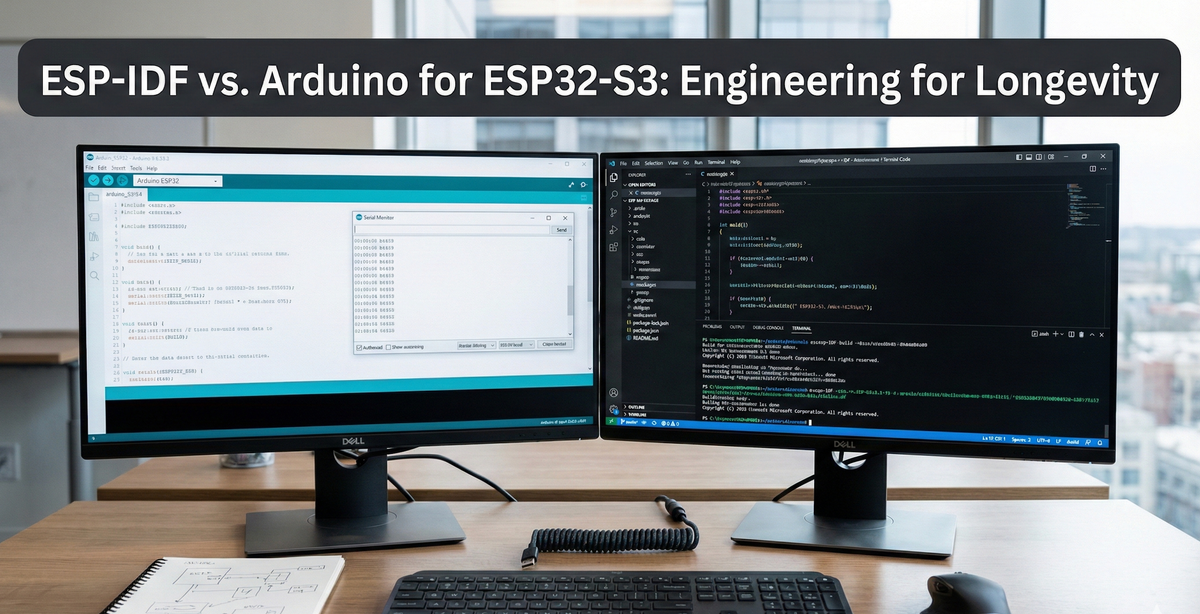
ESP-IDF vs. Arduino for ESP32-S3: The Engineering Pivot to Production
As engineers, the tools we choose set the ceiling of the systems we build. With a powerful SoC like the Espressif ESP32-S3, dual cores, AI vector instructions, ample I/O, the choice of development framework isn't just preference, it's a strategic architectural decision affecting the entire product lifecycle. In the embedded world, that debate usually lands on the approachable Arduino framework versus the native Espressif IoT Development Framework, ESP-IDF.
At Hoomanely, we design interconnected ecosystems spanning battery-powered trackers, sophisticated behavioral monitors like the EverBowl, and edge-compute gateways like the EverHub. We can't choose tools based on how quickly we can blink an LED. We have to choose based on how reliably a device will operate in the field three years from now. This post walks through why, for scalable, production-grade IoT systems on the ESP32-S3, ESP-IDF is the necessary path forward for longevity and maintainability.
The breaking point: when "works on my machine" fails
Our team hit a defining moment early in developing the Tracker. We were using Arduino to speed up the proof-of-concept phase, aggregating BLE beacons from nearby trackers and uploading the data over Wi-Fi. On the bench it worked flawlessly. Once we moved to field trials, we hit a wall: the device would randomly crash or hang, specifically when high-throughput Bluetooth scanning overlapped with a Wi-Fi transmission.
Because the Arduino core for ESP32 abstracts the underlying FreeRTOS scheduler into a single-threaded mental model, debugging the priority inversion between the Wi-Fi stack and the Bluetooth controller was nearly impossible. We were fighting the abstraction, not the hardware. That was our breaking point. Abstraction is often technical debt waiting to happen.
The prototyping paradox
Arduino is a marvel of accessibility. It's democratized hardware development, letting anyone connect a sensor and stream data in an afternoon. For proof-of-concept work, hackathons, or validating a specific sensor integration, it's unbeatable, abstracting complexity across vastly different hardware architectures.
But building a commercial product means the "works on my desk" phase is only about ten percent of the journey. The remaining ninety percent is edge-case handling, ultra-low power optimization, secure OTA updates, manufacturing tests, and deterministic real-time behavior. Arduino for ESP32 is essentially a compatibility layer on top of ESP-IDF, flattening the complex, multi-threaded reality of the ESP32-S3 into the familiar setup() and loop() structure. As system complexity grows, that flattening becomes a real constraint.
Why depth matters in production
Moving to production means moving from "making it work" to "making it unbreakably robust," which requires deep control over system resources that ESP-IDF provides natively.
Deterministic concurrency with FreeRTOS. The ESP32-S3 is a dual-core chip, and using it well means embracing a real-time OS. Arduino for ESP32 runs on FreeRTOS implicitly, your sketch is essentially one task, while ESP-IDF forces you to design with FreeRTOS explicitly. That distinction matters a lot: complex devices need granular control over task priorities, inter-task communication (queues, semaphores, mutexes), and core affinity, pinning specific tasks to CPU0 or CPU1. In our architecture, we pin latency-sensitive wireless interrupt handling to Core 0, while Core 1 handles heavier computation like the sensor fusion algorithms in the Tracker. ESP-IDF gives us the APIs to architect this determinism so a critical telemetry task never gets starved by a lower-priority logging task.
Granular memory management. In long-running IoT devices, memory fragmentation is the silent killer. A device that runs perfectly for 24 hours might crash after 24 days from heap exhaustion hidden behind high-level abstractions. The ESP32-S3 often involves managing internal SRAM alongside external PSRAM, and ESP-IDF gives us the tooling to explicitly decide which data structures belong in fast internal RAM and which large buffers, audio samples, image frames, belong in slower, larger PSRAM. ESP-IDF's heap tracing and debugging tools let us visualize allocation over time and plug leaks before devices leave the factory. Generic malloc wrappers tend to obscure exactly where an allocation is physically happening.
The ecosystem requirement
The real test came when we needed a complex interaction across the ecosystem: EverBowl detecting a specific sound event like barking, triggering EverHub to request a high-frequency GPS sync from the Tracker, and bundling all that telemetry into a single cloud packet. That required three distinct devices sharing identical logic for networking, security handshakes, and data serialization.
With Arduino, we'd likely have ended up with three divergent sketches, copy-pasted code and hoping the versions matched. With ESP-IDF, we built a modular internal platform, a set of components behaving consistently across devices. We can centrally manage networking logic, security protocols, and OTA mechanisms, so patching a vulnerability in our core MQTT component propagates to the Tracker, Bowl, and Hub simultaneously. That level of modularity is genuinely hard to achieve without the component architecture ESP-IDF gives you.
Overcoming team friction
Transitioning to ESP-IDF wasn't painless. We faced resistance, particularly from junior engineers used to the simplicity of Wire.h and the Arduino IDE. The jump to C++, CMake lists, and explicit pointer management felt like unnecessary friction, and "why do we need a forty-line configuration file just to blink an LED" was a common question.
The answer is the build system. ESP-IDF uses CMake, the industry standard for C and C++ build automation, which allows for complex build configurations, automated testing integration, and precise dependency management. When managing a fleet of devices with slightly different sensor configurations or hardware revisions, being able to switch context via idf.py menuconfig and guarantee reproducible builds matters a lot for quality assurance. We treated the transition as a mentorship opportunity, moving from writing scripts to engineering firmware, and once the team saw the benefits of the integrated debugger and stack stability, the friction disappeared.
Bridging the gap
Arduino still has its place. It's an excellent tool for the exploration phase of product development. The common pitfall is carrying prototype code straight into production. Engineering teams need to recognize the strategic pivot point: once a concept is validated and requirements are solid, the firmware should usually get re-architected in ESP-IDF, keeping the lessons from the prototype and leaving the abstraction limitations behind.
Takeaways for teams designing at scale
Embrace the RTOS. Don't hide from FreeRTOS, use it to design deterministic, multi-threaded systems that handle complex concurrent operations without locking up. Own the memory map, since production stability requires precise control over heap versus stack, and abstraction here leads straight to fragmentation and hard-to-debug crashes. Design for maintenance using CMake and ESP-IDF's component architecture to build reusable modules across your device ecosystem, rather than copy-pasting sketches. And treat security as non-negotiable, using IDF-native features like Secure Boot and Flash Encryption that are cumbersome or impossible to implement robustly through high-level wrappers.
The learning curve of ESP-IDF is steeper, but it's an investment that pays off in system stability, security, and the ability to trust that your fleet of devices can handle the realities of the field for years to come.