Finding the Goldilocks Zone: How Lens Choice Shapes a Dog's Thermal Portrait
When you're building a thermal-detection system to watch over a dog, the sensor you pick is only half the story. The lens sitting in front of it — and specifically how wide it sees — quietly decides how far away you can read your pup and how forgiving the aim needs to be. In this post we compare two builds of the very same thermal sensor: one with a wider lens and one with a narrower lens. Same sensor, same resolution, same silicon. The only difference is the glass — and it changes everything about where your dog needs to sit for a clean reading.
What the Thermal Images Show
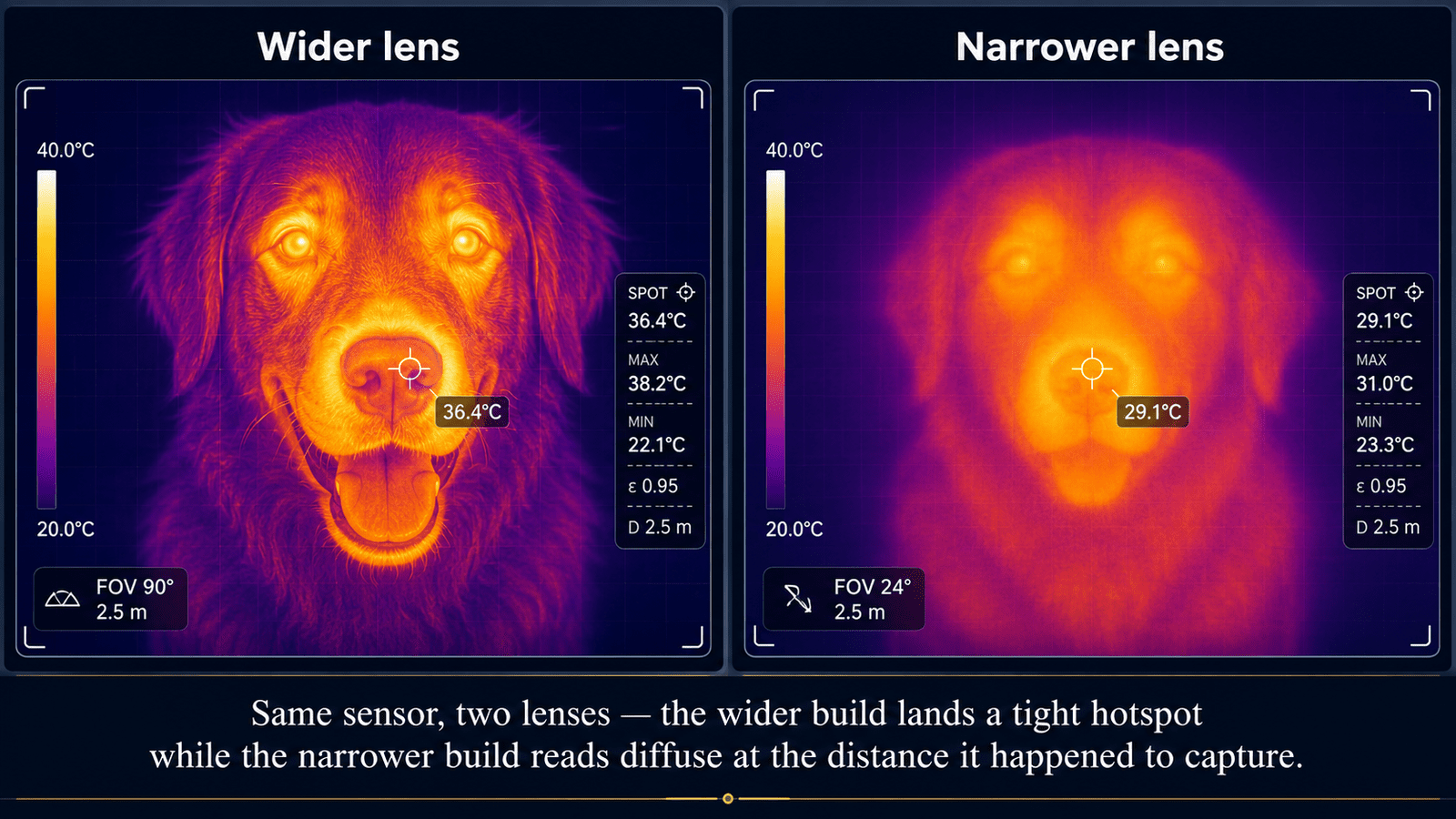
The clearest evidence comes from two devices pointed at a dog's face. On the wider build, the thermal frames produce a tight, well-defined hotspot right on the dog's eye and face — the segmented overlay lands a clean temperature reading exactly where you'd want it. On the narrower build, the thermal field looks diffuse and low-contrast, with no localized hotspot, even in frames where the face is plainly visible in the paired visual image.
That result feels backwards at first — shouldn't the finer lens do better? The answer is that these two devices were simply capturing dogs at different distances, and that is the whole point. Getting a good thermal read is less about the sensor and more about landing your dog inside the lens's usable distance band. Each lens has a sweet spot, and the wider lens and the narrower lens simply put that sweet spot in different places.
How to Size a Thermal Sensor
A thermal sensor has a fixed grid of pixels, and that grid never changes. Because the number of pixels is fixed, spreading them across a wider angle makes each one coarser, while squeezing them into a narrower angle makes each one finer. The wider lens gives each pixel a larger cone; the narrower lens gives each pixel a much smaller one. The finer the pixel, the smaller the real-world patch it sees at a given distance — and the more detail it packs onto your dog's face.
The practical rule is simple: to read something as small as a dog's eye reliably, you want a single pixel to fit comfortably inside it. That's what quietly sets the outer limit on how far the sensor can sit from your pup before the detail smears away.
The Goldilocks Zone
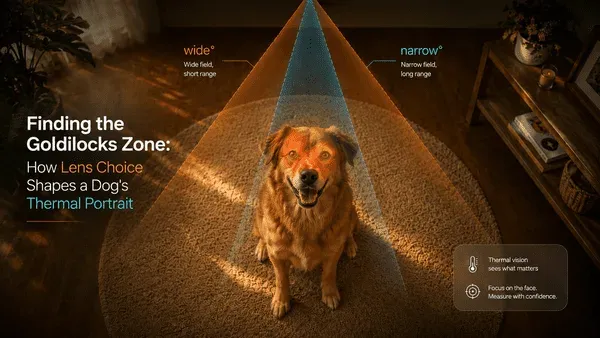
Every lens has a range that is not too close and not too far — a Goldilocks zone where your dog's eye lands cleanly on the pixels. Too close and the face overflows the frame; too far and a single pixel grows wider than the eye, smearing the reading. The wider lens keeps that zone fairly close to the sensor. Because its pixels are finer, the narrower lens stretches that zone out farther, resolving the eye at distances the wider lens simply can't reach.
There's a catch, though, and it's all about coverage. The wider lens floods a much larger area, so it's wonderfully forgiving: your dog can wander off-center and still be caught. The narrower lens trades that forgiveness for reach and detail, so your pup needs to be more centered to land in frame.
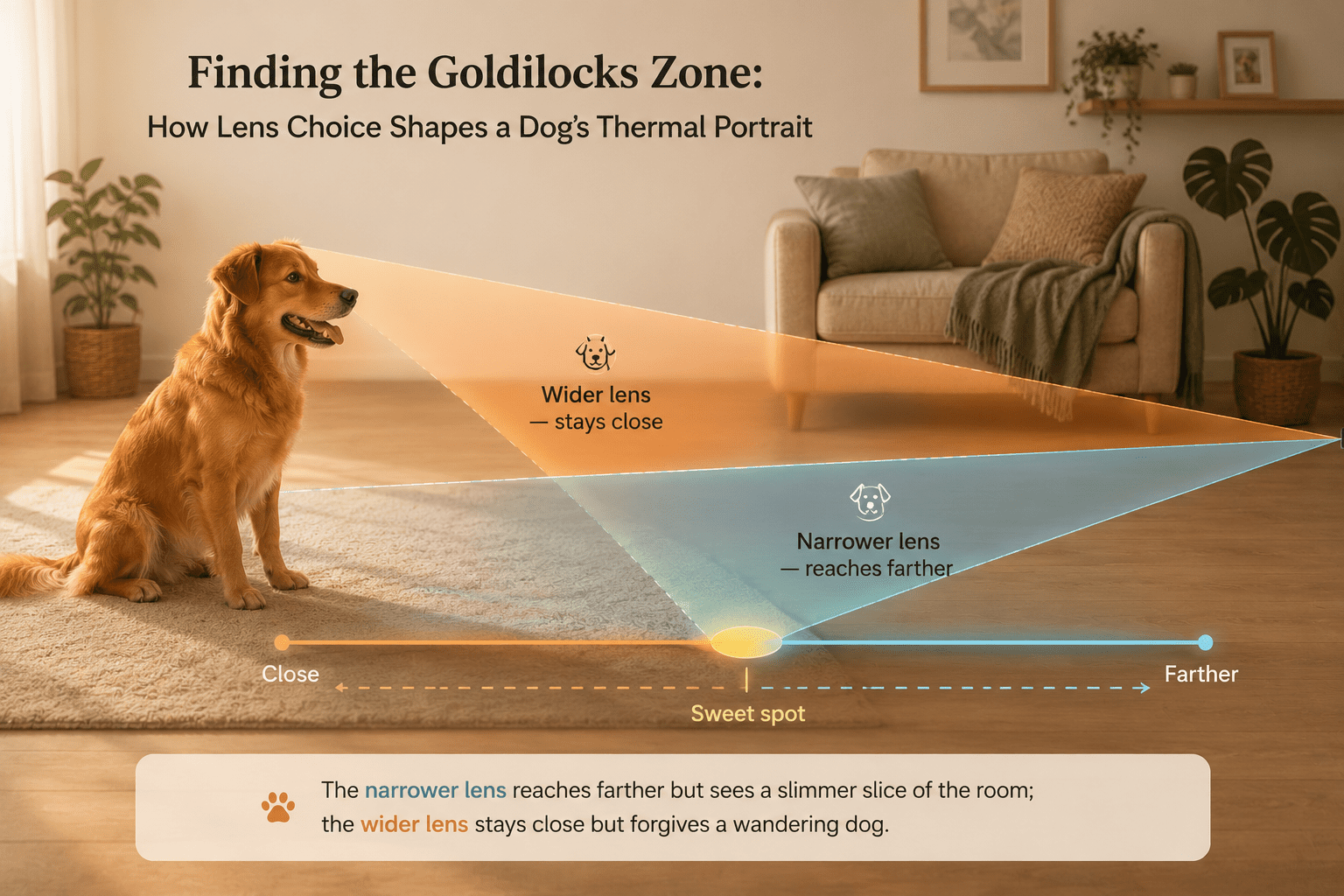
Wider vs Narrower: The Side-by-Side
Both builds use the same sensor and the same resolution. The only difference is the lens, and here's how that single choice ripples through everything that matters for reading your dog.
| What matters | Wider lens | Narrower lens |
|---|---|---|
| Detail on the face | Coarser | Finer |
| Usable distance | Stays close | Reaches farther |
| Coverage | Wide, forgiving | Narrow, precise |
| Aim tolerance | Very forgiving | Needs centering |
| Best for | Off-center pups, close mounting | Reach and fine detail, centered pups |
The Takeaway
Here's the heartwarming twist: the narrower lens actually covers your dog's face better. It's the same sensor, but its finer pixels pack more detail onto the face and resolve the eye at distances the wider lens can't touch. The trade-off is a narrower window on the world, so your dog needs to be a little more centered to be seen. The wider lens gives up some of that fine detail in exchange for a big, forgiving field of view that catches a pup wherever they happen to flop down.
So there's no single "best" lens — just the right one for where your dog lives. Mount close to a favorite bowl or bed and the wider lens shines with easy, forgiving coverage. Need to watch from across the room with crisp detail? The narrower lens is your friend. Same silicon, same little sensor, two very different ways of keeping a caring eye on the good boy or girl in your life.