Finding the Perfect Fit: Board Outline Iteration in Constrained Spaces
Introduction: Where Electrical Meets Mechanical
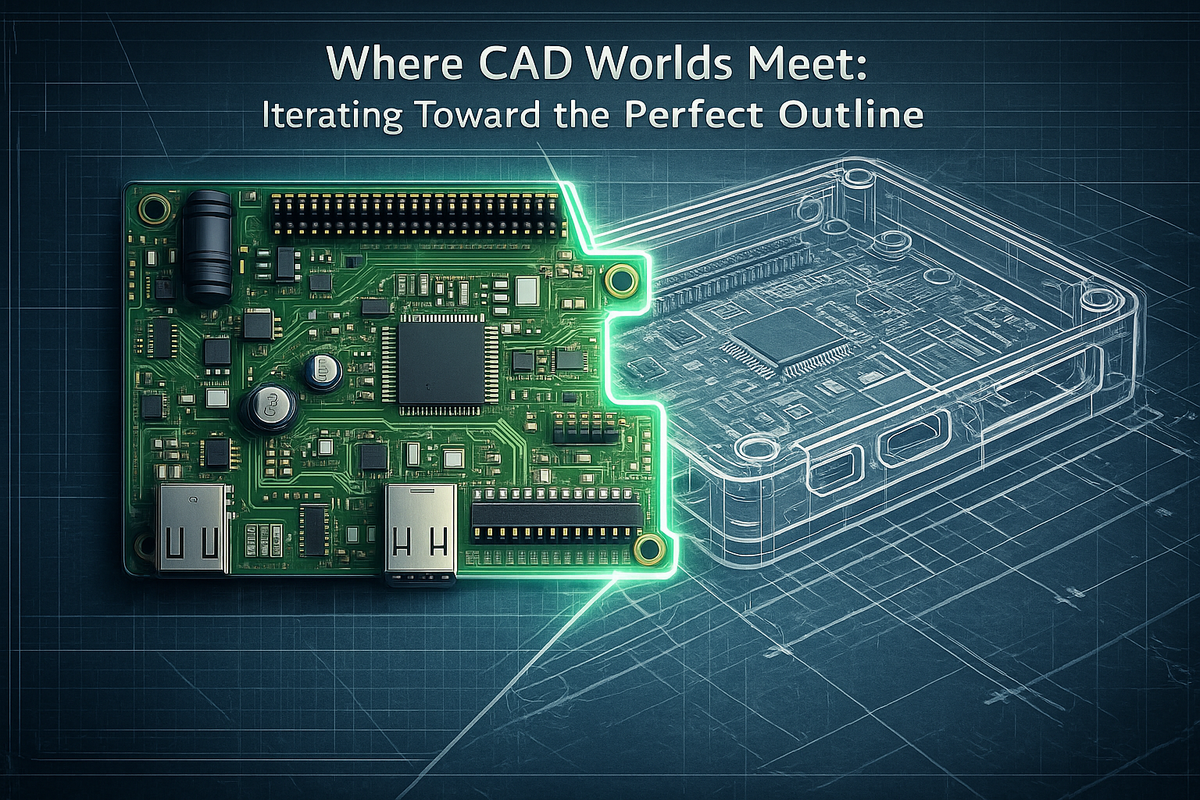
To the untrained eye, it is merely a rectangle—a boundary line. But to us, it is the negotiated truce between electrical ambition and mechanical reality. This outline is not drawn at a whim; it is forged through a rigorous collision of constraints. Component density demands real estate, while enclosure envelopes enforce rigid boundaries. Mounting points anchor the design, while connector placement dictates the flow of the entire harness ecosystem.
For our vBus modular products, this optimization is not just a step—it is the strategy. These modules must inhabit compact enclosures and interface seamlessly through standardized vBus connectors, all while maintaining superior thermal performance. Achieving this balance requires more than just drafting; it demands structured iteration.
Today, I want to share our methodology—the systematic process that transforms rough dimensional estimates into precision-engineered, production-ready architectures.
Initial Constraints: The Design Envelope
Enclosure-Driven Dimensions
Board outline iteration starts with the enclosure:
Maximum PCB Size: Enclosure internal dimensions minus clearances:
- Typical clearance: 2-3mm per side (tolerance stack-up, assembly alignment)
- Example: 100mm × 80mm enclosure interior → ~95mm × 75mm max PCB
Height Restrictions: Vertical space limits component selection:
- Enclosure internal height minus connector protrusion
- Typical consumer products: 10-15mm available height
- Determines component packages: QFN over DIP, SMD over through-hole
Wall Interference Zones: Enclosure features constrain PCB shape:
- Boss posts for screw mounting
- Internal ribs for structural strength
- Component clearances (avoid interference with enclosure details)
Keep-Out Definition: Early mechanical CAD defines prohibited zones:
- Import enclosure 3D model into PCB tool
- Overlay PCB layout area
- Identify interference regions
- Define initial keep-out boundaries
Mounting Point Requirements
Screw Hole Positions: Dictated by enclosure mounting bosses:
- Hole diameter: Typically 3.2mm for M3 screws
- Clearance around hole: 6-8mm diameter copper-free zone
- Position tolerance: ±0.5mm relative to board edges
Mounting Hole Quantity: Balance mechanical stability with board area:
- Minimum: 3 holes (triangular pattern—prevents rotation)
- Typical: 4 holes (corners—maximizes stability)
- Large boards (>100mm): 6+ holes (prevents board flexing)
Standoff Height: Vertical spacing between PCB and enclosure bottom:
- Determines bottom-side component clearance
- Affects thermal contact with enclosure
- Typical: 3-5mm standoffs
Connector Placement Constraints
vBus Connector Position: Standardized location for ecosystem compatibility:
- Edge-mounted on specific board edge
- Height above bottom surface: Fixed by mating connector in enclosure
- Alignment tolerance: ±0.2mm (tight for reliable connection)
External Connectors: User-facing ports aligned with enclosure openings:
- USB port aligned with enclosure cutout
- Power jack centered in opening
- Tolerance: ±0.5mm (accounts for connector and enclosure tolerances)
Connector Accessibility: Space around connectors for:
- Mating connector insertion angle
- Cable bend radius
- Strain relief clearance
Electrical Requirements Drive Area
Component Footprint Analysis
Mandatory Components: Fixed area requirements:
- Main processor: 10mm × 10mm (QFN64) to 14mm × 14mm (LQFP100)
- Power regulators: 3-5 per board, each 5mm × 5mm typical
- Passives: Hundreds of 0402/0603 components
Initial Area Estimate:
- Sum component footprints
- Add 40-60% for routing space (traces, vias, clearances)
- Result: Minimum theoretical board area
Example Calculation:
Major ICs: 200 mm²
Power components: 80 mm²
Passives: 150 mm²
Connectors: 100 mm²
─────────────────────
Component total: 530 mm²
Routing factor: ×1.5 (50% overhead)
Estimated area: 795 mm²
→ Approximate dimensions: 35mm × 23mm
Routing Density Considerations
Trace Width and Spacing: Affects achievable density:
- Fine-pitch routing: 6 mil trace/space enables tighter packing
- Standard routing: 8-10 mil trace/space needs more area
- Power traces: Wider traces (20+ mil) require dedicated routing channels
Via Count: High via density indicates complex routing:
- Blind/buried vias: Enable denser routing (but increase cost)
- Through vias: Simpler manufacturing, need more space
Signal Integrity: High-speed signals constrain layout:
- Differential pairs require matched length (serpentine routing consumes area)
- Clock signals need isolation (spacing from other traces)
Iteration Cycle: Refining the Outline
Iteration 1: Initial Layout Attempt
Starting Point: Maximum available area from enclosure:
- Use full enclosure interior dimensions
- Place mounting holes at corners
- Position connectors at designated edges
Component Placement:
- Critical components first (processor, power regulators)
- High-pin-count components near connectors
- Passives grouped near associated ICs
Routing Attempt:
- Route critical nets (power, clocks, high-speed data)
- Route general signals
- Assess routing completion: 70-80% typical on first attempt
Outcome: Identify problematic areas:
- Congested regions (too many signals competing for space)
- Unreachable pins (routing blocked by other components)
- Thermal hotspots (components too close together)
Iteration 2: Constraint-Driven Refinement
Mechanical Feedback Integration:
Mechanical team reviews initial layout, identifies issues:
Mounting Hole Conflicts:
- "Hole at corner interferes with enclosure boss—move 2mm inboard"
- Adjust board outline to accommodate boss position
- Re-center mounting hole in new location
Component Height Issues:
- "Connector exceeds available height—switch to lower-profile variant"
- Select alternate connector (2mm lower profile)
- Update layout with new footprint
Harness Routing Concerns:
- "Cable clearance insufficient—need 8mm radius bend"
- Add keep-out zone around connector (8mm radius)
- Relocate nearby components outside keep-out
Board Outline Adjustments:
- Trim corners where components don't reach (saves material cost)
- Extend specific edges where routing congestion identified
- Result: Irregular outline optimized for actual component distribution
Iteration 3: Harness Integration Validation
3D Harness Routing Simulation:
Mechanical CAD includes cable assemblies:
Connector-to-Connector Paths: Model actual harness routing:
- vBus connector to external ports
- Power input to power distribution
- Sensor connectors to peripheral interfaces
Bend Radius Verification: Cables follow minimum bend radius:
- Minimum radius: Typically 6-10× cable diameter
- Tighter bends damage cable over time
- Insufficient radius indicates need for board outline adjustment
Clearance Verification: Harnesses don't interfere with:
- Other harnesses (avoid bundled cables crossing)
- Enclosure internal features (ribs, supports)
- Heat-generating components (prevent cable insulation degradation)
Identified Issues:
Connector Too Close to Corner:
- Harness bend radius requires 12mm clearance
- Only 8mm available with current board position
- Solution: Shift board 4mm away from corner
Harness Crosses Hot Zone:
- Power regulator generates 5W heat
- Harness routed directly above (thermal stress)
- Solution: Move regulator to opposite board side, or reroute harness
Connector Orientation Wrong:
- Harness exit direction conflicts with enclosure geometry
- Cable would need unrealistic 90° bend in constrained space
- Solution: Rotate connector 180° (requires PCB routing changes)
Iteration 4: Manufacturing Optimization
DFM Feedback from Fabrication Partner:
PCB manufacturer reviews outline for manufacturability:
Outline Complexity: Non-rectangular outlines increase cost:
- Straight edges: Standard routing operation
- Curved edges: Requires multiple tool passes
- Internal cutouts: Additional routing steps
- Optimization: Simplify curves to straight segments where functionally acceptable
Panel Utilization: Maximize PCBs per manufacturing panel:
- Standard panel: 18" × 24" (457mm × 610mm)
- Board dimensions affect how many fit per panel
- Example: 50mm × 40mm fits 60 per panel; 52mm × 41mm fits only 45
- Optimization: Trim 2mm from non-critical edges → 25% more boards per panel
Mounting Hole Position: Ensure compatibility with test fixtures:
- Test fixture uses standard hole patterns for board registration
- Non-standard hole positions require custom fixture (cost and lead time)
- Optimization: Shift holes to align with standard fixture grid
Board Edge Clearance: Components near board edge risk damage during handling:
- Minimum component-to-edge: 3-5mm recommended
- Edge-mounted connectors exempt (intentionally at edge)
- Optimization: Pull components inward or extend board edge slightly
Iteration 5: Thermal Validation
Thermal Simulation with Actual Outline:
Run thermal FEA with final board shape and component positions:
Thermal Distribution: Identify hotspots:
- Processor temperature: 75°C (within limits)
- Power regulator: 82°C (acceptable but high)
- Ambient to hotspot gradient: 35°C
Thermal Path Analysis: Heat flow to enclosure:
- Processor has thermal pad to enclosure (good—effective cooling)
- Power regulator isolated from enclosure (poor—limited cooling)
Outline Adjustment for Thermal:
- Extend board edge 3mm to position regulator near enclosure wall
- Add thermal pad contact point to enclosure
- Result: Regulator temperature drops to 70°C
Thermal Via Density: Ensure adequate heat transfer through PCB:
- High-power components require dense via arrays
- Board area sufficient for 30+ thermal vias under each hot component
Final Outline: The Optimized Solution
Dimensional Summary
Final Board Dimensions: After 5 iterations:
- Overall size: 48mm × 38mm (vs. initial estimate 35mm × 23mm)
- Area increase: +56% over initial estimate (routing complexity underestimated initially)
- Irregular outline: Three corners chamfered (avoids enclosure bosses)
- Two mounting holes: 3.2mm diameter, positioned per mechanical requirements
Component Placement Results:
- All mandatory components are placed
- Thermal hotspots are managed within limits
- Routing completion: 100% (all nets successfully routed)
Connector Positions:
- vBus connector: Edge-mounted, aligned with mating connector in enclosure (±0.1mm achieved)
- USB port: Centred in enclosure cutout (±0.3mm tolerance)
- Power input: Positioned for optimal harness routing
Key Learnings Captured
Routing Density Reality: Initial estimates typically underestimate space needs:
- Rule of thumb refined: Add 60-80% routing overhead for dense designs (not 40-60%)
- High-speed signals (USB, Ethernet) require even more overhead (differential pairs, length matching)
Mechanical Coordination Critical: Early and frequent mechanical review prevents late changes:
- Review after initial placement (before routing begins)
- Review after routing completion (before finalising)
- 3D interference checking mandatory (catches issues 2D review misses)
Harness Routing Drives Outline: Cable bend radius is non-negotiable:
- Insufficient clearance identified late requires an expensive redesign
- Simulate harness routing in 3D CAD before finalising PCB outline
Panel Efficiency Matters: Small dimensional changes have large cost impacts:
- 2-3mm reduction in non-critical dimension can increase the panel yield 20-30%
- Always ask: "Can this be 1mm smaller without compromising function?"
Design Process Integration
Outline Review Gates
Formal review checkpoints prevent late surprises:
Gate 1 - Initial Outline (Pre-Layout):
- Participants: Electrical, Mechanical, Manufacturing
- Deliverables: Enclosure CAD, mounting requirements, and connector positions
- Approval criteria: All mechanical constraints documented, initial outline agreed
Gate 2 - Post-Placement (Pre-Routing):
- Participants: Electrical lead, Mechanical lead
- Deliverables: Component placement screenshot, 3D assembly view
- Approval criteria: No mechanical interferences, thermal paths viable
Gate 3 - Post-Routing (Pre-Release):
- Participants: Full cross-functional team
- Deliverables: Complete layout, 3D assembly with harnesses, DFM report
- Approval criteria: All routing complete, all clearances verified, manufacturing feedback addressed
Documentation Standards
Board Outline Drawing: Mechanical drawing specifies:
- Dimensions with tolerances (±0.2mm typical)
- Mounting hole positions and diameters
- Critical component positions (connectors, thermal pads)
- Keep-out zones and restricted areas
- Reference to the enclosure CAD file
Revision Control: Outline changes tracked rigorously:
- Major revision (A→B): Dimensional changes affecting enclosure or mounting
- Minor revision (B1→B2): Non-critical changes (internal component shifts)
Conclusion: Iteration Enables Excellence
Board outline optimization isn't a single design decision—it's a collaborative, iterative process where electrical needs, mechanical constraints, harness routing realities, and manufacturing efficiency converge into an optimized solution. Each iteration refines the shape, each review catches issues earlier, and each lesson learned informs future designs.
At Hoomanely, we've embraced this structured iteration as an essential discipline. Our vBus modules achieve remarkable density and functionality in compact form factors not through heroic design effort, but through systematic refinement where multiple perspectives shape the final result. The board outline that emerges isn't a compromise—it's an optimized synthesis that delivers electrical performance, mechanical fit, harness accessibility, and manufacturing efficiency simultaneously.
For tech enthusiasts developing their own designs: embrace iteration. Your first board outline won't be optimal—and that's expected. But through systematic review, cross-functional collaboration, and willingness to adjust based on feedback, you'll converge on designs that fit perfectly, work reliably, and manufacture efficiently. That's the difference between designs that work and designs that excel.