Keeping High-Speed Signals Clean Across Board-to-Board Links
High-speed signals do not fail loudly.
They fail quietly.
A system boots, data starts flowing, and everything appears normal — until you begin seeing intermittent frame drops, occasional communication retries, unexplained latency, or sensors behaving inconsistently under load.
The root cause is often not firmware.
It is the path those signals take between boards.
In modern embedded systems, especially modular architectures, high-speed interfaces rarely stay confined to a single PCB. They travel across connectors, flex cables, mezzanine links, or board-to-board stacking interfaces.
And that transition — from one board to another — is where signal integrity is most vulnerable.
At Hoomanely, we treat board-to-board signal transfer not as an extension of routing, but as a critical interface boundary.
Because the moment a signal leaves a board, it stops being just a trace.
It becomes a system-level behaviour.
The Hidden Problem: “It Works on the PCB”
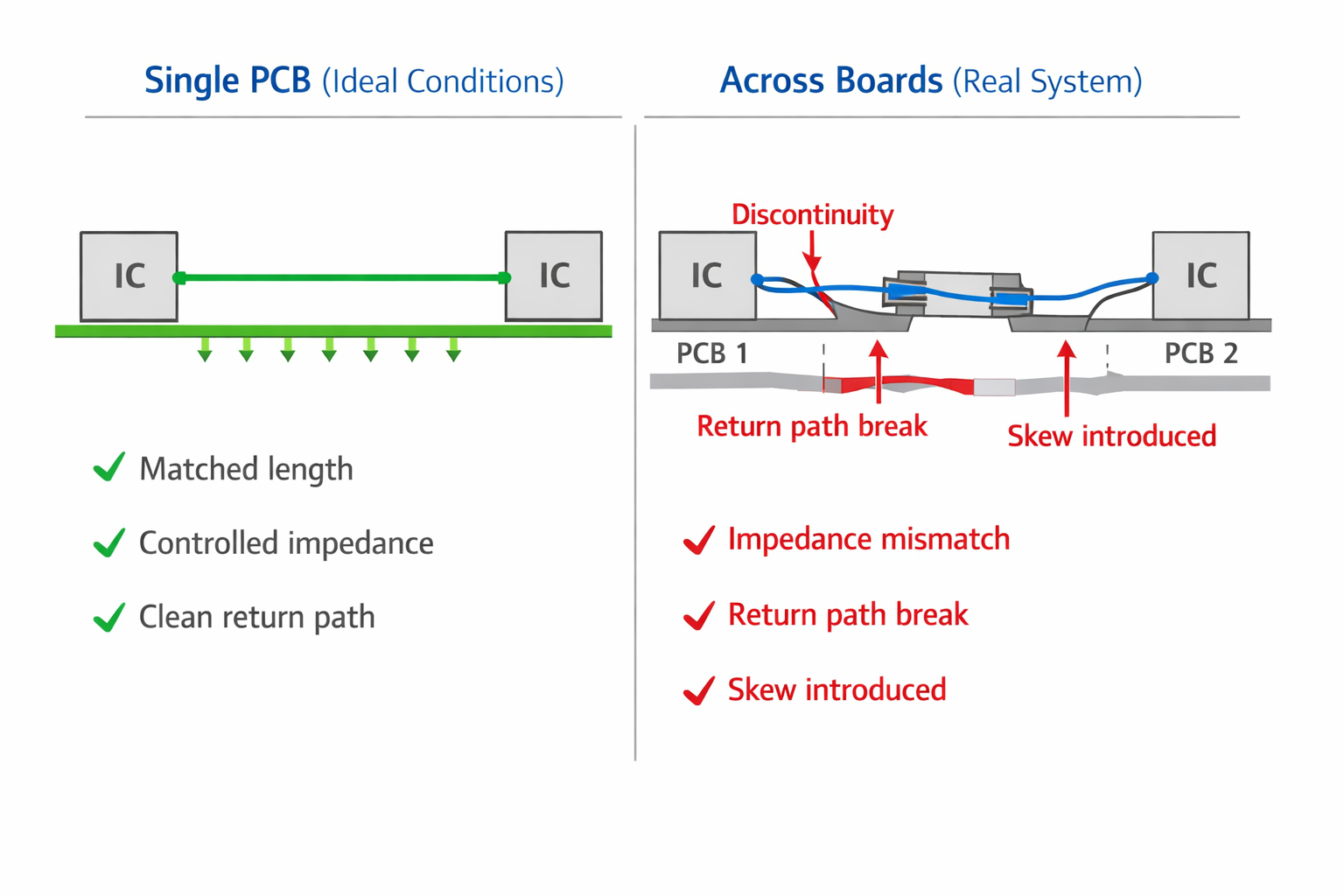
A high-speed interface may look perfect within a single board.
- trace lengths are matched
- impedance is controlled
- return paths are continuous
- routing is clean
But when that same signal crosses into another board:
- impedance changes at the connector
- return path discontinuities appear
- pin mapping introduces asymmetry
- stubs form unintentionally
- reference planes shift
The result is subtle.
The system still works — but not reliably under all conditions.
This is why high-speed issues often appear late in development or only under stress conditions.
Because they are not obvious layout mistakes.
They are interface boundary problems.
A Connector Is Not a Transparent Medium
One of the biggest misconceptions in multi-board design is treating connectors as neutral.
They are not.
A connector introduces:
- impedance discontinuities
- additional parasitic capacitance and inductance
- unequal pin coupling
- skew between differential pairs
- return path fragmentation
Even a well-designed connector can degrade signal quality if:
- pin assignments are not planned
- ground reference is not continuous
- signal pairs are split across regions
- routing into and out of the connector is inconsistent
At Hoomanely, we treat connectors as part of the signal path — not just mechanical links.
That means connector selection, pin mapping, and surrounding layout are all considered together.
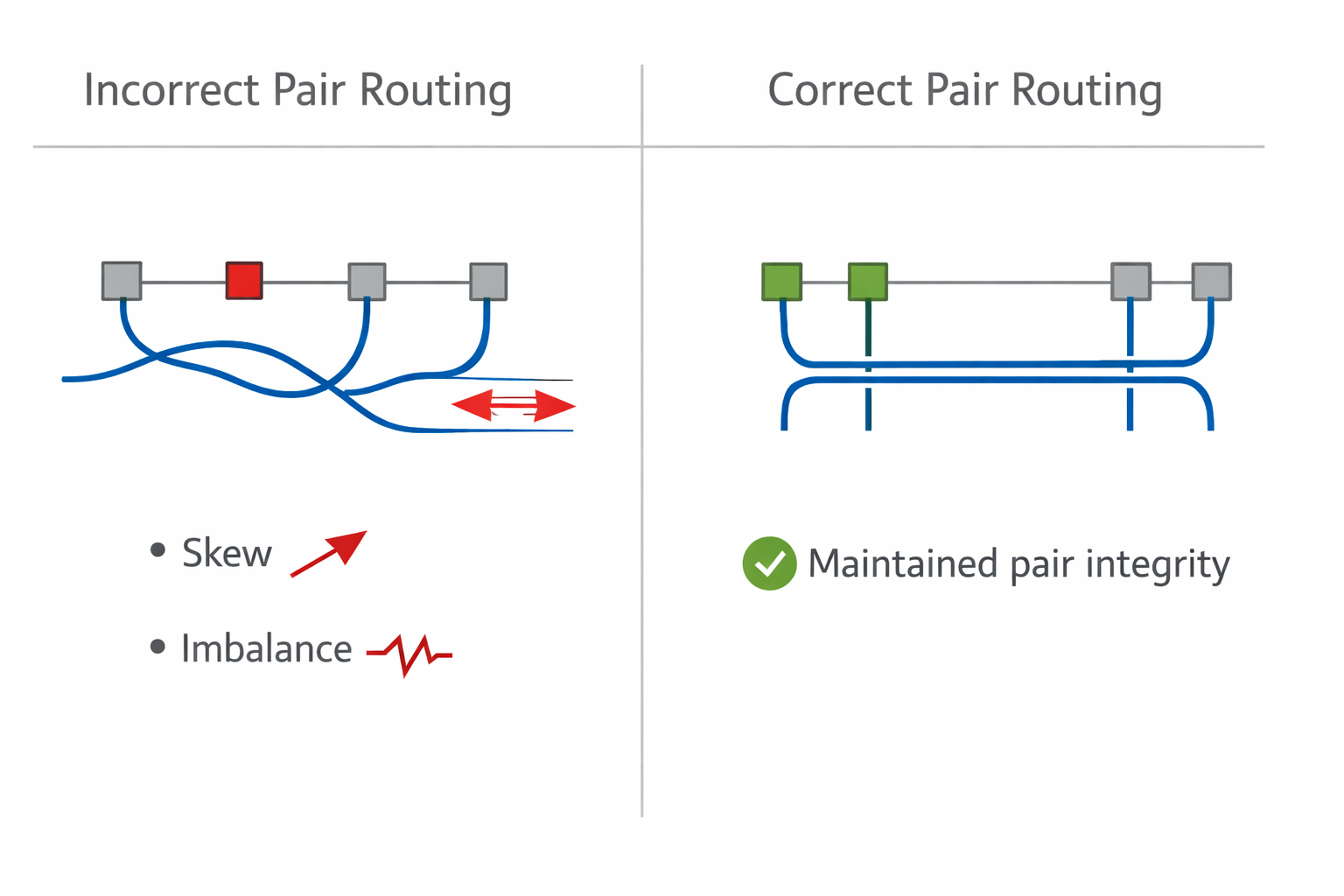
Differential Pairs Must Stay Pairs Across Boards
Inside a PCB, maintaining differential pair integrity is straightforward.
Across boards, it becomes harder.
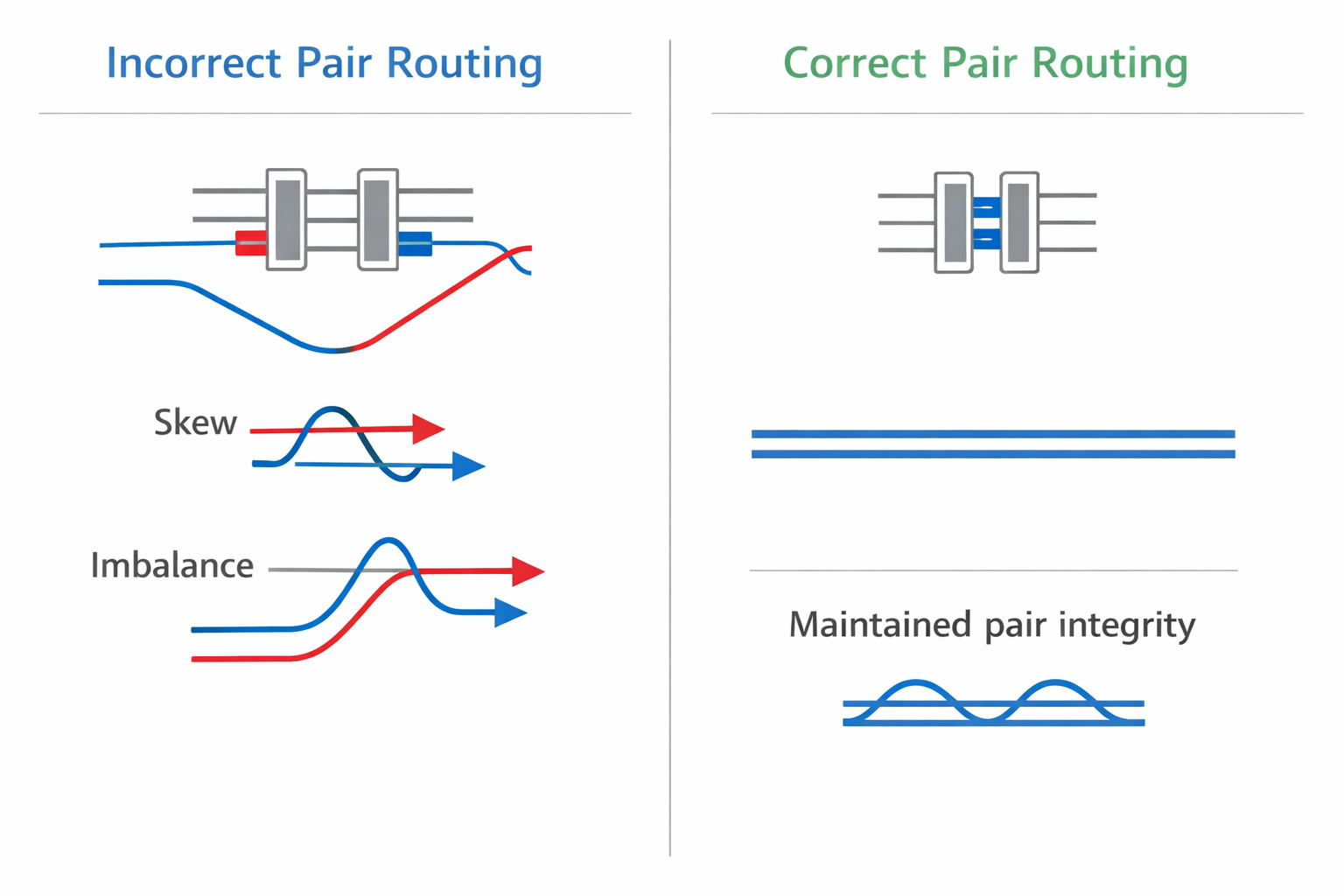
Common mistakes include:
- splitting differential pairs across connector rows
- routing each line through different reference conditions
- introducing unequal via transitions
- allowing asymmetry in entry and exit routing
This creates:
- skew between signals
- imbalance in impedance
- increased common-mode noise
- degraded signal eye
To prevent this, we enforce:
- paired pins in connectors
- symmetrical routing on both boards
- consistent reference plane transitions
- minimal skew across the entire path
A differential pair is not two signals.
It is one system.
That system must remain intact across the entire path.
Return Paths Are Often the First Casualty
High-speed signals do not travel alone.
They depend on return paths.
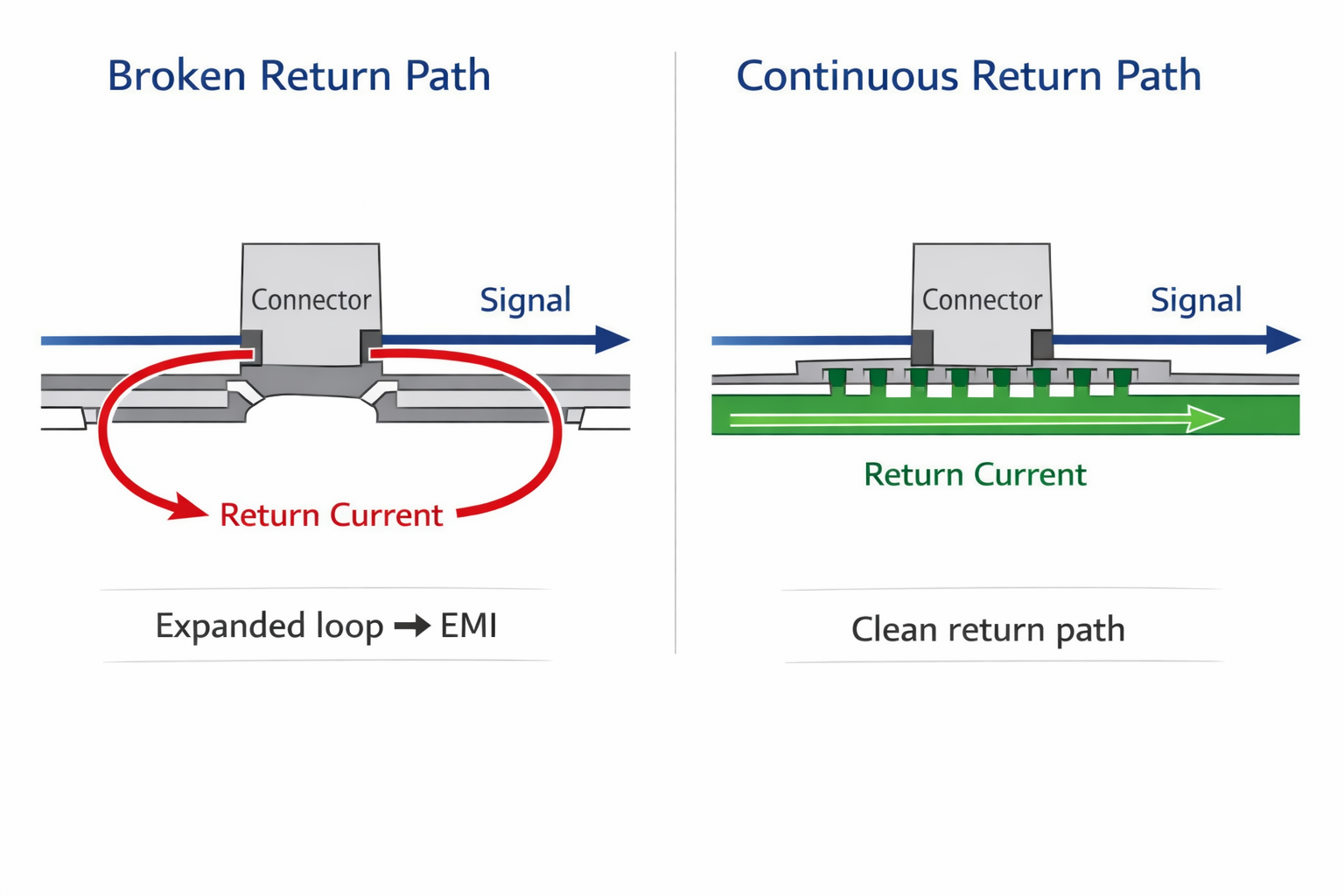
Inside a PCB, return current flows cleanly under the trace through a reference plane.
But at a board-to-board boundary:
- reference planes may not align
- ground continuity may be broken
- return current may be forced to detour
- current loops may expand
This increases:
- EMI
- signal distortion
- jitter
- susceptibility to noise
So we design connectors with ground strategy in mind, not just signal count.
That includes:
- ground pins adjacent to high-speed signals
- continuous ground stitching across connectors
- maintaining reference continuity across boards
- avoiding floating or fragmented ground regions
A signal path is only as good as its return path.
Stubs Are Silent Signal Killers
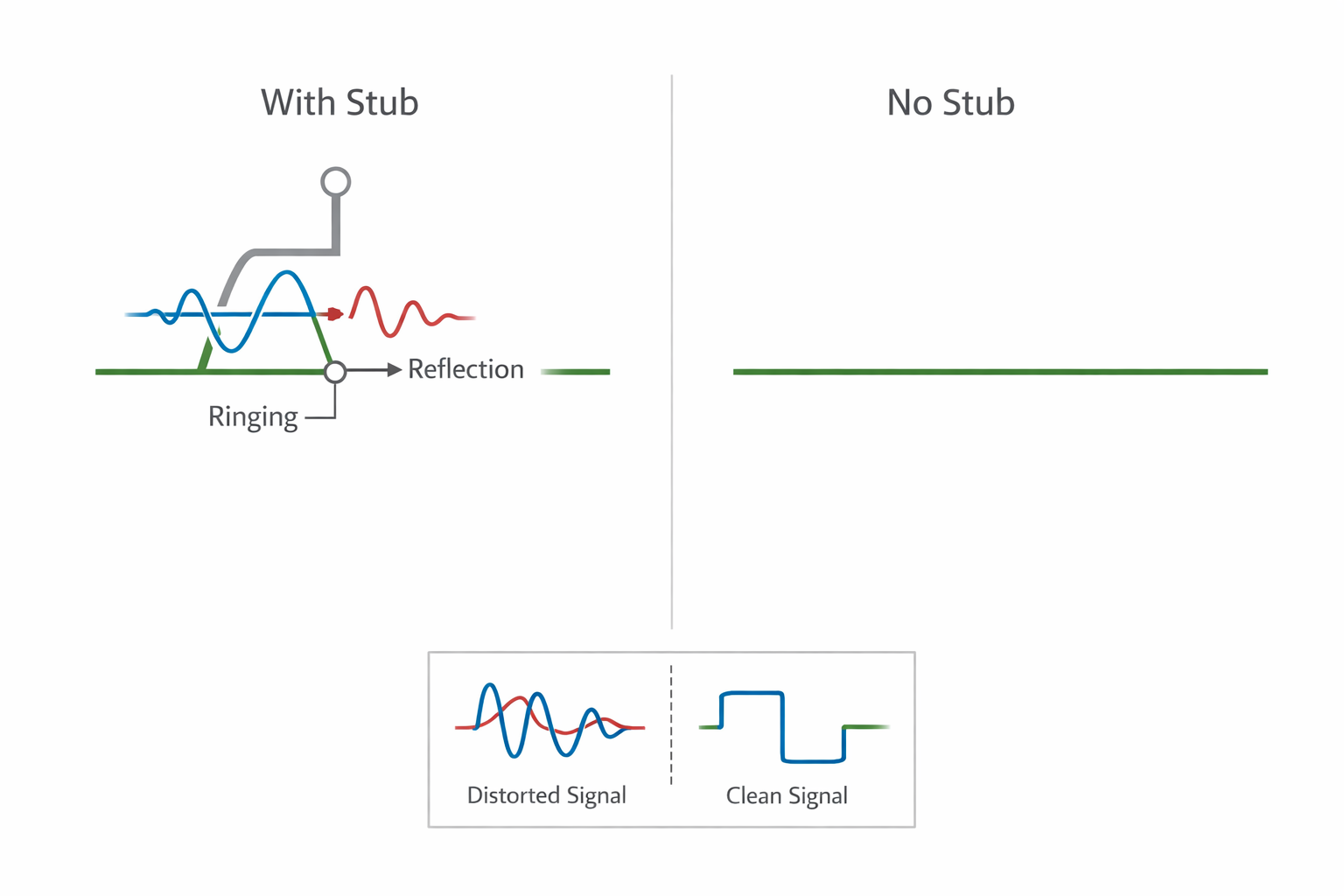
Stubs are one of the most common hidden issues in board-to-board design.
They appear when:
- unused connector pins branch off the signal path
- test points are added incorrectly
- routing splits unnecessarily
- debug hooks remain attached
Even small stubs can reflect energy back into the signal, causing:
- ringing
- reduced signal integrity
- timing uncertainty
- degraded eye diagrams
At high speeds, even a few millimeters matter.
So we enforce:
- no unnecessary branches on high-speed lines
- minimal stub length
- careful placement of test access points
- clean point-to-point routing across boards
If a signal branches, it must be intentional — not incidental.
Routing Into the Connector Matters as Much as the Connector Itself
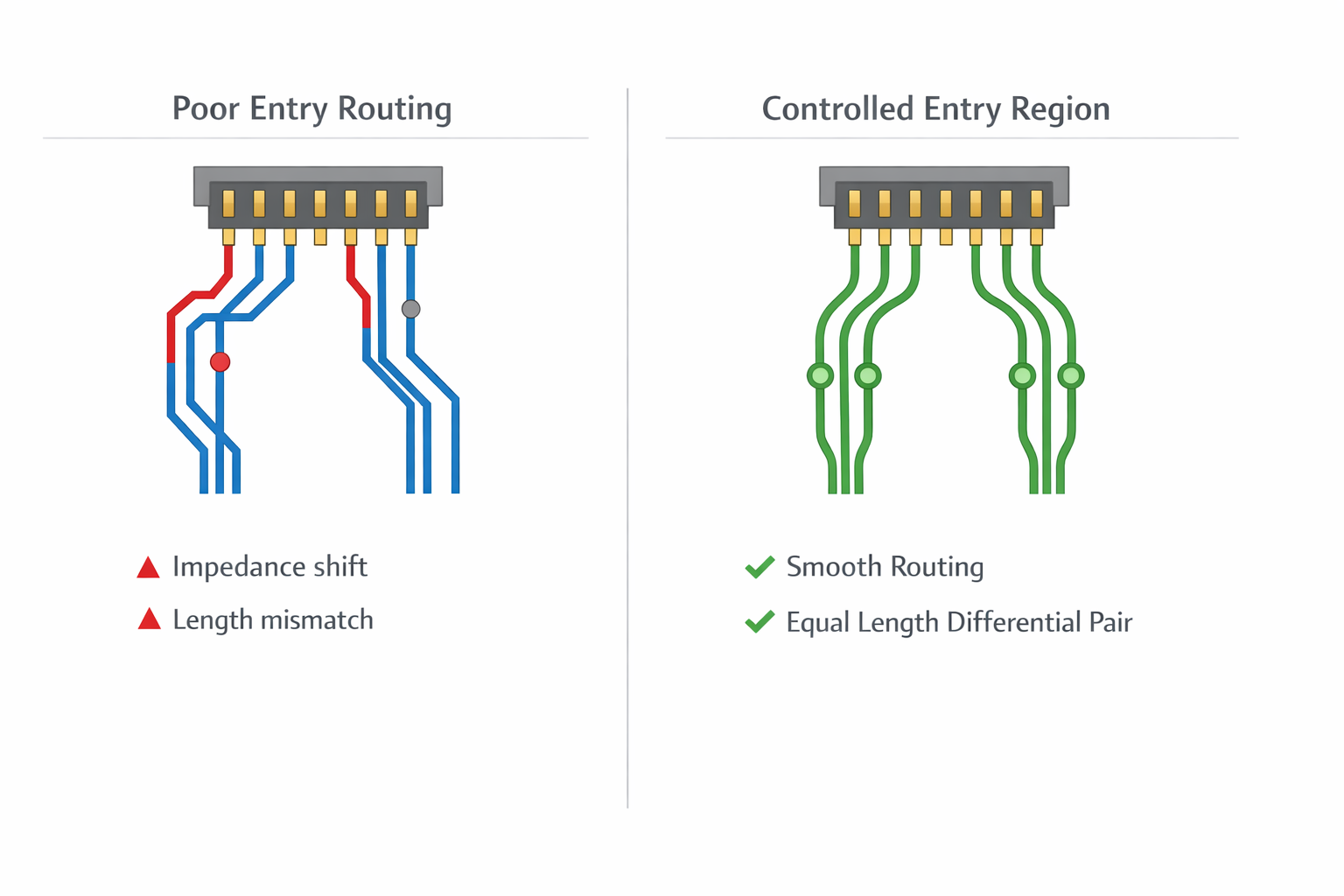
Even if the connector is well chosen, poor routing into it can degrade performance.
Common issues include:
- abrupt impedance changes near connector entry
- uneven trace lengths before entering pins
- different layer transitions for paired signals
- inconsistent via usage
These introduce discontinuities before the signal even reaches the connector.
At Hoomanely, we treat the connector entry region as a controlled transition zone:
- maintain impedance up to the pin
- avoid sharp geometry changes
- keep differential pair spacing consistent
- use symmetric via transitions
- preserve reference planes near entry
The connector does not fix poor routing.
It amplifies it.
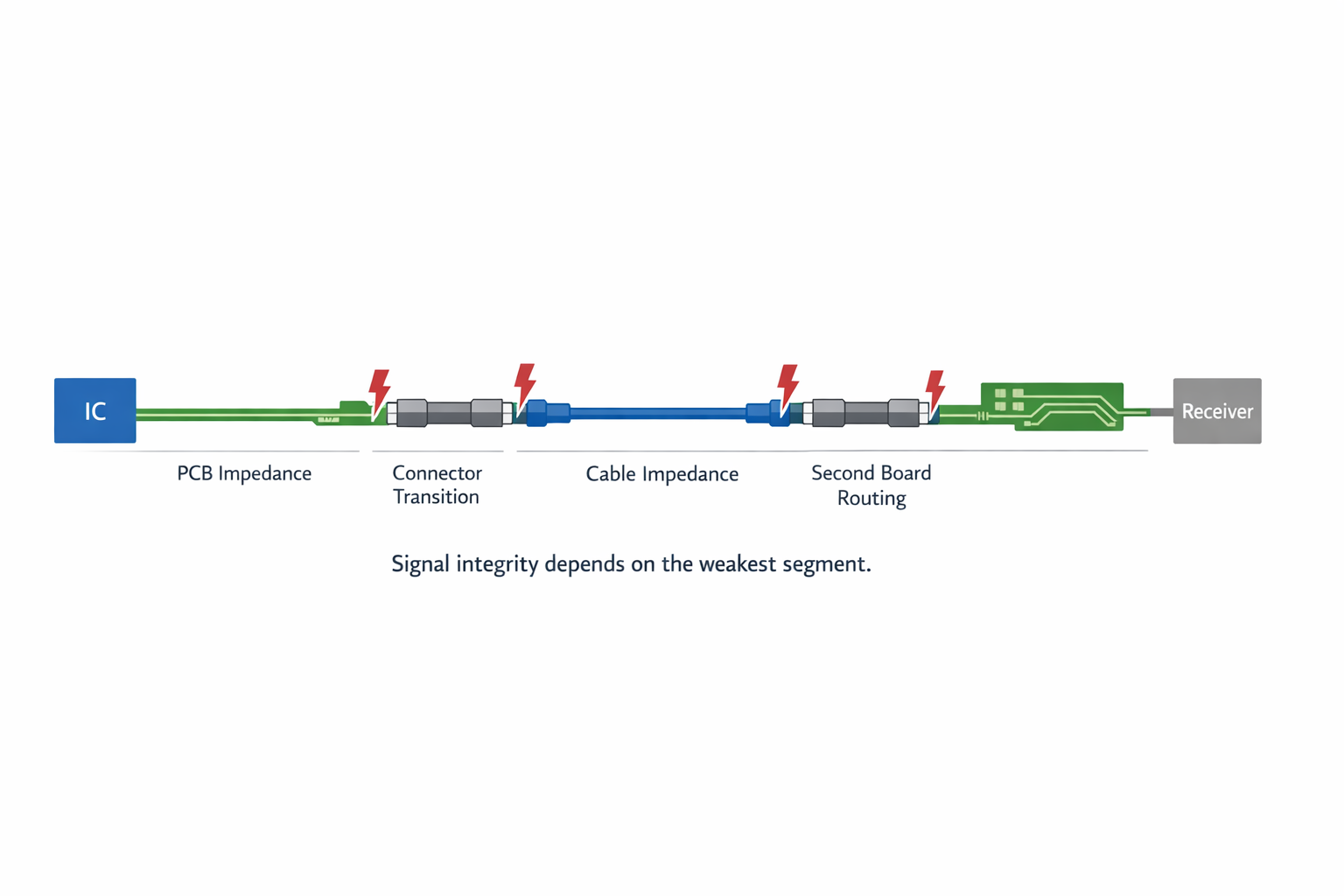
Cable and Flex Interfaces Add Another Layer of Complexity
When signals leave rigid boards through flex or cables, the challenge increases.
Now the signal path includes:
- PCB → connector → cable → connector → PCB
Each transition adds:
- impedance mismatch
- additional capacitance
- mechanical variability
- coupling effects
To manage this, we:
- choose cable impedance carefully
- match PCB routing to cable characteristics
- maintain signal pairing across the entire path
- avoid unnecessary transitions
- validate the full path, not just segments
A high-speed link is only as strong as its weakest segment.
And in multi-board systems, that segment is often outside the PCB.
Practical Improvements We Observed
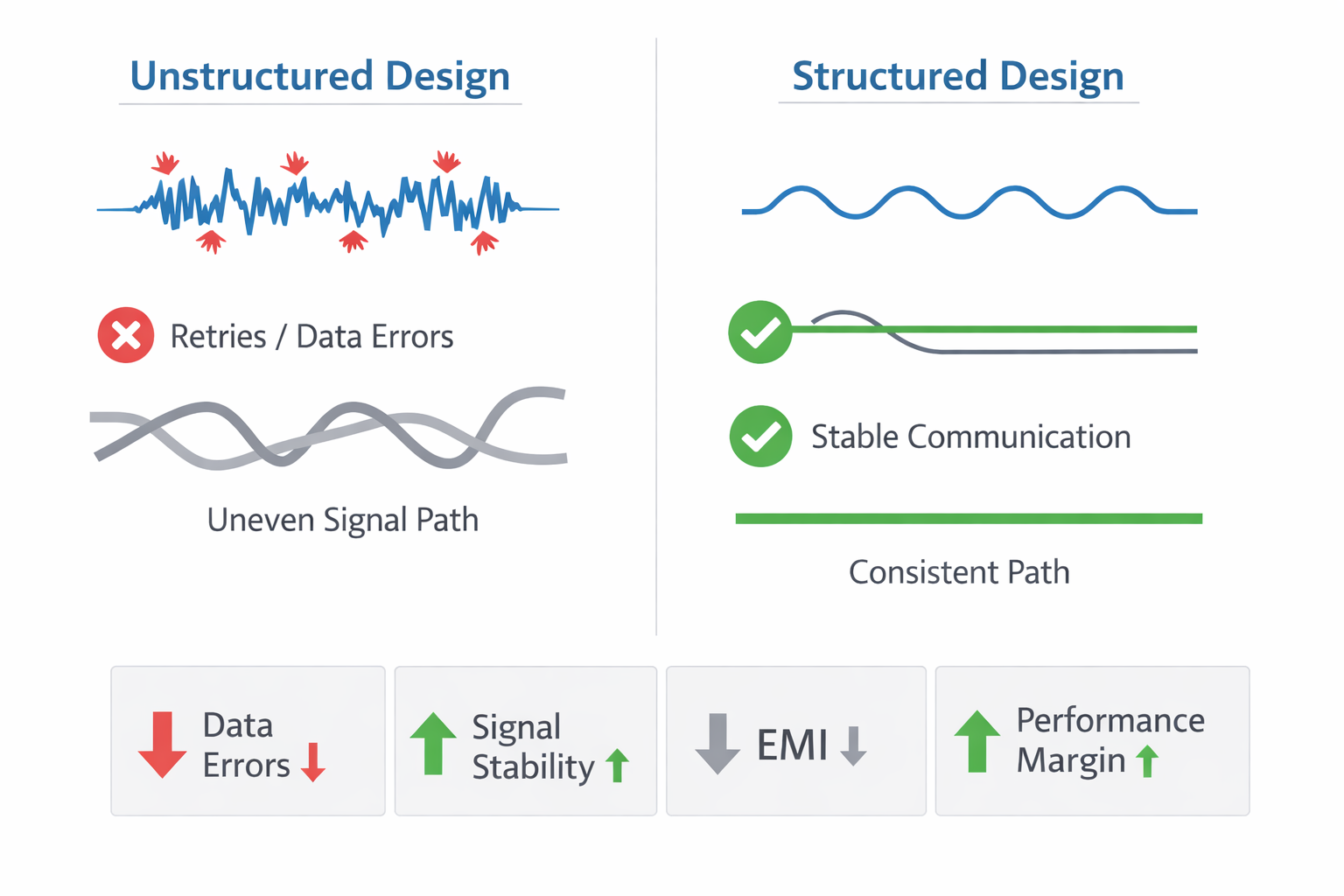
After tightening board-to-board signal discipline, we saw measurable improvements:
Reduced Data Errors
Intermittent communication failures and retries were significantly reduced.
Improved Signal Stability
Waveforms became cleaner with less ringing and distortion.
Better High-Speed Performance Margins
Interfaces operated reliably closer to their maximum rated speeds.
Lower EMI Emissions
Cleaner return paths reduced unintended radiation.
More Predictable System Behaviour
System performance became consistent across temperature and operating conditions.
These improvements were not visible in schematic diagrams.
They were visible in system reliability.
Designing the Signal Path as a Continuous System
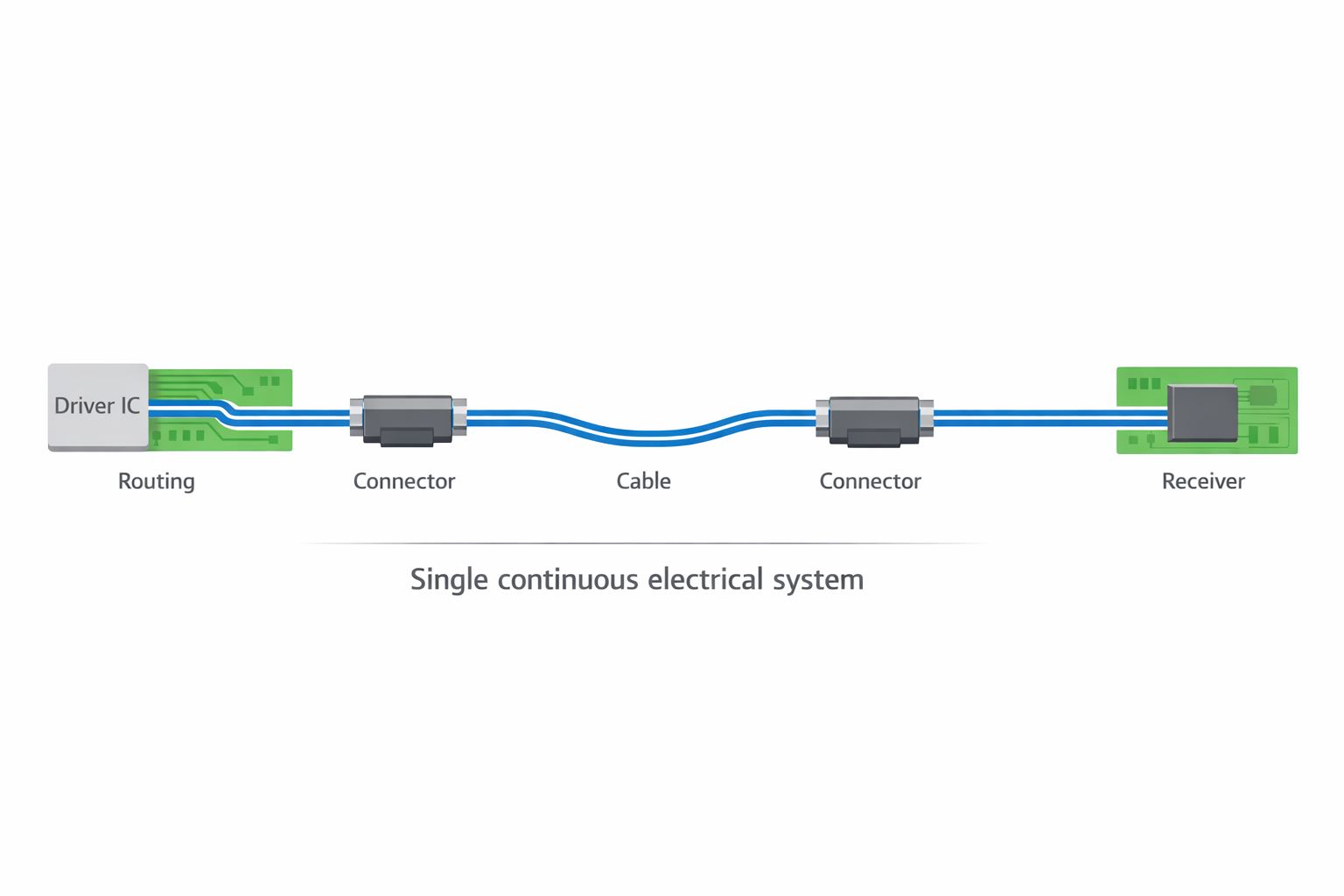
A key shift in our methodology is this:
We do not design signals per board.
We design signals per system path.
That means:
- source driver characteristics
- PCB routing
- connector behavior
- cable or flex interface
- receiving end characteristics
All considered as a single chain.
This approach avoids local optimization that fails globally.
Conventional vs Structured High-Speed Design
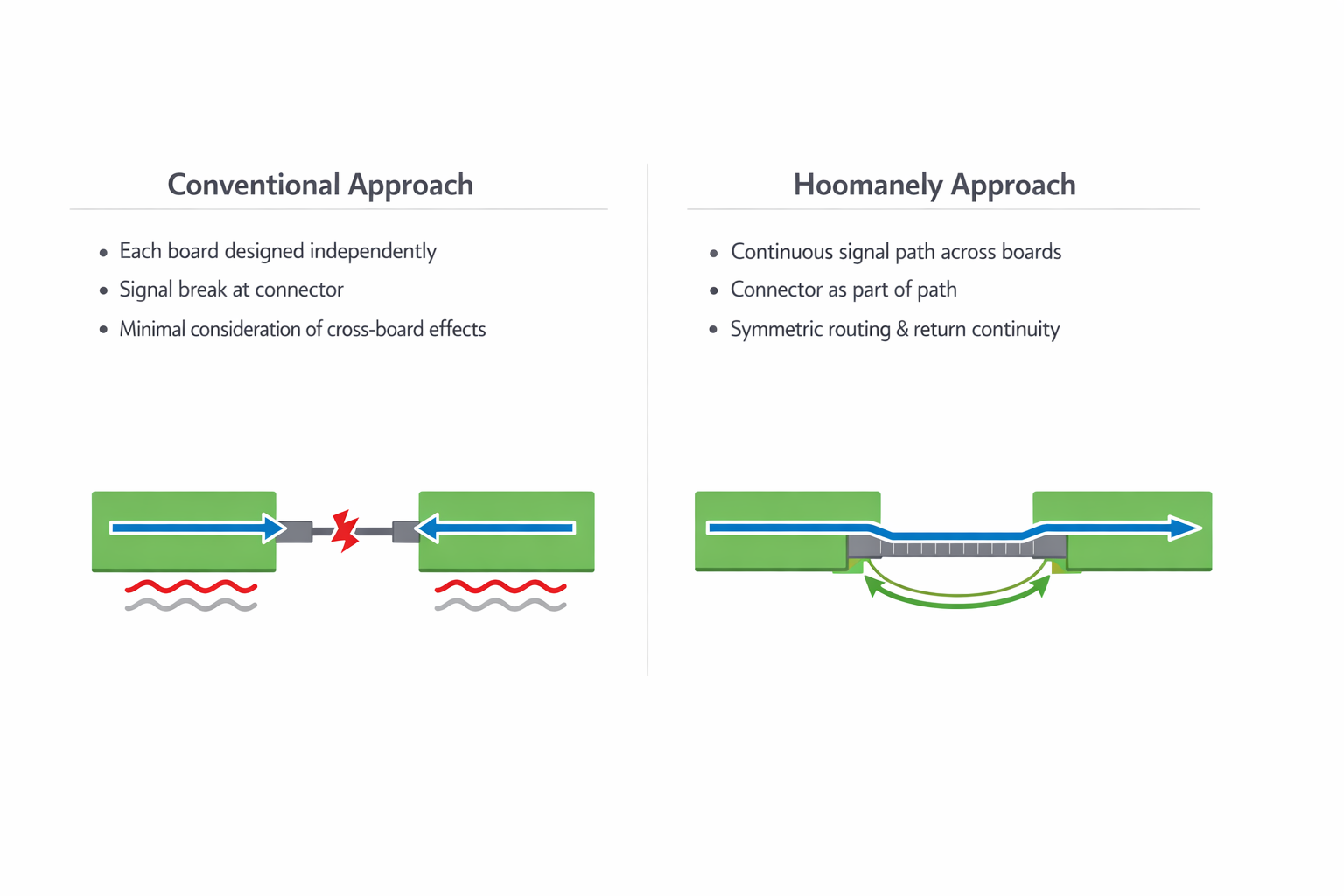
Conventional approach:
- optimize routing within each PCB
- assume connectors behave ideally
- treat boards independently
Hoomanely approach:
- design entire signal path across boards
- treat connectors as active signal elements
- enforce pair integrity across boundaries
- maintain return path continuity
- eliminate stubs across the system
The difference is not visible in layout screenshots.
It is visible in system stability.
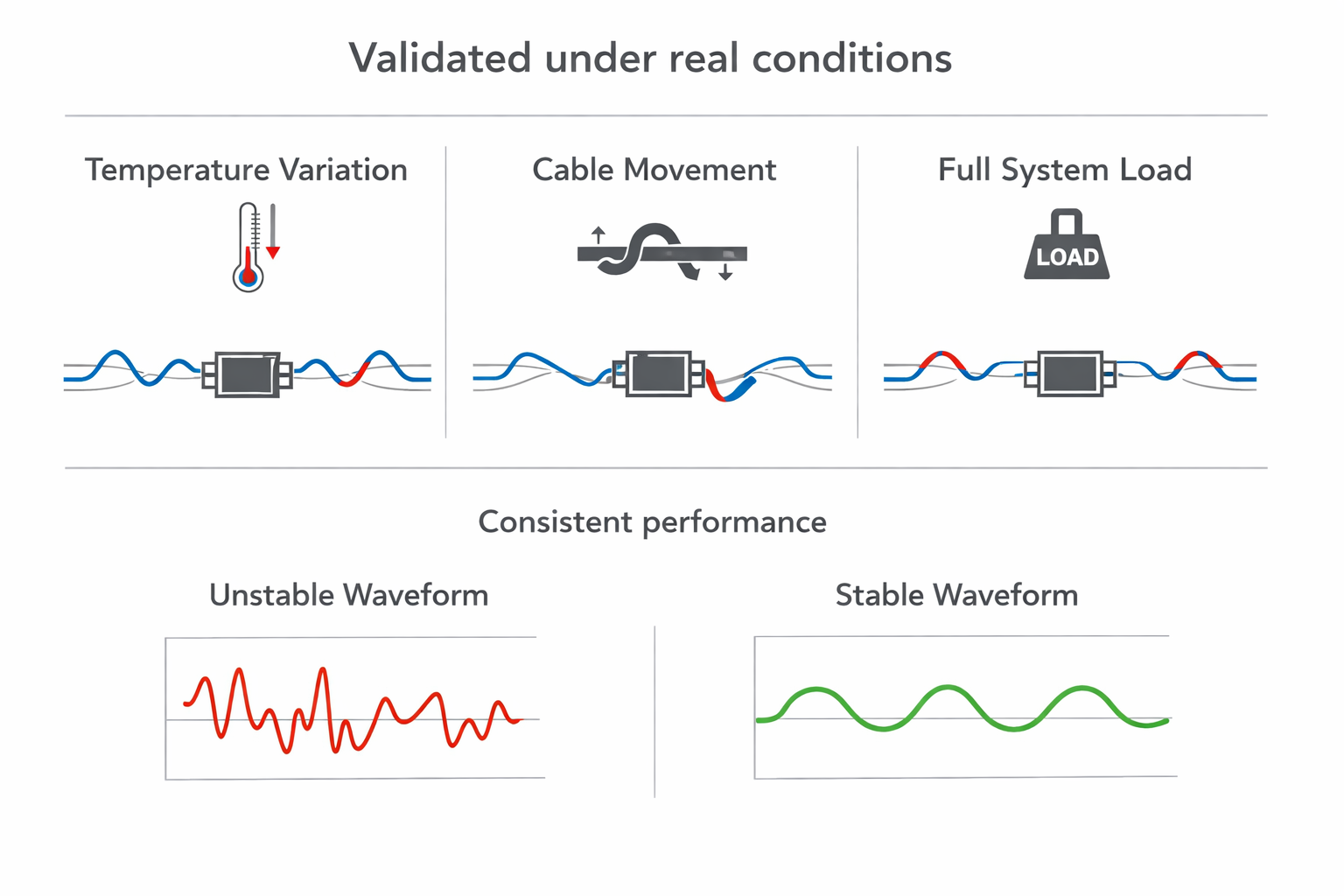
Designing for Real Conditions, Not Ideal Conditions
High-speed signals behave differently in real environments:
- temperature changes affect materials
- connectors age and wear
- cable positioning changes coupling
- power noise varies under load
If the system only works under ideal lab conditions, it is not robust.
We validate:
- across temperature ranges
- under full system load
- with cable movement
- across production variation
Because high-speed integrity must hold under all conditions, not just best-case scenarios.
The Core Principle
A high-speed signal does not belong to a board.
It belongs to a path.
That path must remain consistent from source to destination — across every transition, connector, and interface.
Once this is understood, design decisions become clearer:
- connectors are chosen differently
- pin assignments become deliberate
- routing becomes symmetrical
- debug stubs are minimized
- return paths are preserved
The system stops being a collection of boards.
It becomes a continuous electrical structure.
Final Thought
High-speed issues are rarely dramatic. They are quiet, intermittent, and difficult to trace.
That is what makes them dangerous.
A system that “mostly works” is often one where signals are just barely holding together across boundaries.
At Hoomanely, we design those boundaries deliberately.
Because keeping signals clean across board-to-board links is not about pushing performance limits.
It is about removing uncertainty.
And in embedded systems, removing uncertainty is what turns a working prototype into a reliable product.