Designing Debug Access That Doesn’t Become a Liability
Debug access is one of the most useful parts of a board during development. It's how firmware gets flashed, how logs are captured, how dead boards get recovered, and how engineers figure out what the system is actually doing. But in a real product, debug access is never just a convenience. It's a physical entry point into the system. If it's left too open, too permanent, or too casually routed, it can start creating problems of its own.
At Hoomanely, we don't treat debug access as a loose collection of headers and test pads. We treat it as part of the product architecture. The goal is simple:
- Make debugging easy during development
- Useful during manufacturing
- Safe during service
- Quiet in the shipped product
That sounds obvious, but it changes the board design significantly. Because the best debug access isn't the one that exposes everything. It's the one that gives the right access, at the right time, in the right form.
Debug access is helpful, until it starts disturbing the product
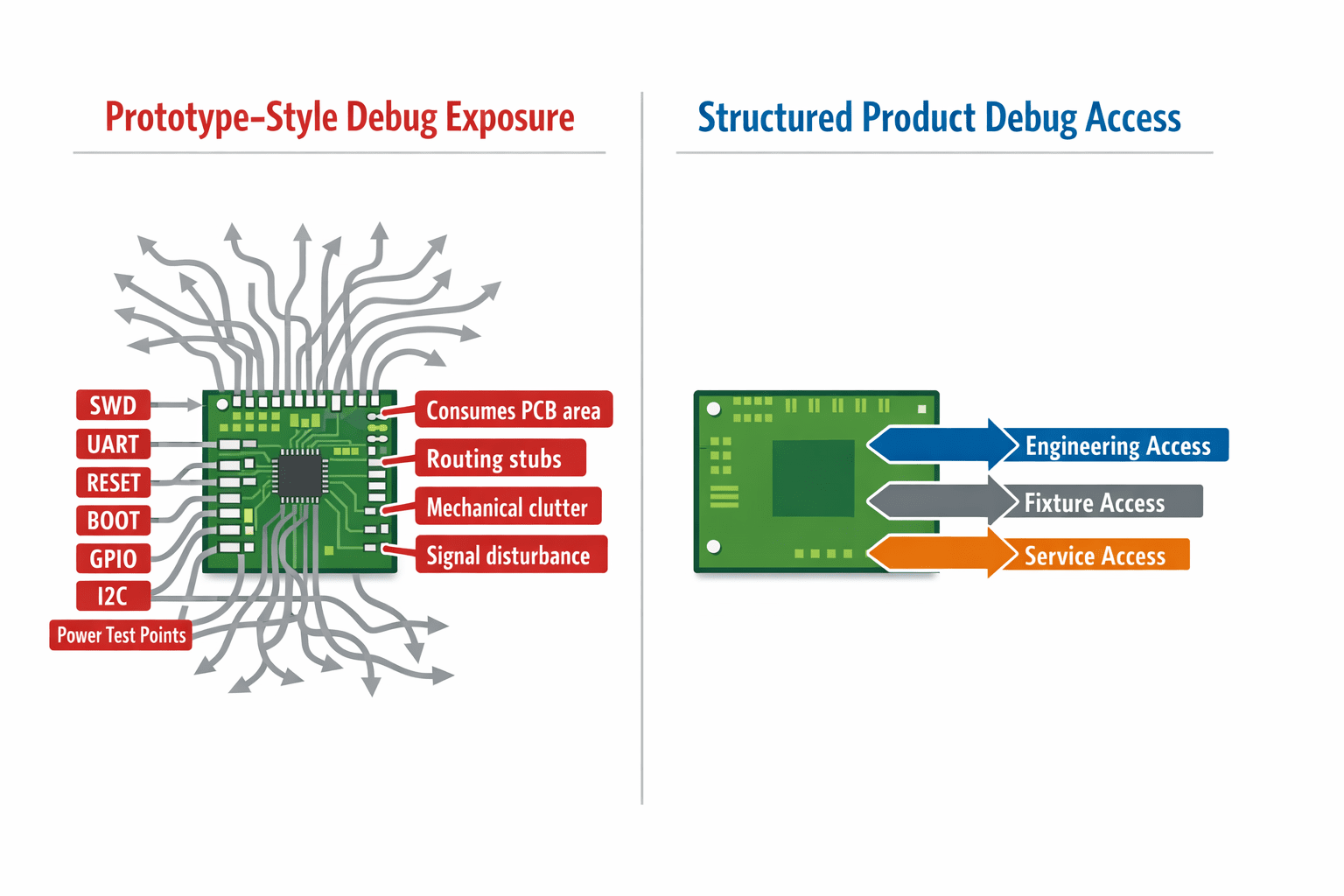
On early prototype boards, the natural instinct is to expose as much as possible, SWD or JTAG, UART console, reset, boot mode pins, test points for rails, spare GPIOs, I2C or SPI breakouts. That helps during bring-up, but if those same decisions carry forward unchanged, they begin to cost the product in less obvious ways:
- Consuming PCB area
- Complicating enclosure design
- Adding routing stubs
- Weakening signal integrity
- Exposing sensitive control pins
- Confusing service procedures
- Making manufacturing fixtures more awkward
So the problem isn't debug access itself. The problem is unstructured debug access. A good debug design increases observability without increasing confusion.
Access and exposure are not the same thing
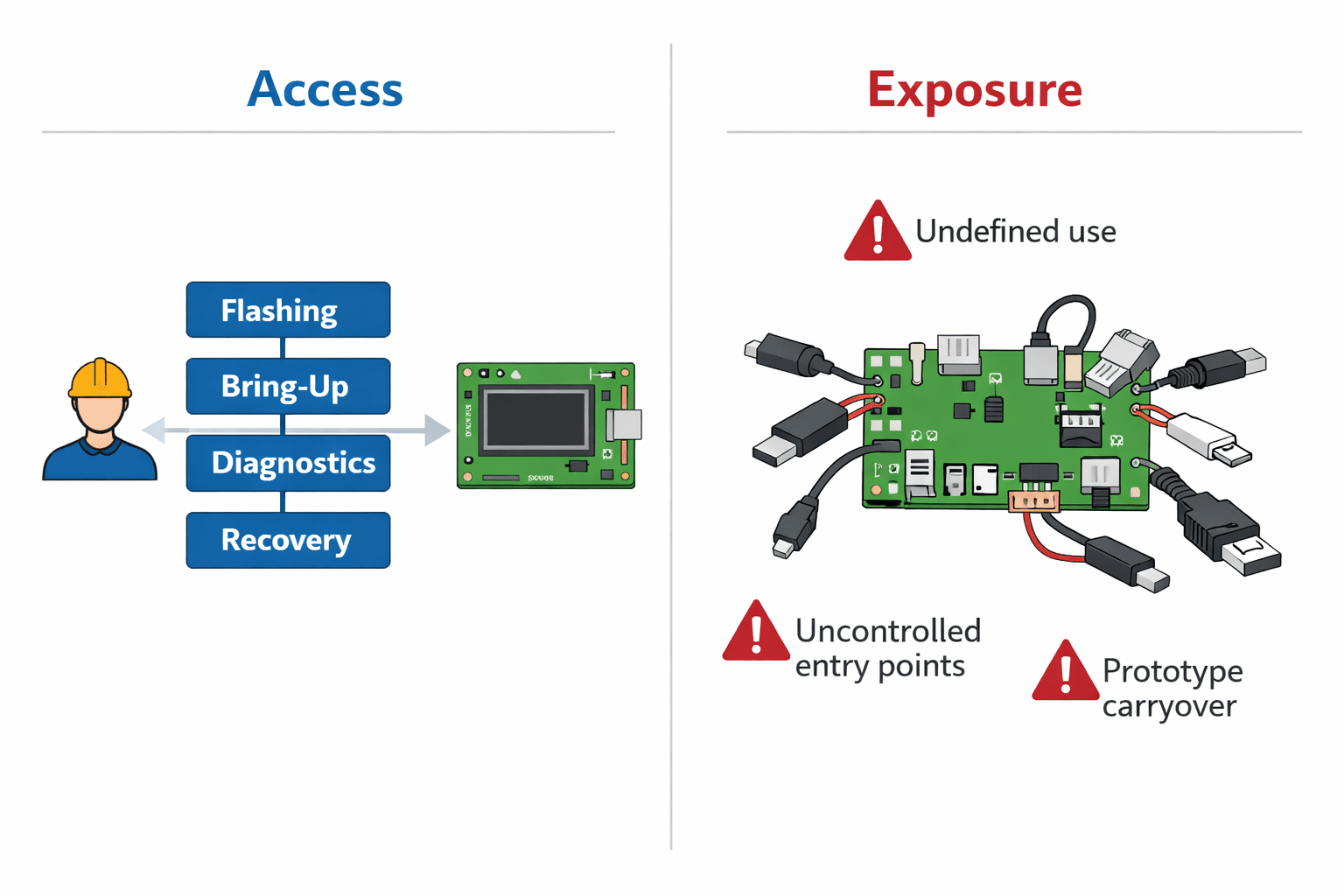
This is one of the most important distinctions in board design. Access is intentional, it exists for a defined use case: firmware flashing, board bring-up, production testing, controlled recovery, diagnostics. Exposure is accidental, it exists because no one decided how much access was actually needed.
A board with proper debug access feels deliberate. A board with too much exposure feels like it never left the prototype stage. At Hoomanely, we start by asking:
- Who needs this interface
- At what stage
- For what exact action
- Does it need a connector or just fixture access
- Should it still exist in the shipped product? These questions usually reduce clutter and improve clarity at the same time
Debug needs change across the product lifecycle
A board doesn't need the same kind of debug access forever, different stages need different levels of control. During bring-up we may need SWD, UART, reset, boot override, and rail visibility. During firmware development we may still need fast flashing, console access, recovery access, and timing visibility. During manufacturing what matters is different, fixture-friendly programming, simple pass/fail validation, stable contact points, and minimal operator ambiguity. During service the need becomes narrower, controlled recovery, deterministic diagnostics, and low-risk access. In the shipped product, debug access shouldn't interfere with normal operation at all.
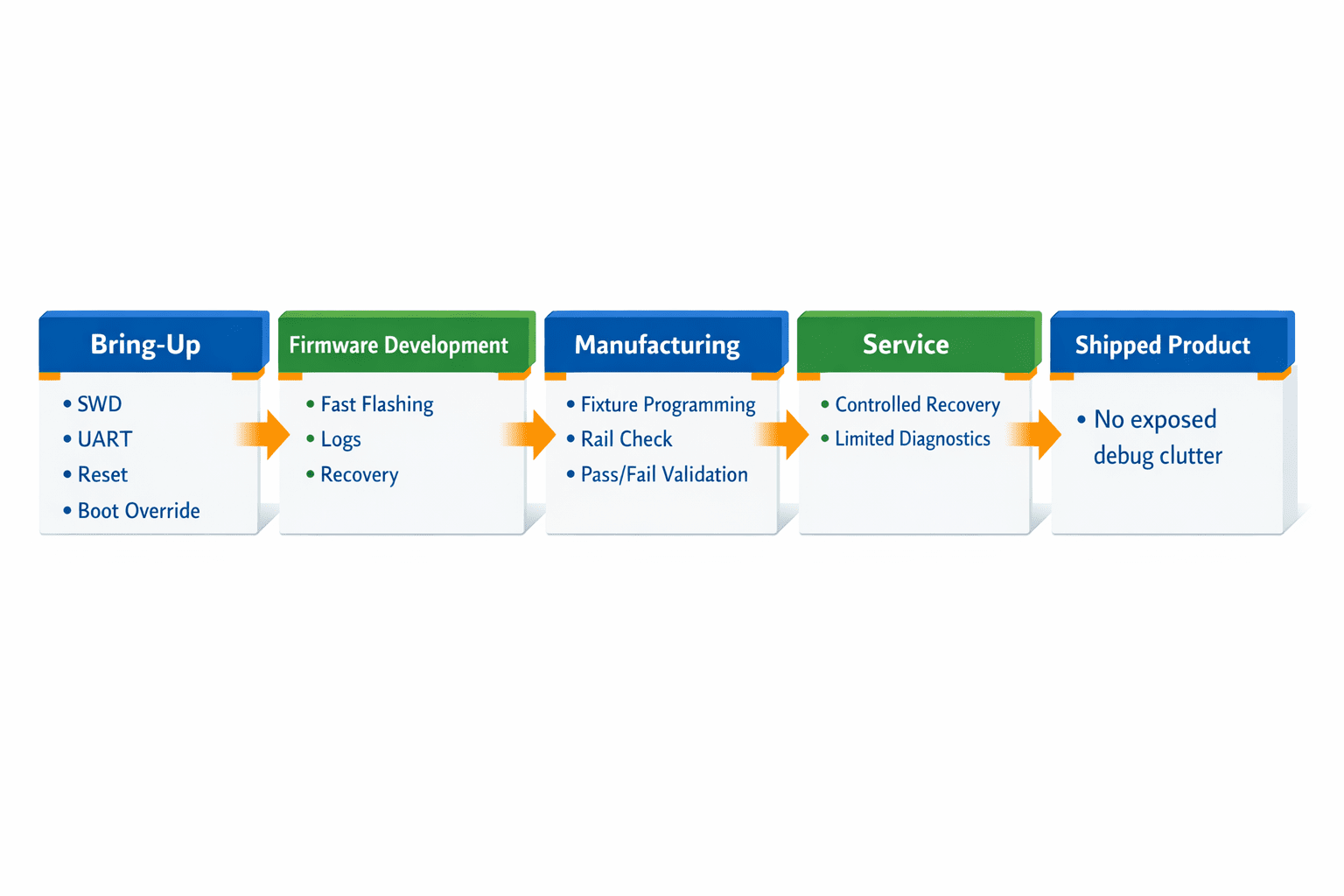
This is why we don't design one fully open interface and force it to serve every phase. We design debug in layers, some access meant for engineering only, some for production fixtures, some kept for service, and some that should never remain user-accessible in the final system.
A connector is not always the best debug interface
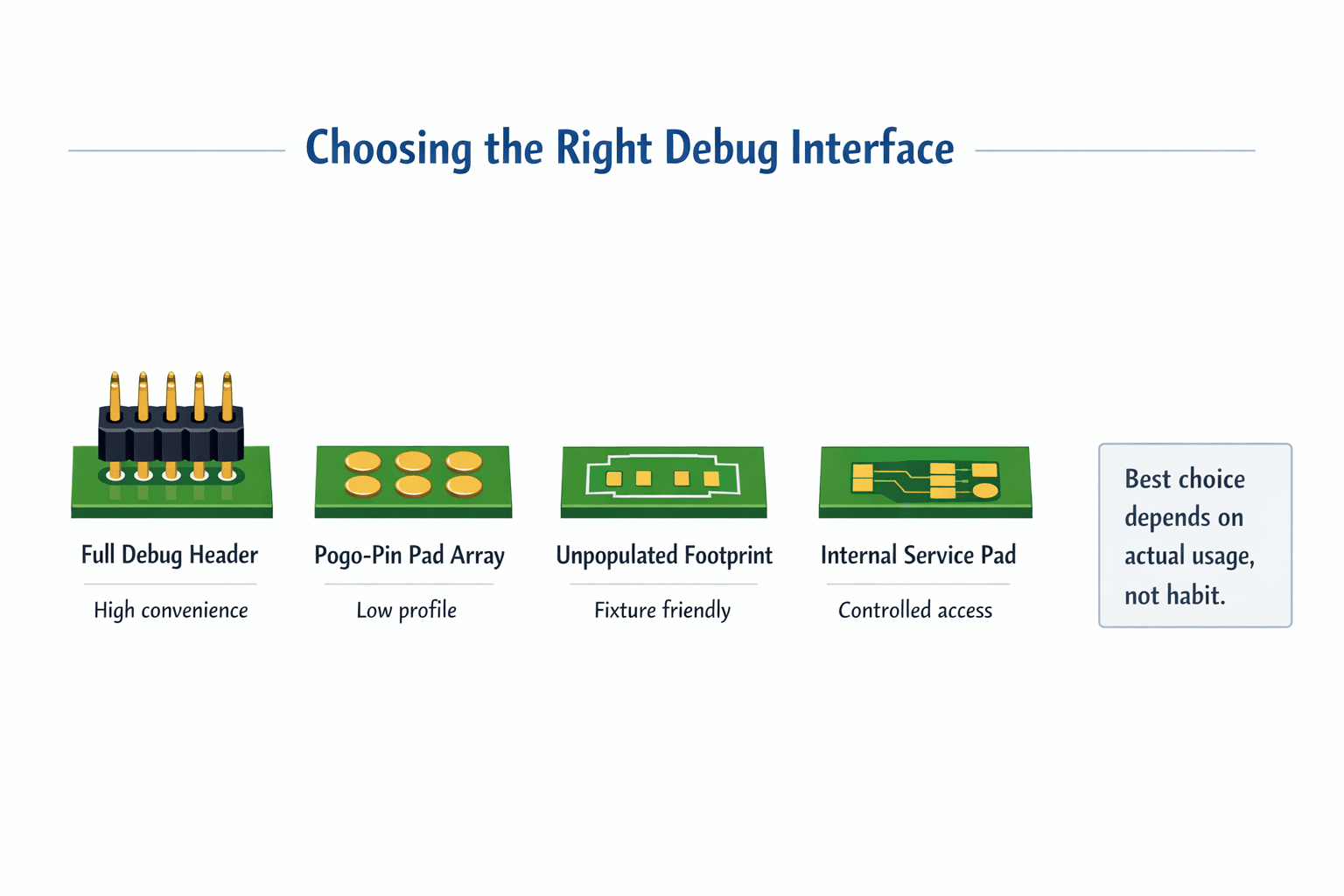
A common assumption is that debug access must mean a visible connector. That's often unnecessary. In many cases, better options are tagged test pads, pogo-pin pads, compact unpopulated footprints, internal service pads, or small programming interfaces hidden inside the enclosure. Connectors cost more than BOM value, they take space, affect mechanical packaging, add height, and invite accidental handling. If an interface is mainly used in bring-up or fixture programming, a clean pad array may be the better choice, still giving access, but without turning the board into a permanent development platform.
Debug signals must not weaken functional signals
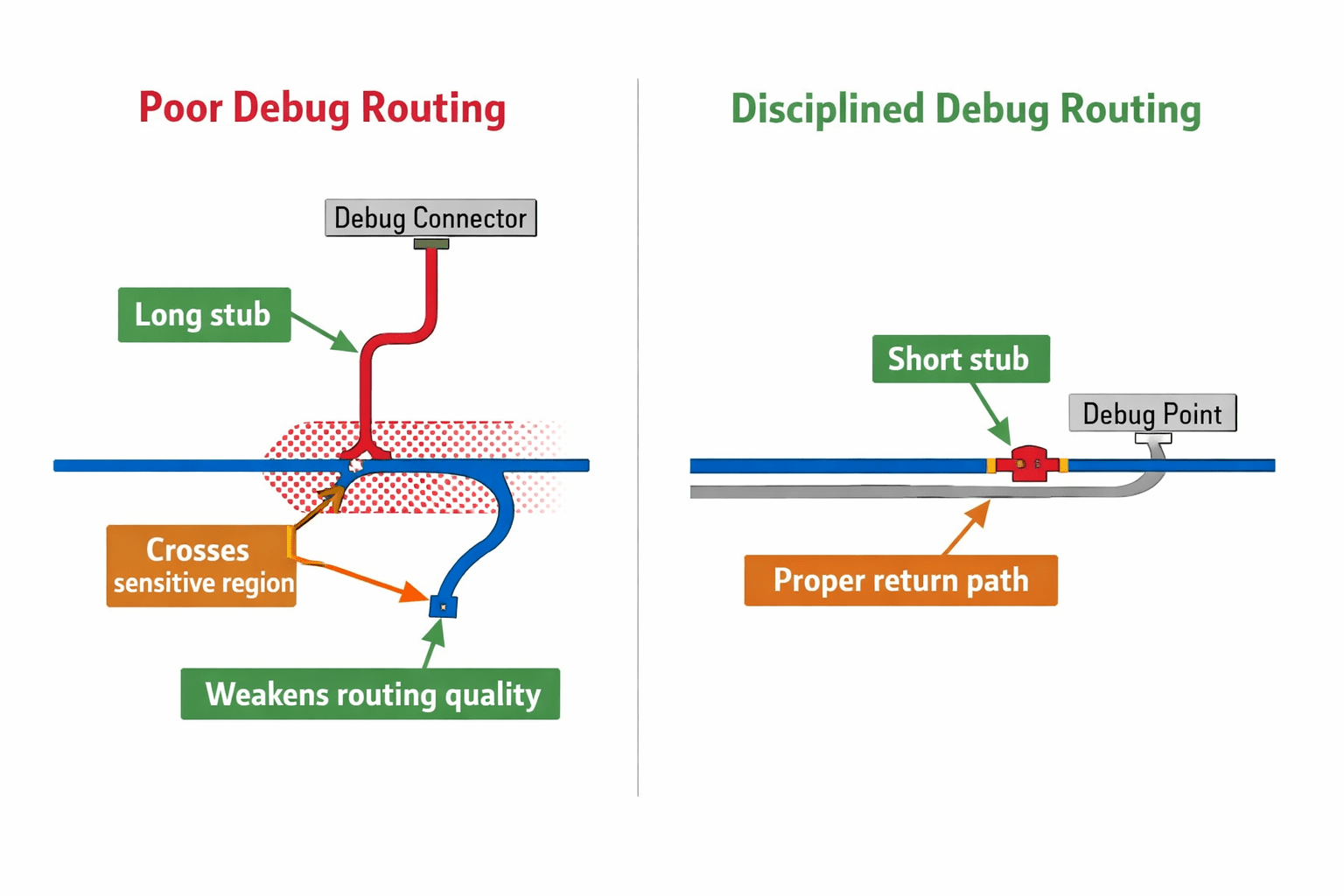
Debug routing is often treated casually because these signals are "only for development." That's a mistake. A reset line extended to a convenient header can become too long and too exposed. A UART trace routed across the board may pass through sensitive regions. A boot strap pin may become easier to disturb than intended.
At Hoomanely, debug nets are routed with the same discipline as functional nets, short paths, controlled placement, minimal stubs, good return paths, no unnecessary crossings through sensitive areas. Debug should observe the system, not disturb it. If a debug path weakens a product signal, then the board is paying too much for convenience.
Boot control is useful, but it must be strongly defined
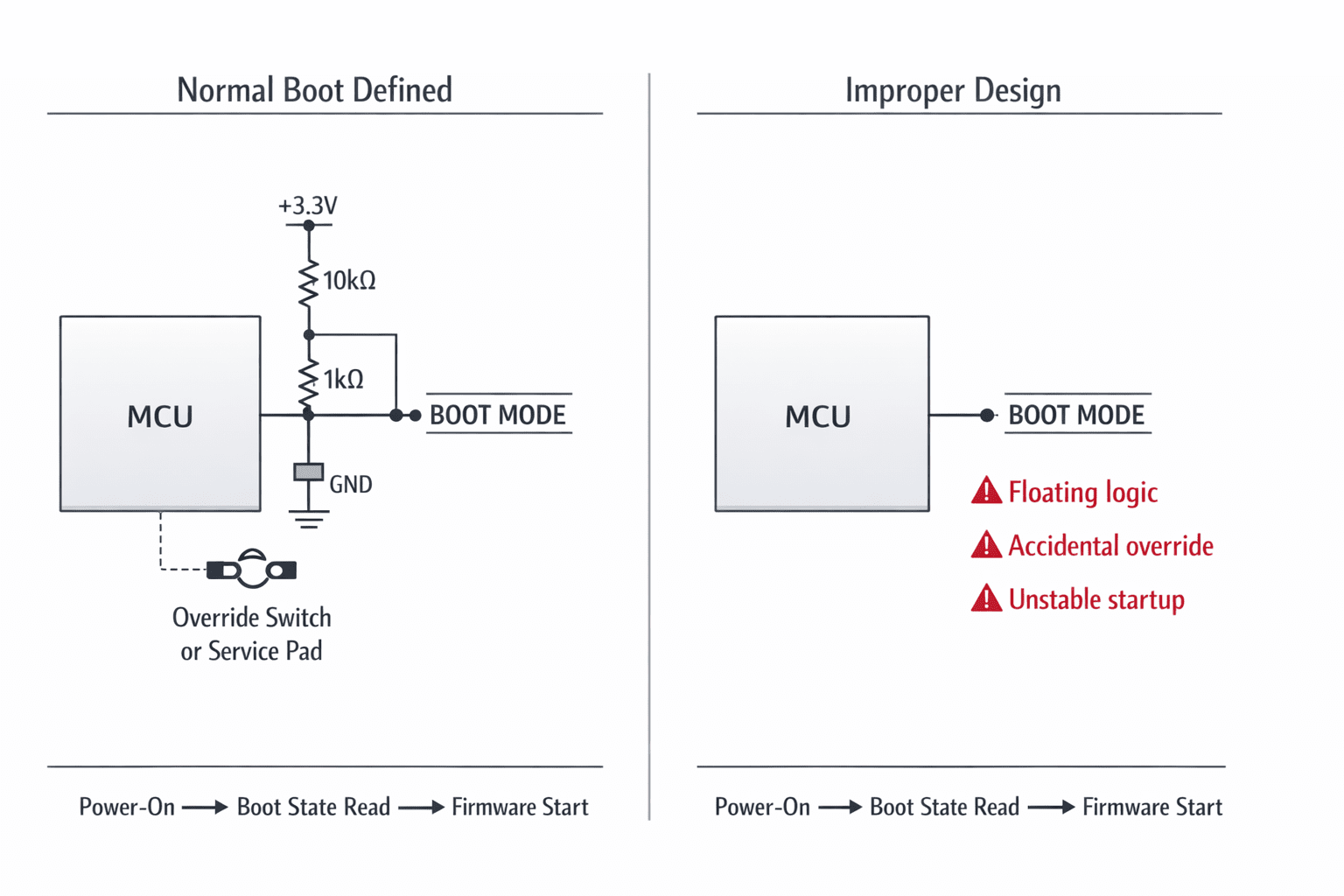
Boot mode access is one of the most valuable debug tools in embedded systems, helping with recovery, reflashing, entering programming modes, and bypassing broken firmware states. But it can also become a source of instability if the hardware doesn't strongly define the normal boot condition. If boot straps are too exposed or weakly biased, the system may enter the wrong mode due to floating logic, probing mistakes, accidental grounding, or noisy handling during power-up.
So the board must always know what "normal boot" means, through strong default pull states, clear override behavior, no ambiguous access paths, and override only when intentionally invoked. Boot debug should be possible. Accidental boot-mode entry should not.
Reset access must respect the system architecture
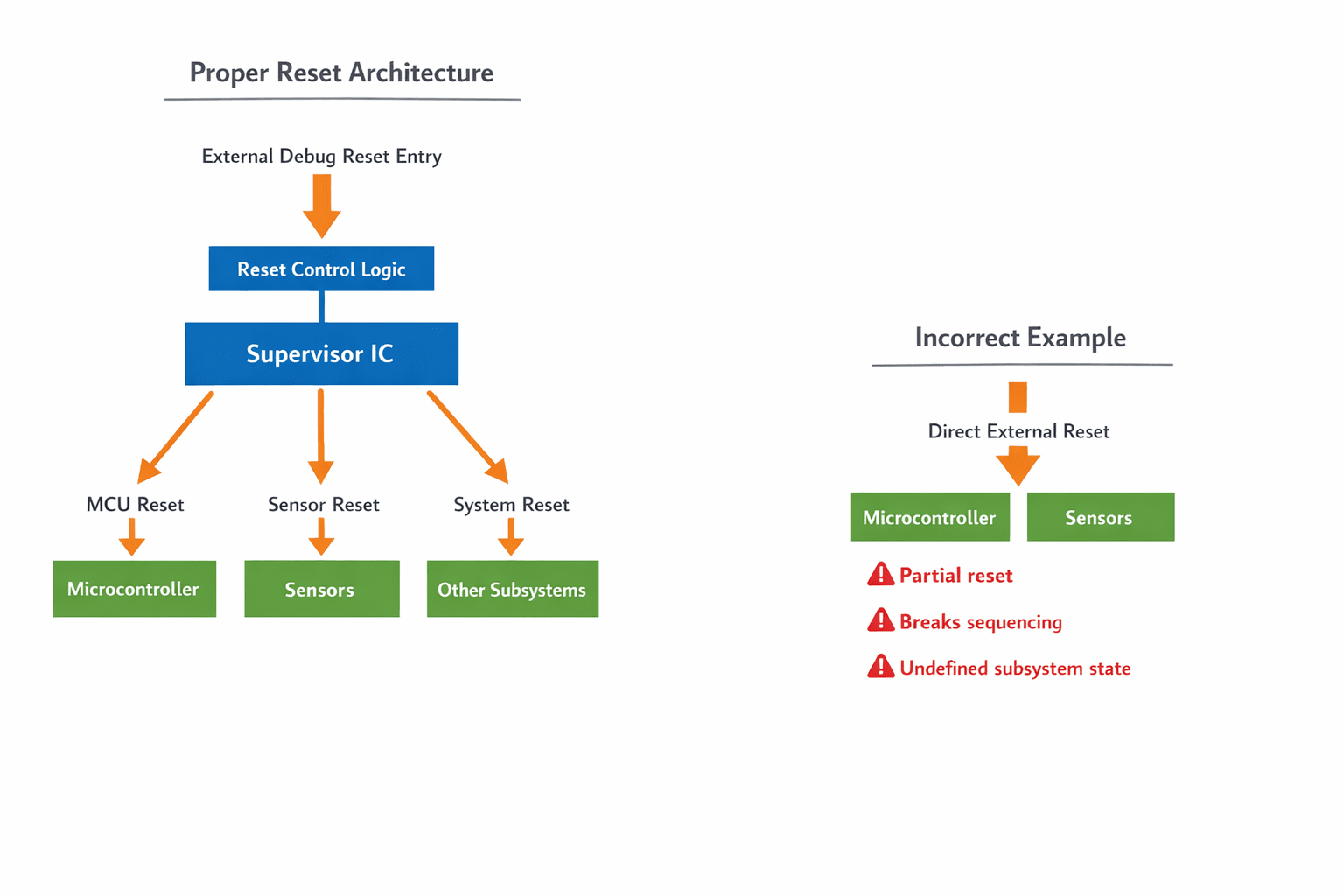
Reset access is another area that looks simple but becomes messy if handled carelessly. An external reset path can become a liability if it picks up noise, bypasses supervisor logic, causes partial resets, or leaves some subsystems active while others restart.
At Hoomanely, reset is designed as part of the full reset architecture, the reset hierarchy is defined first, external reset points are controlled, subsystem resets are separated where required, and supervisor behavior remains intact. A reset signal should return the system to a known state. If it creates a half-reset condition, it isn't helping.
Better observability is more valuable than raw control
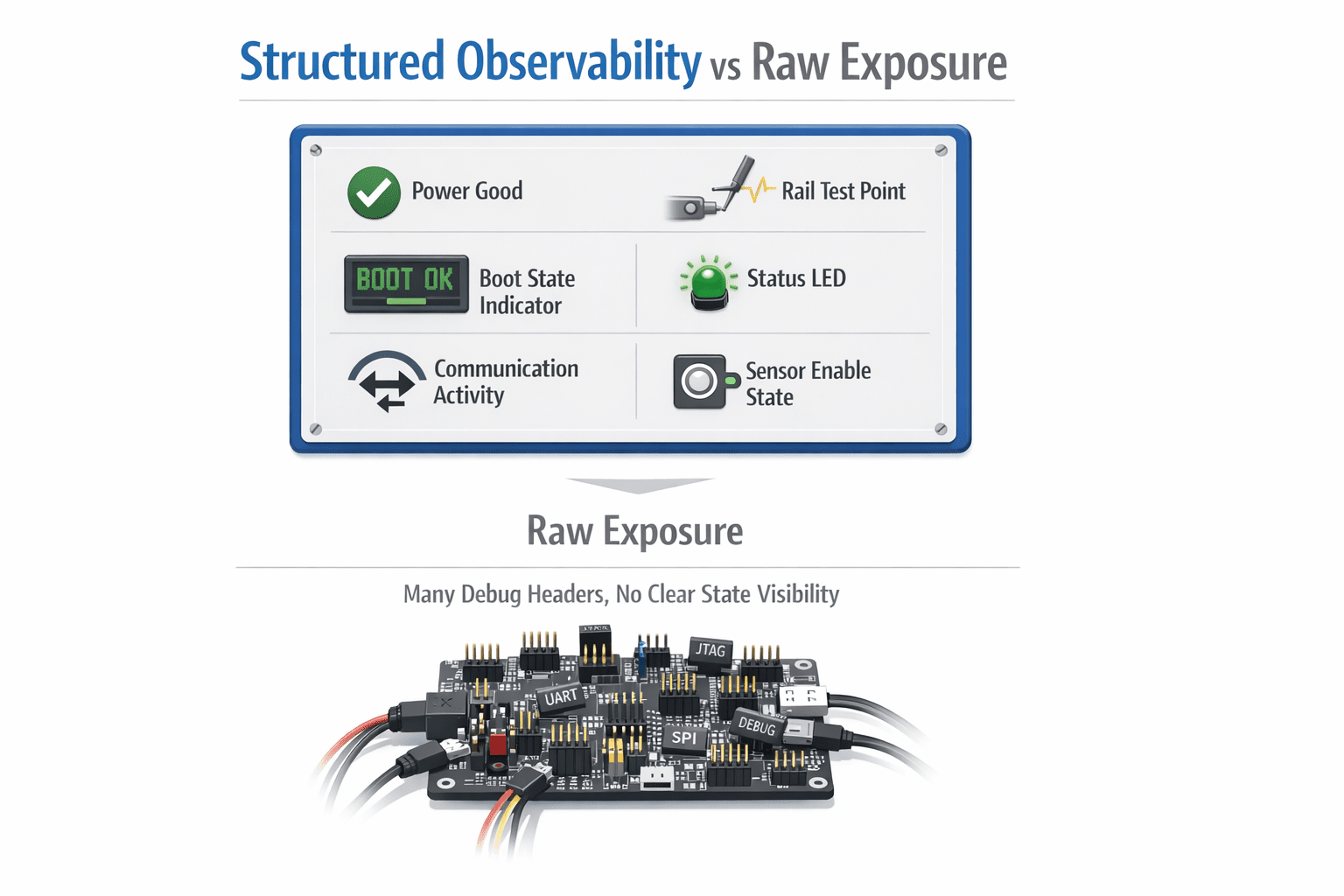
Many teams focus first on control, more straps, more headers, more override pins. But in real products, observability is often more useful than raw control. A board is easier to debug if it clearly tells you which rail is up, whether a subsystem is present, whether firmware reached a specific stage, whether reset occurred, whether a sensor rail is enabled, and whether communication is active.
Useful observability includes meaningful status LEDs, cleanly labeled rail test points, power-good visibility, known boot-state indicators, and deterministic programming points. A board that explains its own state needs less invasive troubleshooting, which improves both development speed and long-term maintainability.
Engineering debug and manufacturing debug should be different
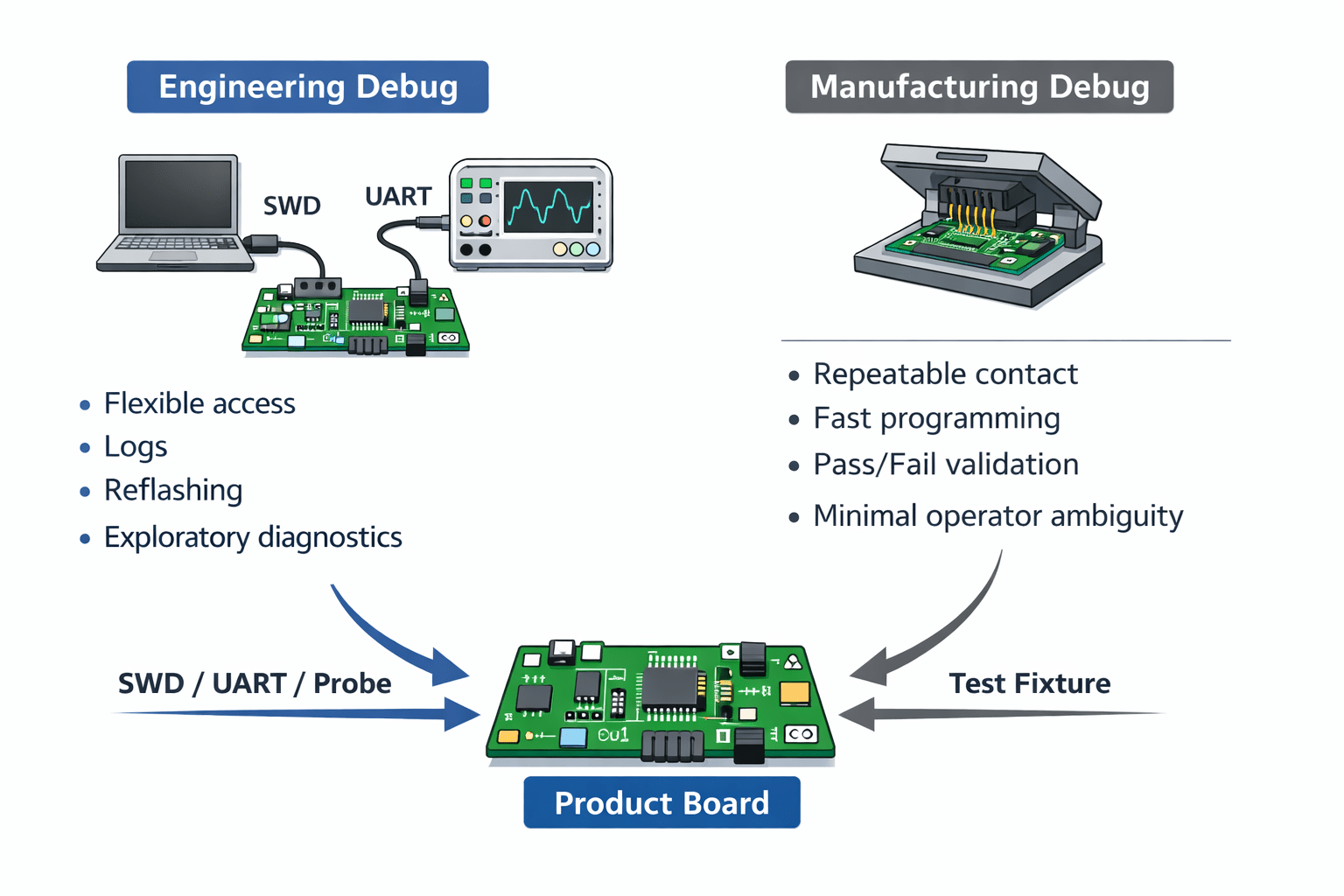
One mistake many boards make is trying to use the exact same debug pathway for both engineers and manufacturing. That sounds efficient, but usually creates friction. Engineering debug wants flexibility, reflashing, console access, exploratory access. Manufacturing wants fast, repeatable connection, fixture compatibility, simple programming flow, and clear pass/fail output. Those aren't the same needs.
So we separate those paths wherever possible:
- Engineering access for development
- Fixture-friendly access for production
- Narrower recovery access for service
That makes each workflow cleaner and reduces handling mistakes.
Service access should be narrow, not unlimited
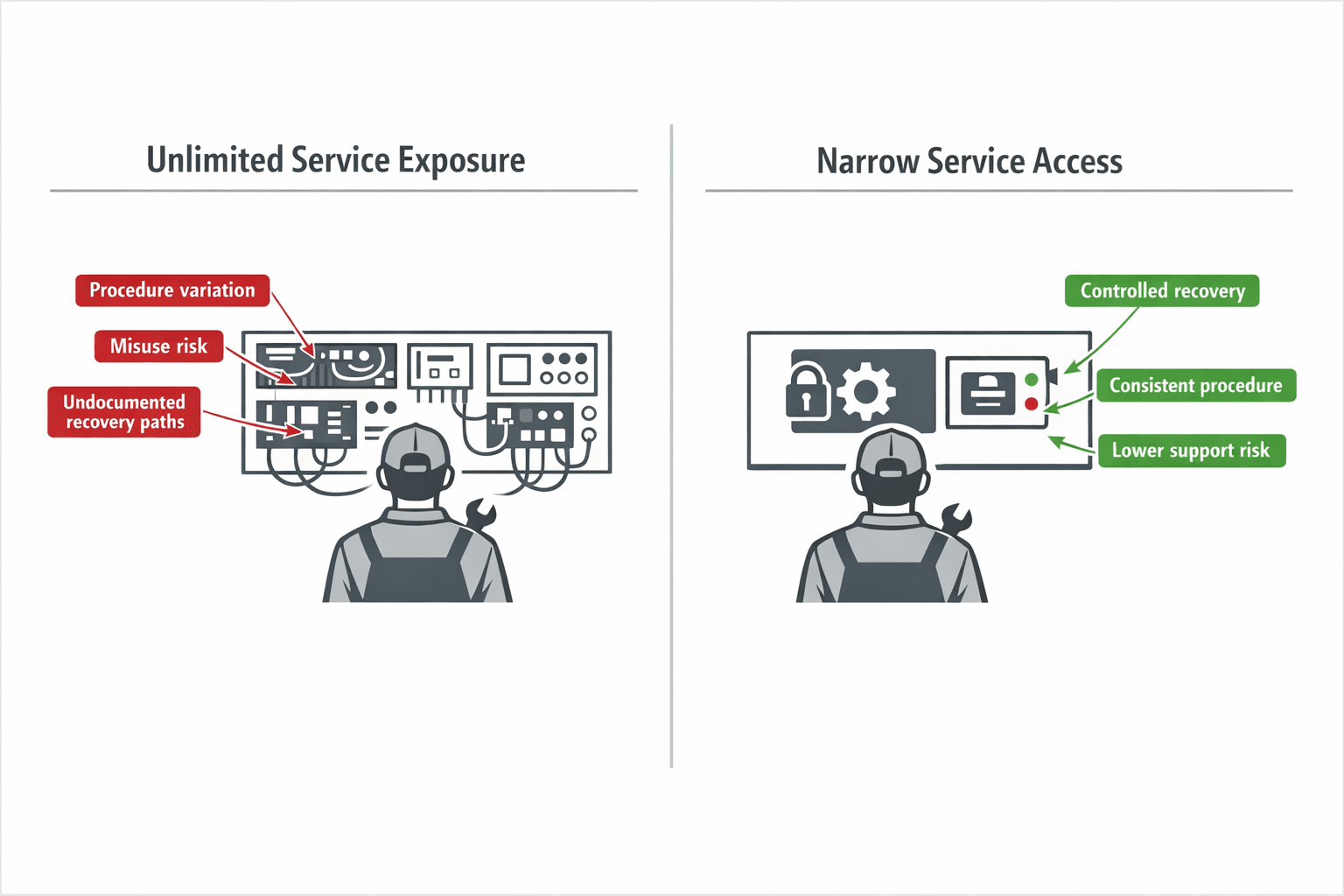
By the time a product reaches service, the need changes again. Service doesn't need every internal debug feature, it needs reliable diagnosis, controlled recovery, and low risk of causing new problems. This is where too much debug access becomes dangerous, if service can touch every low-level interface, procedures become inconsistent and error-prone.
A better service model is usually one defined recovery path, one trusted programming route, and one clear status method. That makes the product easier to support and less dependent on undocumented engineering knowledge. Good service access is not "everything exposed." It's "only what is needed."
Placement matters as much as the interface
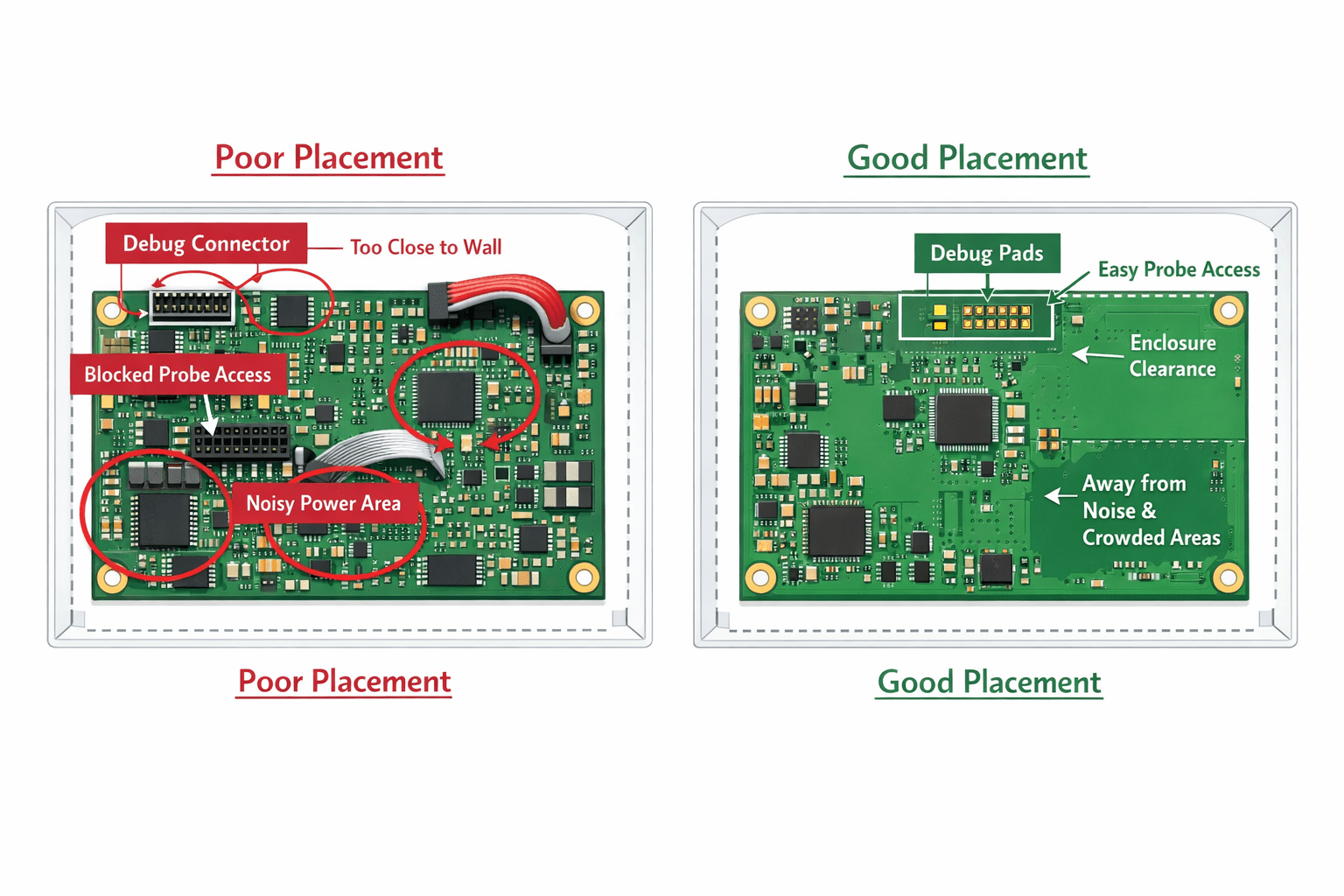
Even if the electrical design is correct, poor physical placement can still make debug access a liability. A badly placed connector or pad field can clash with enclosure walls, block other probes, complicate fixture contact, interfere with rework, or sit too close to power or noise sources. So debug placement must be planned as part of the whole board system, checking whether it can be accessed during bring-up without blocking measurements, used in fixtures repeatedly, kept out of the final user-facing experience, and left unpopulated without hurting the design.
What better debug architecture improves
When debug access is designed intentionally, the gains are practical:
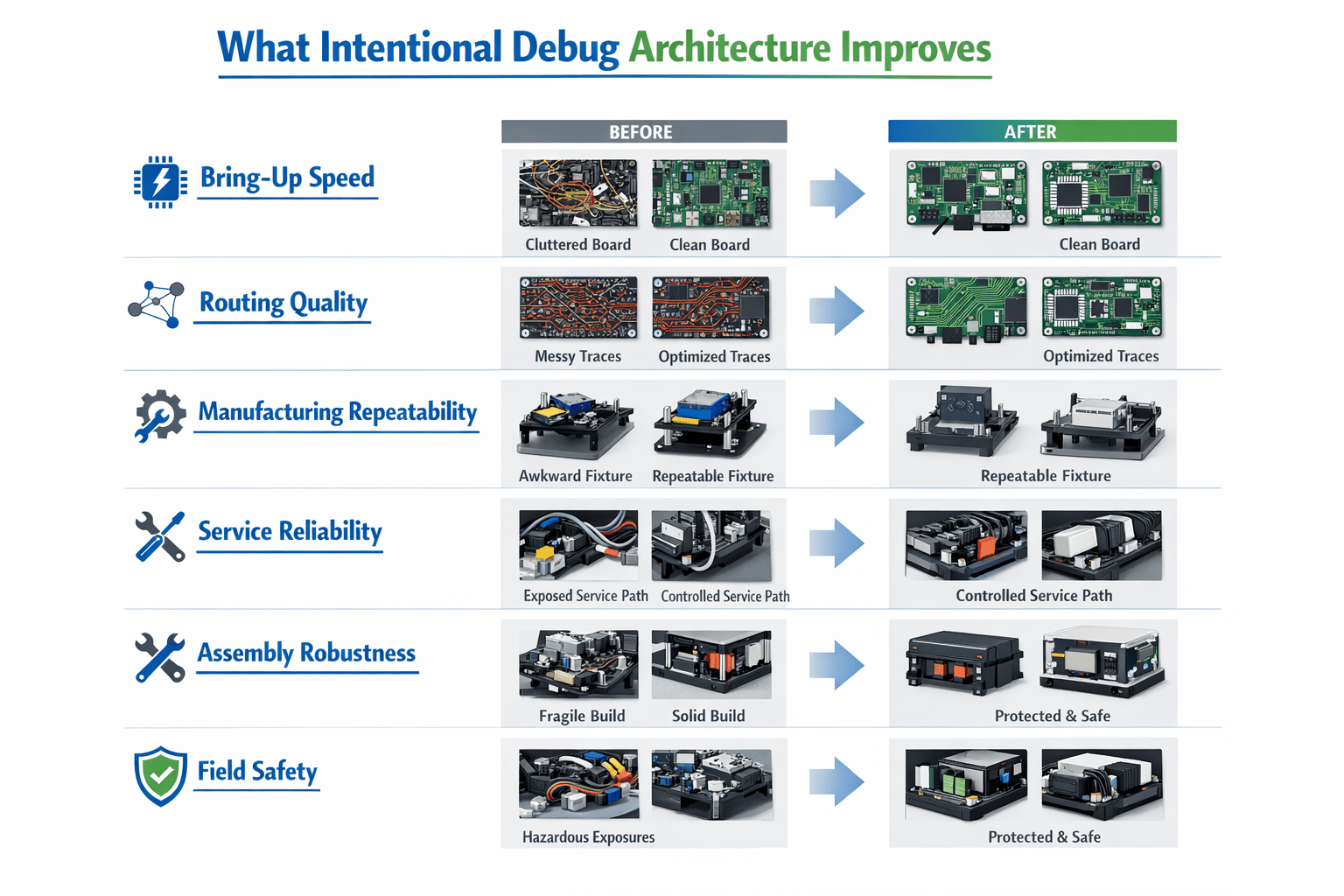
- Bring-up speed improves as the board becomes easier to initialize and recover
- Routing quality improves as functional nets stay cleaner
- Manufacturing repeatability improves as programming and validation become faster and more consistent
- Service reliability improves as recovery methods become controlled instead of improvised
- Assembly robustness improves as fewer unnecessary connectors reduce mechanical risk
- Field safety improves as the shipped product exposes fewer accidental entry points
The Hoomanely approach
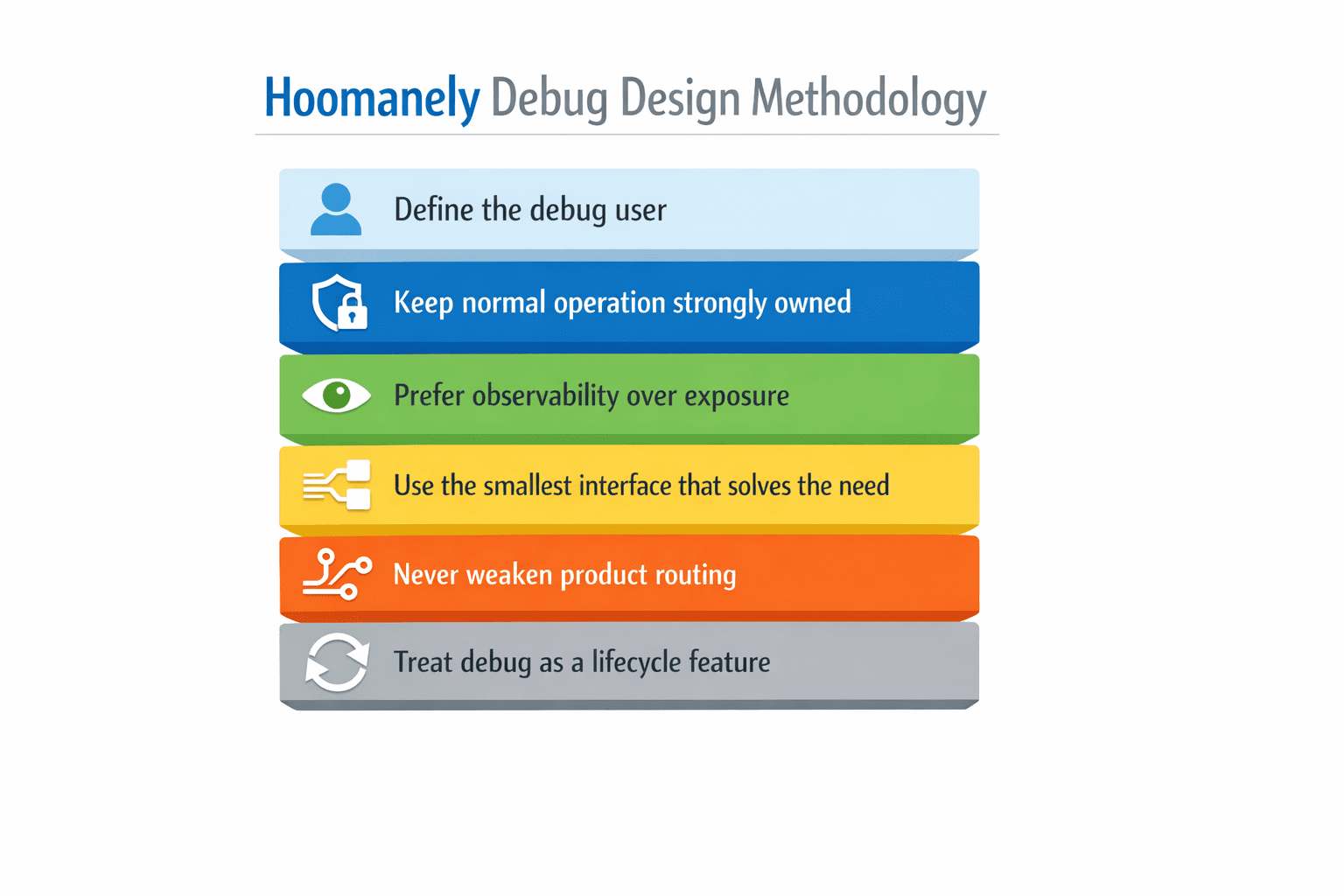
Our debug design methodology: define the user of the debug path, engineer, fixture, or service technician. Keep normal system behavior strongly owned, boot, reset, and power-up must remain deterministic. Prefer observability over excessive exposure, the board should explain itself clearly. Use the smallest interface that solves the real need, pads, fixture points, or compact headers only where justified. Never let debug routing weaken product routing, functional behavior always comes first. Treat debug as a lifecycle feature, not every debug path belongs in the final shipped product.
Final thought
Debug access is essential. But if it's designed casually, it slowly turns from a development advantage into a product liability. The right goal isn't to expose everything. The right goal is to make the board easy to debug, easy to manufacture, easy to service, and hard to misuse. That's the balance we aim for at Hoomanely. Because the best debug access isn't the one that gives unlimited control. It's the one that gives the right control, in the right place, at the right time, and then stays out of the way.