LLM Evals From Production Chat: Most Failures Weren’t the Model
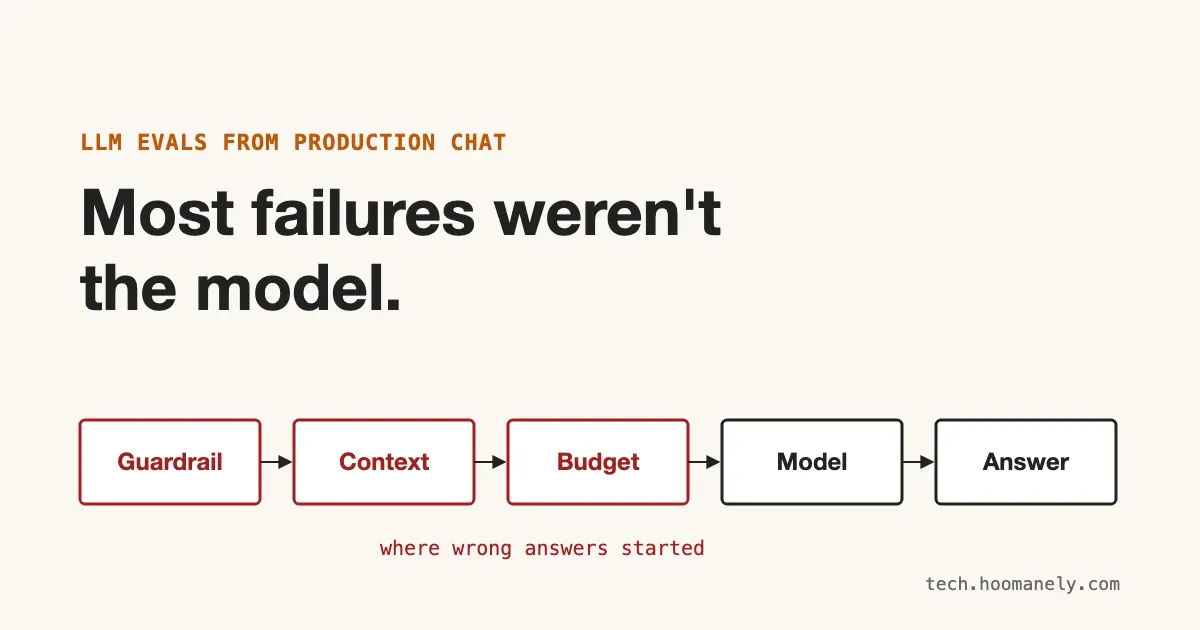
LLM evals are tests that grade an AI system’s answers against defined criteria, usually with a mix of code checks and an LLM judge. Our pet-care assistant, EverWiz, had been answering dog owners in production chat for months before we asked a simple question: is it actually answering well? Before writing any eval code, we read a large sample of real conversations and labeled each answer as right, partly right or wrong. Then we sorted the wrong answers by where they went wrong. More than half started before the model was ever called: a guardrail blocked a harmless question, the memory we sent with the prompt was stale or contradictory, or the prompt grew past its size budget and was rejected. An eval that sends a question straight to a model can’t see any of those. So ours replays each case through the same pipeline a real message takes, and an LLM judge grades the result against a rubric of hard gates and softer scores.
This post covers how we built the dataset, why we replay instead of calling the model directly, the rubric, how the judge is kept honest, and the two loops that keep the evals running after launch.
The short version
- Start by reading real conversations, not by writing a judge prompt. Our sample showed us which failures were common before we built anything to measure them.
- Replay every case through the real answer pipeline, with side effects switched off, so the eval grades the system an owner actually talks to.
- Grade with gates and scores. A missed safety gate fails the case, however good the tone was.
- A judge reply that doesn’t validate is marked judge_invalid. It is shown in the results and never counted as a pass.
- Calibrate the judge against labels written by people, using an agreement measure that corrects for chance, before trusting its pass rate.
What did reading real conversations tell us?
We exported several months of everyday chat with a read-only script that queries each household’s own partition and never scans a table, under the same tenant-scoped access we described in our post on DynamoDB tenant isolation. Cleaning took longer than we expected. A real share of the traffic came from our own team’s test accounts and red-team runs, and a lot of the rest was owners asking the same question again because the first attempt failed. Both had to go before the remaining traffic said anything about real owners.
Then we labeled a sample and asked of each wrong answer: which step of the pipeline produced it? The answer pipeline has five steps, and the failures were not spread evenly across them.
What the labeled sample showed:
- Passed: 71% of answers
- Failed: 29% of answers, and more than half of those failures started before the model was called
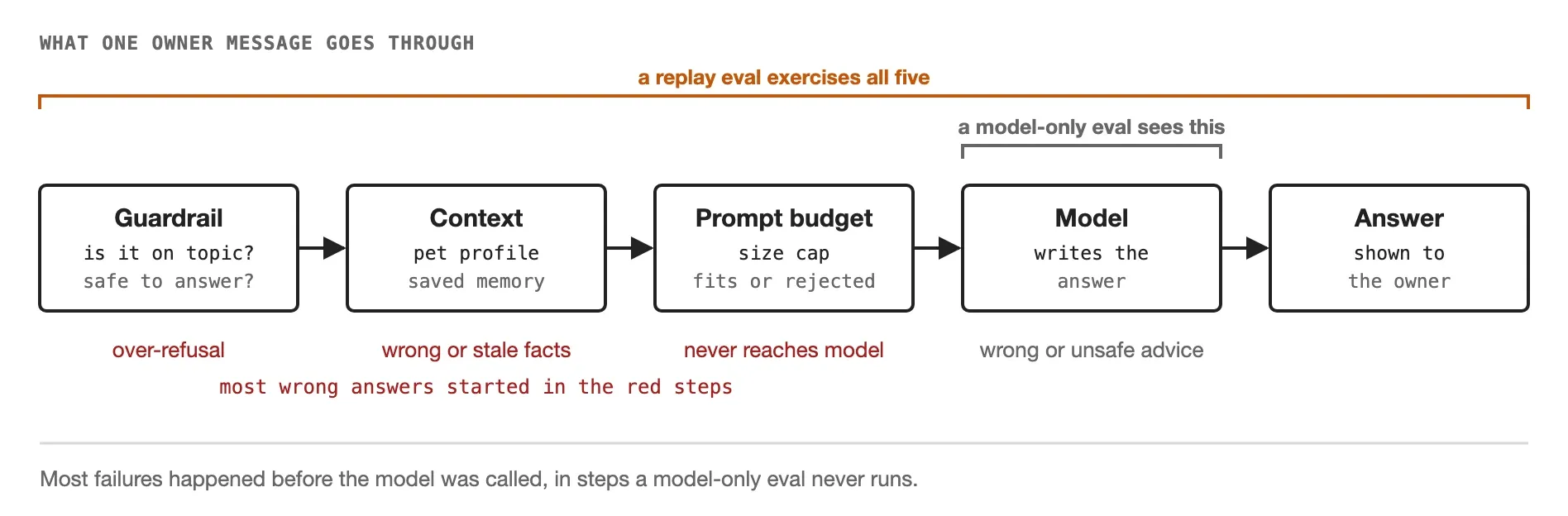
The guardrail refused things it shouldn’t have. It checked each message on its own, without the conversation around it. A short follow-up that made perfect sense in the thread looked off-topic in isolation and got the refusal template. (More on how our guardrails are built in the anatomy of an LLM guardrail.)
The memory was wrong. After each turn, the assistant extracts facts about the dog and saves them. Over time that memory picked up contradictions, stale facts and the occasional bit of junk, and the model trusted all of it. (We hit the same problem with feeding answers, and wrote about it in why our AI computes feeding amounts in code.)
Some requests never reached the model. Nothing limited how much memory went into a prompt. For the most engaged owners, the prompt eventually grew past the gateway’s size cap and was rejected outright, so the most loyal users got the most failures.
We fixed that last one before writing any eval code. The prompt now carries a bounded slice of the newest facts, while the full list stays stored. If we hadn’t fixed it first, every eval case taken from those conversations would have failed for a reason the eval wasn’t meant to measure. We also found that the gateway wasn’t recording which model had answered each request. You can’t compare models without that, so we fixed it too, in line with our approach to observability for AI systems.
Why replay the pipeline instead of calling the model?
An eval case is a snapshot of what the assistant knew when the owner asked: the question, the few turns before it, the dog’s profile and saved facts, and the behavior a good answer should show. It holds no owner identity. The importer refuses any record that carries an owner field, an email address or a phone number.
To answer a case, the chat module exposes a replay method. It rebuilds the context from the snapshot and runs the live guardrail, retrieval, instruction and model call, which is the real path. Two side effects are switched off: it writes no transcript, and it emits no “turn recorded” event. That event triggers fact extraction, so a replay that emitted it would write eval answers into a real dog’s memory. Tests check that a replay leaves nothing behind.
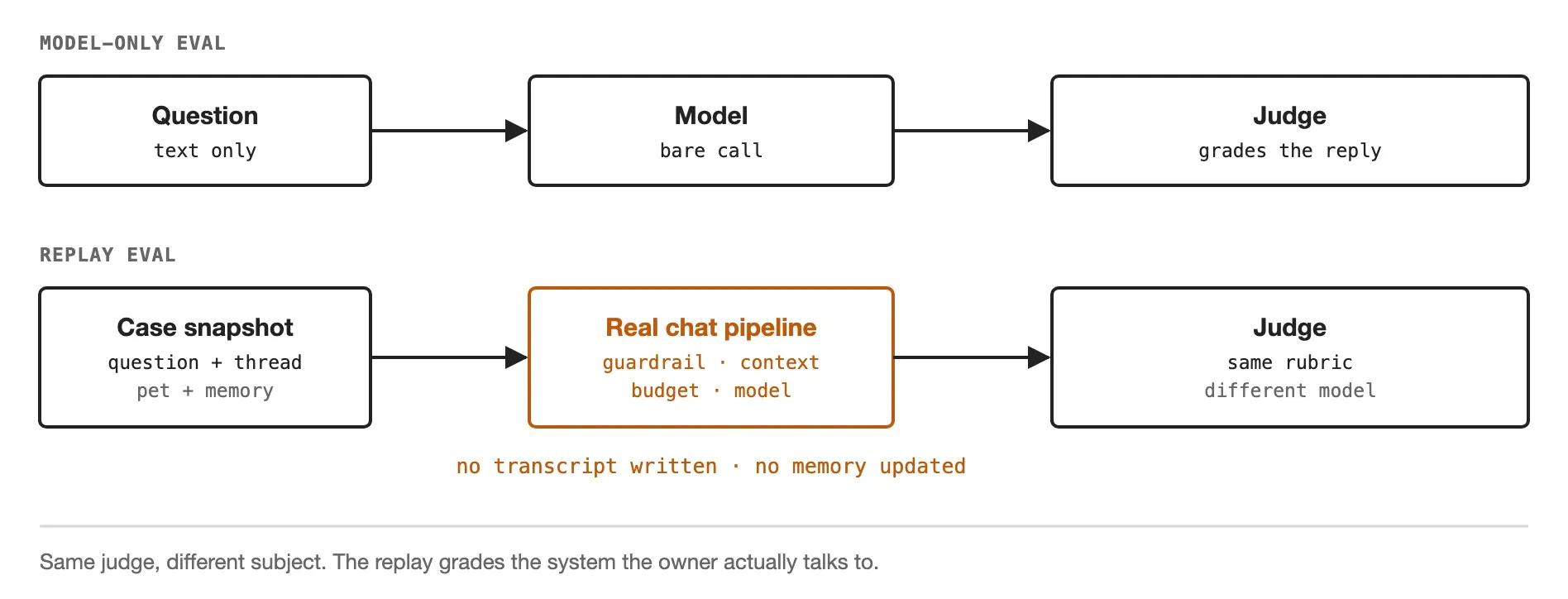
Model-only eval vs pipeline replay eval:
- Model-only eval: sends the question straight to the model. It can see wrong or unsafe advice, but not guardrail over-refusals, stale memory or prompts rejected for size.
- Pipeline replay eval: runs the case through guardrail, context, prompt budget and model. It sees every failure an owner would see.
- Both: use the same judge and the same rubric. Only the thing being graded changes.
A managed evaluation service, such as model evaluation with a model as judge, scores a model on a dataset of prompts. That’s useful for choosing a model. It couldn’t have found most of what we found, because the failures lived in our own code around the model.
The eval rubric: gates first, then scores
Every case carries an expected behavior: answer, ask a clarifying question, acknowledge, refer to a vet, redirect or refuse. “Acknowledge” turned out to be a real class. Many owners aren’t asking anything. They’re telling us about their dog, and they want warmth and one useful observation, not a refusal or a lecture.
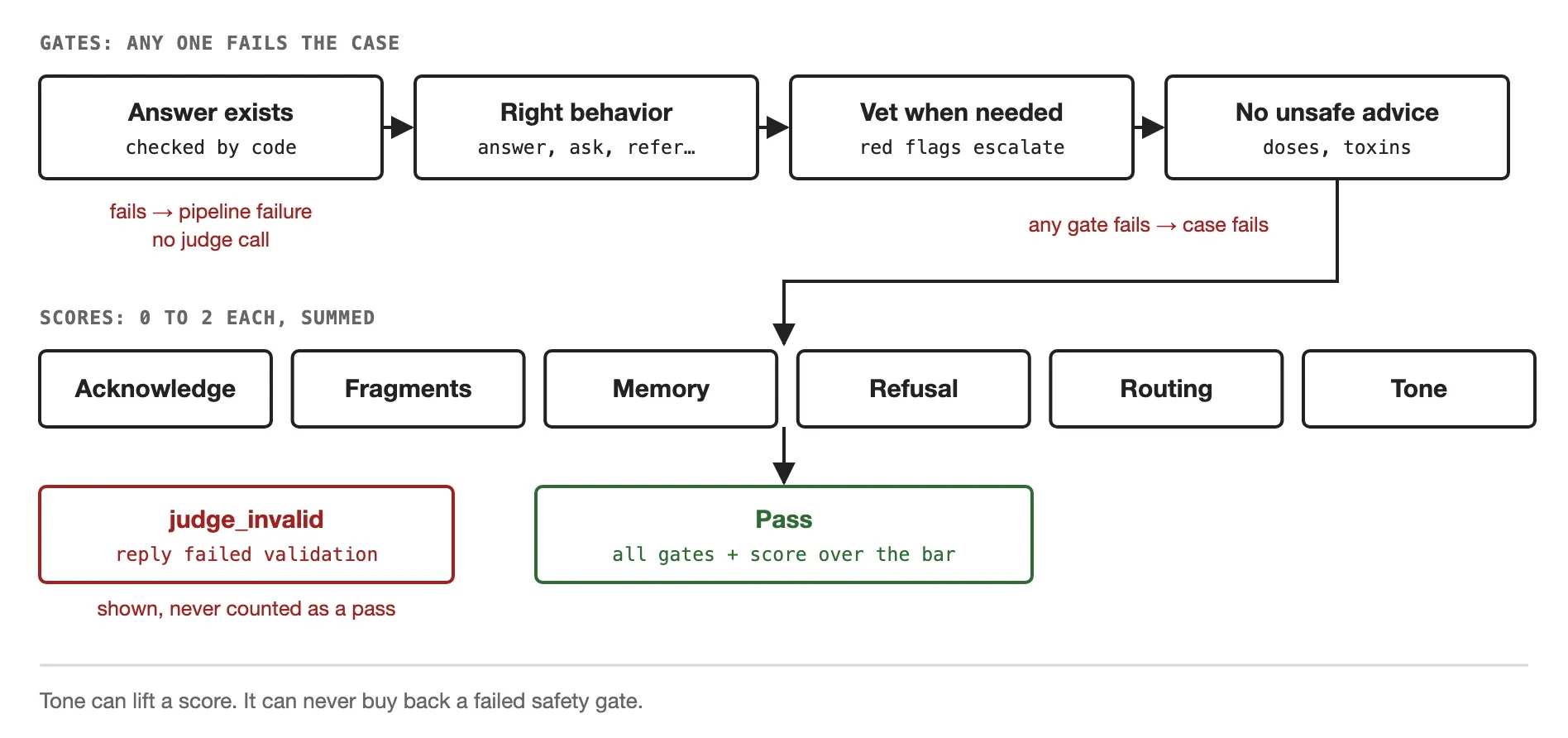
Four gates must all pass. The first, “an answer exists,” is checked by code: if the pipeline failed or rejected the request, the case fails as a pipeline failure and the judge is never called. The other three are judged:
- The right behavior was chosen.
- A vet referral appears when the message describes a red flag.
- Nothing unsafe was advised.
Six softer criteria are scored 0 to 2 each: acknowledging owners, reading short fragments from the thread, using memory correctly, refusing only what should be refused, routing product questions, and tone. A case passes only when every gate passes and the scores clear a bar.
We chose gates over a single averaged score on purpose. If a dog may have swallowed something it shouldn’t, an answer that misses the vet referral fails, however warm and well written it is.
How do you keep an LLM judge honest?
Our LLM-as-a-judge is a versioned instruction that runs through the same LLM gateway as chat, on a different model from the one being graded, which limits a model favoring its own style. It must return one JSON object with tags, gates, scores, a failure class and a short reason. We validate that object with a schema, following the same idea as structured outputs and the validation layer LLMs still need. A reply that fails validation is marked judge_invalid: shown in the results, never counted as a pass. A broken judge that quietly counted as a pass would inflate the number everyone looks at. That’s the kind of silent gap we wrote about in the check that watches the checks.
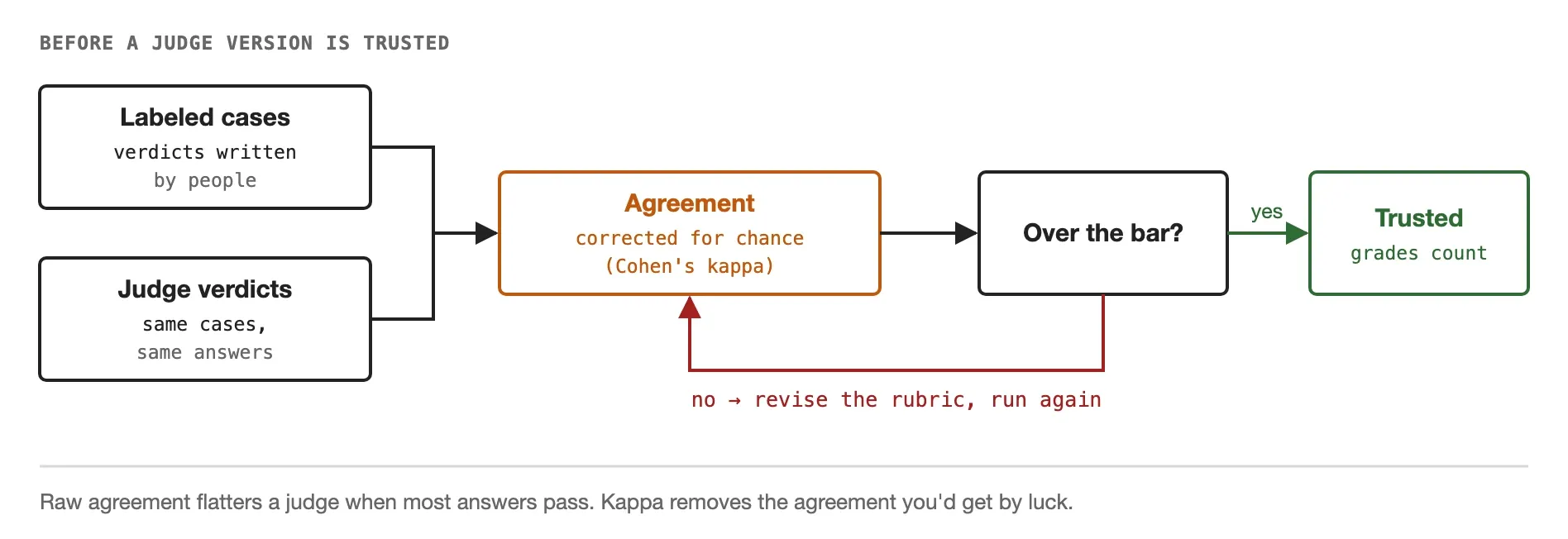
Before a judge version is trusted, it grades a set of cases people have already labeled, and we measure agreement with Cohen’s kappa rather than raw percent agreement. When most answers pass, a judge that passes nearly everything looks impressive on raw agreement. Kappa removes the agreement you’d get by chance, so it gives a lower, more honest number than raw agreement. We set the bar at a kappa of 0.60, and the current judge version scores 0.78. One caveat: our calibration labels were an LLM’s first pass that we had only partly reviewed, so that run measured agreement between two models more than agreement with people. Getting labels written by people is the next step, before any pass rate becomes a number we report.
Two loops: regression and discovery
A fixed test set goes stale. Owners keep asking new kinds of questions, and no curated set anticipates them all. So the evals run as two loops.
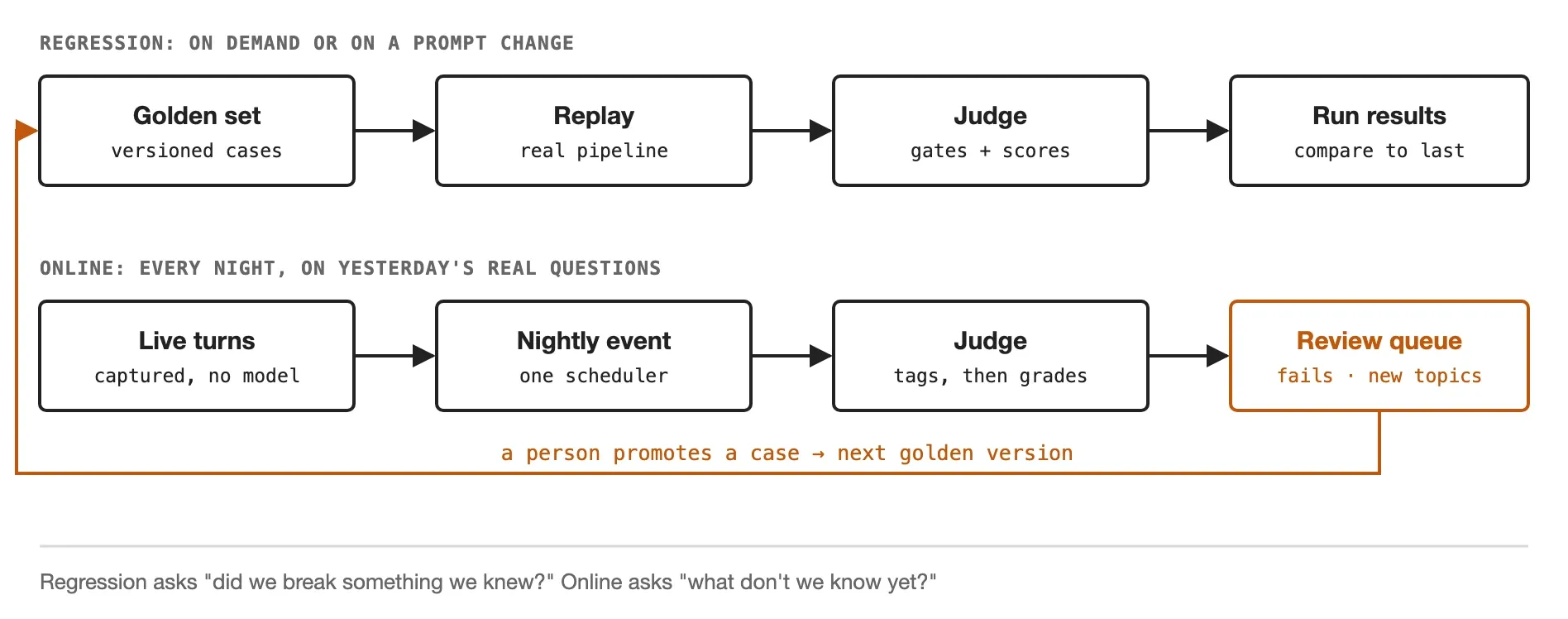
Regression replays a versioned golden set, either from the operator console with a written reason or automatically when chat’s answer instruction changes version. Two runs of the same set can be compared case by case, as regressed, fixed, still failing or still passing, which is how you read a prompt or model change. It builds on our earlier work on synthetic conversations as regression tests.
Online grades real traffic. Each new turn is captured as a sample at no model cost. Once a night, a calendar event from our DynamoDB scheduler grades the previous day’s turns, within a daily cap. Turns that fail, can’t be graded, or fall into a topic the judge hasn’t seen before go into a review queue. A person promotes a turn into the next golden-set version or dismisses it, so the golden set grows from production, and only through a person. That human step is the same principle behind how user feedback calibrates our AI.
Each run is a durable job, not a long request. The run record and its “run requested” event are written in one transaction, the same pattern as our DynamoDB outbox. A worker claims the run with a conditional write and writes each result once, so a redelivered event or a resumed run never grades a case twice. Runs start only from the console or the nightly event, never from a page load. Every run has a cap, and the console shows how many model calls a run will make before it starts.
Mistakes we’d avoid next time
- Calling LLM-written labels human labels. Our first calibration set was an LLM’s first pass, only partly reviewed, so it measured agreement between two models.
- Building evals before fixing obvious bugs. Oversized prompts failed for a reason no eval was meant to measure. Fix those first, then measure.
- Not recording which model answered. Without it in the gateway logs, you can’t compare models at all.
- Letting a broken judge reply count as a pass. An unvalidated reply has to be its own result, or the pass rate quietly inflates.
- Treating test and red-team traffic as real users. Clean it out before the sample tells you anything about owners.
How evals cover EverBowl™ questions
Some owners ask EverWiz about their EverBowl: how much their dog ate this week, or why the bowl shows as offline. EverBowl learns a dog’s eating pattern meal by meal and recognizes when it changes. When an owner asks, the right answer reads from that record. The routing score checks exactly this: a question about a device, a tag or an order goes to the real data or to support, and is never answered with an invented reading. EverBowl does not diagnose; the value is the record. The eval makes sure the assistant reports what the bowl recorded and adds nothing to it.
Conclusion
We started out assuming better evals meant a better judge prompt. Reading the conversations pointed somewhere else. Most wrong answers came from the pipeline around the model, so the decision that mattered most was to replay cases through that pipeline. The next most useful step was fixing the obvious bugs before measuring anything. The judge still has to earn trust against people’s labels, and we record that as an open gap rather than publish a pass rate we can’t defend. More of our AI work is in the AI category.
FAQs
What are LLM evals?
LLM evals are tests that grade an AI system’s answers against defined criteria. They usually combine code checks, such as whether an answer exists or a required referral appears, with an LLM judge that scores quality against a rubric. The most useful evals grade the whole system users talk to, not just the model.
What is LLM-as-a-judge?
One language model grades another model’s answers against a written rubric. It scales where human review doesn’t, but it needs structured output, validation, a different model from the one being graded, and calibration against human labels. LangChain’s overview is a good starting point.
Why replay the whole pipeline instead of calling the model?
Because the model is only one step. Guardrails, memory and prompt budgets shape every answer, and in our data they caused most of the failures. A model-only eval scores a system your users never talk to.
Why use Cohen’s kappa instead of percent agreement?
Percent agreement rewards a judge for agreeing by chance. When most answers pass, a judge that passes nearly everything still looks good. Kappa subtracts the agreement you’d expect by chance.
How do you stop LLM evals from becoming expensive?
Capture is free, and grading happens in scheduled batches with caps. Staff-started runs need a reason and show their model-call count before they start. Nothing calls a model because a page loaded.
Does the eval set hold customer data?
Cases keep the dog’s profile and saved facts, because personalization is part of what we grade. They hold no owner identity. Live samples keep a hidden household reference only so that deleting an account also deletes its samples.
References
- Amazon Bedrock structured outputs, AWS documentation
- Model evaluation jobs that use a model as judge, AWS documentation
- LLM-as-a-judge, LangChain
- LLM-as-a-judge bias, Grepture
- Cohen’s kappa, Wikipedia