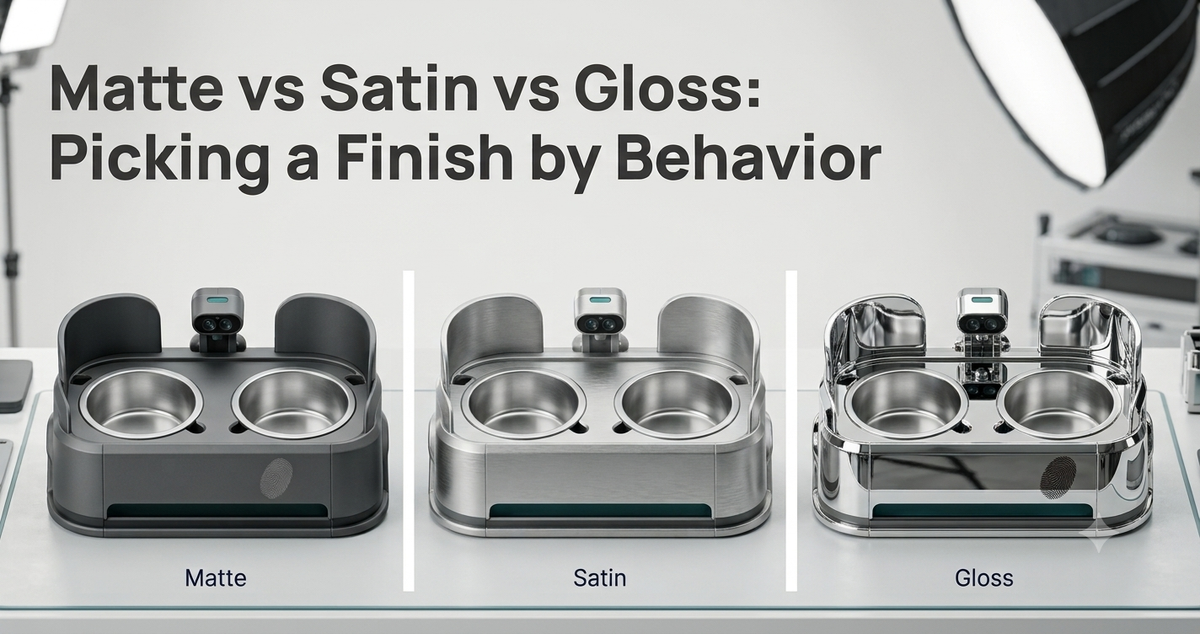
Matte vs Satin vs Gloss: Picking a Finish by Behavior
Matte, satin and gloss are three gloss bands, and each band behaves differently under fingers, scratches and light. Measured at 60 degrees, matte reads under 10 GU, satin reads about 10 to 40 GU, and gloss reads above 70 GU. In our illustrative bench set, a 500-cycle abrasion test moved gloss down by 33 GU and matte up by 5 GU, so wear pulls every finish toward the middle.
This post covers what a gloss unit measures, how each finish handles fingerprints, scratches and glare, and how we test wear on a part that gets touched, licked and washed daily. It ends with what this work lets EverBowl do.
The short version
- Gloss units (GU) measure specular reflection at 60 degrees, and the bands are under 10 for matte, about 10 to 40 for satin and above 70 for gloss.
- Smudges were visible from 50 cm on 11 of 12 gloss plaques, 6 of 12 satin plaques and 2 of 12 matte plaques.
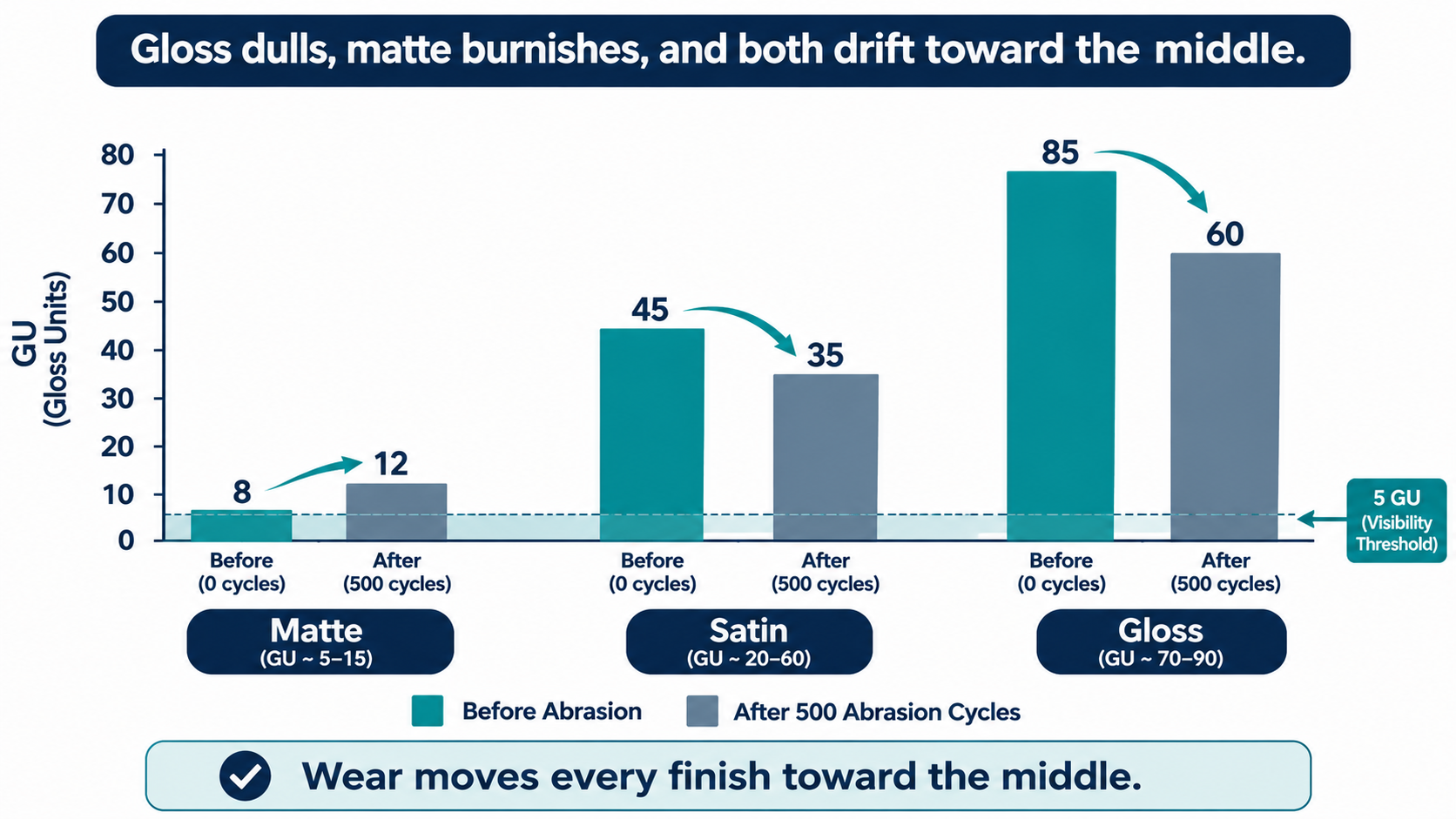
- After 500 abrasion cycles, gloss lost 33 GU, satin lost 8 GU and matte gained 5 GU.
- We treat a shift of more than 5 GU as visible wear, so we pick finish by zone and behavior, not by sample card.
What a gloss unit measures
A gloss meter shines light at a fixed angle and reads how much bounces off as a mirror reflection. The scale is set so a polished black glass standard reads 100 GU.
The angle changes with the finish. Use 60 degrees for most parts, 20 degrees when 60-degree readings pass 70 GU, and 85 degrees when they fall under 10 GU. ISO 2813 and ASTM D523 define these rules.
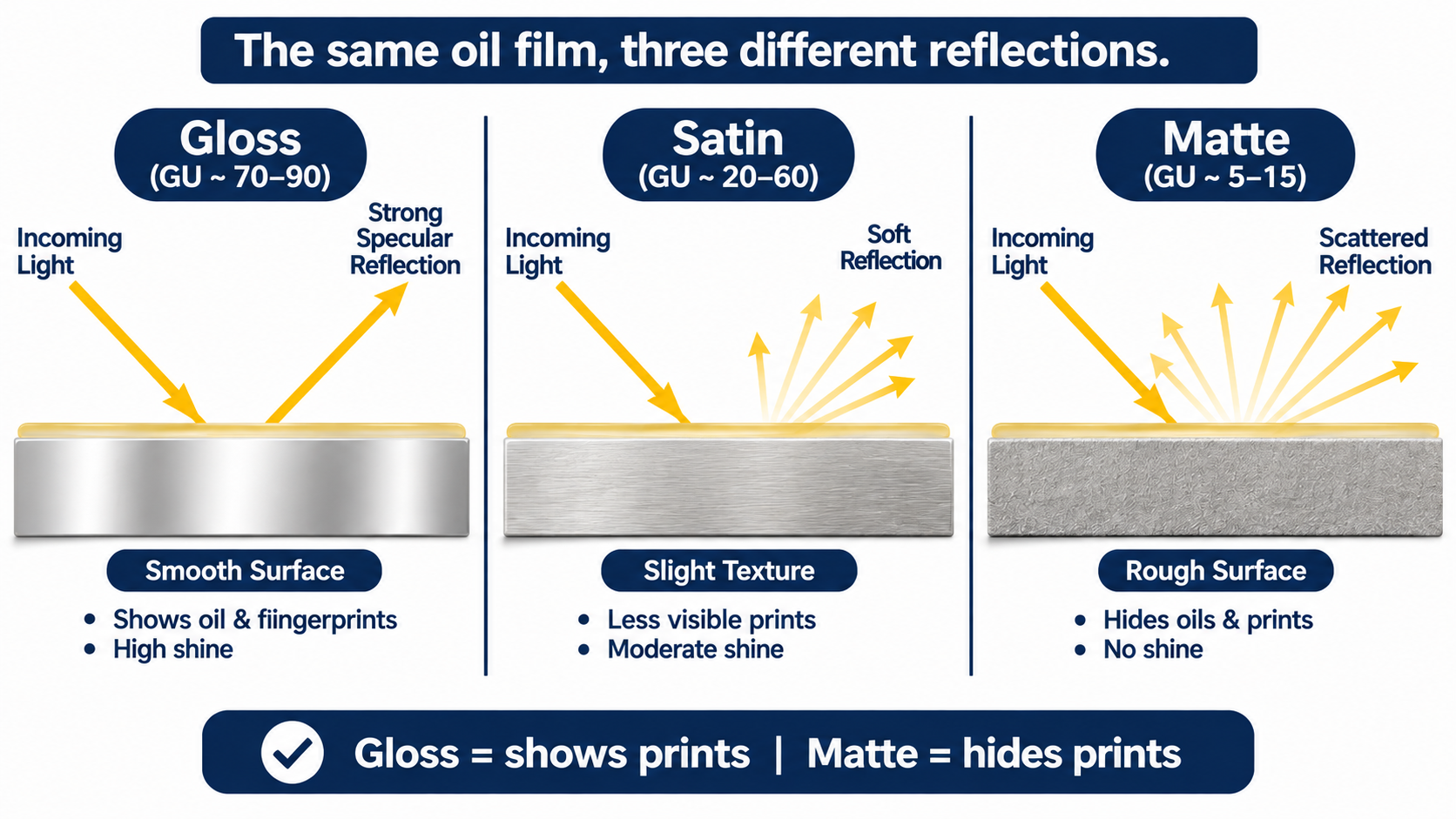
The mechanism is surface roughness. A smooth surface sends light out in one direction (specular). A rough surface scatters it in many directions (diffuse). Finish is a roughness choice that you read in GU.
What failed first
We first picked finishes from sample cards under showroom light. Cards are clean, flat and untouched.
A real bowl is handled with oily hands, licked, scratched by claws and scrubbed in the sink. The finish that looked best on the card was not the one that looked best after a month of that.
So we stopped asking which finish looks better. We started asking how each finish behaves.
Stage by stage: how each finish behaves
Behavior | Matte (under 10 GU) | Satin (about 10 to 40 GU) | Gloss (above 70 GU) |
|---|---|---|---|
Fingerprints | Hidden at first, oil darkens the texture | Hides well on mid tones | Shows every smear |
Scratches | Burnish into shiny streaks | Faint haze, easy to miss | Bright white lines |
Light | Diffuse, no hotspots | Soft sheen | Mirror glare and reflections |
Cleaning | Oil sits in the texture, slower wipe | Wipes clean in 2 passes | Wipes clean in 1 pass |
Wear direction | Gets shinier | Drifts a little | Gets duller |
Fingerprints
Gloss shows fingerprints because the oil film is smooth and flat. It reflects differently from the bare surface, so the print stands out.
Matte hides prints at first because texture breaks up the film. The catch is that oil settles into the texture and darkens that patch. On dark matte this reads as a grey smear that never fully wipes away.
Our illustrative panel: 12 plaques per finish, each touched once, then checked from 50 cm under room light. Smudges were visible on 11 of 12 gloss, 6 of 12 satin and 2 of 12 matte.
Engineering insight: Fingerprint visibility depends on color as well as GU. A light color on satin hides oil better than a dark color on the same finish.
Scratches
A scratch is a local change in roughness. That change reads differently on each finish.
On gloss, a scratch adds roughness to a smooth surface, so it scatters light and shows as a bright line. On matte, rubbing flattens the peaks of the texture, so the scratched area gets smoother and shinier than its surroundings.
This is why wear pulls finishes toward the middle. Gloss gets duller and matte gets shinier.
Gloss Shift (GU) = GU after wear − GU before wear
Illustrative numbers (hypothetical): after 500 abrasion cycles, gloss went from 85 to 52 GU (a shift of −33), satin from 25 to 17 GU (−8) and matte from 4 to 9 GU (+5). We treat a shift of more than 5 GU as visible wear.
Light and glare
Gloss reflects the room. A window or ceiling light shows up as a hotspot on the part, and the hotspot moves as you walk past.
Matte spreads light evenly, so the part looks the same from any angle. Satin sits in between, with a soft sheen that adds depth without a hard reflection.
Glare also matters for anything with a camera nearby. A bright reflection near a lens can wash out the frame.
How we test finish behavior
One look at a fresh sample tells you very little. We use four steps.
Step 1: Measure fresh GU
Measure each plaque at 60 degrees, using 20 or 85 degrees where the rules above call for it. Take three readings per plaque on a flat area. Record the average.
Step 2: Run a touch panel
Touch each plaque once with a clean finger. Check from 50 cm under normal room light. Record how many plaques show a visible smudge.
Step 3: Abrade
Run a fixed number of abrasion cycles, 500 in our set, with the same pad and load on every plaque. Keep the pad and load identical across finishes so the comparison is fair.
Step 4: Re-measure and wash
Measure GU again, then wash the plaques and measure once more. Wear shows up in the first shift, and the wash tells you how much of the smudging was only surface oil.
Picking finish by zone
Each part of the product has a different job, so each gets a different behavior.
- Surfaces touched daily: pick satin or fine matte to hide prints and show wear slowly.
- Surfaces that get scrubbed: pick the finish that wipes clean in the fewest passes, which is usually satin or smoother.
- Surfaces near the camera: pick low gloss so the lens does not see stray reflections.
- Surfaces meant to look premium: use gloss sparingly and only where it is not touched.
For EverBowl, the stored finish specs follow this logic: the bowl at VDI 0 to 12, the lens bezel at SPI A1 to A2, the housing in a Mold-Tech texture and the wand at VDI 18 to 24. Smoother textures go where wiping matters, and coarser ones go where hands land.
What this lets EverBowl do
Pet parents will touch, wash and handle EverBowl™ every day. Choosing finish by behavior keeps the surfaces looking consistent and the area around the camera free of stray glare. That helps EverBowl recognize which pet is at the bowl, one frame at a time.
The honest limit: our numbers come from bench plaques, not from bowls aged in real homes over months. We will report field results once we have them.
EverBowl does not diagnose; the value is the record.
Conclusion
Pick a finish by how it will be touched, scratched, lit and cleaned, then check it with GU before and after wear. Test on a plaque from the same tool as the final part. Revisit the choice once field units show real wear.
More of our mechanical design work is in the product category page for this series.
FAQs
What is a gloss unit?
A gloss unit (GU) is the reading from a gloss meter. It compares the light reflected as a mirror image against a polished black glass standard that reads 100 GU. Higher numbers mean a shinier surface.
Which finish hides fingerprints best?
Satin usually hides prints best on mid and light colors. Matte hides them at first, but oil can darken the texture. Gloss shows them most.
Does matte scratch less than gloss?
Matte shows scratches less, but it does not resist them better. Rubbing burnishes the texture and leaves shiny streaks. Gloss shows the same damage as bright lines.
Which finish is easiest to clean?
Smoother surfaces wipe clean faster because oil has no texture to sit in. In our illustrative set, gloss cleaned in 1 pass, satin in 2 and matte in 4.
How do you measure gloss on a curved part?
A gloss meter needs a flat area at least as large as its footprint. Mold a flat plaque from the same tool and finish, and measure that instead.
Which measurement angle should I use?
Use 60 degrees first. Switch to 20 degrees if the reading is above 70 GU, and to 85 degrees if it is below 10 GU.
References
- ISO 2813, paints and varnishes, specular gloss at 20, 60 and 85 degrees
- ASTM D523, standard test method for specular gloss
- VDI 3400 texture reference with Ra values
- SPI mold finish standards