Protection by Design: Engineering Reliability Into Every vBus Module
Introduction: Reliability as a Design Standard
At Hoomanely, we design consumer products for real-world home and office environments—where power adapters vary in quality, USB cables get swapped between devices, and static electricity from carpets is an everyday occurrence. Our vBus modular architecture thrives in these conditions through deliberate design philosophy: comprehensive protection circuits are mandatory, not optional.
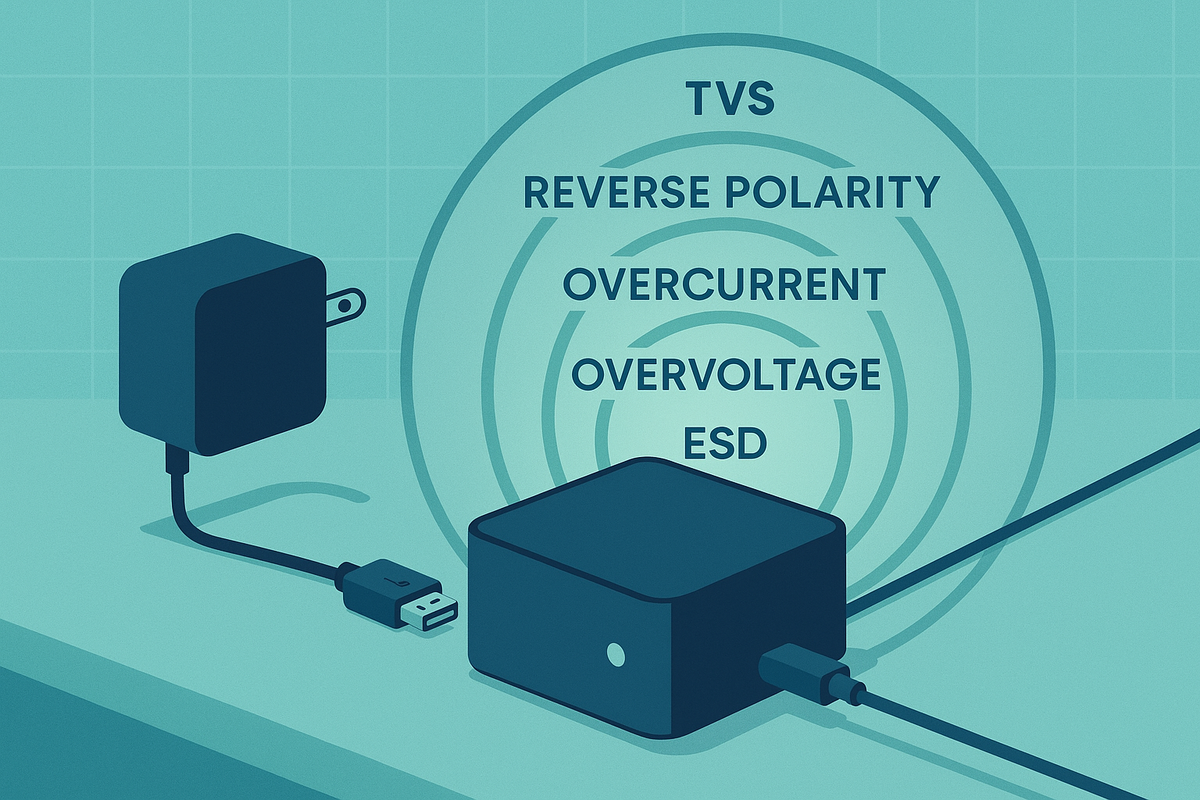
We treat safety and protection as a design policy rather than a checklist. Every SoM, every carrier board, every product that carries the Hoomanely name includes a standardized suite of protection circuits that guard against the most common electrical threats: transient voltage spikes, reverse polarity connections, overcurrent conditions, overvoltage scenarios, and electrostatic discharge.
This isn't defensive engineering—it's proactive design that ensures our products operate reliably with diverse power adapters, in various indoor environments, and through typical consumer usage patterns. Today, I want to share the protection architecture that's become standard across our vBus ecosystem.
Transient Voltage Suppression: The First Line of Defense
TVS Diodes on Critical Interfaces
Transient voltage events—brief, high-energy voltage spikes—occur in everyday consumer electronics. Power adapters switching off, USB hotplugging, and coupled noise from adjacent devices all generate transients that can damage sensitive electronics.
Our Standard Implementation:
External Interface Protection: Every connection point that leaves a module receives TVS diode protection. USB ports, communication connectors, and sensor inputs all include dedicated TVS diodes rated for the specific voltage and energy levels of that interface.
vBus Connector Protection: Communication lines on vBus connectors—particularly CAN_H, CAN_L, and differential signal pairs—include bidirectional TVS diodes. These devices clamp voltage excursions above safe levels, shunting transient energy to ground before it reaches sensitive transceivers or processors.
Power Supply Protection: Input power lines incorporate TVS diodes that protect against transients from switching power adapters—common in consumer electronics where multiple devices share power strips.
Component Selection Criteria:
- Clamping voltage: Below the absolute maximum rating of protected ICs (typically 10-20% margin)
- Peak pulse power: Adequate for expected transient energy (commonly 400W to 600W for signal lines)
- Capacitance: Low enough to avoid signal degradation on high-speed interfaces like USB
- Response time: Sub-nanosecond for effective protection against fast transients
Strategic Placement
TVS diode effectiveness depends heavily on placement. We position them immediately adjacent to connector pins—before any traces route signals into the circuit. This minimizes the impedance path between the transient source and the protection device, ensuring the TVS diode absorbs energy before it propagates into sensitive circuitry.
Polarity Protection: Foolproof Power Connections
Reverse Voltage Protection Architecture
Power supply connections are inherently vulnerable to human error—users might connect generic power adapters with swapped polarity, or damaged USB cables create unexpected voltage paths. Our polarity protection ensures these scenarios don't result in damaged hardware.
P-Channel MOSFET Protection:
Our preferred implementation uses a P-channel MOSFET in the high-side power path with its body diode reverse-biased:
VIN+ → [P-MOSFET Source-Drain] → Protected VIN
Gate tied to Ground through resistor
Operation: When voltage is applied correctly (positive on source), the MOSFET conducts with minimal voltage drop (typically 50-150mV at rated current). When voltage is reversed, the body diode is reverse-biased and blocks current flow, preventing damage.
Advantages:
- Low forward voltage drop (preserves power efficiency)
- No continuous power dissipation (unlike series diode protection)
- Handles rated current without heating
- Automatically resets when correct polarity is applied
Schottky Diode Alternative: For lower-power interfaces or cost-sensitive designs, we use series Schottky diodes for polarity protection. While they dissipate more power than MOSFETs, their simplicity and reliability make them ideal for secondary power inputs or peripheral connections.
vBus Connector Polarity Management
The vBus architecture itself provides inherent polarity protection through intelligent pin allocation: power pins and ground pins are physically separated on the connector, making reverse insertion mechanically impossible for keyed connectors. For non-keyed connectors, we implement the MOSFET protection scheme on each SoM's power input stage.
Overcurrent Protection: Guarding Against Short Circuits
Active Current Limiting
Overcurrent events occur when load impedance drops below expected values—short circuits in damaged USB cables, failed components, or accidental contact with conductive materials. Without protection, excessive current can overheat traces, damage connectors, or create safety hazards.
Our Implementation Strategies:
Electronic Fuses (eFuses): Modern overcurrent protection uses dedicated ICs that monitor load current and disconnect power when thresholds are exceeded. Unlike traditional fuses that must be physically replaced, eFuses automatically reset after the fault clears.
Key Features:
- Programmable current limit (set via external resistor)
- Fast response time (microseconds to milliseconds)
- Retry logic (automatic reconnection after fault clears)
- Fault indication output (signals processor that overcurrent occurred)
- Low on-resistance (minimal voltage drop during normal operation)
Power Distribution Switches: For individual subsystem control, we use high-side power switches with integrated current limiting. Each peripheral SoM or power domain has its own protected supply, preventing a fault in one module from affecting others.
Current Sensing: Critical power rails include dedicated current sense amplifiers that continuously monitor consumption. These feed into the system processor, enabling:
- Real-time power budgeting and management
- Predictive fault detection (gradually increasing current suggests degradation)
- Usage analytics (power profiling for optimization)
- Fault diagnostics (which rail exceeded limits?)
vBus Power Distribution Protection
The vBus Power SoM implements multi-channel overcurrent protection, with independent current limiting on each voltage rail (5V, 3.3V, 1.8V). If a connected SoM develops a short circuit, only that module's power is disconnected—the rest of the system continues operating.
Overvoltage Protection: Input Voltage Range Management
Voltage Clamping and Regulation
Input voltage can exceed specifications due to power adapter faults, mis-configured bench supplies during development, or using incorrect power adapters. Overvoltage protection prevents damage when input voltage strays beyond acceptable limits.
Zener Diode Clamping: Simple overvoltage protection uses Zener diodes (or TVS diodes operated in breakdown region) across the power rail. When voltage exceeds the Zener breakdown voltage, the device conducts and clamps the voltage. Series resistance limits current, and local capacitance absorbs energy.
Voltage Supervisor ICs: More sophisticated protection uses dedicated voltage monitoring ICs that compare input voltage against precision references. When overvoltage is detected, they:
- Assert a reset signal to the processor
- Disable downstream DC-DC converters
- Generate fault indication for system logging
Overvoltage Lockout (OVLO): Many modern regulators include built-in OVLO that prevents operation when input voltage exceeds safe limits. We select components with appropriate OVLO thresholds for consumer power adapter ranges (typically 5V USB or 12V barrel jack inputs).
Wide Input Range Regulators
Where possible, we design power supplies with reasonable input voltage tolerance (e.g., 4.5V-5.5V for USB, 9V-15V for 12V barrel jack systems). This margin accommodates power adapter variation without triggering protection circuits, improving system robustness and user experience.
Undervoltage Protection and Brown-Out Handling
Power-Good Monitoring
Undervoltage conditions—where voltage drops below minimum operating specifications—occur with low-quality power adapters or when multiple high-current devices share a power source. Processors operating below specified voltage may execute instructions incorrectly, corrupting memory or configuration data.
Implementation:
Voltage Supervisors: Dedicated ICs monitor each critical power rail against precision voltage references. When voltage drops below threshold (typically set 5-10% below nominal), the supervisor:
- Asserts a reset signal, holding the processor in reset state
- Prevents execution during undervoltage conditions
- Automatically releases reset when voltage recovers to safe levels
Hysteresis: Voltage supervisors include hysteresis (typically 50-100mV) to prevent oscillation when voltage hovers near the threshold. The release threshold is slightly higher than the assertion threshold, ensuring clean transitions.
Power-Good Sequencing: In multi-rail systems, power-good signals from each regulator chain together, ensuring downstream regulators don't start until upstream supplies are stable. This prevents undervoltage conditions during power-up sequencing.
ESD Protection: Human Interface Hardening
Electrostatic Discharge Immunity
Any user-accessible interface—buttons, connectors, USB ports, touchpoints—requires ESD protection to handle static discharge events. Human body ESD can reach 8-15kV in low-humidity environments, common in heated homes during winter or air-conditioned offices.
Protection Strategies:
Dedicated ESD Diode Arrays: Multi-channel ESD protection ICs placed at connector pins. These devices have ultra-low capacitance (preserving signal integrity on high-speed USB interfaces) and fast response times (sub-nanosecond) to shunt ESD energy to ground.
TVS Diodes: Serve dual purpose—transient voltage suppression and ESD protection. Selected devices meet IEC 61000-4-2 ESD immunity requirements (±8kV contact discharge for consumer electronics).
PCB Layout Considerations: ESD protection effectiveness depends on layout—wide, low-impedance ground connections from ESD devices to ground plane, protection devices placed immediately at connector pins before any signal routing, and ground plane continuity under connectors.
USB Interface Protection
USB ports are particularly vulnerable to ESD since users frequently plug and unplug cables. Our standard USB protection includes:
- Dedicated USB ESD protection ICs (protecting D+, D-, VBUS, and GND)
- Low capacitance (< 3pF) to maintain USB 2.0 High-Speed signal integrity
- Integration with TVS diodes for combined ESD and overvoltage protection
Standardized Protection Across vBus Modules
Module-Specific Protection Standards
Each vBus SoM category has tailored protection requirements:
CPU SoMs:
- Input power: Polarity protection (P-MOSFET), overvoltage clamping, overcurrent limiting
- USB interfaces: Dedicated USB ESD protection ICs
- Communication interfaces: TVS diodes on all exposed signals
- Debug ports: ESD protection on programming interfaces
- I2C/SPI/UART: Low-capacitance TVS diodes
Power SoMs:
- Input supply: TVS diodes for adapter transient protection
- Output rails: Overcurrent protection per channel, short-circuit shutdown
- Enable signals: Transient-immune control inputs
- Thermal protection: Overtemperature shutdown on regulators
Peripheral SoMs:
- Sensor interfaces: TVS protection on analog inputs, ESD diodes on digital interfaces
- vBus connector: Full protection suite (polarity, overvoltage, overcurrent)
- External connectors: Application-specific protection for user-accessible ports
Communication SoMs:
- USB: Integrated USB protection ICs with data line ESD protection
- WiFi/Bluetooth: TVS diodes on antenna connections
- Wired communication: TVS protection on exposed signal lines
Design Review Integration
Protection circuits are mandatory checklist items in our design review process:
✓ All external interfaces have TVS or ESD protection
✓ Power inputs include polarity protection
✓ Each power rail has overcurrent limiting
✓ Voltage supervisors monitor critical rails
✓ USB ports have dedicated ESD protection ICs
✓ Protection device ratings verified for consumer electronics standards
✓ Layout follows best practices (short ground connections, proximity to pins)
Testing and Validation
Protection Circuit Verification
Every design undergoes protection circuit validation during development:
Reverse Polarity Test: Apply reverse voltage to input—verify no damage and correct operation when polarity is corrected.
Overvoltage Stress: Apply voltage 20% above maximum rating—verify protection circuits activate and system survives.
ESD Testing: IEC 61000-4-2 compliance testing on all user-accessible points—contact discharge testing per consumer electronics standards (±4kV to ±8kV).
Short Circuit Test: Force short circuit on power outputs—verify current limiting engages and system recovers when fault is cleared.
USB Hotplug Testing: Repeated USB connection/disconnection cycles under various conditions to verify interface protection robustness.
These tests validate that protection circuits function as designed and that systems meet applicable consumer electronics safety and immunity standards.
Real-World Protection Scenarios
Common Consumer Use Cases Protected
Mixed Power Adapters: Users often substitute power adapters from other devices. Our wide input range and overvoltage protection handle variations in adapter output voltage.
USB Port Overload: Connecting high-current USB devices or damaged cables triggers overcurrent protection, protecting both the product and the connected device.
Static Discharge: Winter conditions create high ESD potential. Touching USB connectors or buttons after walking on carpet generates discharge events that our ESD protection handles seamlessly.
Cable Damage: Worn or damaged cables can create intermittent shorts or voltage irregularities. Protection circuits detect and respond to these conditions automatically.
Hot-Swapping Modules: vBus modularity encourages module swapping during development and even in some deployed configurations. Protection circuits handle the inrush currents and transients associated with hot-plug events.
Conclusion: Defense in Depth for Consumer Reliability
Our protection circuit policy reflects a fundamental design philosophy: consumer products must handle real-world usage patterns gracefully. Every vBus module incorporates multiple layers of protection—polarity, transient, overcurrent, overvoltage, undervoltage, and ESD—creating defense in depth that ensures reliable operation in diverse home and office environments.
This protection strategy enables the confidence to support modular designs where users can connect and reconfigure systems without fear of damage. It protects against the inevitable variations in power adapter quality, cable condition, and environmental factors that characterize consumer electronics deployment.
The modest cost of protection circuits—typically adding just a few dollars to module BOM—pays dividends through reduced support costs, enhanced product longevity, and customer confidence in system robustness. As our vBus ecosystem expands into new consumer applications, our protection circuit standards evolve with it, but the core principle remains constant: protection by design, not as an afterthought.