Running a Design Freeze Without Killing Momentum
How our "Stage 2.5" design freeze helped eliminate scope creep while keeping Everbowl moving toward production.
Introduction
Every hardware team eventually has to answer a hard question: are we done designing? The temptation is always one more improvement. A bracket that could be a little stronger. A PCB that could be rearranged. A cleaner cable route. One more firmware feature. Each of those ideas is usually good on its own, but stack enough of them up and a product never actually leaves the design phase.
We ran into this directly on Everbowl. As the prototype matured, the improvements got smaller but came more often. None of them looked like a big deal by itself, but together they delayed manufacturing decisions, threw off supplier timelines, and made assembly planning harder to pin down.
Instead of calling a traditional design freeze, we introduced something we started calling Stage 2.5 internally: a controlled handoff between engineering and manufacturing. The point wasn't to stop change. It was to make sure every remaining change actually earned its cost. That let us keep engineering moving without letting it eat the production schedule.
Why design freeze often fails
In a lot of hardware projects, design freeze gets treated like a finish line. CAD files get released, drawings get finalized, and the assumption is that nothing changes after that.
That's rarely how it actually goes. Once physical prototypes exist, engineers keep finding things worth improving: easier assembly, better cable routing, cleaner aesthetics, better manufacturability, fewer parts.
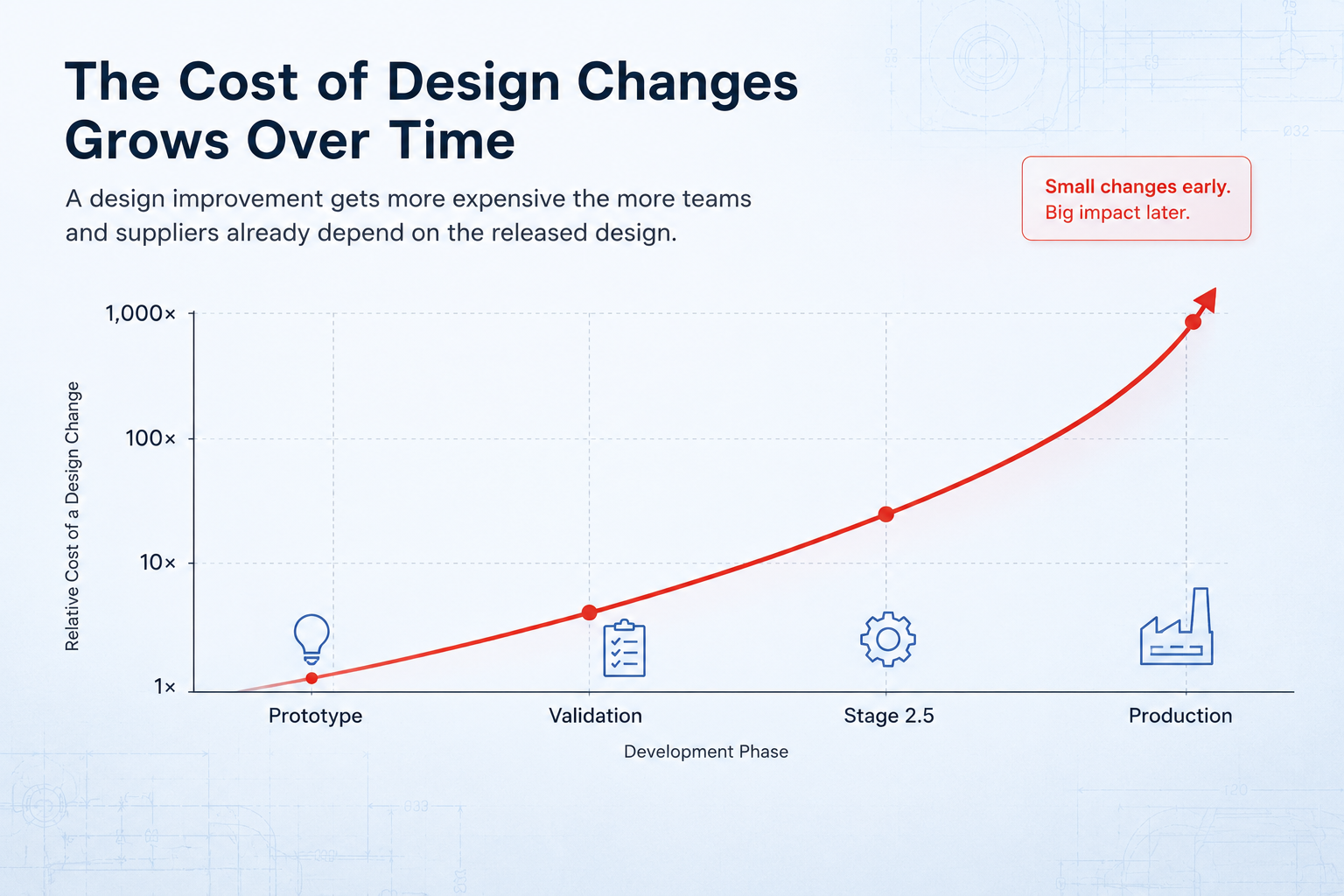
None of those improvements are the problem. The problem is that a late-stage change never stays contained to the CAD model. Relocating one hole can mean new machining drawings, updated laser-cut profiles, modified PCB clearances, revised assembly instructions, and new inspection dimensions. Late changes get expensive fast because they ripple through everything downstream of them.
Introducing Stage 2.5
Instead of treating design freeze as one binary event, we split it into a phase of its own: Stage 2.5. The idea was simple, freeze the architecture before freezing the details.
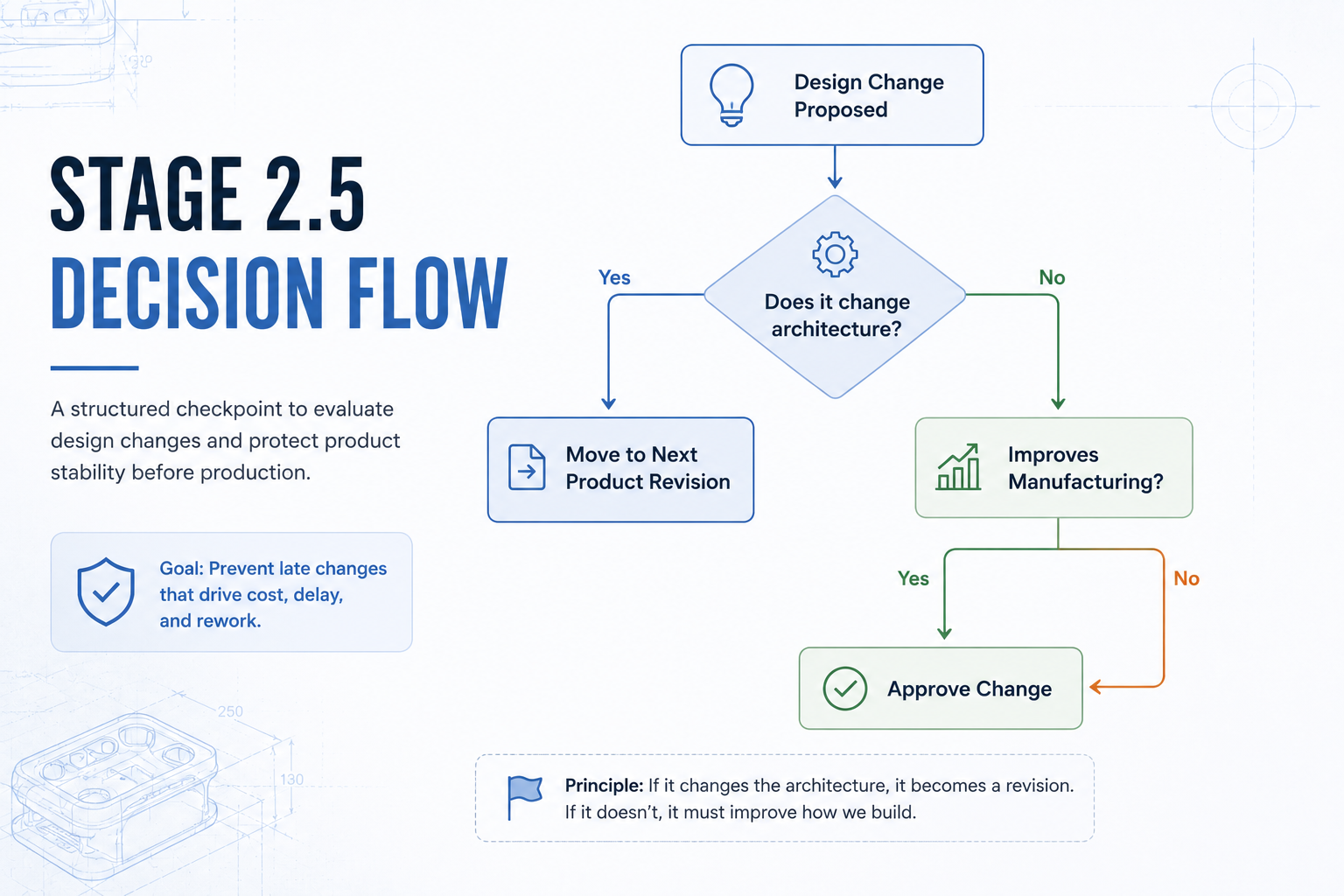
During this phase, the overall mechanical architecture stayed fixed, sensor locations were locked, PCB dimensions couldn't move, manufacturing processes were finalized, and supplier drawings went out. We still allowed limited changes, but only ones that reduced assembly effort, improved reliability, didn't touch interfacing components, and needed no tooling changes.
That distinction turned out to matter a lot. Stage 2.5 didn't stop engineering. It redirected it toward optimizing what already existed instead of reinventing it.
What we froze first
The mechanical architecture came first: aluminum ring geometry, load cell placement, fastener layout, overall enclosure dimensions, internal PCB mounting strategy. These touched nearly every other subsystem, and changing any of them later would have cascaded across mechanical, electrical, and firmware work all at once.
We locked the manufacturing approach at the same time: vacuum casting for the production plastics, laser-cut aluminum rings, threaded inserts, surface finishing, paint process, assembly sequence. Changing any of those later would have invalidated most of the process validation we'd already done.
What we still allowed to change
Not every improvement needed a redesign. Small chamfers that made assembly easier, label positioning, fastener torque specs, paint masking improvements, cable tie locations, and assembly documentation all kept evolving through Stage 2.5.
The pattern there is worth noticing: these changes improved manufacturing without touching the product's architecture. Keeping that line clear is what let the team stay productive while the schedule stayed protected.
Engineering insight: A design freeze that works doesn't stop engineering. It changes what kind of engineering happens. The question stops being "what should we redesign?" and becomes "how do we build this the same way every time?"
Measuring scope creep
One benefit of Stage 2.5 we didn't expect was how much it clarified the conversation. Instead of arguing about changes on gut feel, every proposed change had to answer three questions: what problem does it solve, what downstream work does it create, and is the benefit actually bigger than the delay.
A lot of ideas that sounded good on first pass got pushed to the next product revision once we ran them through that filter, because the improvement was marginal but the documentation and validation cost wasn't. That's what kept features from quietly piling up near the end of development.
The impact on team momentum
The usual worry with any design freeze is that it slows engineering down. That's not what happened here. Once the architecture stopped moving, mechanical engineers shifted to manufacturability, electrical engineers focused on testing, firmware engineers worked on calibration and diagnostics, manufacturing started writing work instructions, and quality started building inspection methods.
Instead of every discipline reacting to the last design change, they were all working in parallel on the same stable product, and that made a real difference to how fast things moved.
Here's roughly how it played out:
| Metric | Before Stage 2.5 | After Stage 2.5 |
|---|---|---|
| Major architectural changes | Frequent | 0 |
| Average decision cycle | ~5 days | ~2 days |
| Late-stage redesign requests | High | Reduced by ~75% |
| Schedule adherence | Variable | >95% milestone completion |
| Documentation revisions | Frequent | Minimal |
These numbers describe our own project, not an industry benchmark. The real win wasn't just fewer changes. It was being able to trust that the released documentation would still be accurate next week.
Stage 2.5 changed how we thought about progress
Early on, progress meant adding features. Later, it meant removing uncertainty. A stable design let us finally answer questions that constant redesign kept postponing: can this be assembled the same way every time? Are the tolerances actually repeatable? Can suppliers produce identical parts run after run? Can any technician build a unit the same way as the last one?
Those questions, more than any new feature, are what decide whether a prototype turns into an actual product.
How this shows up at Hoomanely
Building Everbowl taught us that product maturity comes from disciplined decision-making, not from iterating forever. Stage 2.5 let us stabilize the architecture while manufacturing, assembly, and validation kept improving underneath it. Separating architectural changes from production refinements cut unnecessary redesign, protected our timeline, and kept every hour of engineering work pointed at shipping rather than back toward redesign.
Key takeaways
- A design freeze should stabilize architecture, not stop engineering.
- Late-stage changes get expensive because they touch multiple disciplines at once.
- Stage 2.5 gave us a structured transition between engineering and manufacturing.
- Refinements to assembly or reliability were still welcome, as long as they didn't touch the core architecture.
- A stable design lets engineering, manufacturing, and quality work in parallel instead of in sequence.
- Cutting scope creep improves schedule adherence without costing you product quality.
Conclusion
A common misconception in product development is that a design freeze ends engineering. It doesn't. It just changes what engineering is for. Stage 2.5 gave us the confidence to stop redesigning Everbowl and start refining how it would actually get built, assembled, and validated. Protecting the architecture while still allowing real production improvements kept momentum up without letting scope creep back in.
Shipping something reliable was never about making every possible improvement. It was about knowing which improvements belonged in this version, and which ones could wait for the next one.