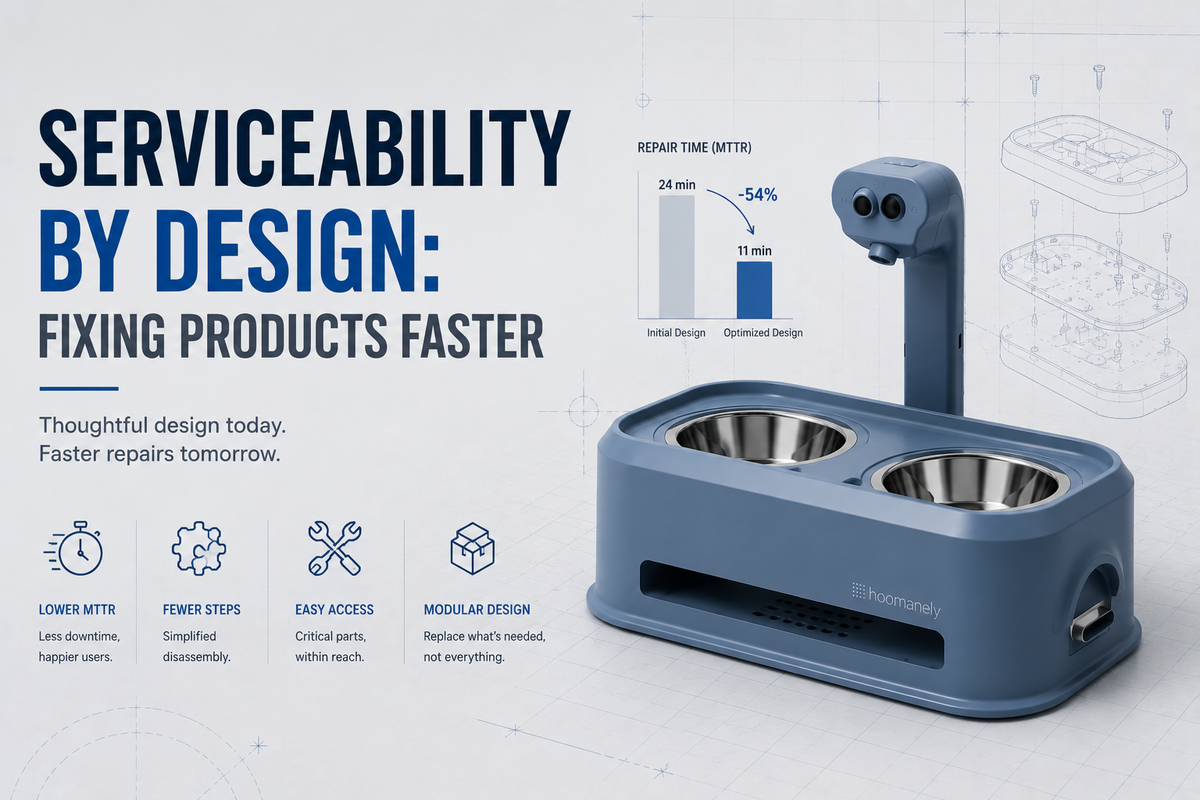
Serviceability by Design: Fixing Products Faster
How thoughtful design reduced repair time, simplified maintenance, and improved the ownership experience.
Introduction
Most hardware gets designed around one question: how do we assemble this? A much smaller number of products get designed around the equally important question of how do we take it apart.
For consumer products, serviceability tends to be an afterthought. Components get packed in tight, cables end up buried, screws hide where you don't expect them, and replacing one failed part can mean tearing down most of the product to get to it.
None of that looks like a big deal on a single unit. But once a product is out in the field, every extra screw, every hidden connector, and every unnecessary step in the teardown adds directly to repair time, labor cost, and how long a customer is without their product.
Working on Everbowl, we realized designing for service wasn't just about making repairs faster. It was about designing something that could stay reliable across its whole life, not just its first assembly. Good serviceability doesn't happen by accident. Someone has to design for it on purpose.
Designing beyond assembly
Early prototypes were all about getting things to fit: giving sensors room, protecting the electronics, keeping wiring out of sight, keeping the enclosure looking clean. As the product matured, a different question started mattering more: if a component fails two years from now, how fast can someone actually replace it?
That answer was already locked in by decisions we'd made months earlier, whether we'd thought about it at the time or not.
Why serviceability matters
Every extra minute spent on a repair costs someone. For the customer, it's more downtime, more frustration, and a higher repair bill. For us, it's higher warranty spend, more technician time, more logistics overhead, and lower service throughput overall. Even shaving five minutes off a single repair adds up fast once you're talking about hundreds or thousands of units.
Designing for access
The simplest way to cut repair time is to make things easier to reach in the first place. Instead of burying the parts that fail most often under layer after layer of assembly, we put frequently serviced components where a technician can get to them directly: electronics behind a removable cover, connectors that are actually accessible, cable routing you can follow with your eyes, sensor assemblies that come out as a unit. Once a product is in production, being easy to reach usually matters more than being compact.
Reduce disassembly steps
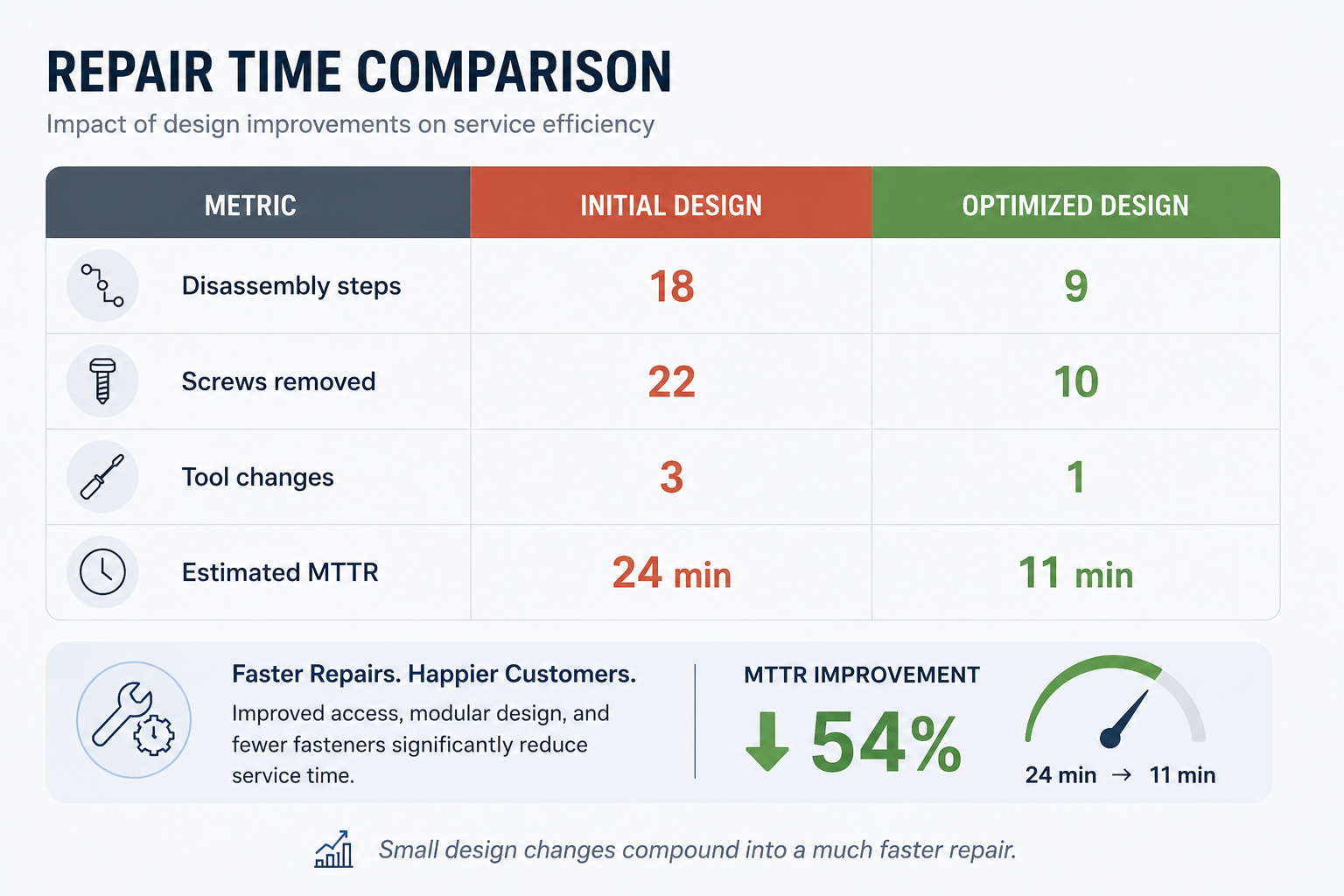
Every screw you remove is a chance to lose hardware, cross-thread something, scuff a cosmetic surface, or just add time. Worth asking in every design review: does this cover really need six screws? Can one bracket do the job of two? Can two parts become one? Can this module slide out without disturbing anything next to it?
Cutting the number of steps in a teardown usually matters more than cutting the number of parts.
Design modular components
Rather than pulling half the product apart because one subsystem failed, we isolated the major functions into modules that can come out on their own: camera module, sensor assembly, PCB module, power module, mechanical linkage. Once those modules are independent, diagnostics get easier, spare parts get simpler to manage, repairs get more predictable, and field servicing gets faster across the board.
Make fasteners technician-friendly
Fasteners are one of the biggest time sinks in a repair. Standardizing screw sizes, using the same driver wherever you can, avoiding hidden screws, keeping screw lengths consistent, and designing so screws can't fall into a cavity you can't reach all add up. Just cutting down on tool changes alone noticeably speeds up service.
Protect against assembly errors
A repair should be hard to do wrong. Keyed connectors, asymmetrical mounting features, polarized cables, locator pins, and captive hardware all push a technician toward the one correct way to put something back together. If a part can only fit one way, training a technician on it barely takes any time at all.
Consider cable routing
A lot of service issues have nothing to do with electronics failing. They're cables: pinched wires, broken connectors, reassembly that doesn't go back the way it came apart, cables routed somewhere they shouldn't be. Dedicated routing channels and retention clips fix most of this, and they make servicing faster and more reliable at the same time.
Serviceability begins in CAD
Every design review should be asking whether every screw can be reached with a standard driver, whether there's real clearance for tools, whether connectors can be unplugged without pulling neighboring parts, whether the product can be serviced without marking up the cosmetic surfaces, and whether a repair actually needs a full teardown.
Answering those questions in CAD costs almost nothing. Answering them after the product's already in production usually means a redesign.
Measure serviceability
Serviceability should get measured the same way strength or weight does:
| Metric | Why it matters |
|---|---|
| Mean time to repair (MTTR) | Overall repair efficiency |
| Disassembly steps | Simpler procedures mean less technician effort |
| Tool changes | Fewer tools means faster repairs |
| Replaceable modules | How modular the product actually is |
| Fastener count | Fewer fasteners generally means less service time |
| Assembly errors | How intuitive the product is to put back together |
Once serviceability has real numbers attached to it, the engineering decisions get a lot easier to make.
Designing for the product's entire life
The best products aren't just easy to build. They're easy to assemble, test, ship, service, upgrade, and eventually recycle. Thinking past the factory floor changes how you design something. You stop optimizing purely for day one on the assembly line and start optimizing for years of use after that.
Conclusion
Serviceability is invisible right up until something needs a repair. Then it's the only thing that matters.
Easy access, a modular architecture, standardized hardware, and fewer disassembly steps save more than technician time. They cut warranty costs, keep customers happier, and stretch out how long a product stays useful. Designing for service isn't designing around failure. It's just acknowledging every product has a lifecycle, and making sure that lifecycle runs as efficiently as the product itself does.