Smart Power Control: The LTC2955 as a Multi-Function Interface Solution
Introduction: One Button, Many Possibilities
At Hoomanely, we design products that are powerful yet intuitive. Our vBus-based systems pack sophisticated functionality into compact modules, but we've always believed that complex capability shouldn't require complex interaction. This philosophy led us to adopt the LTC2955 PushButton On/Off Controller as our standard solution for user interface across our smart product portfolio.
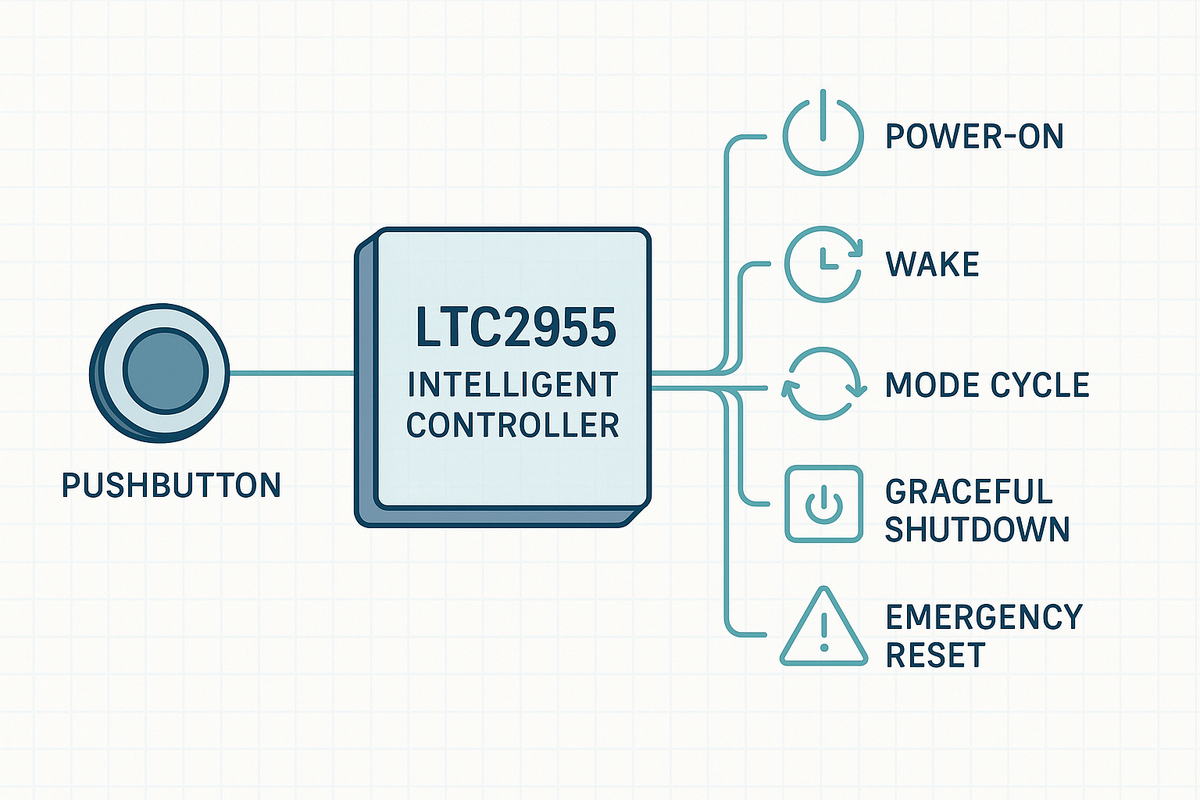
The LTC2955 isn't just a power switch—it's an intelligent interface controller that transforms a single pushbutton into a versatile control mechanism. Press briefly to wake the system. Hold longer to trigger specific functions. Press and hold to initiate a graceful shutdown. All from one elegant physical button, backed by sophisticated power management logic that ensures reliable operation and protects against accidental activation.
Today, I want to share why this unassuming IC has become a cornerstone of our user experience design and how it enables both intuitive control and robust fault handling across our product ecosystem.
The LTC2955: More Than a Power Switch
Intelligent Press Duration Detection
The LTC2955's core capability is remarkably elegant: it monitors pushbutton press duration and generates corresponding output signals that your system processor can interpret. But unlike simple GPIO-based button reading, the LTC2955 handles all the timing and debouncing in hardware, freeing your processor from constant polling and delivering clean, unambiguous signals.
Key Operating Modes:
Short Press Detection (typically 64ms minimum): Sufficient to register intentional button activation while filtering out accidental touches or mechanical bounce. The LTC2955 requires this minimum duration before asserting its output, ensuring that brief contact or noise doesn't trigger false activations.
Long Press for Power-On: A configurable press duration (commonly set to 256ms-1s via external capacitor) required to turn the system on from the off state. This prevents pocket activation or accidental power-on while protecting battery life in portable applications.
Extended Hold for Shutdown: Press and hold for a longer configured duration (typically 2-4 seconds) signals the system to initiate graceful shutdown. The processor receives advance warning via the interrupt output, allowing it to save state, close files, and power down cleanly rather than experiencing hard power loss.
Kill Timer Protection: If the system becomes unresponsive and can't execute shutdown, the LTC2955 includes a configurable kill timer that will force power-off after an extended button hold (typically 8+ seconds). This hardware-based watchdog ensures users can always recover from system lockups.
Hardware-Based Reliability
What makes the LTC2955 particularly valuable is that these timing functions happen in dedicated hardware logic—not firmware that could crash or hang. Even if your main processor locks up completely, the LTC2955 continues monitoring the button and will execute the kill timer sequence. This hardware independence is critical for real-world reliability.
The device also includes built-in debounce circuitry that handles the mechanical characteristics of pushbuttons—eliminating the need for external RC debounce networks or software debounce algorithms. Your processor receives clean edges and timing signals, not noisy mechanical switch behavior.
Multi-Function Control: User Experience Innovation
Context-Aware Button Functions
By monitoring the LTC2955's output signals, our products implement sophisticated button functionality that adapts to system state:
Wake from Sleep:
- Short press while system is in low-power sleep mode
- LTC2955 asserts the ON output, processor wakes and resumes operation
- Fast, responsive wake-up experience with minimal power consumption during sleep
Mode Cycling:
- Short press while system is running
- Processor detects interrupt from LTC2955, cycles through operational modes
- Example: Sensor display cycling through temperature → humidity → pressure readings
- Example: LED brightness adjustment through preset levels
Function Triggering:
- Double-press detection (firmware interprets two rapid presses)
- Processor uses LTC2955 interrupt timing to identify pattern
- Triggers special functions like calibration mode, data logging start/stop, or Bluetooth pairing
Graceful Shutdown:
- Long press (2-4 seconds) while running
- LTC2955 interrupt warns processor of impending shutdown
- System saves configuration, closes communication sessions, powers down peripherals
- Clean shutdown sequence protects data integrity and extends component lifetime
Emergency Reset:
- Very long press (8+ seconds) when system is unresponsive
- LTC2955 kill timer expires and forces power-off via hardware
- User recovery path that always works, even during total system failure
Firmware Integration
Integration with system firmware is straightforward. The LTC2955 provides two key signals to the processor:
INT Output (Interrupt): Asserted when button is pressed, providing real-time notification to firmware. The processor can measure the pulse width to determine press duration and respond accordingly—short press vs. long press vs. very long press.
KILL Output: Controls the main system power switch (typically a P-channel MOSFET). When asserted, cuts power to the system. Firmware can monitor this signal to detect impending shutdown and execute cleanup routines.
A typical firmware state machine monitors these signals and implements the desired button behavior matrix—customizable per product while leveraging the same hardware foundation.
Fault Handling: Reliability Through Hardware
System Hang Recovery
One of the LTC2955's most valuable features is its role in fault recovery. Embedded systems occasionally hang due to software bugs, communication timeouts, or peripheral failures. Without a recovery mechanism, a hung system becomes a bricked device requiring battery removal or waiting for battery drain.
The LTC2955's kill timer provides guaranteed recovery: hold the button beyond the timeout threshold (typically 8-10 seconds), and the LTC2955 forcibly removes power regardless of processor state. The system resets, and users regain control.
This hardware-enforced timeout is critical because it operates independently of the processor. Even if firmware is completely locked up—infinite loop, crashed interrupt handler, deadlocked communication bus—the LTC2955 continues functioning and responds to the button press sequence.
Power Sequencing Protection
The LTC2955 includes logic that prevents power glitches during turn-on sequences. It won't assert the KILL output (turning on main power) until the button has been held for the required minimum duration, ensuring that brief button contact or switch bounce doesn't cause power cycling during the startup phase.
Similarly, during shutdown sequences, the LTC2955 provides configurable delays that allow the processor to execute graceful shutdown before power is removed. This timing margin protects against corruption of file systems, configuration memory, or communication protocol state.
Debounce and Noise Immunity
Physical buttons exhibit mechanical bounce—the contacts make and break multiple times during a few milliseconds when pressed or released. Without proper debouncing, the processor sees multiple rapid press events from a single physical action.
The LTC2955's integrated debounce circuitry filters these mechanical artifacts, presenting only clean logical transitions to the processor. This eliminates an entire category of edge cases and weird behavior that users might otherwise encounter ("why did my device turn off when I pressed the button once?").
Additionally, the IC includes noise filtering on its input, providing immunity to electrical noise that might couple into button wiring—particularly important in products with motors, switching regulators, or wireless radios generating electromagnetic interference.
Design Implementation: Minimal External Components
Simple Circuit Topology
One of the LTC2955's practical advantages is its minimal external component count:
Required External Components:
- 1 pushbutton (SPST normally-open)
- 1 power control MOSFET (P-channel)
- 2-4 timing capacitors (setting press duration thresholds)
- 1 pull-up resistor (INT output)
- 1 bypass capacitor (supply decoupling)
Typical Circuit:
Pushbutton → LTC2955 (PB input)
LTC2955 (KILL) → P-MOSFET gate → System Power Control
LTC2955 (INT) → Processor GPIO → Interrupt Handler
External capacitors → LTC2955 (Timer pins) → Set timing thresholds
The timing capacitors are the key customization points—by selecting different capacitor values, you adjust the press duration thresholds to match your product's user experience requirements. Longer thresholds prevent accidental activation but require more deliberate user action. Shorter thresholds provide faster response but increase accidental press risk. We typically tune these through usability testing with target users.
Standard vBus Integration
Across our vBus-based product portfolio, we've standardized LTC2955 implementation:
On CPU SoMs: The LTC2955 sits between the main power input and the CPU power supply, controlling system-level power. The INT signal connects to a processor GPIO configured for interrupt-on-edge, allowing the firmware to respond immediately to button events.
On Standalone Products: Similar topology—LTC2955 controls main system power, with the button accessible on the product enclosure and the INT signal routed to the main controller.
On Peripheral SoMs: Some complex peripheral modules include local LTC2955 implementations, allowing the peripheral to be independently powered-on or reset via a dedicated button (useful for development and troubleshooting).
This standardization means our firmware libraries include ready-made LTC2955 driver code that works across products. Engineers integrate button functionality by configuring the state machine for their specific application rather than reimplementing low-level button handling.
Real-World Applications Across Our Portfolio
Portable Sensor Platforms
In battery-powered environmental monitoring systems, the LTC2955 enables:
- Power-efficient standby: System stays off until button press, consuming zero power (only the LTC2955's microamp quiescent current)
- Quick data check: Short press wakes the display to show current readings without fully activating communication radios
- Long-term logging start/stop: Long press toggles data logging mode
- Emergency shutdown: Very long press forces power-off if the system hangs during outdoor deployment
Industrial Control Modules
In industrial vBus systems, the LTC2955 provides:
- Operator control: Single button on front panel for power and mode selection
- Fault recovery: Guaranteed shutdown path if control firmware encounters issues
- Graceful shutdown: System saves operational state and retracts actuators before power removal
- Safety compliance: Hardware-independent shutdown mechanism for fail-safe system design
Communication Gateway Devices
In gateway and router products, the LTC2955 enables:
- User-friendly power management: Clean power-on and shutdown without unplugging power supply
- Network disconnection: Long press initiates graceful network disconnect and state synchronization before shutdown
- Factory reset initiation: Specific button sequence (detected via firmware monitoring INT signal) triggers factory reset while system is running
- Lockup recovery: Hardware kill timer provides recovery from network stack hangs or firmware deadlocks
Beyond Power: A Foundation for Intuitive Interaction
What started as a solution for clean power control has evolved into a fundamental user interface building block. The LTC2955's intelligent press detection and hardware reliability enable sophisticated single-button interactions that would be complex and unreliable if implemented purely in firmware.
By standardizing on this device across our product portfolio, we've achieved:
Consistent User Experience: Users familiar with one Hoomanely product intuitively understand button behavior on other products—short press to wake, long press to shutdown becomes second nature.
Firmware Simplification: Our software teams work with clean, debounced button signals and reliable timing, not the complexity of GPIO polling, debounce algorithms, and timing corner cases.
Hardware Reliability: The independent hardware logic ensures users always have a recovery path, even during catastrophic software failures—a critical feature for deployed systems that can't be easily accessed for manual reset.
Development Acceleration: New products inherit proven button handling architecture, reducing development time and eliminating a category of bugs related to button interface implementation.
Conclusion: Small Device, Big Impact
The LTC2955 exemplifies our engineering philosophy at Hoomanely: choose components that do one thing exceptionally well, integrate them thoughtfully into a larger architecture, and standardize on solutions that prove themselves in real-world deployment.
This unassuming pushbutton controller has become integral to how users interact with our products—providing intuitive control, reliable operation, and guaranteed recovery paths. It's a perfect example of how the right component choice, thoughtfully integrated, elevates the entire user experience.
As our vBus ecosystem continues expanding into new application domains, the LTC2955 remains our standard solution for intelligent button interfaces—a testament to its versatility, reliability, and elegant design.