Designing Beyond the PCB: The Engineering Math of Volume and Logistics
In hardware engineering, functionality often takes precedence over form. However, a critical design variable frequently impacts the product's success long before it reaches the end-user: Logistics.
For products intended for international markets, the physical footprint dictates commercial viability as much as the Bill of Materials (BOM) cost. The Hoomanely approach prioritizes Design for Logistics (DFL), demonstrating how modular decomposition and volumetric efficiency revolutionize the supply chain.
The Objective: Combating Volumetric Weight
Logistical inefficiency stems from how carriers calculate shipping costs. The metric is rarely dead weight; it is Volumetric (or Dimensional) Weight.
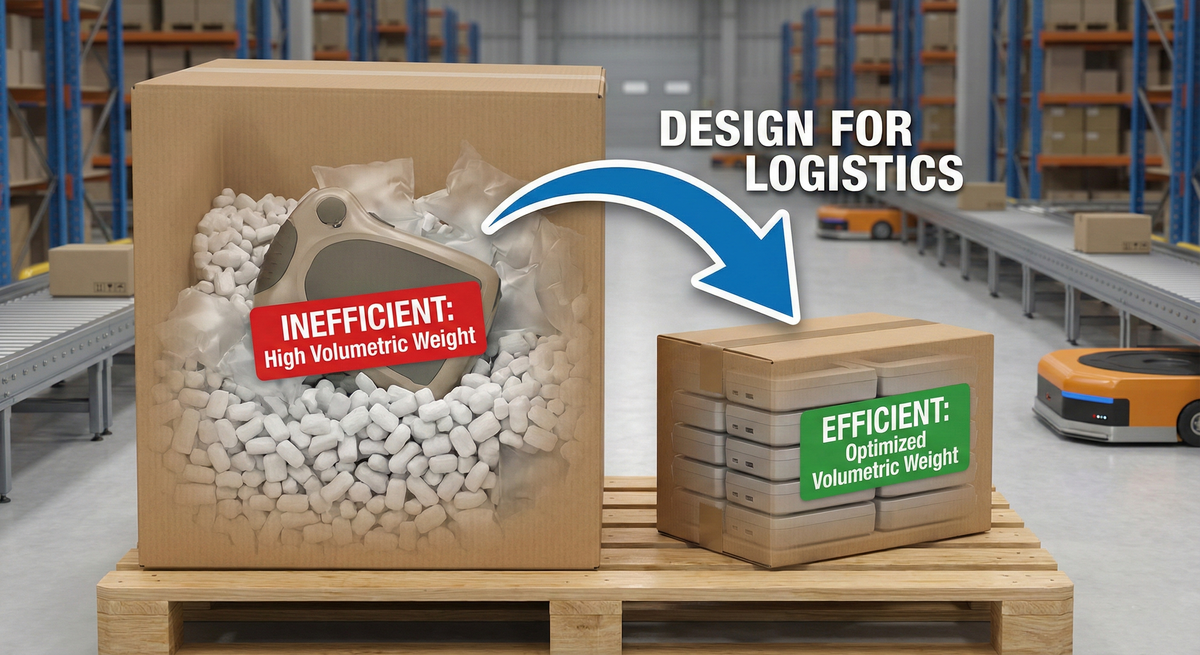
Designing a monolithic device with fixed protrusions—such as non-removable mounting brackets or rigid housings—expands the product's "bounding box." Carriers charge for the entire rectangular volume the product occupies, meaning empty space equates to wasted budget. Optimizing for simple height or width is insufficient; the goal is to optimize for total volume.
The Strategy: Sub-Unit Architecture
To eliminate volumetric waste, engineering must shift from monolithic structures to a sub-unit architecture.
Instead of a single, rigid device, the product is engineered as a collection of functional sub-units. These independent blocks are designed to be mechanically separated for transport and reassembled at the destination or by the user.
High-Density Interconnects
The core enabler of this modularity is the use of robust interconnects for board-to-board connections.
Rather than relying on large, fixed wiring harnesses that consume space and prevent tight packing, sub-units utilize high-density, direct board-to-board connectors. This allows the electronics within different sub-units to couple securely and compactly. By standardizing these interconnects, the device maintains signal integrity and power distribution efficiency while gaining the ability to be "deconstructed" into a denser form factor during shipping.
Mechanical Decomposition
Chassis design often drives volumetric inefficiency. Welded or glued unibody frames create unalterable shapes. The superior alternative is the use of bolt-on or slide-lock mechanical interfaces.
This approach permits the device to ship in a collapsed state. Components that typically protrude are detached and nested into the voids of other sub-units. This transforms an awkward, irregular shipping profile into a uniform, dense geometric shape.
The "Zero Void" Packing Protocol
Once the product is decomposed into sub-units, packaging design focuses on Zero Void Packing.
The goal is to eliminate air gaps. Sub-units are placed neatly and tightly within the packaging, often utilizing the negative space of one component to house another. This precise arrangement offers two distinct technical advantages:
- Structural Rigidity: A tightly packed box is mechanically superior. When sub-units are flush against one another, separated only by minimal protective layers, they provide mutual structural support. This reduces the dependency on excessive filler materials like bubble wrap or foam.
- Volumetric Density: Reducing individual box volume exponentially improves palletization efficiency, allowing for a higher unit count per cubic meter of cargo space.
The Result: Engineering Efficiency
Adopting a sub-unit strategy turns logistics into a precise engineering discipline.
- Cargo Optimization: Shipments consist of distinct, high-value components rather than empty space, which is critical for international freight where container volume is premium.
- Storage Density: Reduced unit dimensions maximize inventory storage per square foot in warehousing facilities.
- Cost Control: A product designed with sub-units significantly lowers the cost per unit in shipping, directly impacting the bottom line.
Conclusion
Product design extends beyond the enclosure walls to the pallet, the container, and the warehouse.
Engineers must challenge standard form factors. A monolithic design often represents a missed opportunity for optimization. By leveraging sub-units with reliable board-to-board interconnects, designs achieve maximum density and efficiency. When every cubic centimeter is accounted for, the result is not just a better package, but a superior product.