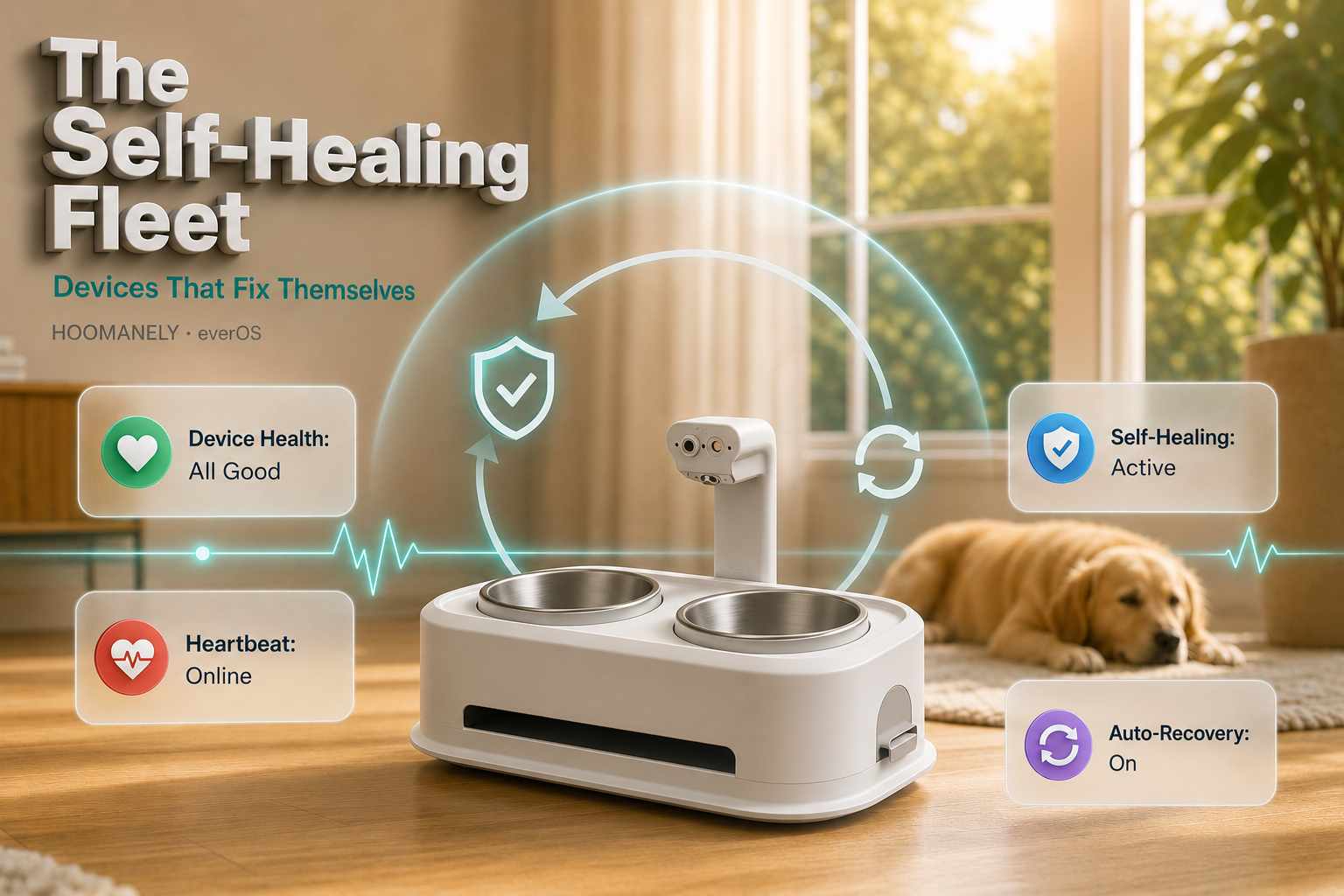
The Self-Healing Fleet: Devices That Fix Themselves
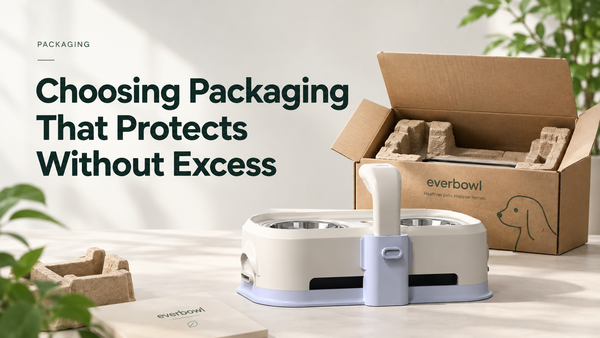
At 3 a.m., a smart pet bowl in a customer's kitchen notices it hasn't captured anything in half an hour. The sensor path has quietly wedged — the kind of stall that, on a normal device, would sit there dead until someone noticed the app had gone silent and filed a support ticket. Instead, the bowl restarts the stuck subsystem, confirms captures are flowing again, and goes back to work. Nobody was watching. Nobody had to be. For a health device that lives in a home for years — with no IT staff, no reset button anyone will press, and no tolerance for silent gaps in a pet's record — this kind of autonomy isn't a nice-to-have; it's the product. This is how everOS, the operating system behind Hoomanely's Everbowl, keeps a whole fleet alive without anyone touching it.
The Concept: Autonomy as a Feature
Most software assumes someone is around to fix it — an operator to restart a service, an engineer to clear a full disk, an admin to reboot a hung box. A device in a customer's living room has none of that. It has to be its own operator.
So everOS is built to watch itself and recover itself. Every critical function runs as a supervised service, and a set of always-on mechanisms continuously ask the questions a good operator would: Are captures still landing? Is the disk filling up? Is the clock right? Am I still reaching the cloud? When the answer is wrong, the device acts — and only if it truly can't recover does it raise a hand to the backend.
The goal isn't to never fail. Hardware and software always eventually misbehave. The goal is that a failure heals on its own, or is at least reported, instead of turning into a silent dead spot in a pet's health timeline.
Why It Matters: Nobody Is Coming to Reboot It
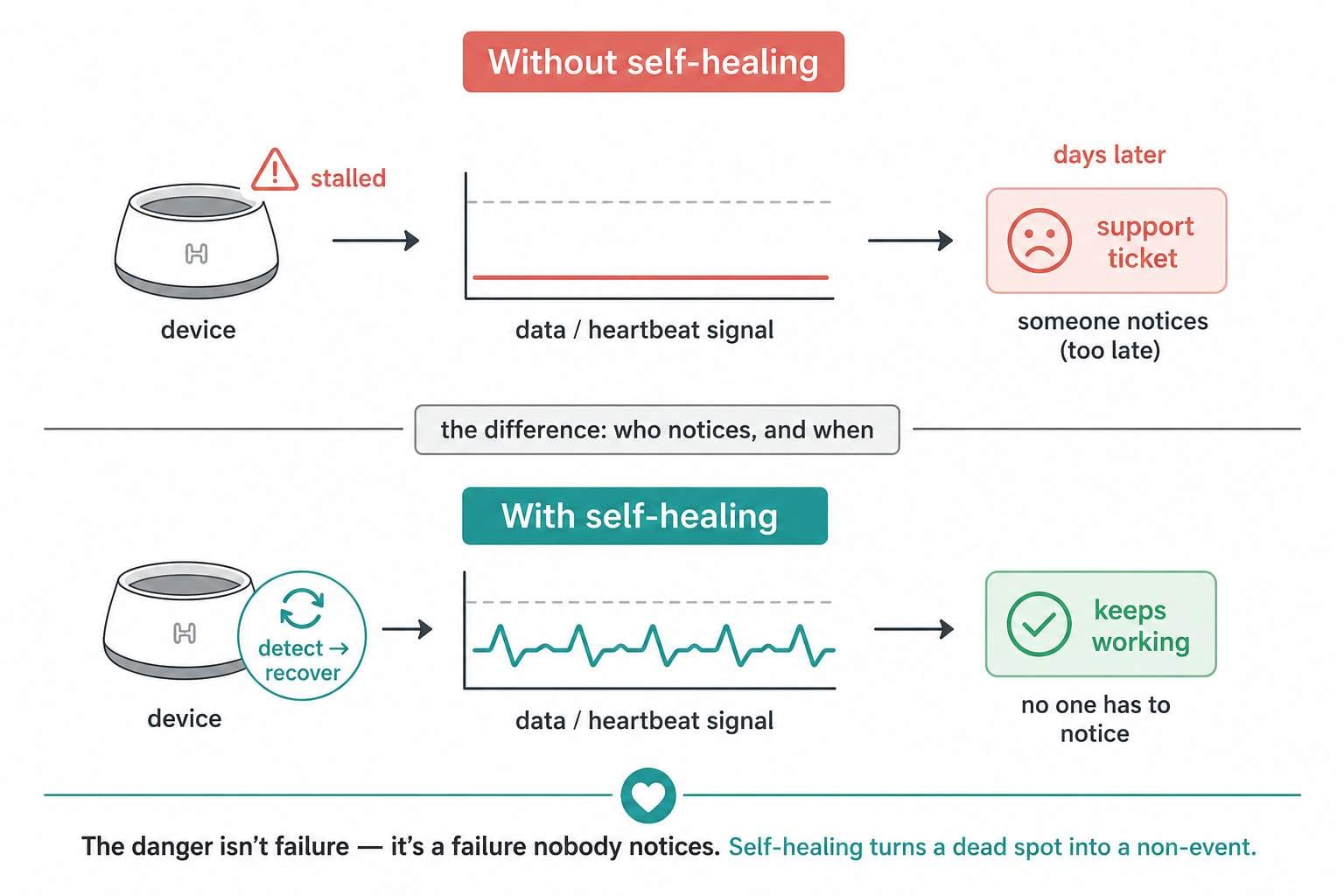
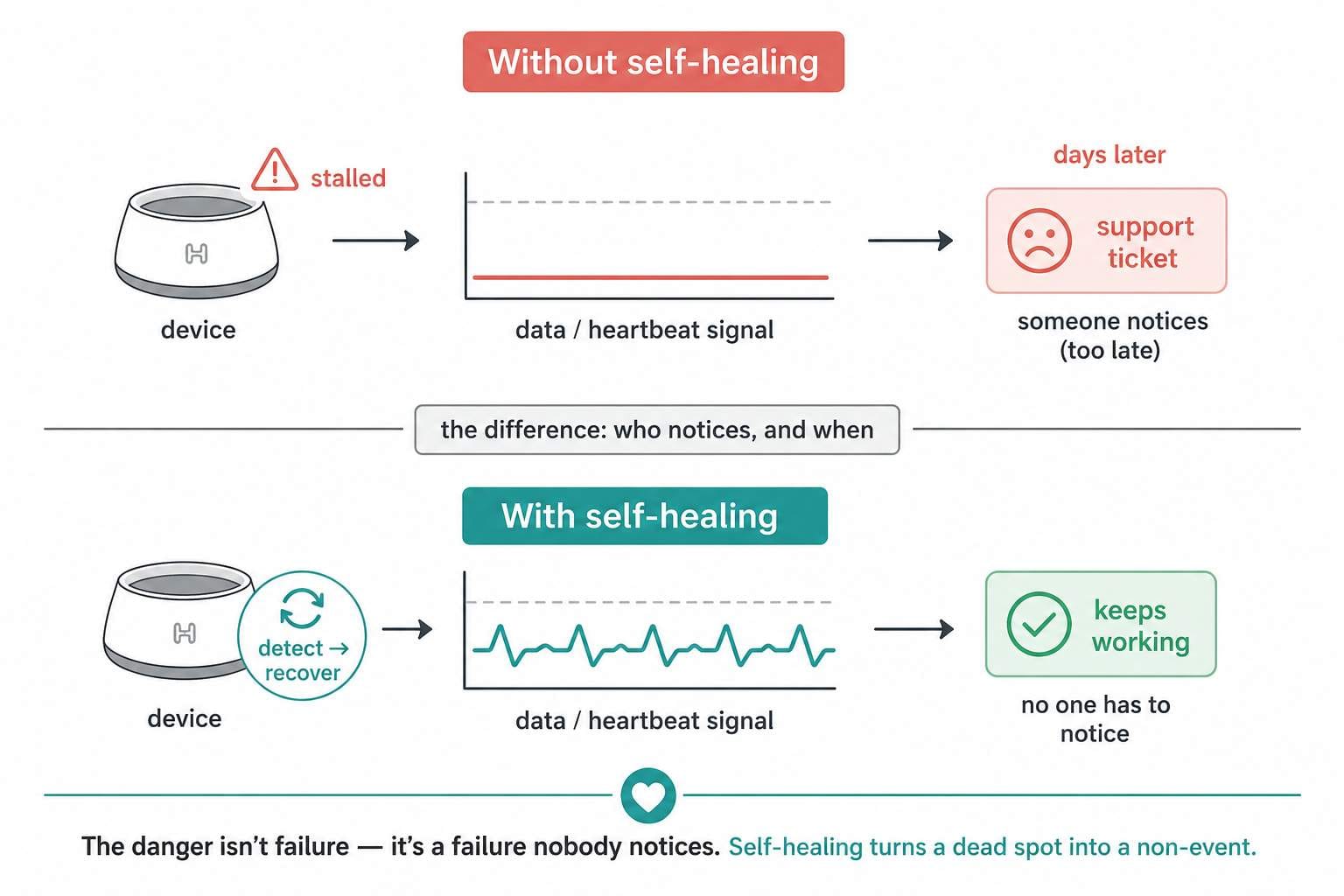
Continuous monitoring is a promise measured in years, and it quietly assumes the device is up the whole time. A single wedged afternoon can hide the early limp or the change in appetite that mattered most. Worse, the device usually still looks online while recording nothing — the most dangerous kind of failure, because it's invisible.
There's also no cheap recovery path in a home. You can't walk over and power-cycle a stranger's bowl, and dispatching a technician for a stuck service would make the whole product uneconomical. The only affordable operator is the device itself.
That reframes reliability engineering: instead of "how do we prevent every failure," the question becomes "how does the device notice trouble and get itself back to healthy" — and, when it genuinely can't, "how does it tell us before the customer does."
How It Works: Layers of Automatic Defense
everOS doesn't rely on one safety net; it stacks several, each guarding a different failure mode and running on its own schedule. Together they form a quiet immune system.
- Heartbeat (every minute): an "alive and online" signal to the backend. It's what powers the dashboard's live/last-seen status and the fastest way the fleet knows a device went dark.
- Diagnostics (at boot, every 30 minutes, daily): deeper health posted to the cloud, so the team has fleet-wide visibility into trends, not just up/down.
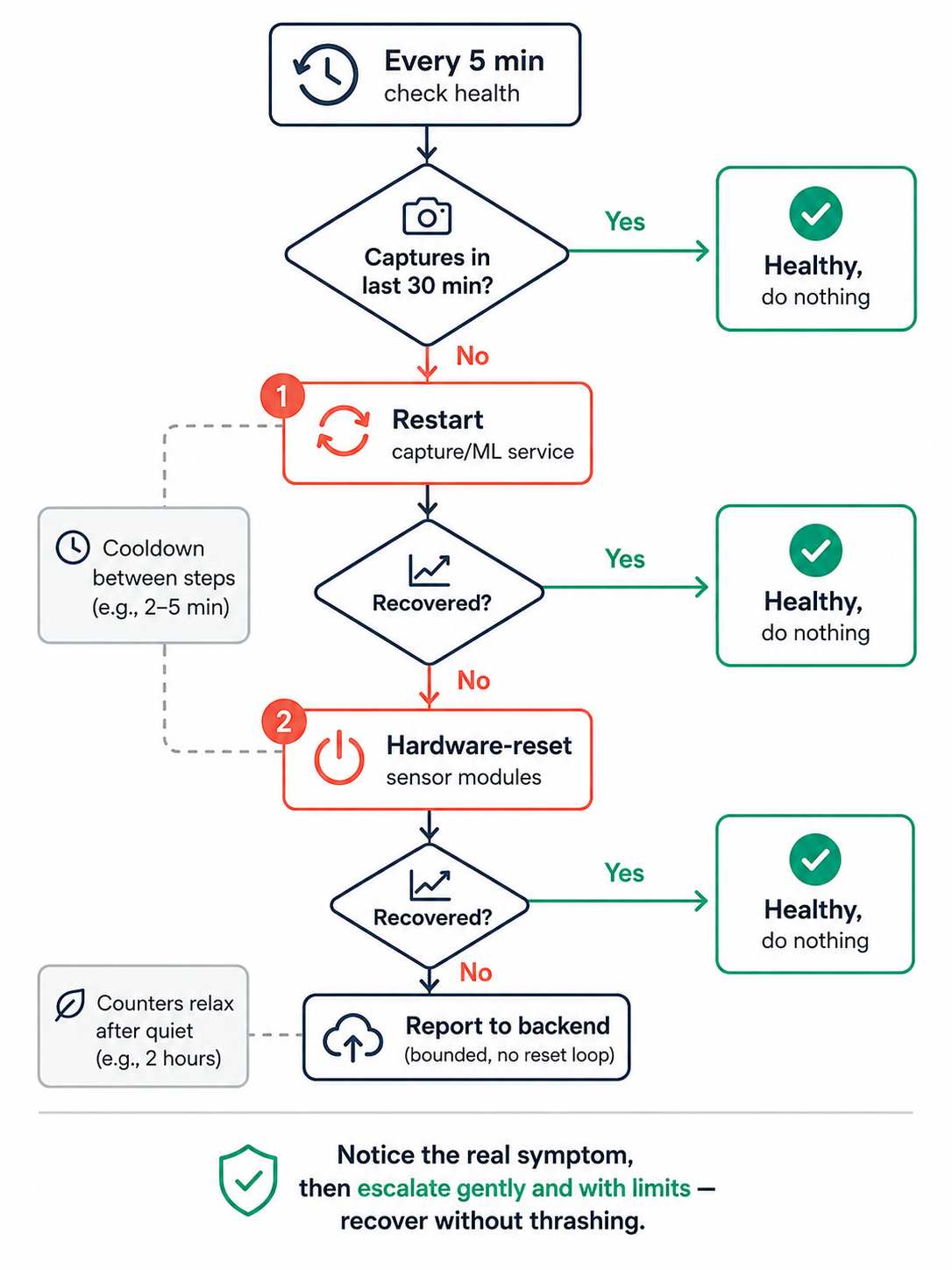
- Pipeline watchdog (every 5 minutes): the active healer. If no captures have landed for 30 minutes, it restarts the stalled capture/ML path — and if that isn't enough, it escalates to hardware-resetting the sensor modules.
- Retention janitor (every 10 minutes): purges already-uploaded data so the data partition and scratch storage never fill — a full disk would break both capture and updates.
- Timesync (at boot and every 6 hours): keeps the clock correct, which secure access and accurate event timestamps both depend on.
Layered on top is the OTA health-gate and watchdog from the update system: after any update, the device commits only a slot that proves healthy, and otherwise rolls back automatically. Recovery is designed into upgrades, not just into steady-state operation.
The Active Healer: Escalation, Not Panic
The pipeline watchdog deserves a closer look, because it shows the shape of good self-healing: escalate gently, and cap the aggression. It doesn't nuke the device at the first sign of trouble — it climbs a ladder.
First it notices the real symptom — no captures for 30 minutes — rather than guessing from a proxy. Its first action is the least invasive one: restart the stalled service. Only if the pipeline is still dead does it escalate to the bigger hammer: hardware-resetting the sensor modules to force them back to a known-good state. Each step has a cooldown so it can't thrash, and the counters relax after a stretch of quiet.
The escalation is bounded on purpose, so a genuinely unrecoverable fault gets reported rather than triggering an endless reset loop. Self-healing that panics is just a new failure mode.
The Golden Rule: Heal the Children, Never Yourself
There's one principle underneath all of it worth stating plainly: the compute module never reboots itself as a fix. It restarts services, it power-cycles the sensor modules, it purges data, it rolls back an update — but the brain running all of this recovery stays up.
That's deliberate. The supervisor has to be the one thing you can trust to still be running when everything else is being nursed back to health. A system that reboots itself to solve a problem loses its own diagnostic state, drops its cloud connection, and risks turning a small stall into a full outage — or worse, a reboot loop. Recovery flows downward: the healthy core heals its subsystems; it never gambles on healing by killing itself.
In Practice: Healthy Is a Checklist
Because the device self-reports, "healthy" is a concrete, checkable state rather than a vibe: no failed services, the sensor bus is up, the clock is correct, the data partition isn't full, and the heartbeat is reaching the cloud. Those five conditions are exactly what the automatic mechanisms defend, and exactly what an engineer would confirm first if a device did need a look.
The payoff shows up as absence — of support tickets, of truck rolls, of mysterious silent gaps. Most stalls never become visible to anyone because a watchdog cleared them minutes after they started, and the ones that can't be cleared arrive as a clear signal on a dashboard instead of a confused customer email. Boring, again, by design.
Why It Matters at Hoomanely
Hoomanely is reinventing healthcare for pets — replacing reactive, imprecise care with continuous, clinical-grade monitoring that catches problems early. Our devices form a Physical Intelligence ecosystem: sensors fused at the edge, feeding the Biosense AI Engine that turns raw signals into personalized, preventive insights.
That word continuous is only true if the device is genuinely up, day after day, without anyone tending it. Self-healing is how we make it true at fleet scale: thousands of bowls in thousands of homes, each quietly detecting and recovering from its own hiccups, so the health record stays whole and the insights stay trustworthy.
It's invisible to the owner, and that's the point. The bowl just keeps working — and the small army of watchdogs, heartbeats, and janitors making that happen is the difference between a gadget and a health companion a family can rely on for years.
Key Takeaways
- Assume no operator. A device in a home must be its own admin — detecting and recovering from failures without a human or a reset button.
- Silent failure is the real enemy. A device that looks online while recording nothing is worse than one that's obviously down; heartbeats and diagnostics exist to surface that.
- Stack layered guards. Separate mechanisms on separate schedules — heartbeat, diagnostics, watchdog, janitor, timesync, OTA health-gate — each cover a distinct failure mode.
- Escalate gently and cap it. Notice the real symptom, try the least-invasive fix first, escalate only if needed, and bound retries so recovery never becomes a thrash.
- Heal downward, never reboot the supervisor. The core that runs recovery must stay up; it restarts its subsystems but never gambles on restarting itself.
Author's Note
This self-healing layer is part of everOS, the operating system behind Hoomanely's Everbowl and the physical-intelligence ecosystem it belongs to. It's the least visible engineering in the product and, in a way, the most important — the quiet machinery that lets a health device disappear into a family's kitchen and simply keep working. Capture and AI get the spotlight; staying alive, unattended, for years is what makes any of it worth building.