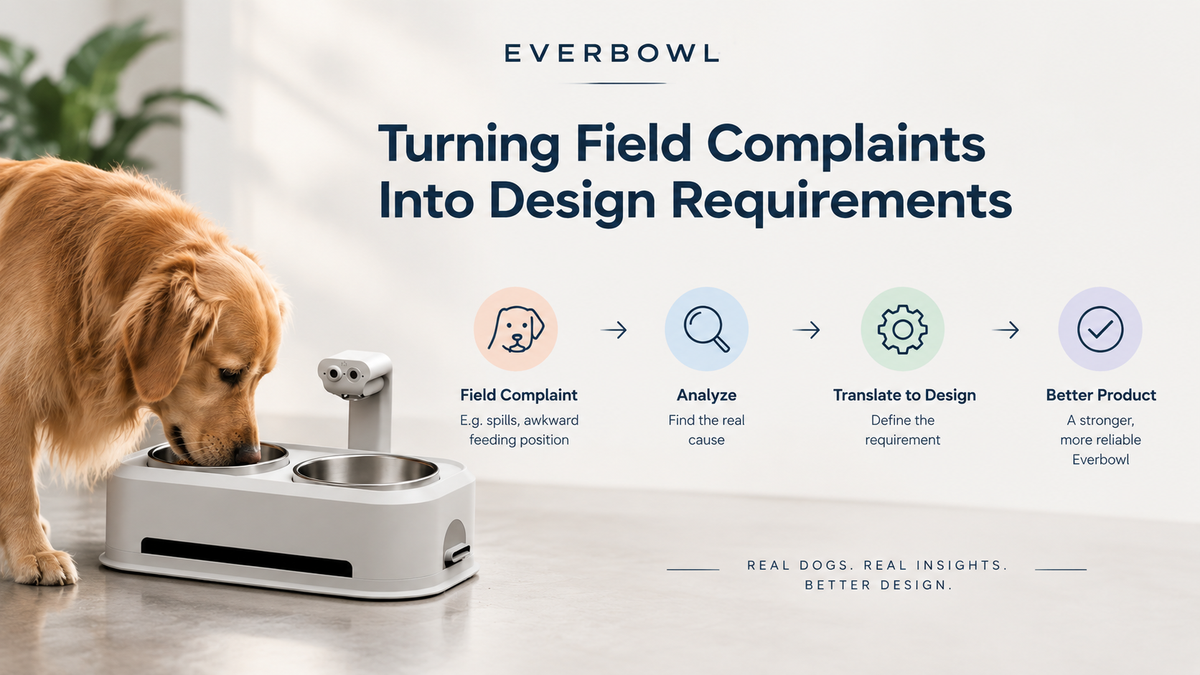
Turning Field Complaints Into Design Requirements
How early user feedback became formal engineering inputs for Everbowl.
Introduction
A product rarely fails the same way it fails on a test bench. In the lab, we control the load, the environment, the assembly process, and how the product gets handled. In someone's home, none of that is controlled. People place things differently, apply force from directions we didn't expect, clean things their own way, drop components, and interact with a product in ways that are genuinely hard to anticipate at the design stage.
That became obvious pretty quickly with Everbowl. Some of our most useful mechanical changes never came from a simulation or a design review. They started with something much simpler: a complaint from someone actually using the product. The real shift wasn't learning to listen to complaints. It was learning how to translate them into engineering requirements.
The problem with treating complaints as isolated issues
A field complaint usually sounds specific: "the bowl feels loose," "this part is hard to assemble," "the surface gets scratched," "the sensor sometimes triggers incorrectly," "the product behaves differently depending on where I put it." It's tempting to solve each one individually, but a complaint is usually just the visible symptom of something deeper.
If someone says a component feels loose, the actual chain might be clearance, then tolerance stack-up, then joint movement, then the feeling of looseness. Unexpected handling might mean impact load, then local deformation, then cosmetic damage. Different placement might mean an altered optical path, then reflection, then an incorrect sensor reading. The field became another source of engineering information once we stopped asking "how do we fix this complaint?" and started asking "what design assumption did this complaint just prove wrong?" That question changed how feedback turned into actual design work.
From complaint to engineering requirement
The useful part of field feedback was never the complaint itself. It was the engineering condition hidden inside it. We started treating the whole process as a chain: field observation, then failure mode, then root cause, then design requirement, then design change, then verification. That kept feedback from turning into a pile of one-off fixes.
Say repeated handling revealed unexpected movement between two components. The obvious first response is to tighten the assembly, but that doesn't necessarily fix the actual problem. Instead we'd dig into the nominal clearance, the manufacturing tolerances, the full tolerance stack, how much movement shows up in the worst-case condition, whether the joint relies on friction, preload, or geometric constraint, whether temperature changes the fit, and whether repeated loading opens the clearance up over time.
That turns "the part should feel tighter" into something closer to "the interface must maintain less than X mm of relative movement under the defined handling and load conditions." That's a requirement an engineer can actually design against and verify.
The field became another test condition
One of the bigger shifts in our thinking was realizing that real users create test conditions engineers don't always think to specify. A part might get tested under its intended vertical load, but a real person might grab it from the side, push against an edge, rotate it while carrying it, set it down at an angle, apply repeated small impacts, or interact with it while another component is already loaded. None of that violates the product's intended use. It just exposes conditions the original engineering model never included.
That mattered even more on Everbowl, since mechanical, sensing, and user-interaction systems are all tightly connected there. A small mechanical change can ripple into load distribution, sensor alignment, optical geometry, assembly repeatability, enclosure clearances, surface durability, or just how premium the product feels. A field complaint about one area can end up revealing a requirement somewhere else entirely.
Turning "something feels wrong" into something measurable
One of the most useful lessons was learning to separate what the user actually experienced from what the engineer actually needs to measure. Take a simplified case: the field observation is "the bowl sometimes feels slightly unstable." The engineering investigation looks at interface clearance, support geometry, tolerance stack-up, contact locations, load position, friction, deformation under load, and assembly variation.
Out of that, the vague observation turns into measurable parameters: maximum allowable relative movement, minimum contact area, maximum allowable tilt, allowable positional variation, or required preload. The updated design then gets tested under nominal geometry, worst-case tolerance, repeated loading, off-center loading, and representative handling.
The complaint was never the requirement. It was evidence that a requirement was missing or defined wrong.
The same approach applied to sensing
This mattered a lot for the proximity sensing system. The sensor worked fine tested in an open configuration, but once it was integrated into the product, the enclosure geometry became part of the optical system. Cover position, air gap, aperture geometry, internal surface finish, and the surrounding enclosure surfaces could all shift the optical path. A sensor that behaved perfectly on a bench could behave differently inside the finished product.
The useful question wasn't "why is the sensor bad?" It was "what physical condition exists in the product that wasn't represented in the original test?" That pointed the investigation toward optical crosstalk, internal reflections, aperture geometry, and enclosure surfaces, and the resulting requirements turned out to be as mechanical as they were electronic: control the distance between sensor and cover, cut down unwanted air gaps, control the optical aperture, choose the right internal surface finishes, and validate the sensor inside its actual final environment. The field behavior showed us that the enclosure was, functionally, part of the sensor system.
Complaints also changed how we thought about durability
The same logic applied to mechanical durability. A part can pass a static strength simulation and still develop problems over time, because a real product doesn't experience one big load. It experiences thousands of small ones: load, unload, vibration, handling, impact, repeat. Over time that produces wear, loosening, surface damage, joint movement, fatigue, or a change in fit.
That's where field feedback got genuinely useful. If a component kept showing wear in the same spot, that stopped being a cosmetic note and became evidence of a recurring mechanical interaction. We'd ask whether the contact pressure was too high, whether the relative movement was expected, whether the material pair made sense, whether the surface finish was contributing to wear, whether the geometry was concentrating force, or whether the tolerance was allowing too much movement. The resulting requirement could then target the actual mechanism instead of just specifying a cosmetic outcome.
Building traceability into the design process
Feedback gets a lot more useful once you can trace it through the whole development process:
| Field input | Engineering interpretation | Design response | Verification |
|---|---|---|---|
| Component movement | Excessive interface clearance | Revised interface tolerance | Fit + movement test |
| Surface damage | Local contact or impact condition | Geometry or finish revision | Handling-cycle test |
| Sensor mistrigger | Enclosure-induced optical interaction | Revised aperture or surface geometry | Integrated sensor test |
| Assembly inconsistency | Tolerance or preload sensitivity | Improved locating features | Assembly variation test |
| Repeated wear | Relative motion at interface | Revised contact geometry or material | Cycle-life test |
The important column is the last one. A design change shouldn't happen just because someone reported a problem. It should eventually answer whether the change actually removed the failure mode, and that's what turns this into a feedback loop instead of a pile of reactive fixes.
What changed in our design process
The biggest change wasn't any particular tolerance or component. It was how we treated information coming from the field. Earlier on, feedback felt like something that showed up after engineering was already done. Over time we started treating it as another input into engineering, documenting what actually happened, where it happened (which interface, environment, orientation, or use condition), why it could happen physically, which assumption failed, what should actually change, and how we'd verify it. That structure made field feedback a lot more actionable.
Engineering insight: A field complaint is often a measurement of a requirement you didn't know you needed. The goal isn't to design around every individual user's behavior, since that would just make the product needlessly complicated. The goal is finding the repeatable physical condition hiding inside those behaviors. If ten users interact with the product ten different ways and hit the same failure mode, the useful engineering information isn't the ten stories. It's the one mechanism connecting them.
The feedback loop became part of product development
The most useful way to look at field feedback ended up being a continuous loop: product, then user interaction, then observation, then failure mode, then requirement, then design change, then validation, then back to the product. That loop doesn't end when a redesign ships. The updated product creates new observations, which can reveal new assumptions worth questioning.
That matters especially for something like Everbowl, where mechanical structure, sensing, electronics, software, and user interaction all shape each other. A mechanical tolerance can influence sensor behavior. An enclosure change can influence optics. An assembly feature can influence calibration. A surface decision can influence durability. The product doesn't experience any of that as separate engineering disciplines. It experiences it as one system.
What we learned
The most valuable outcome from field feedback wasn't a checklist of resolved complaints. It was a better way of turning real-world behavior into engineering decisions. We learned to look past the immediate symptom and ask what the observation was actually telling us about the design. A complaint about movement could become a tolerance requirement. A cosmetic complaint could reveal a repeated mechanical load. A sensor complaint could expose an enclosure-level optical problem.
That also made design changes a lot easier to justify. Instead of "we changed this because people didn't like it," we could say we found a repeatable failure mode, traced it to a specific physical mechanism, turned that into a measurable requirement, changed the design, and verified the result. That's a much stronger loop to stand behind.
How this shows up at Hoomanely
At Hoomanely, the goal is building technology that fits naturally into everyday life instead of asking people to adapt around it. That makes real-world interaction especially important. Everbowl reinforced that product engineering can't stop at CAD, simulation, and controlled lab testing. The product ultimately has to work in kitchens, around pets, through constant handling, under conditions a lab can never fully reproduce.
Turning field observations into formal design requirements is one of the ways we close that gap, moving a product from "works under our test conditions" toward actually behaving predictably in the conditions people create on their own.
Key takeaways
- A complaint is an observation, not a requirement. The engineering job is finding the physical condition behind it.
- Look for repeatable failure modes rather than designing around individual anecdotes.
- Convert observations into measurable parameters: clearance, load, movement, wear, environmental limits.
- Trace every significant design change back to its original field input so the reasoning stays visible.
- Verify the fix. Don't just assume a redesign solved the problem.
- Consider the system-level consequences. A mechanical change can touch sensing, assembly, calibration, appearance, and manufacturing all at once.
- Use field feedback to challenge assumptions, not just to accumulate fixes.
A product is never fully understood inside the lab. Real users become another source of engineering data, and their interactions expose the gaps between what we designed, what we tested, and what the product actually goes through. The most valuable shift for us was learning to treat those gaps not as isolated complaints, but as the next requirement the product was quietly asking us to define.