Wi-Fi and BLE Coexistence: Mastering Schedulers, Airtime, and Fair Sharing
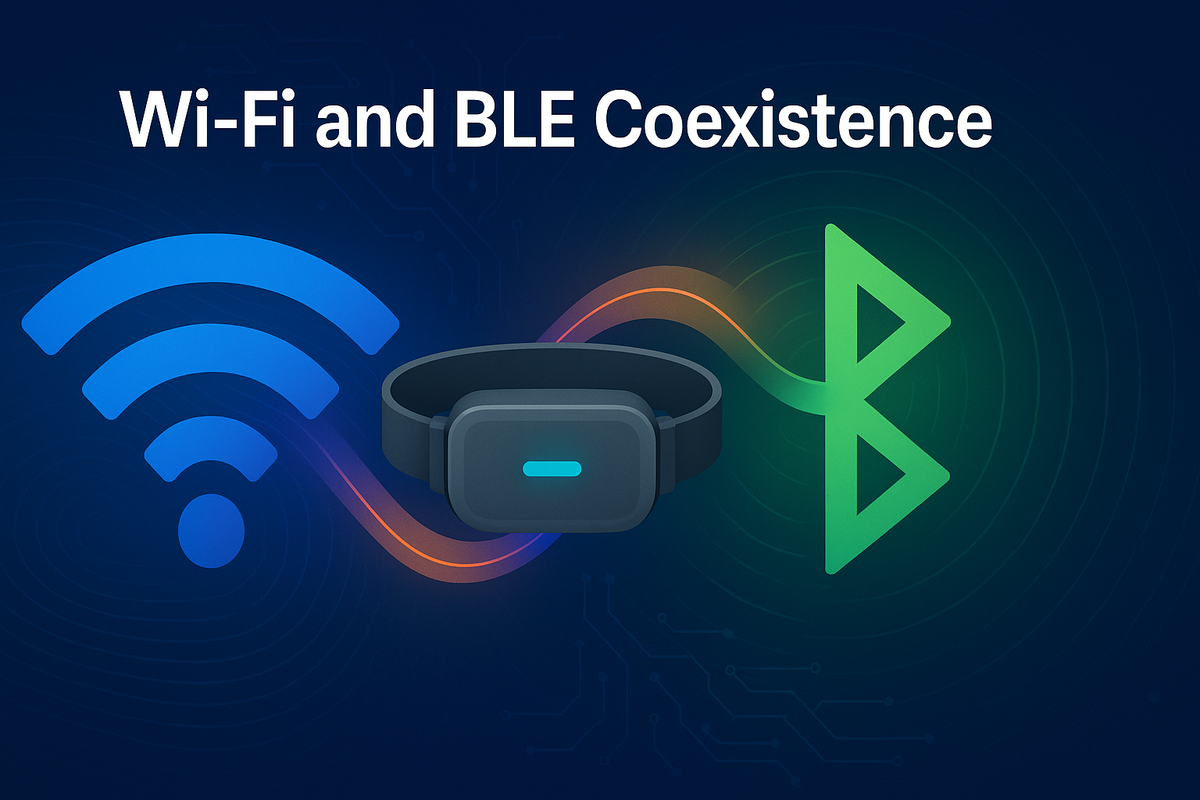
In the world of IoT devices, particularly in pet health monitoring systems, reliable wireless connectivity isn't just a nice-to-have—it's mission-critical. When your device needs to simultaneously stream real-time health data over Wi-Fi while maintaining BLE connections to multiple sensors, the challenge of wireless coexistence becomes very real. As an embedded firmware engineer working on Hoomanely's interconnected smart pet monitoring ecosystem, I've spent countless hours debugging mysterious packet drops, unexplained latency spikes, and intermittent connection failures—all symptoms of poor coexistence management.
This post dives deep into how Wi-Fi and Bluetooth Low Energy (BLE) can share the same 2.4 GHz spectrum without stepping on each other's toes, exploring the schedulers, airtime allocation strategies, and fair sharing mechanisms that make it all work.
The 2.4 GHz Collision Course
Both Wi-Fi (802.11b/g/n in 2.4 GHz) and BLE (Bluetooth 4.0+) operate in the same 2.4–2.48 GHz ISM band. Wi-Fi uses 20 MHz or 40 MHz wide channels, while BLE hops across 40 narrow 2 MHz channels. When both radios are active on the same chip (common in ESP32, nRF52, and similar SoCs), they're essentially competing for the same RF frontend, antenna, and spectrum.
Without proper coexistence mechanisms, you get:
- Packet collisions: BLE advertisements colliding with Wi-Fi beacons
- Throughput degradation: Wi-Fi speeds dropping by 30-60% when BLE is active
- Connection drops: BLE peripherals disconnecting during heavy Wi-Fi traffic
- Increased latency: Time-critical sensor data arriving too late for real-time processing
For a pet health monitoring system that needs to maintain continuous BLE connections to wearable sensors while uploading data to the cloud via Wi-Fi, these issues can mean missed health alerts or incomplete activity tracking.
Coexistence Architecture: How the Radio is Shared
Modern SoCs implement coexistence through a combination of hardware arbitration and software scheduling. Here's the typical architecture:
Hardware Components
PTA (Packet Traffic Arbitration): A hardware state machine that decides which radio gets access to the RF frontend at any given microsecond. Think of it as a traffic cop directing data flow.
Priority Signals: Each radio asserts priority lines (WLAN_ACTIVE, BT_ACTIVE, BT_PRIORITY) to indicate transmission intent and urgency.
Status Signals: Feedback lines (TX_STATUS, RX_STATUS) inform the scheduler about ongoing operations.
Software Layers
Radio Scheduler: The firmware layer that coordinates transmission timing, manages queues, and implements fairness policies.
Protocol-Aware Logic: Understanding protocol timing constraints (e.g., BLE connection events, Wi-Fi TBTT) to schedule optimally.
Dynamic Arbitration: Real-time decision-making based on traffic patterns, QoS requirements, and protocol state.
Scheduling Strategies: Who Gets to Talk and When
The scheduler's job is to allocate airtime between Wi-Fi and BLE while respecting protocol timing requirements. Several strategies exist:
1. Time Division Multiplexing (TDM)
The simplest approach: divide time into slots and alternate between radios. For example, 10ms for Wi-Fi, 2ms for BLE, repeat.
Pros: Predictable, simple to implement, guaranteed minimum airtime for both radios.
Cons: Inefficient when one radio is idle, can't adapt to bursty traffic, fixed overhead regardless of actual needs.
2. Priority-Based Arbitration
Assign priority levels to different traffic types. BLE connection events might get higher priority than Wi-Fi background scans, while Wi-Fi data packets take precedence over BLE advertisements.
Priority Example:
1. BLE connection events (time-critical)
2. Wi-Fi real-time data (health metrics upload)
3. Wi-Fi beacon reception
4. BLE scanning/advertising
5. Wi-Fi background tasksPros: Flexible, respects protocol requirements, can optimize for latency-sensitive traffic.
Cons: Risk of starvation for lower-priority traffic, requires careful tuning, priority inversion can occur.
We implemented a 4-level priority system where BLE connection maintenance events always preempt non-critical Wi-Fi operations. This ensured our sensor connections stayed stable even during heavy cloud uploads.
3. Hybrid Adaptive Scheduling
The most sophisticated approach combines TDM baseline with dynamic priority adjustments. The scheduler continuously monitors:
- Queue depths for each radio
- Packet deadlines and latency budgets
- Protocol state (e.g., is a BLE connection event imminent?)
- Historical throughput and retry rates
Based on these metrics, it dynamically adjusts the schedule. During low Wi-Fi traffic, BLE gets more slots. When a large file needs uploading, Wi-Fi gets extended windows, but BLE connection events are still protected.
Airtime Allocation: The Numbers Game
How much time does each radio actually get? This depends on use case requirements and protocol characteristics.
BLE Timing Constraints
BLE connection events occur at fixed intervals (connection interval, typically 7.5ms to 4s). Each event has a defined window where data exchange must occur. Missing this window means:
- Waiting until the next connection interval
- Potential connection timeout if multiple events are missed
- Supervisor timeout (typically 6-20 seconds) leading to disconnection
For our pet monitoring collar, we use a 30ms connection interval with a 5ms window. The scheduler must guarantee BLE gets at least this 5ms window every 30ms, non-negotiably.
Wi-Fi Timing Constraints
Wi-Fi DTIM (Delivery Traffic Indication Message) periods are critical for power save modes. If your device is in power save and misses the DTIM beacon, it won't know about buffered multicast frames.
For continuous data transfer, Wi-Fi needs extended airtime. A typical 802.11n connection at 65 Mbps requires roughly:
- 1.5ms to transmit a 1500-byte packet (including protocol overhead)
- SIFS, DIFS, and backoff add another 0.3-0.5ms
- ACK transmission: 0.05ms
To sustain 5 Mbps throughput, you need approximately 10-15ms of Wi-Fi airtime per 30ms interval.
Real-World Allocation
In our production firmware for Hoomanely devices:
- BLE Base Allocation: 5ms every 30ms (16.7% guaranteed)
- Wi-Fi Base Allocation: 20ms every 30ms (66.7% guaranteed)
- Flexible Pool: 5ms (16.7%) allocated dynamically based on traffic
This provides BLE connection stability while allowing Wi-Fi to handle sustained throughput. During idle periods, BLE can use Wi-Fi's unused time for scanning or advertising.
Fair Sharing Mechanisms
Fairness doesn't mean equal time—it means each radio gets enough time to meet its QoS requirements without starving the other.
Weighted Fair Queuing
Instead of simple round-robin, assign weights based on traffic class and protocol needs. BLE connection maintenance gets weight 3, Wi-Fi bulk data gets weight 5, BLE advertising gets weight 1.
The scheduler grants transmission opportunities proportional to weights while respecting minimum guarantees.
Token Bucket Algorithm
Each radio has a "bucket" that accumulates tokens at a fixed rate. Transmitting consumes tokens. When a bucket is empty, that radio must wait. This naturally rate-limits each radio while allowing bursts.
// Simplified token bucket example
typedef struct {
    uint32_t tokens;
    uint32_t max_tokens;
    uint32_t rate;  // tokens per ms
} token_bucket_t;

bool request_airtime(token_bucket_t *bucket, uint32_t cost) {
    if (bucket->tokens >= cost) {
        bucket->tokens -= cost;
        return true;
    }
    return false;
}

void refill_tokens(token_bucket_t *bucket, uint32_t elapsed_ms) {
    bucket->tokens = MIN(bucket->max_tokens,
                         bucket->tokens + bucket->rate * elapsed_ms);
}
Deficit Round Robin
Track the "deficit" (unfulfilled airtime) for each radio. In each scheduling round, allocate time to the radio with the highest deficit first. This ensures long-term fairness even with variable packet sizes.
Implementation Challenges and Solutions
BLE Connection Interval Synchronization
Problem: BLE connection events are scheduled by the central device (often a smartphone). The peripheral (our collar) must wake up at precise times. If Wi-Fi happens to be transmitting at that moment, the BLE event is missed.
Solution: Implement a lookahead mechanism. The scheduler reads the BLE connection anchor points 5ms in advance and reserves those time slots. Wi-Fi transmissions are chunked to fit between BLE windows.
// Check for upcoming BLE events before starting Wi-Fi TX
if (ble_connection_event_in_next_n_ms(5)) {
    // Defer Wi-Fi TX or split into smaller chunks
    schedule_wifi_after_ble_event();
} else {
    begin_wifi_transmission();
}
Wi-Fi Fragmentation Overhead
Problem: Breaking Wi-Fi packets into tiny chunks to accommodate BLE windows creates massive protocol overhead. A 1500-byte packet split into 10 fragments means 10x the header overhead and ACK delays.
Solution: Use adaptive fragment sizing. During low BLE activity, allow large Wi-Fi frames. As BLE connection events approach, switch to fragmented transmission only for the vulnerable window.
Power Management
Problem: Constantly switching between radios, managing clocks, and running arbitration logic consumes power. For battery-powered pet wearables, this is unacceptable.
Solution:
- Batched Operations: Accumulate small BLE notifications and send in one connection event instead of waking for each.
- Coordinated Sleep: When both radios are idle, enter deep sleep. Schedule wakeup for the earliest event (BLE or Wi-Fi).
- Radio-Specific Power States: Keep BLE in light sleep between connection events, Wi-Fi in power-save mode between data transfers.
Our optimized coexistence implementation reduced average power consumption from 95mA to 42mA in active monitoring mode—a 56% improvement.
Performance Metrics That Matter
When evaluating coexistence performance, track these key metrics:
BLE Connection Stability: Measure missed connection events and supervision timeouts. Target: <0.1% missed events under normal load.
Wi-Fi Throughput: Compare single-radio vs. coexistence throughput. We achieve 85-90% of single-radio performance with proper scheduling.
Latency: Track end-to-end latency for time-sensitive data (e.g., heart rate alerts). Target: <100ms from sensor to cloud during coexistence.
Packet Loss Rate: Monitor retransmissions for both protocols. Elevated retries indicate collision issues.
Fairness Index: Use Jain's fairness index to quantify how evenly airtime is distributed relative to configured weights.
Best Practices from the Field
After shipping multiple generations of coexistence firmware:
Start with Conservative Timing: Give both protocols generous margins. You can optimize later; getting it working reliably matters first.
Respect Protocol Requirements: BLE connection events and Wi-Fi beacon reception are not negotiable. Build your flexibility around these fixed points.
Monitor Real-World Performance: Lab testing is necessary but not sufficient. Real networks have unpredictable behavior—deploy instrumented beta firmware.
Implement Adaptive Backoff: When detecting excessive collisions, temporarily increase guard intervals or reduce concurrent operations.
Profile Power Continuously: Coexistence mechanisms can silently increase power draw. Always profile before and after changes.
At Hoomanely, we're building the world's first complete pet healthcare ecosystem—interconnected smart devices that continuously monitor, analyze, and translate pet well being into actionable insights. Our VBus architecture connects multiple sensors (activity trackers, smart bowls, environmental monitors) via BLE, while Wi-Fi provides the backbone for cloud communication and edge AI data processing.
Reliable coexistence isn't just a technical requirement; it's fundamental to our mission. When a pet's heart rate anomaly is detected, that data must reach our ML models without delay. Any gap in connectivity—whether from BLE disconnections or Wi-Fi throughput drops—could mean missing critical early warning signs.
This work directly strengthens Hoomanely's vision: making pet longevity a reality through evidence-based decision making powered by continuous, reliable data collection. The firmware foundations we build today enable the preventive care insights that will help pets live happier, healthier, and longer lives.
Key Takeaways
Coexistence is a scheduling problem: Success requires understanding protocol timing constraints and implementing schedulers that respect them.
Fairness ≠ Equal Time: Each protocol needs enough airtime to meet its QoS requirements. BLE connection events are non-negotiable; Wi-Fi benefits from burst capability.
Hybrid approaches win: Pure TDM is too rigid; pure priority risks starvation. Adaptive scheduling with baseline guarantees provides the best real-world performance.
Power matters: Aggressive coexistence without power optimization will drain batteries. Coordinate sleep states and batch operations.
Test in the real world: Networks behave unpredictably. Deploy instrumented firmware and monitor coexistence metrics continuously.
The challenge of Wi-Fi and BLE coexistence isn't going away—if anything, it's becoming more critical as IoT devices pack more functionality into smaller packages. By mastering schedulers, airtime allocation, and fair sharing, we can build devices that reliably serve their users even in the crowded 2.4 GHz spectrum.