Alignment, Cache Coherence, and DMA Safety: Building Memory Buffers That Behave Under Real Load

When DMA problems appear, they rarely announce themselves with a big red flag. More often, they show up as vague instability: a frame that arrives corrupted once every few thousand cycles, a sensor payload that occasionally looks stale, or a buffer that behaves differently at low throughput vs sustained load.
In our case, the failures weren’t theoretical—they were operational anomalies. DMA reads would return old data. Writes would overlap fresh frames. Some buffers behaved deterministically; others didn’t. Interrupt tuning, driver restructuring, priority changes—none of these touched the real issue.
The breakthrough came only when we noticed a quiet pattern:
aligned buffers behaved correctly; unaligned ones didn’t.
cache-disabled regions behaved predictably; cached regions didn’t.
That’s when the architecture clicked. This article unpacks why this happens, how the fix transformed our pipelines across Hoomanely’s multi-device pet-care ecosystem, and what patterns help build DMA-safe buffers that hold up under real engineering load.
Context: Hoomanely’s Multi-Device
Across Hoomanely’s ecosystem—Tracker, EverBowl, and EverHub - DMA is everywhere:
- Tracker streams motion, environmental, and positional data from sensors in bursts that must remain consistent across radio uplinks.
- EverBowl pulls continuous audio, photos, and weight samples into asynchronous processing pipelines.
- EverHub aggregates multiple upstream telemetry flows while performing local inference at the edge.
All of these devices depend on a SoM-based architecture where memory regions, DMA engines, cache attributes, and alignment rules must remain consistent across variants. Even small mismatches create subtle cross-device bugs.
This story comes from stabilizing those flows.
1. Context: Everything Looked Fine Until Load Increased
Early prototypes behaved perfectly in controlled tests. Buffers updated, DMA streams looked clean, and sensor pipelines appeared deterministic. But when pushed into sustained, real-world throughput, strange things emerged:
- Some DMA reads reflected previous frames
- Some writes partially overlapped other writes
- Rare but repeatable corruption showed up only when multiple peripherals were active
- Debug logs pointed everywhere and nowhere
The driver stack was redesigned multiple times—interrupt schedules, priority boosts, lock refinements—but none of it changed the outcome.
The root cause wasn’t timing. It wasn’t ISR load. It wasn’t bandwidth.
It was memory behavior.
2. Challenge: DMA and CPUs Don’t Always Agree on Reality
We often assume memory behaves like a single, consistent entity. But once DMA enters the picture, that assumption breaks.
Here’s the real model:
- The CPU sees memory through caches.
- The DMA engine sees memory through the system bus.
- If a region is cached, aligned poorly, or mis-tagged in MPU/MMU,
both parties may observe different truths.
Three issues repeatedly caused trouble:
(1) Alignment violations
Misaligned buffers straddled cache lines or burst boundaries, causing DMA to copy partial lines or overwrite adjacent bytes.
(2) Cache incoherence
Cached regions held old data the DMA engine never saw—or DMA wrote fresh data the CPU never reloaded.
(3) Mix-up between “normal memory” and “device-safe memory”
Some buffers were allocated normally; others were in special sections, but drivers weren’t consistent.
These issues don’t fail loudly. They fail quietly—under load, when systems are stressed, when multiple peripherals share the bus.
3. Approach: Shift the Focus - From Code to Memory Architecture
The turning point was realizing that no amount of driver rearrangement would fix mismatched memory semantics.
We redesigned the buffer architecture around three principles:
A. Always Align Buffers With Physical Realities
Buffers used by DMA must respect boundaries:
- cache-line alignment
- burst-size alignment
- peripheral FIFO width
- region alignment in MPU/MMU
An aligned ring buffer solves most issues immediately because every DMA transaction starts and ends on a clean boundary. Even without cache complexity, alignment alone stabilizes behavior dramatically.
B. Separate DMA-Safe Memory From Normal Memory
We split memory into:
- DMA-safe regions: uncached or write-through, aligned, fixed placement
- CPU-only regions: fully cached, optimized for computation
This separation ensures that DMA buffers never accidentally drift into cached or misaligned territory.
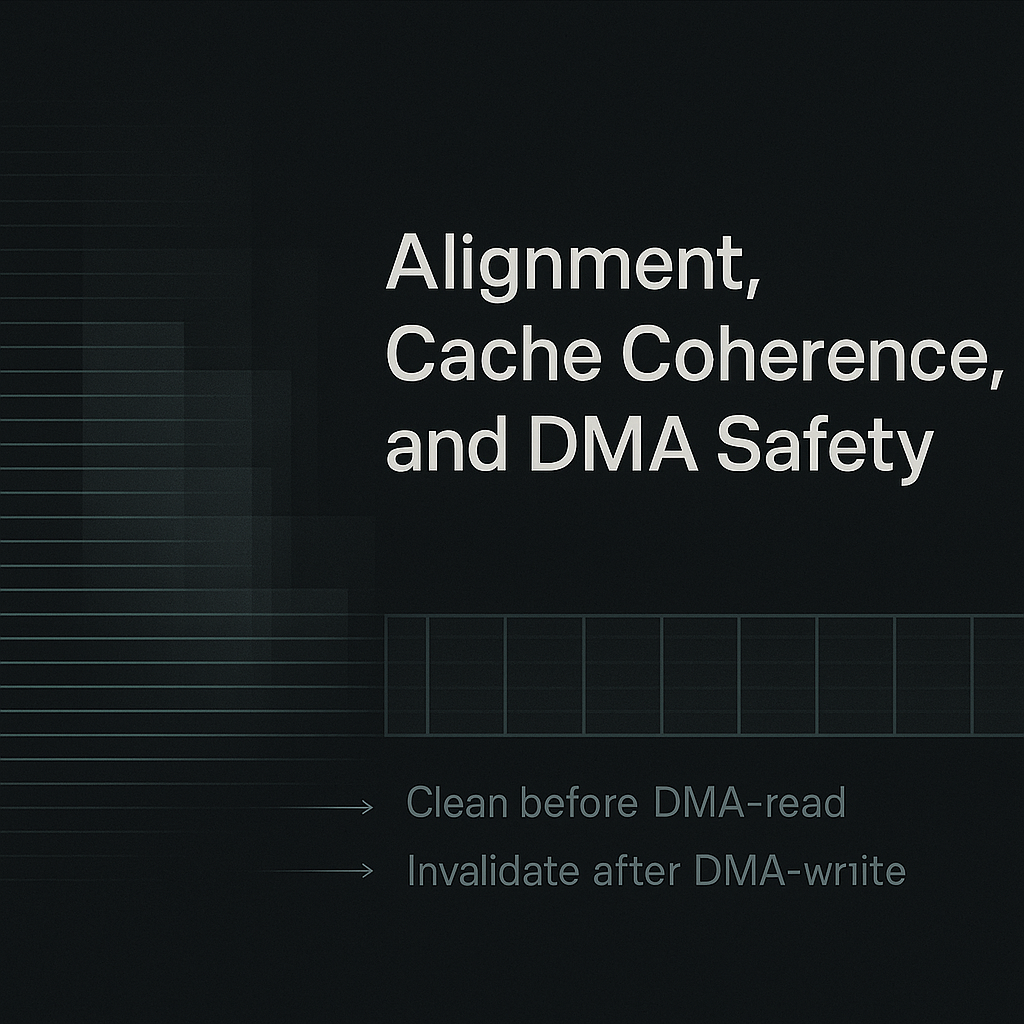
C. Manage Cache Coherence Explicitly
Before DMA reads from memory:
- CPU performs cache clean/write-back (push data to RAM)
After DMA writes to memory:
- CPU performs cache invalidation (pull fresh data from RAM)
This forces both parties to agree on the same data—removing stale-frame bugs entirely.
4. Result: Predictable, Load-Stable DMA Behavior Across Devices
Once alignment rules, buffer placement, and cache coherence steps were formalized, the problems vanished—not just the intermittent corruption, but the subtle timing drift and rare stale reads too.
The effect across Hoomanely's ecosystem:
- Tracker telemetry streams stabilized even under parallel sensor bursts.
- EverBowl’s multi-sensor frames stopped exhibiting cross-frame residue.
- EverHub pipelines behaved identically across SoM variants—even when mixing cache policies and DMA engines.
The fix wasn’t a patch.
It was an architectural correction.
5. Learnings: The Hidden Rules of DMA-Safe Buffer Design
After going through this, several principles became non-negotiable:
1. Alignment is not an optimization - it’s a contract.
If a buffer can cross a cache-line or burst boundary, DMA behavior is undefined.
2. Cached memory cannot be trusted without explicit handshakes.
Invalidate. Clean. Repeat. Pretend the CPU and DMA speak different languages—because they do.
3. DMA regions must be declared consciously.
Mixed allocations are where bugs hide.
4. Problems surface only under real load.
Synthetic tests rarely reproduce the interplay between CPU caches, bus contention, and DMA bursts.
5. Driver changes can’t fix memory-architecture bugs.
When the buffer model is wrong, software logic becomes irrelevant.
6. Architecture Reasoning: Why the Fix Actually Works
Most DMA engines operate independently of CPU caching logic. The CPU assumes “memory reflects my writes” unless told otherwise. DMA assumes “memory reflects physical RAM” at all times.
These assumptions diverge unless we:
- align buffers so DMA never crosses partial boundaries
- separate regions so the MMU/MPU enforces consistent access semantics
- use explicit cache ops so both views converge
The architecture succeeds because it restores one truth between CPU and DMA. Once both agents operate on the same timeline, the system becomes deterministic again.
Final Takeaways
1. DMA doesn’t fail randomly—it fails when memory lies.
If the CPU and DMA disagree about memory boundaries or contents, strange behavior emerges.
2. Alignment and cache coherence must be intentional.
Default allocation never guarantees DMA safety.
3. Stabilizing DMA is an architectural problem, not an ISR problem.
Once the memory model is correct, drivers become dramatically simpler.
4. These patterns apply to any IoT or embedded system.
Whether it's a sensor hub, camera pipeline, audio interface, or weight-sensing system—DMA engines behave the same everywhere.