Beyond Brute Force: Why HNSW is the Gold Standard for Vector Search
The bottleneck of modern vector retrieval.
When working with high-dimensional embedding space-whether serving semantic search, recommendation engines, or Retrieval-Augmented Generation (RAG) pipelines - the fundamental challenge is nearest-neighbor search. Exact nearest-neighbor methods require calculating the vector distance (like Cosine or Euclidean) between a query vector and every single item in a dataset. At O(N) computational complexity, this brute-force approach rapidly hits a latency wall as collections scale into millions of records. To deliver sub-millisecond query responses without burning through compute infrastructure, systems must abandon exact global comparisons in favor of Approximate Nearest Neighbor (ANN) algorithms.
What HNSW actually is under the hood.
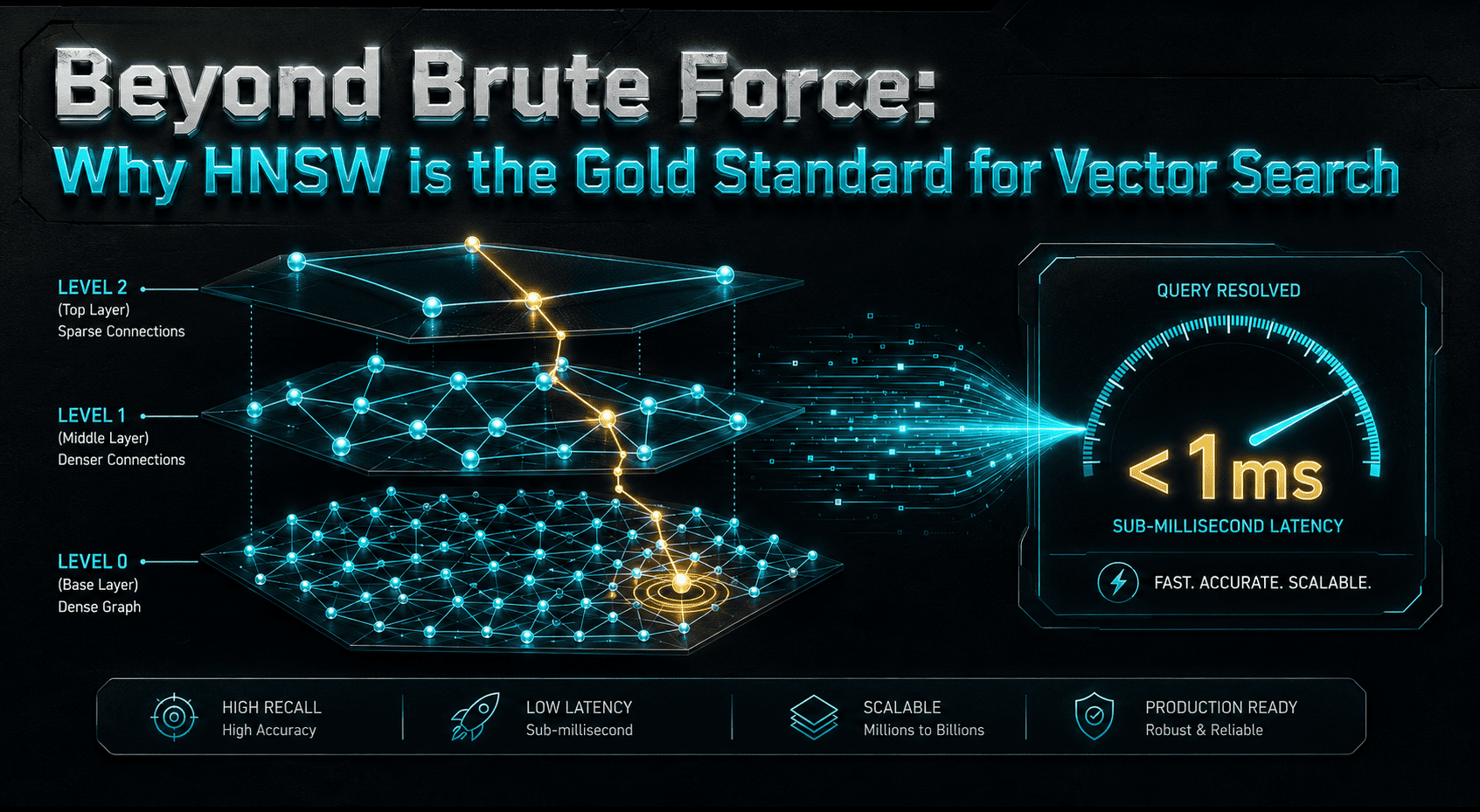
Hierarchical Navigable Small World (HNSW) is a state-of-the-art, graph-based index structure designed for high-dimensional ANN retrieval. It merges two distinct computer science concepts: the multi-layered Skip List and the Navigable Small World (NSW) graph. Rather than keeping all data points in a single flat structure, HNSW constructs a multi-layer graph. The top layers are sparse, containing fewer nodes connected by long-range highway links. As you descend through the hierarchy, each layer becomes progressively denser with shorter-range edges, ending at the bottom layer, which contains every vector in the database linked to its immediate visual or semantic neighbors.
How query routing traverses the hierarchy.
Searching an HNSW index mirrors navigating a highway system to find a specific local address. A search begins at a fixed entry point on the top, sparsest layer. The algorithm executes a greedy search across those long-range connections, rapidly hopping toward whichever node gets closest to the query vector. Once it hits a local minimum on that layer, it drops down to the corresponding node in the layer below and resumes the search. This top-down coarse-to-fine traversal trims down the search space exponentially, yielding logarithmic O(log N) search complexity that turns massive multi-dimensional vector collections into ultra-fast lookup paths.
Why HNSW outperforms alternative vector indices.
HNSW is widely regarded as the gold-standard vector indexing technique because it delivers an exceptional trade-off between query throughput and recall accuracy. Alternative methods like IVF (Inverted File Index) rely on coarse k-means clustering to partition the search space, which often hurts recall if the query falls near cluster boundaries unless you scan many clusters (nprobe). Tree-based structures (like KD-Trees) degrade quickly in high dimensions due to the curse of dimensionality. HNSW avoids these traps by building proximity graphs directly in the vector space, consistently yielding 95%+ recall rates at microsecond query latencies, even across complex, high-dimensional datasets.
The trade-offs: memory costs and build overhead.
The exceptional speed of HNSW comes at a real cost. Building an HNSW graph requires extensive pairwise distance computations to construct and prune optimal edges (M connections per node) across every layer, resulting in heavy CPU overhead and slow indexing times. More importantly, storing all bidirectional graph pointers alongside high-dimensional vectors in RAM makes HNSW memory-intensive. Furthermore, handling node deletions can degrade graph connectivity over time unless the database actively manages tombstone cleanup. It isn't a silver bullet for write-heavy or low-RAM environments, but for read-heavy vector workloads requiring raw retrieval speed, the performance dividend is unmatched.