Content-Security-Policy in Next.js: Environment-Aware Headers, connect-src Rules, and Realtime Pitfalls

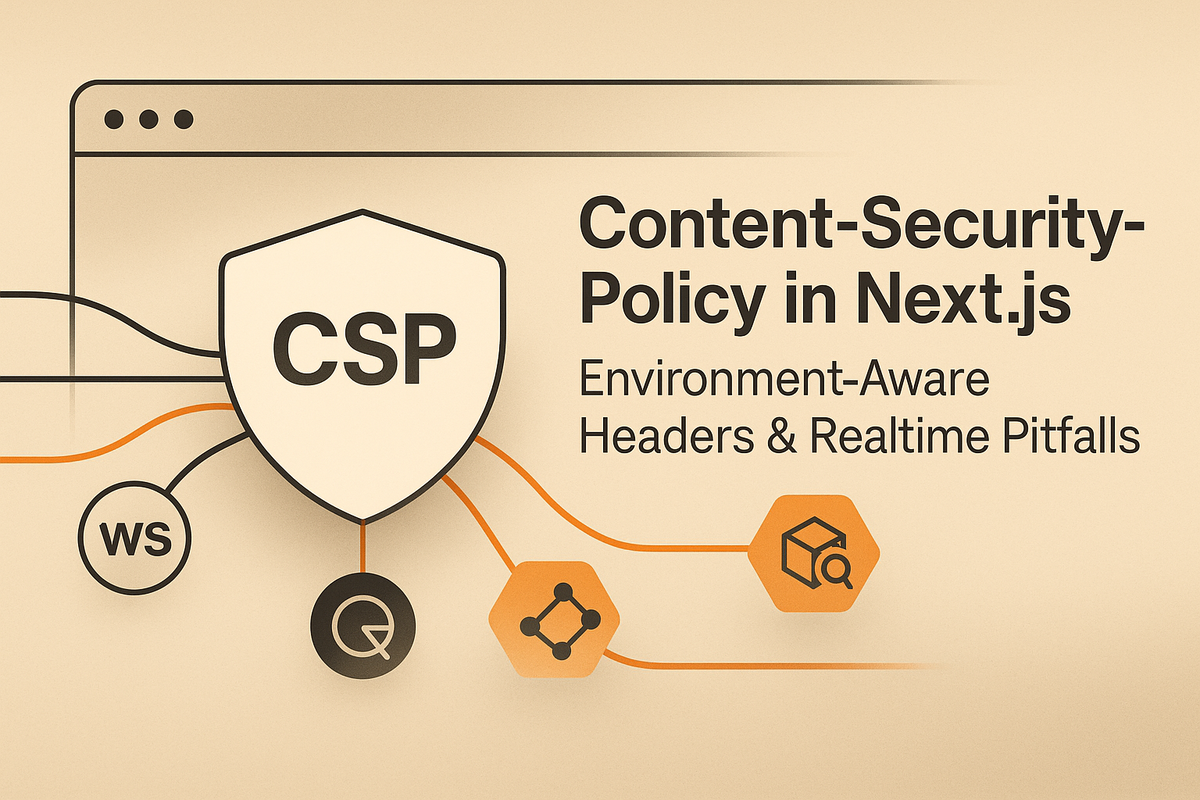
Content-Security-Policy (CSP) is often treated as a box to check: paste a template from OWASP, sprinkle a few nonces, and call it secure. But in modern application stacks especially those built on the Next.js App Router, React Server Components, and real-time GraphQL connections a static CSP is not just insufficient; it’s dangerous. It can silently block hydration, kill WebSocket upgrades, or collapse real-time telemetry flows without leaving meaningful traces.
In this deep dive, we’ll walk through the architecture, reasoning, and real-world pitfalls of implementing environment-aware CSP rules with headers() in the App Router. The focus is on one directive that causes disproportionate engineering pain: connect-src.
Along the way, I’ll share how we use environment-specific CSP at Hoomanely, where our fleet of SoM-based devices—Tracker, EverBowl, and EverHub—relies on real-time telemetry ingestion. While the frontends powering our internal dashboards are cloud-based rather than device-hosted, the same CSP considerations apply whenever you need streaming logs, live device health, or gated admin access to real-time channels.
Problem: Why CSP Breaks Modern Next.js Apps
A CSP is meant to restrict where scripts, images, fonts, and connections can originate. But the web of 2025 is no longer static HTML + JS. A modern Next.js app includes:
- React Server Components that interleave server and client execution
- Streaming responses that rely on hydration scripts
- Edge-rendered layouts that preload data
- GraphQL clients that batch requests and retry over multiple transports
- Real-time connections using WebSockets, SSE, or AppSync subscriptions
- Analytics and monitoring scripts that spin up background
connectevents
A static CSP template is usually unaware of these interactions. A single missing directive can cause failures like:
- Hydration never starts because inline bootstrap scripts are blocked
- WebSocket connections silently downgrade or fail
- GraphQL subscriptions disconnect immediately
- AppSync real-time endpoints are blocked
- Inline nonce mismatches between RSC and client shell
- Dev tools stop working (Next dev server is heavily dependent on
ws://localhostconnections)
And the worst part? Next.js will render the page without errors, leaving you debugging a "suspected race condition" when the culprit is simply a too-strict CSP.
This is why CSP must be environment-aware, not “copy-pasted once and deployed forever.”
Why It Matters: CSP Is Not One Policy - It's Three
A correct CSP is inherently tied to its environment:
1. Development
- Requires
localhost:*connections - Requires WebSocket dev channel
- Often uses eval-like constructs internally
- Uses inline scripts for fast refresh
- Requires permissive
connect-src
2. Staging
- Requires real backend domains
- Needs AppSync/GraphQL endpoints
- Still requires debugging and observability tools
- Should be stricter than dev but not prod
3. Production
- Must eliminate unsafe code
- Must use nonces or hashes for bootstrap scripts
- Must explicitly allow only real domains
- Must support real-time connections without wildcard fallbacks
Trying to use one CSP for these three worlds will produce fragile, brittle apps.
A well-designed CSP should be flexible where it must be, strict where it can be.
Architecture: Designing an Environment-Aware CSP Model
A resilient CSP for the App Router typically adopts a layered approach:
Layer 1: Core Structure
A predictable CSP for Next.js App Router apps often includes:
default-src 'self';script-src 'self' 'nonce-{nonce}';style-src 'self' 'unsafe-inline';img-src 'self' data: blob:;font-src 'self';connect-src <dynamic>;
Everything in this template is stable except connect-src.
This is where DX, real-time communication, and production lockdown collide.
Layer 2: The connect-src Expansion Pack
To support real-time systems, connect-src must anticipate:
- REST fetches
- GraphQL queries/mutations
- GraphQL subscription endpoints
- AppSync real-time endpoint
- WebSocket fallback transports
- SSE event streams
- Analytics ingestion
- CDN-backed prefetching
These connections vary dramatically across environments.
Layer 3: Per-Environment Merge Rules
A practical pattern:
connect-src 'self' http://localhost:* ws://localhost:* https://*.ngrok.io data:;Why so permissive?
- Fast Refresh uses WebSockets
- Vite-style tools (if present) use event streams
- Dev tunnels need wildcard domains
- Errors appear instantly instead of failing silently
Staging
connect-src 'self' https://staging-api.example.com wss://staging-rt.example.com https://*.amazonaws.com;Why?
- Mirrors production
- Allows real-time debugging
- Restricts localhost
- Supports CDN + AppSync
Production
connect-src 'self' https://api.example.com wss://rt.example.com https://<region>.amazonaws.com;Why?
- Clear, tight allow-list
- Supports production AppSync & subscription URLs
- Eliminates wildcard domains
- Eliminates localhost and eval-based tools
Implementation: headers() API and Dynamic CSP
The App Router’s headers() hook lets you generate CSP per request.
Pseudo-pattern:
export function headers() {
  const env = process.env.APP_ENV;

  return [
    {
      source: "/(.*)",
      headers: [
        {
          key: "Content-Security-Policy",
          value: generateCsp(env),
        },
      ],
    },
  ];
}
Where generateCsp() returns environment-specific policies.
You can also insert per-request nonce like:
const nonce = crypto.randomUUID();
Used to unlock Next.js' RSC bootstrap script.
Real-World Usage: Where CSP Intersects IoT Dashboards
At Hoomanely, our internal tools visualize telemetry from:
- Tracker devices (motion, altitude, external events)
- EverBowl (body temperature, audio events, weight curves)
- EverHub (edge inference and pipeline decisions)
Much of this data is streamed via GraphQL subscriptions or WebSocket-backed SSE.
Because real-time data is essential for validating device behavior, we run dashboards in three environments: dev, staging, production. Each environment has different transports and endpoints.
A strict but environment-unaware CSP would:
- Block EverHub’s real-time decision logs
- Block Tracker live positional traces
- Block EverBowl audio event streaming
- Prevent dev tools from connecting
By designing a configurable, environment-aware connect-src, we ensure:
- Real-time flows in development stay fluid
- Staging reproduces the production environment accurately
- Production stays secure without DX sacrifices
This balance is essential in multi-device ecosystems where telemetry is time-sensitive.
Common Pitfalls: Why Realtime Breaks Silently
Engineers often encounter these issues when adding a CSP to Next.js:
1. WebSockets Blocked by Missing wss:// Domains
Next.js dev server uses WS heavily. AppSync subscriptions use a different connection URL than GraphQL queries. Forgetting the wss:// endpoint silently kills real-time features.
2. SSE Fails Because of Missing EventStream MIME Allowances
Not all real-time solutions use WebSockets.
Some require:
connect-src …;
plus ensuring no other directive blocks them.
3. Hydration Fails Because Inline Scripts Are Restricted
Next.js injects a minimal inline script to bootstrap the RSC boundary. This requires a nonce. Without it:
- the JS bundle loads
- the client never hydrates
4. AppSync Real-time Endpoint Not Matching Your GraphQL URL
AWS AppSync uses a secondary endpoint for subscriptions:
https://xxxxxxxx.appsync-realtime-api.<region>.amazonaws.com
Many engineers allow only:
https://xxxxxxxx.appsync-api.<region>.amazonaws.com
and subscriptions fail instantly.
5. Preload and Prefetch Requests Blocked Under connect-src
Next.js issues background requests for:
- RSC preloads
- Pre-rendered route segments
- Optimistic client navigations
If connect-src doesn’t include your CDN + data source domain, prefetching dies, increasing TTFB.
Takeaways
1. CSP is not static—it’s a living specification tied to environments.
Development needs freedom; production demands precision.
2. connect-src is the hardest part of CSP for modern, real-time apps.
WebSockets, AppSync, SSE, analytics, and RSC preloads all require explicit allowances.
3. Next.js App Router relies on inline scripts that require nonce-based unlocking.
Missing this breaks hydration silently.
4. Environment-aware CSP design prevents common debugging rabbit holes.
Write code that generates CSP per environment—not a single template.
5. In multi-device IoT ecosystems, real-time data is non-negotiable.
CSP must secure production without strangling live telemetry.