Corrugated flute selection: B, C or E for shipping boxes
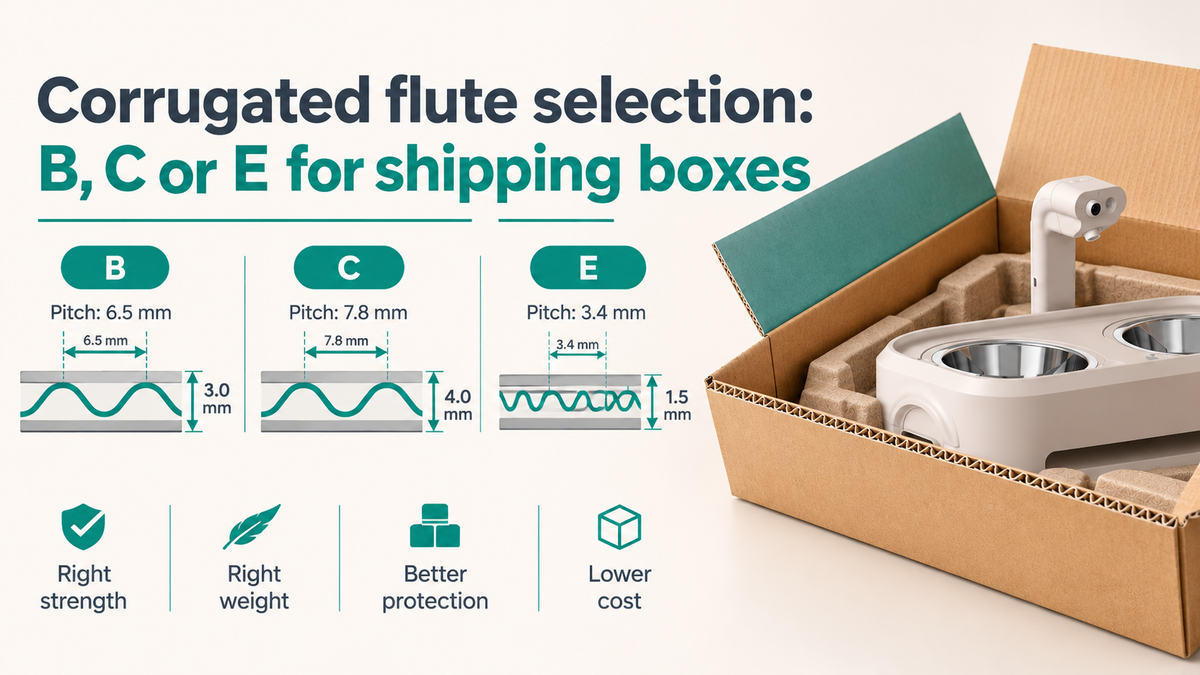
For a stacked shipping carton, C flute is the safer pick over B and E. In our illustrative sizing of a 400 × 300 × 200 mm carton, with the same 5.6 kN/m edge crush grade on all three, C flute carried 2,460 N of lab box compression strength, B carried 2,130 N and E carried 1,506 N. After derating for humidity and storage time, only B and C cleared a 2.0 safety margin against the stack load. E flute wins on print, with a flute pitch of 3.4 mm against 7.8 mm for C.
This post covers what a flute changes, why print quality and stacking strength pull in opposite directions, and how edge crush test (ECT) turns into box compression strength in newtons. It ends with what this work lets EverBowl do.
The short version
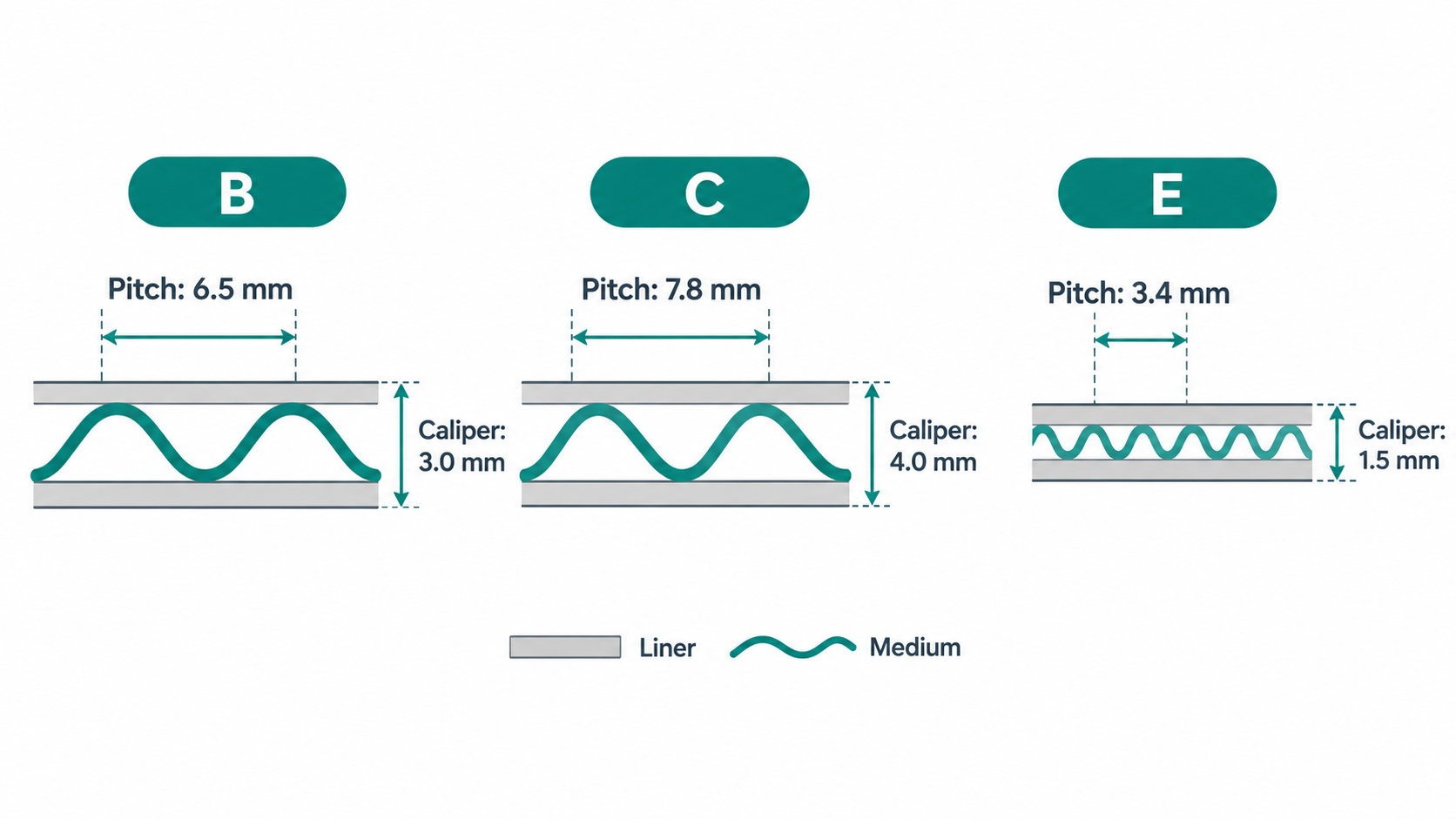
- B flute is about 3.0 mm thick with 47 flutes per foot, C is about 4.0 mm with 39, and E is about 1.5 mm with 90.
- At 5.6 kN/m ECT on a 1,400 mm perimeter, the McKee estimate gives C 2,460 N, B 2,130 N and E 1,506 N.
- After a 0.408 derating for 80 percent humidity and 30 days under load, the margins against a 392 N stack load are 2.6 for C, 2.2 for B and 1.6 for E.
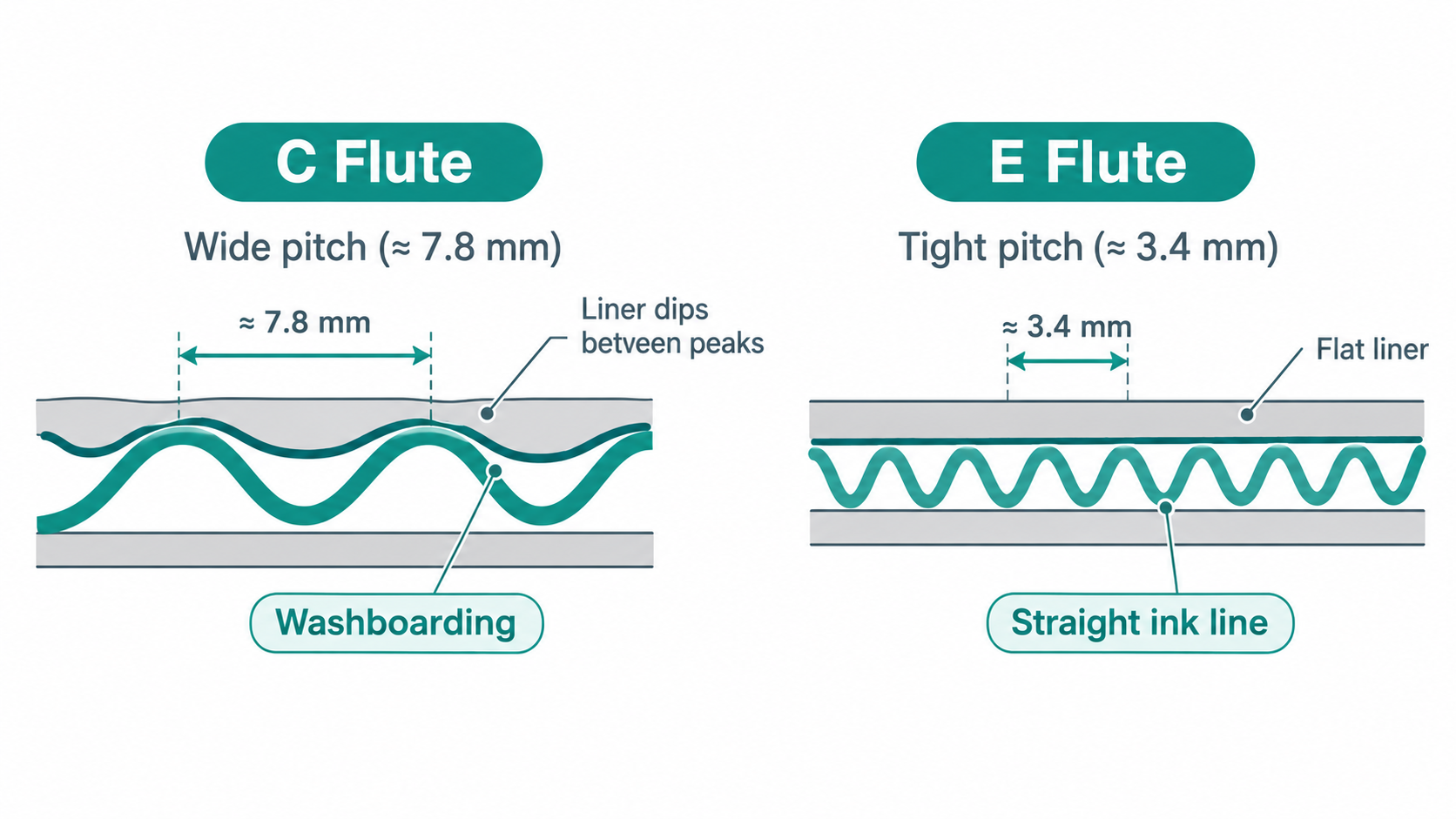
- E flute prints best because its 3.4 mm pitch leaves the liner less room to sag than C’s 7.8 mm, so it belongs in sleeves and inner cartons, not stacked outers.
What a flute is and why it changes strength
Corrugated board is a sandwich: two flat liners glued to a wavy paper medium. Mechanically it is a sandwich panel, with the flute acting like the web of an I-beam. Flute height sets board thickness (caliper), and thickness sets bending stiffness, which resists buckling when boxes are stacked.
Flute pitch is the distance between peaks. A short pitch gives the liner more support points, so the face is flatter. A tall flute gives a stiffer column but a wavier face.
| Flute | Typical caliper (mm) | Flutes per foot | Pitch (mm) | Strong at | Weak at |
|---|---|---|---|---|---|
| B | 3.0 | 47 | 6.5 | Print, die-cut, point loads | Stack strength, cushioning |
| C | 4.0 | 39 | 7.8 | Stacking, cushioning | Print show-through |
| E | 1.5 | 90 | 3.4 | Print, tight folds, thin profile | Stacking, cushioning |
Values are typical vendor figures and shift by mill.
What goes wrong first
The usual first pick is by feel. Someone presses an E flute sample, finds it stiff and clean to print, and specs it for the outer carton.
That test is wrong because hand stiffness measures bending of a small sample. Stacking loads the vertical panels as columns on their edges. Thin board buckles at the edge first, and humid storage has already weakened it by then.
A carton can pass a drop test and still lean and collapse after weeks on a pallet. Board also creeps under steady load, the same effect we covered in creep in plastics: why screws lose clamp load over months. The fix is to start from the load, not from the sample.
Edge crush test (ECT): the board number
ECT is the load per unit width that a short strip of board carries on its edge before it buckles, in kN/m. For reference, 1 kN/m is about 5.7 lb/in, so a 32 ECT board is about 5.6 kN/m.
ECT belongs to the board, not the box. The box adds its own geometry, which is where the next formula comes in.
From ECT to box compression strength in newtons
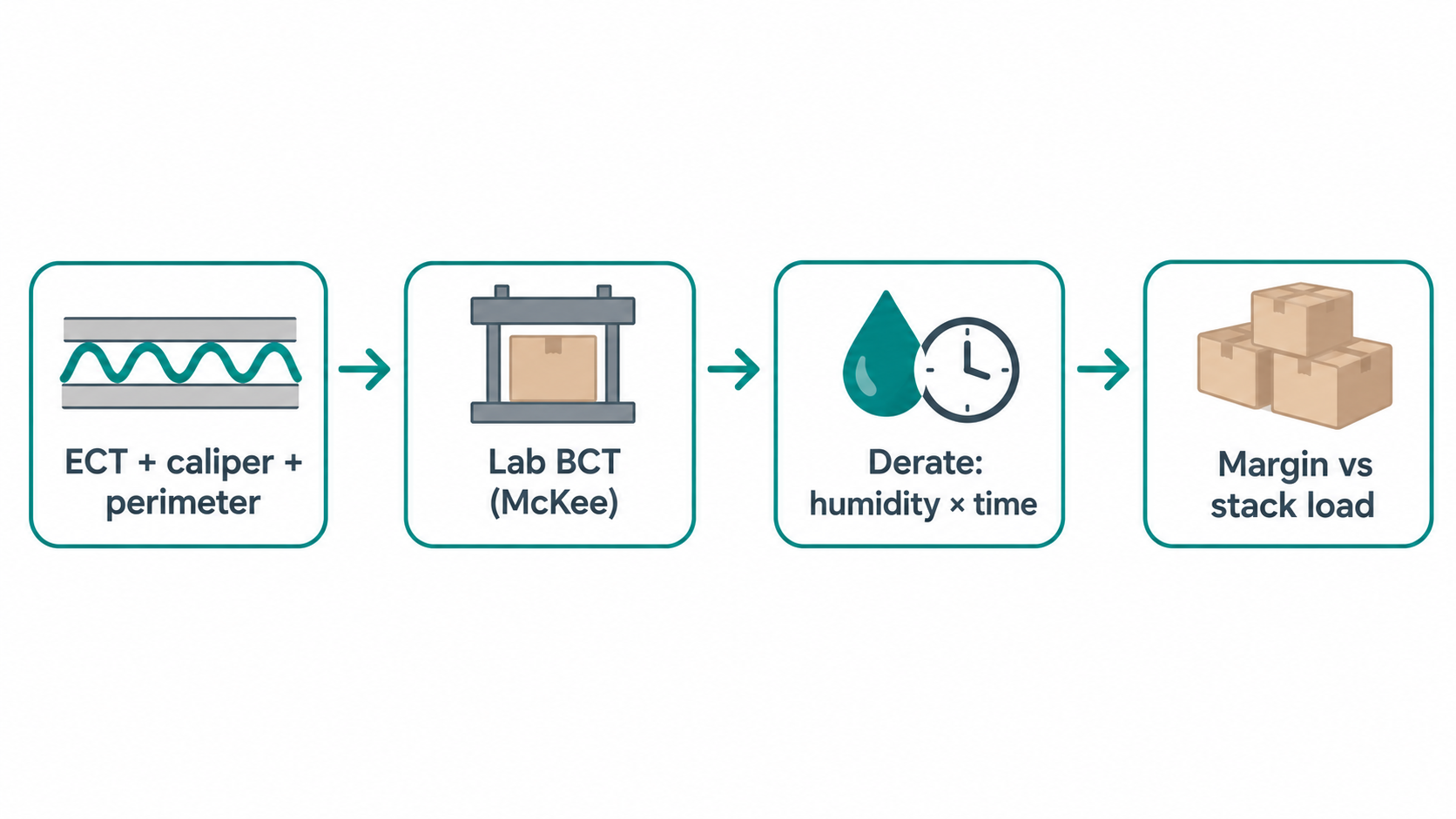
McKee’s simplified formula estimates box compression test (BCT) strength from three inputs:
BCT = 5.87 × ECT × √(Z × t)
BCT in N | ECT in kN/m | Z = 2 × (L + W) in mm | t = caliper in mm
ECT sets strength per unit width. Perimeter times caliper sets how much board, and how much stiffness, holds the walls straight. Caliper sits under a square root, so a thicker flute helps, but less than a higher ECT does.
Step 1: Compute lab strength
Our hypothetical carton is 400 × 300 × 200 mm, so Z = 1,400 mm. We assume 5.6 kN/m for all three flutes, so caliper is the only variable.
- B (3.0 mm): 2,130 N
- C (4.0 mm): 2,460 N
- E (1.5 mm): 1,506 N
Step 2: Derate for the real world
Lab BCT is a fresh carton at 50 percent relative humidity. Packaging references give a multiplier of 0.68 for 80 percent humidity and 0.60 for 30 days under load. Multiplied, that is 0.408.
Derated strength: B 869 N, C 1,004 N, E 615 N.
Step 3: Compare with stack load
Assume an 8 kg packed carton stacked six high. The bottom carton carries five above it: 5 × 8 kg × 9.81 = 392 N.
Margin is derated BCT divided by load: C 2.6, B 2.2, E 1.6. Our hypothetical rule is 2.0 or better, to cover handling scatter. E fails.
Working backward, a 2.0 margin needs 1,924 N of lab strength. That means ECT of 4.4 kN/m for C, 5.1 for B and 7.2 for E. Thin board has to make up the difference with heavier liners.
Print quality: why E wins and what it costs
The liner spans the gap between flute peaks. Under roller pressure and drying, it dips between them, so ink lands on a rippled surface. This is often called washboarding.
At C’s 7.8 mm pitch the ripple shows on fine halftones. At E’s 3.4 mm pitch it mostly disappears.
B and C can still print well in two ways: print the liner before corrugating, or laminate a printed sheet. Both add process steps and lead time. For a logo, handling marks and a barcode, direct flexo on B or C is fine.
Choosing between B, C and E
- C: default outer carton for stacked, heavy or long-route shipments.
- B: modest stack loads, small perimeters, die-cut precision and puncture resistance. It resists flat crush better than C.
- E: inner cartons, sleeves and light retail-facing mailers.
- Double wall (EB or BC): when one carton needs both print and strength.
McKee is built on averages, so individual boxes scatter above and below it. Run a BCT test on prototype cartons before placing the order.
What to ask the vendor
- ECT in kN/m at 50 percent humidity. Many quotes list only GSM and burst factor.
- Board caliper in mm for the exact flute and liner combination.
- Print method: direct flexo, preprint or laminated.
- A BCT report on a sample at your carton size.
What this lets EverBowl do
EverBowl™ learns each pet’s routine, and that record starts the day the unit reaches a kitchen intact. Sizing the carton from stack load, humidity and storage time gives us a board spec we can put in front of Bengaluru vendors for EverBowl pilot packaging. The pulp and cardboard inserts carry cushioning, so the carton only has to carry the stack.
The honest limit: every number here is a McKee estimate on a hypothetical carton, not a test on pilot units. EverBowl does not diagnose; the value is the record.
Conclusion
Pick the flute from the load, not from the sample. Compute BCT from ECT, derate for humidity and time, and check the margin against your real stack. Choose C for stacked outers and E for print-led sleeves, then confirm with a prototype BCT test before ordering.
More of our mechanical design work is in the product category page for this series.
FAQs
What is the difference between B, C and E flute?
They differ in flute height and pitch. B is about 3.0 mm thick with 47 flutes per foot, C about 4.0 mm with 39, and E about 1.5 mm with 90. Taller flutes stack and cushion better, and shorter flutes print and fold better.
What is ECT and why does it matter for boxes?
Edge crush test measures the load per unit width a board strip carries on its edge before buckling. It is the main board input to box compression estimates. A 32 ECT board is about 5.6 kN/m.
Can E flute be used for shipping?
Yes, for light, unstacked loads, and as an inner carton or sleeve. In our illustrative sizing it fell short of a 2.0 margin at an 8 kg carton stacked six high. It would need about 7.2 kN/m ECT to pass.
How much does humidity weaken a corrugated box?
Packaging references give about 32 percent strength loss at 80 percent relative humidity and 52 percent at 90 percent. Long storage under load adds more. Derate before you trust a lab number.
Is C flute always stronger than B?
No. Strength depends on ECT, caliper and box perimeter together. A higher ECT B board can beat a lower ECT C board, though B has less caliper to help. B resists flat crush and point loads better.
References
- iPack, How-to guide: measuring boxes (McKee formula, humidity and storage multipliers)
- Georgia Tech, Effects of moisture content on box compression strength
- Garbowski et al., Energies 14, 155: McKee formula and corrugated box strength
- Racklify, Die-cut corrugated box: materials, flute types and structural performance
- Packoi, Different types of corrugated paper
HTML category line for the blog maker:More of our mechanical design work is in the <a href="https://tech.hoomanely.com/category/product/">product</a> category page for this series.