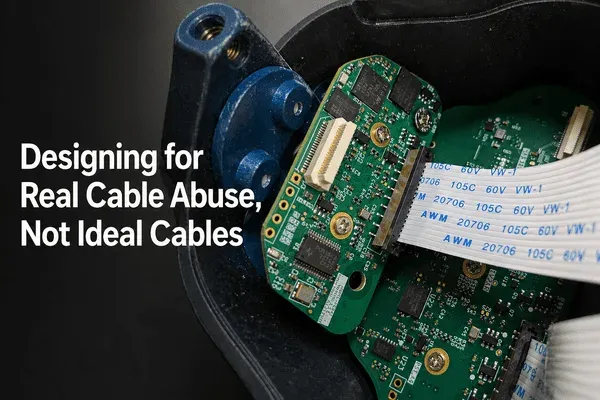
Designing for Real Cable Abuse, Not Ideal Cables
Cables are one of the most underestimated variables in embedded systems design. On paper, they're treated as passive conductors, short, well-terminated, and electrically invisible. Schematics assume clean transitions, stable impedance, and perfect contact. But once a product leaves the lab, cables stop behaving like ideal interconnects and start behaving like dynamic, failure-prone system elements.
They're bent, twisted, partially inserted, replaced with cheaper alternatives, routed alongside noise sources, and subjected to mechanical stress that was never part of the original design assumptions. And yet, many systems continue to be designed as if none of this happens.
At Hoomanely, we take a different approach. We assume from the beginning that cables will degrade, behave unpredictably, and occasionally fail in subtle ways. The design isn't built around ideal conditions, it's built to remain stable despite real-world cable abuse. Because when cables fail, they rarely fail cleanly. They introduce intermittent, non-deterministic behavior that's extremely difficult to trace and often misattributed to firmware, sensors, or processing logic.
The electrical reality of cables
A cable isn't just a connection between two points. It's an electrical structure with distributed resistance, capacitance, and inductance. These properties aren't constant, they change with physical conditions like bending, stretching, and environmental exposure.
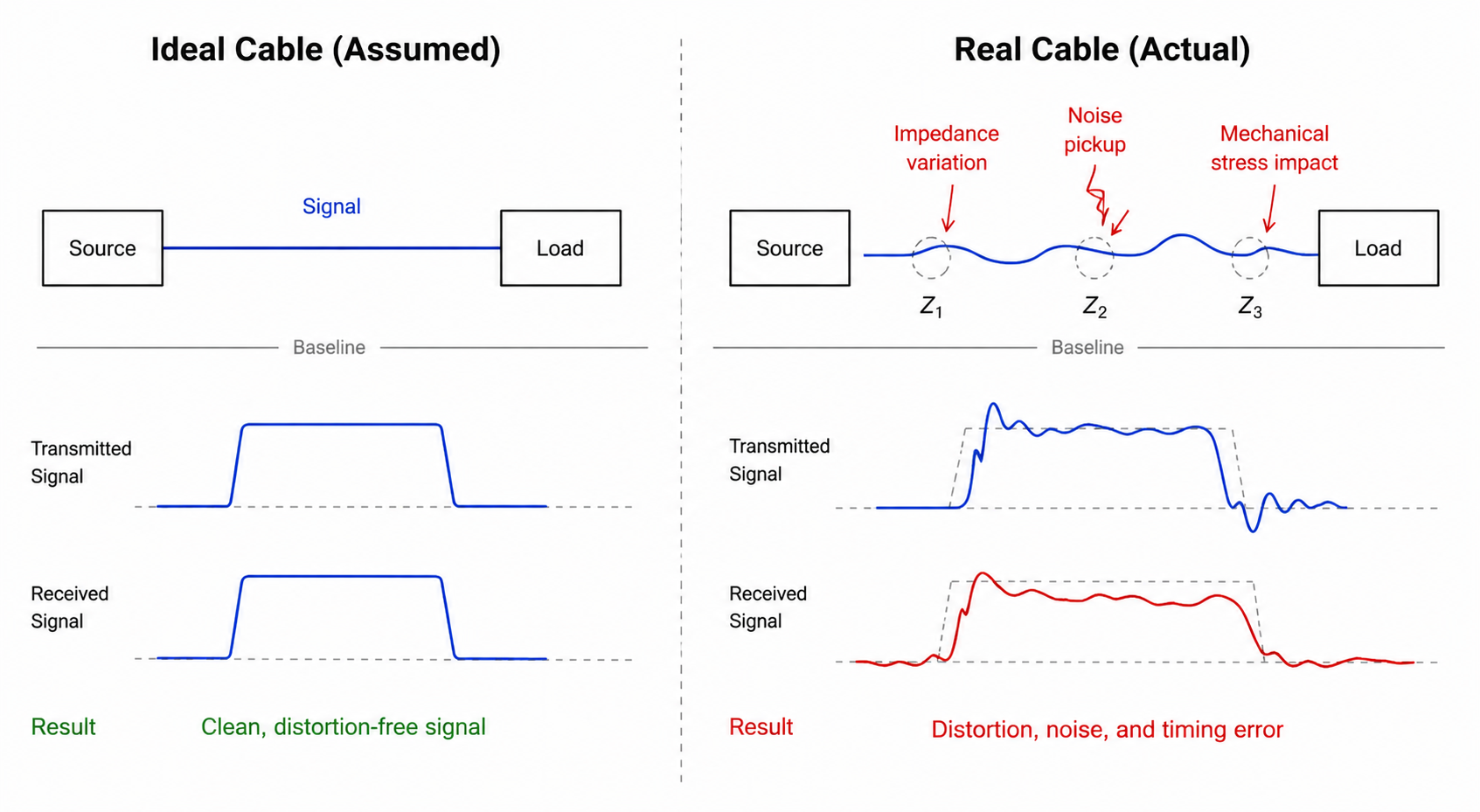
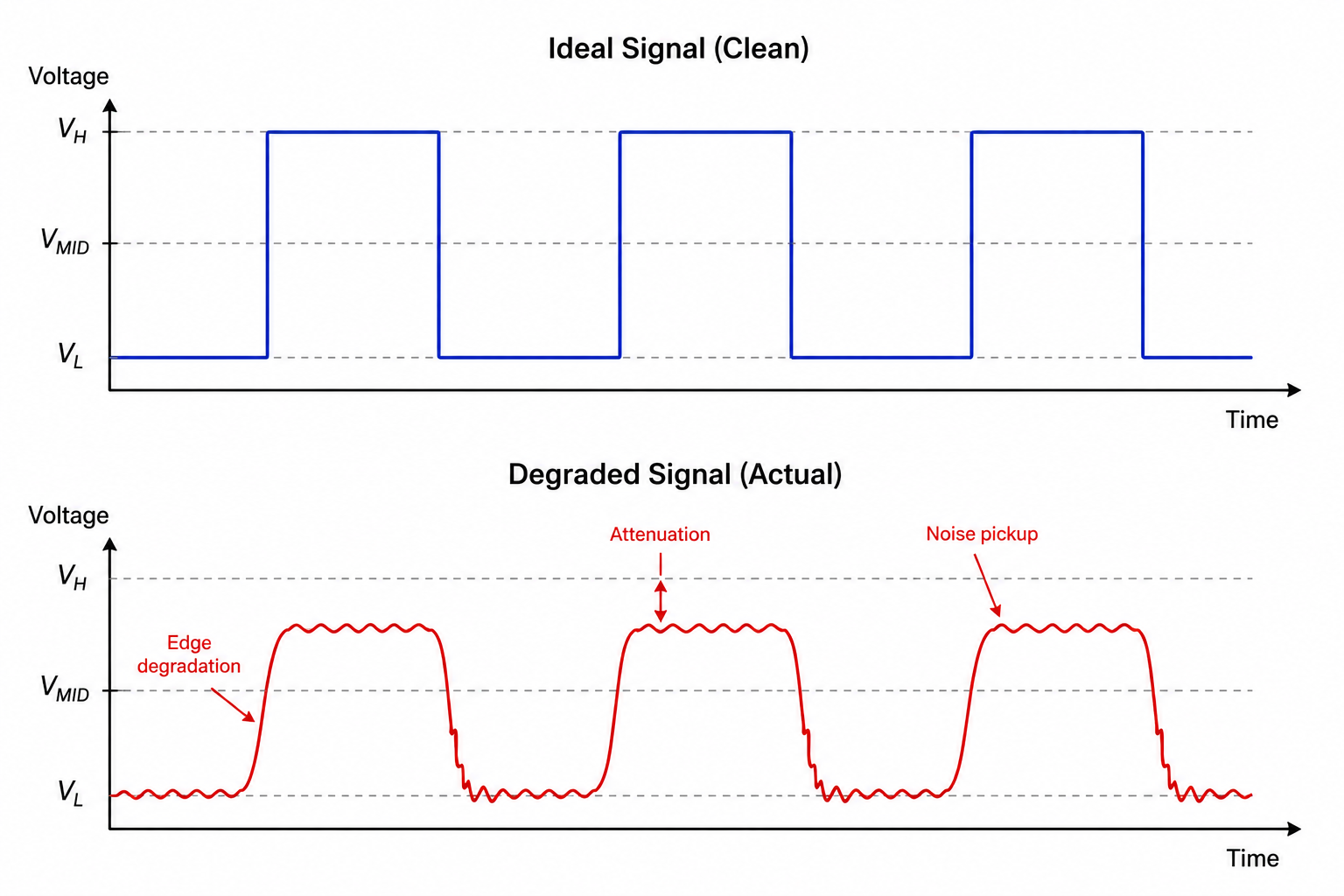
When a cable bends sharply, its effective impedance changes. When shielding is compromised, it becomes susceptible to external electromagnetic interference. When connectors are slightly misaligned or partially inserted, contact resistance increases unpredictably. These effects manifest as signal reflections due to impedance discontinuities, attenuation over longer or degraded paths, noise pickup from nearby switching elements, and transient voltage drops under load.
What makes these issues particularly challenging is that they're rarely consistent. A system may work perfectly under static conditions and fail only when the cable is moved slightly or when environmental conditions change. This is why cable-related issues are often mistaken for software bugs, they don't follow deterministic patterns.
Why designing for ideal conditions fails
Most designs implicitly assume the cable behaves as an extension of the PCB trace. The signal path is considered continuous and predictable, with negligible degradation. In practice, however, the cable introduces multiple discontinuities:
- Connectors with varying contact quality
- Transitions between PCB traces and cable conductors
- Differences in impedance between cable types
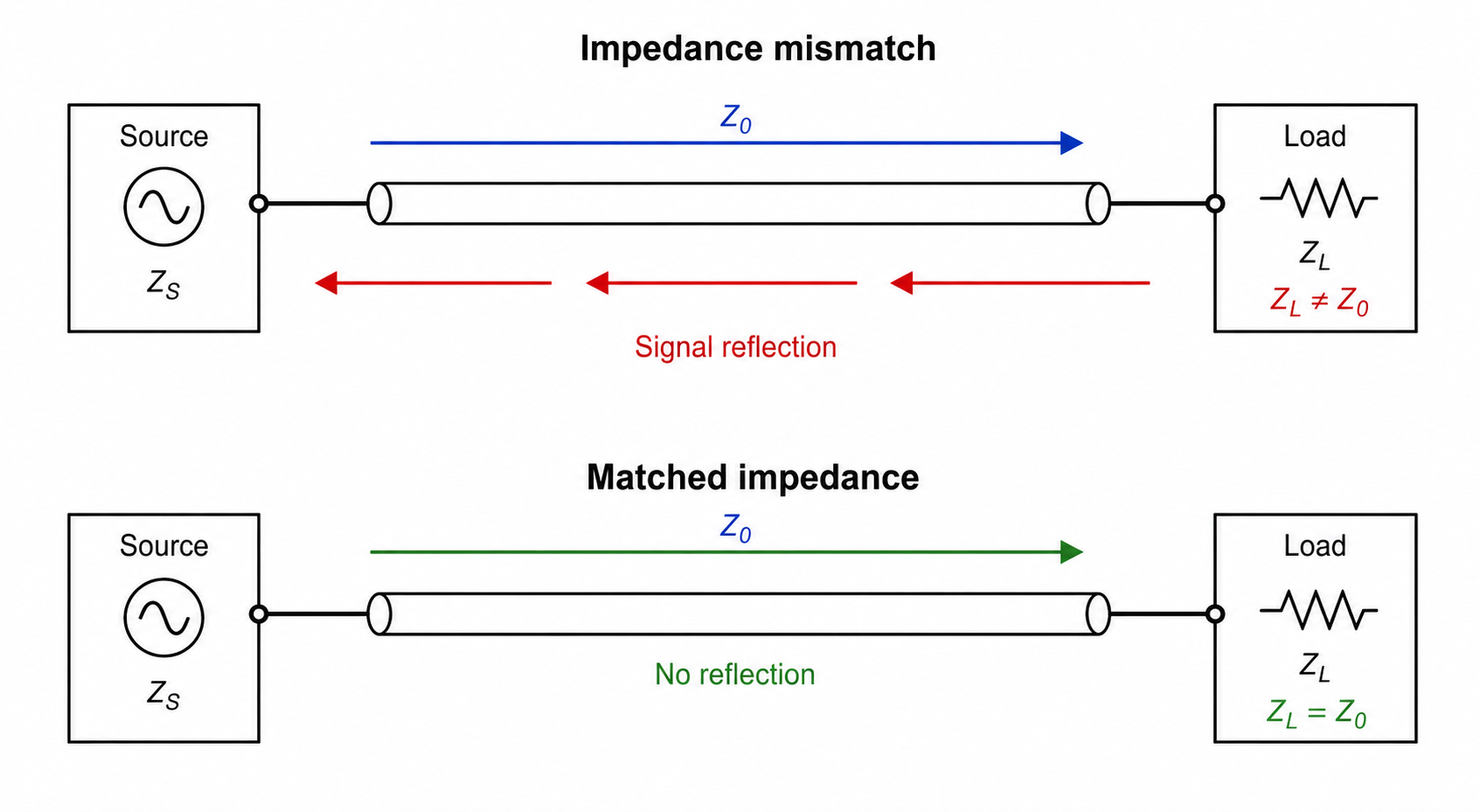
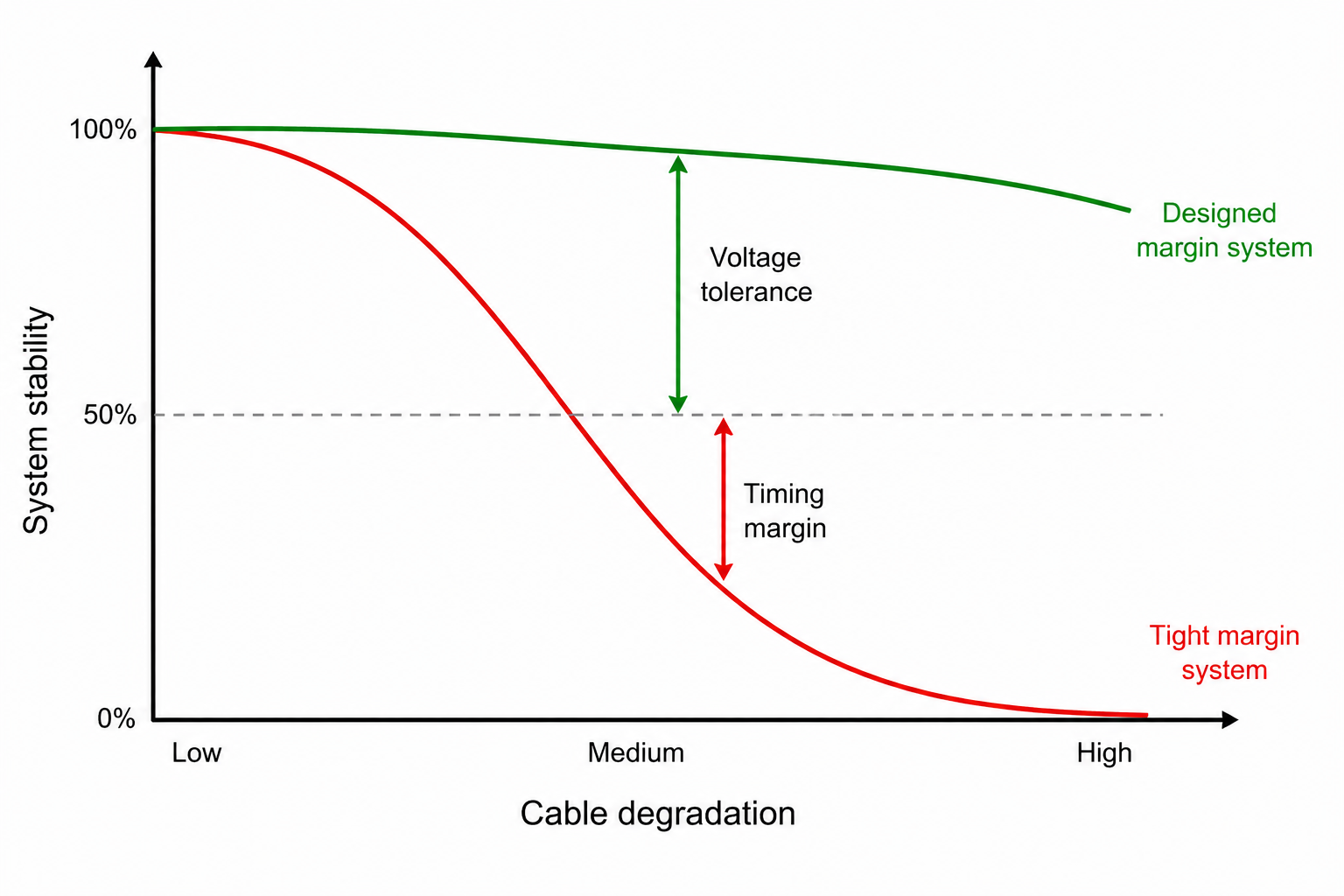
Even a small mismatch at these interfaces can cause reflections, especially in high-speed or timing-sensitive systems. If the system is designed with tight margins, minimal voltage thresholds or aggressive timing constraints, these imperfections push the system beyond its stable operating range. The result isn't immediate failure, but instability. Communication errors increase. Sensor readings become noisy. Power delivery fluctuates under load. Designing for ideal cables effectively means designing a system that only works in controlled environments.
Introducing electrical margin as a design requirement
The most effective way to handle cable variability is to introduce deliberate electrical margin. This isn't about overdesigning the system, it's about acknowledging that the signal path is imperfect and ensuring the system can tolerate that imperfection.
Voltage margins must account for drops across connectors and cables. Logic thresholds must be robust against degraded signal edges. Communication protocols must tolerate minor distortions and delays. For example, a digital interface that works perfectly at 3.3V logic levels may begin to fail if the effective voltage at the receiving end drops due to cable resistance and connector losses. By designing the system to operate reliably across a wider voltage range, these issues can be absorbed rather than exposed. Similarly, timing margins must consider the additional propagation delay introduced by cables, especially in longer runs or lower-quality conductors. The key idea is simple: the system shouldn't operate at the edge of its capabilities when the cable is perfect, because the cable will not remain perfect.
Connectors as electrical and mechanical interfaces
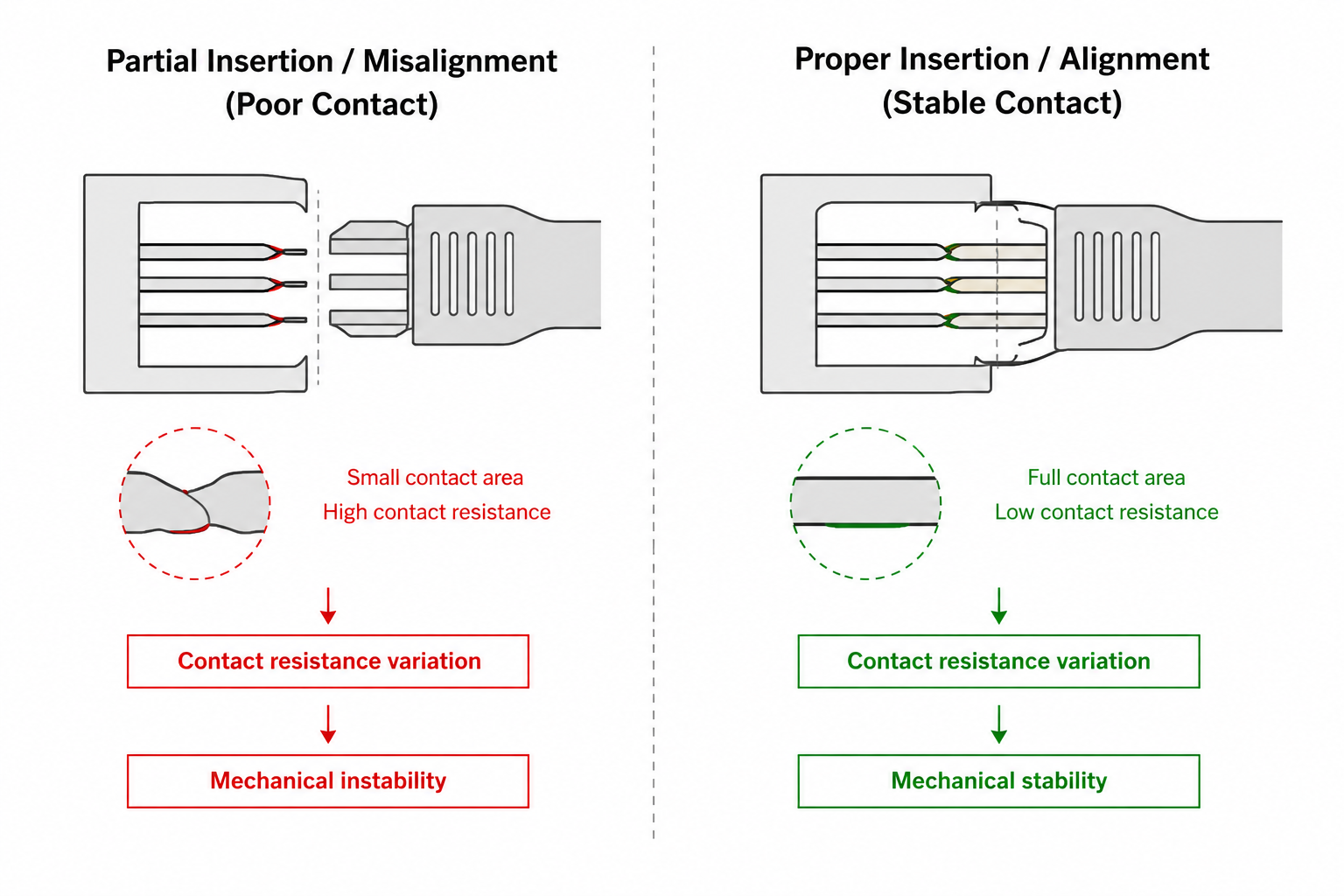
The connector is often the weakest link in the entire signal chain. While the cable itself may be well-constructed, the interface between the cable and the board introduces variability. Contact resistance changes with wear, insertion force, and alignment. Mechanical stress on the connector can translate directly into electrical instability.
At Hoomanely, connectors are treated as both electrical and mechanical components. Their placement, orientation, and support structure are carefully considered to minimize stress and maintain consistent contact, ensuring connectors aren't subjected to bending forces from cable movement, providing adequate mechanical anchoring on the PCB, and designing the surrounding layout to support reliable mating. In modular systems, where connectors are used extensively to link subsystems, their role becomes even more critical. They aren't just connection points, they define the reliability of the entire system architecture.
Signal integrity beyond the PCB
Once a signal leaves the PCB, control over its behavior decreases significantly. Within the board, impedance can be tightly controlled through trace geometry and layer stack-up. In a cable, especially one that may not meet strict specifications, this control is lost.
Reflections become more likely when the impedance of the cable doesn't match the source and load. Noise pickup increases when shielding is inadequate or compromised. Crosstalk between adjacent conductors can introduce additional distortion. To mitigate these effects, the system must be designed with an understanding of the cable environment. Termination strategies become important, especially for high-speed interfaces, and in some cases adding simple series resistors can help damp reflections and improve signal quality, while differential signaling may be preferred to improve noise immunity elsewhere. The goal isn't to eliminate cable-induced effects, that's often impossible, but to ensure they don't push the system into instability.
Power delivery over real cables
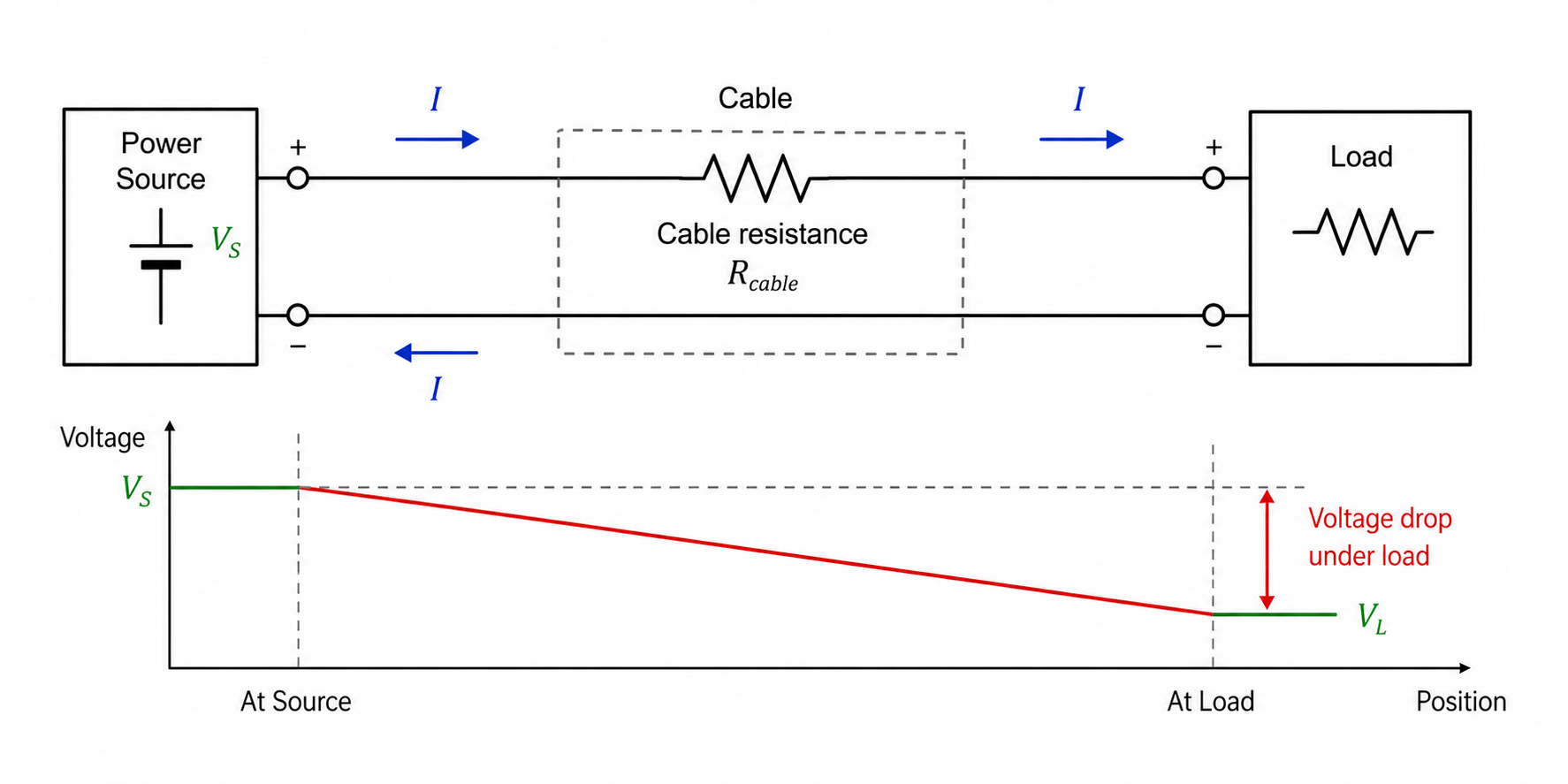
Power lines are often assumed to be robust, but they're equally susceptible to cable-related issues. Resistance in the cable causes voltage drops, which become more significant under higher current draw. Poor connections introduce additional resistance, leading to localized heating and further degradation.
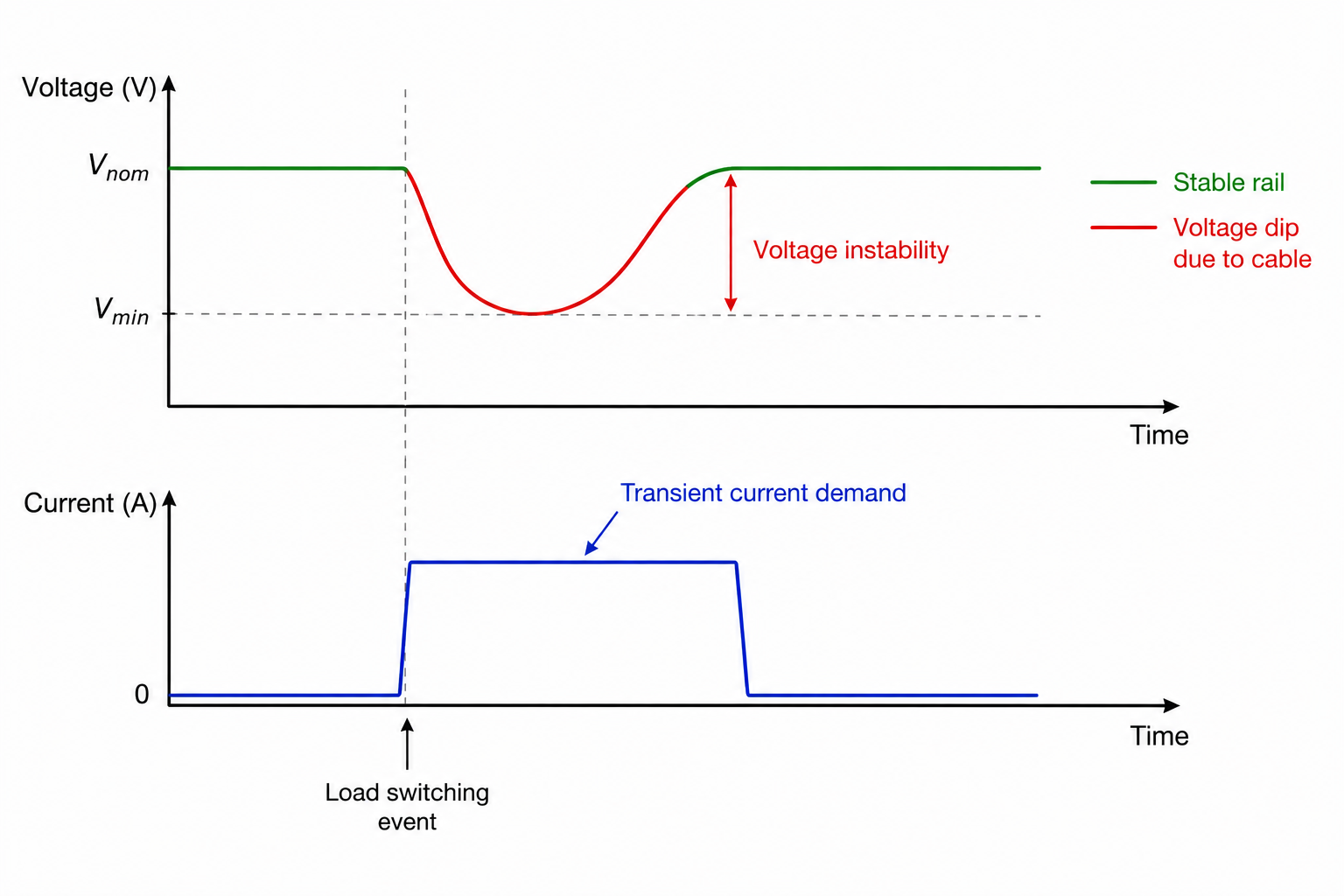
Transient conditions, such as sudden current demands, can cause voltage dips that propagate through the system. If the design doesn't include sufficient decoupling or regulation near the load, these dips can trigger resets or degrade performance. To address this, power delivery must be designed with the assumption that the cable isn't ideal, local decoupling capacitors near critical components help stabilize voltage, power regulation stages must tolerate input variation without losing stability, and in some cases monitoring supply voltage can provide early indication of cable-related issues. The system shouldn't rely on the cable to provide perfect power, it should compensate for the cable's limitations.
Mechanical stress and its electrical consequences
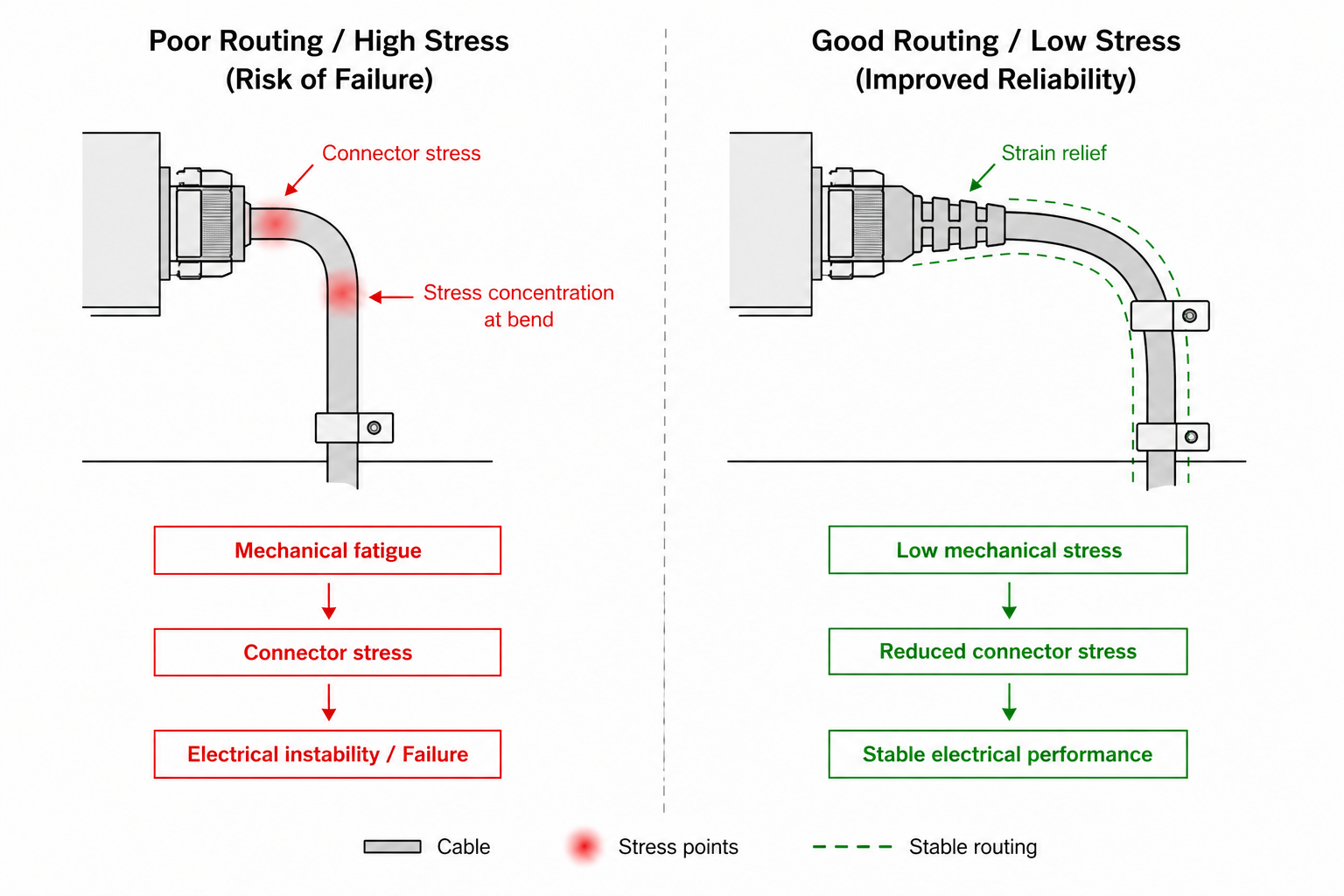
Cable abuse isn't just an electrical problem, it's fundamentally mechanical. Repeated bending, twisting, and pulling introduce stress at the connector interface. Over time, this leads to loosening, misalignment, and eventual failure. Even before complete failure, these mechanical changes affect electrical performance, contact resistance fluctuates, leading to intermittent behavior, and signals may be partially interrupted, creating glitches that are difficult to reproduce.
Designing for real cable usage means addressing these mechanical factors directly. Strain relief mechanisms can reduce the load on connectors. Connector placement can minimize the impact of cable movement. Routing of cables within the enclosure can prevent sharp bends and reduce stress concentration. A system that's electrically robust but mechanically fragile will still fail in the field.
Handling the reality of "wrong" cables
One of the most important design assumptions is that users will not always use the intended cable. They may use longer cables, lower-quality cables, unshielded variants, or cables with different electrical characteristics. The system shouldn't immediately fail under these conditions.
This doesn't mean supporting every possible cable, but it does mean avoiding catastrophic behavior when the cable deviates from the ideal. Interfaces should be tolerant to a reasonable range of conditions, detection mechanisms can identify when the cable is operating outside expected parameters, and protective measures can prevent damage even if performance is degraded. The goal is to degrade gracefully, not fail abruptly.
Observations from real systems
In systems similar to EverBowl, where multiple modules are interconnected and cables are frequently handled, the impact of cable design assumptions becomes very clear. Early designs that assumed ideal cables exhibited intermittent failures that were difficult to trace. Sensor readings fluctuated unpredictably. Communication links occasionally dropped without clear cause. Debugging cycles became longer and more complex.
After redesigning with cable variability in mind, these issues were significantly reduced. The system became more stable under real-world usage. Failures, when they occurred, were more deterministic and easier to diagnose. The overall reliability of the product improved without major changes to core functionality. This wasn't the result of a single fix, but of a shift in design philosophy, from assuming ideal conditions to designing for realistic ones.
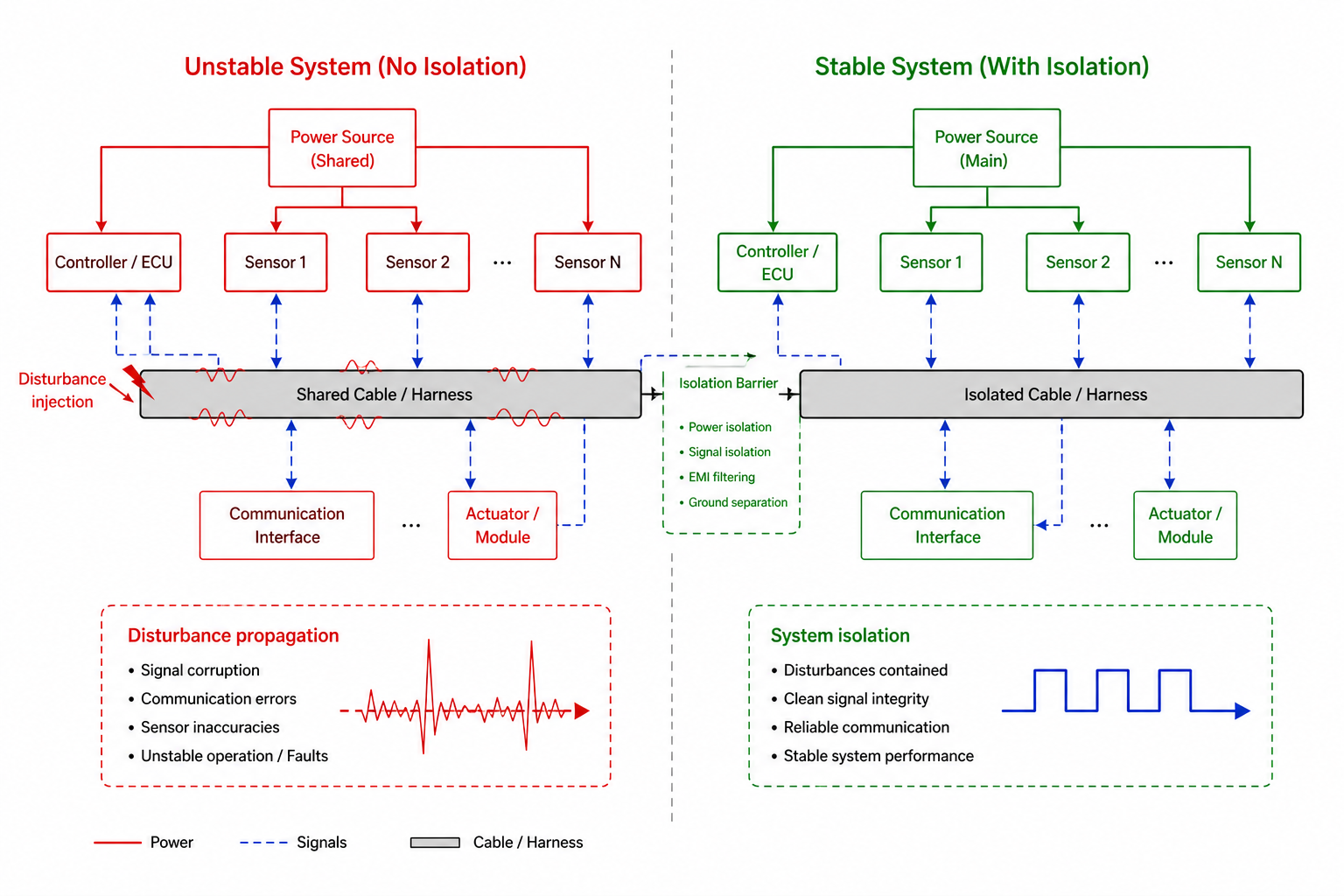
A more realistic design philosophy
The difference between conventional and structured design approaches isn't in the components used, it's in the assumptions made. A conventional design assumes the environment will behave as expected. A structured design assumes it will not. By treating cables as variable, imperfect elements, the design becomes inherently more robust. Electrical margins absorb variation. Mechanical design reduces stress. Signal integrity considerations extend beyond the PCB. This approach doesn't eliminate cable-related issues entirely, but it prevents them from destabilizing the system.
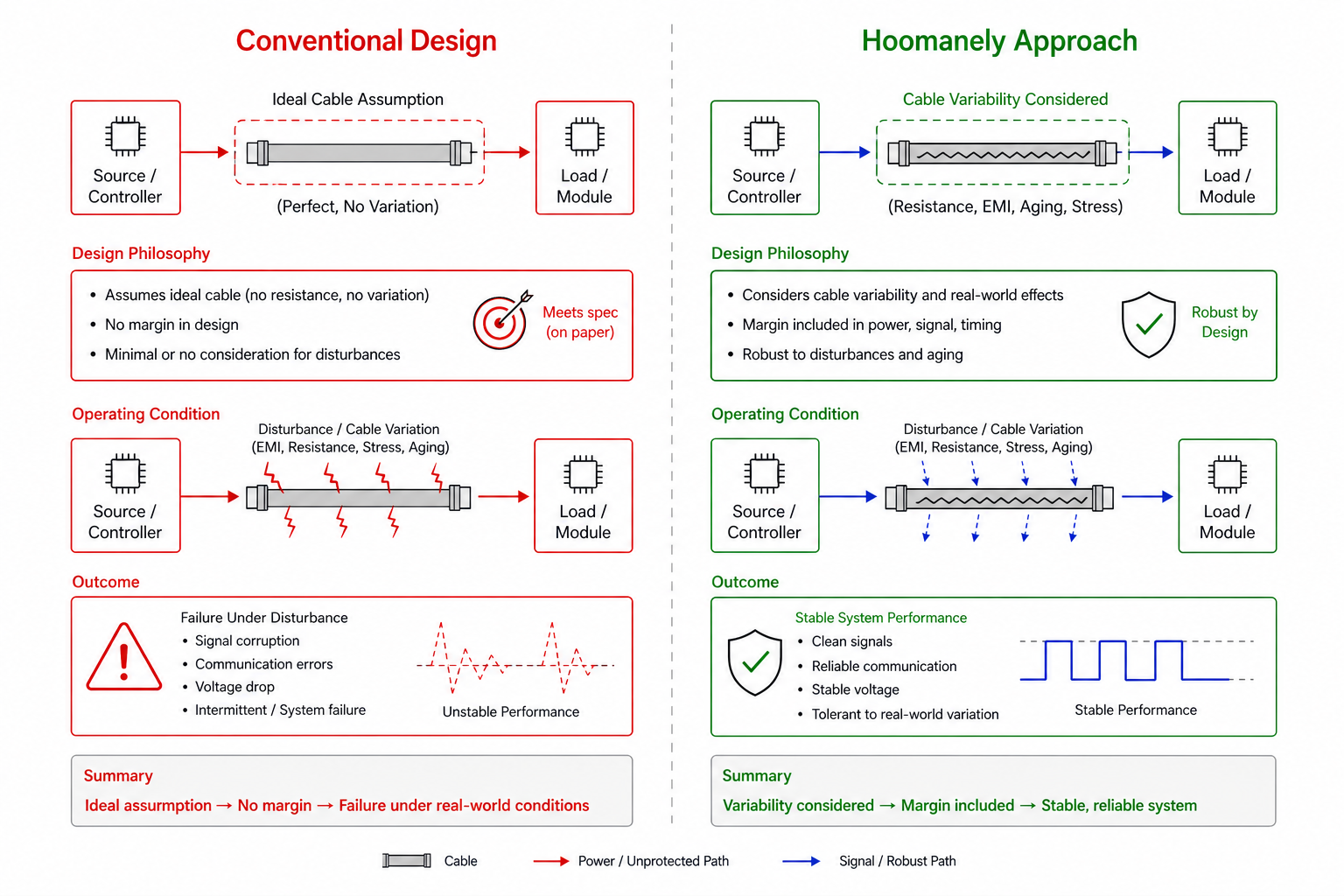
Final thought
A cable isn't a passive, perfect conductor. It's an active participant in the system, introducing variability, noise, and uncertainty. Designing as if it were ideal creates fragile systems that only work under controlled conditions. Designing with its imperfections in mind creates systems that remain stable in the real world.
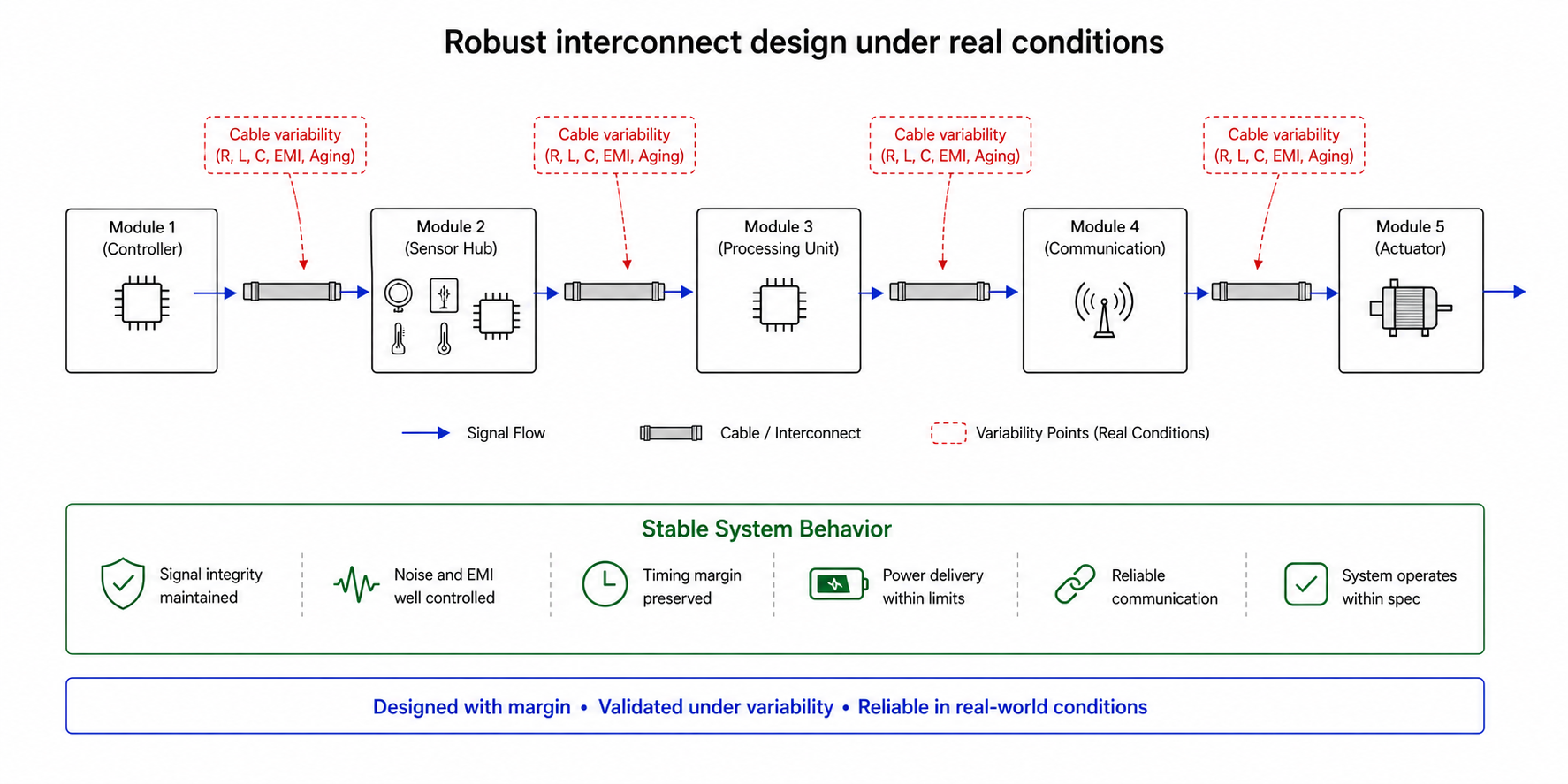
Hardware doesn't live on a test bench. It lives in the hands of users, in environments that are unpredictable and often unforgiving. At Hoomanely, we design systems that acknowledge this reality. Cables aren't trusted to behave perfectly. Instead, the system is built to remain stable even when they do not. Because the goal isn't to achieve perfect performance under ideal conditions, it's to achieve reliable performance under real conditions. And that begins with accepting that cables will never be ideal.