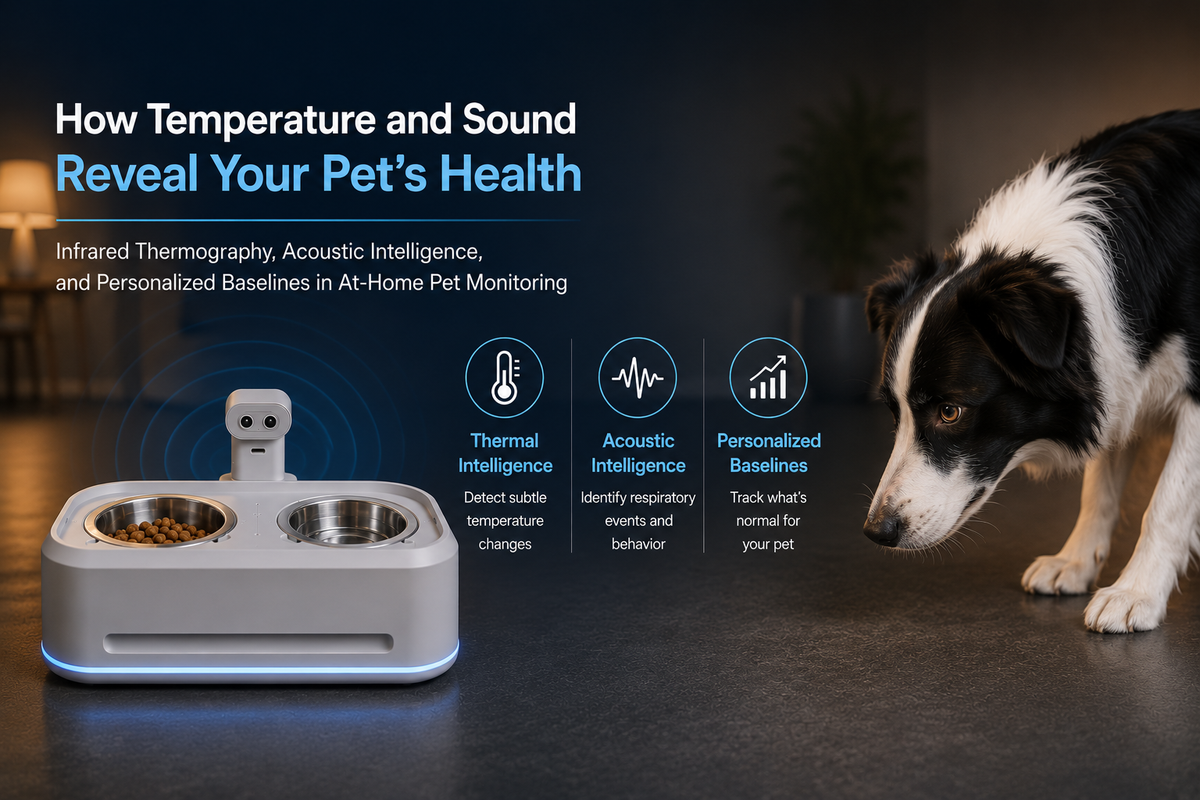
Infrared Thermography, Acoustic Intelligence, and Personalized Baselines in At-Home Pet Monitoring
The signals pets never verbalize
A dog developing a low-grade fever won't announce it. Neither will a dog starting to feel dental discomfort. Companion animals are wired, evolutionarily, to mask weakness, a survival trait that predates domestication by a long way. By the time a pet parent notices their pet is "acting off," the underlying condition has often been building quietly for days or weeks.
That creates one of the bigger blind spots in modern pet care: health signals mostly become visible only once behavior changes are already obvious. At Hoomanely we've been asking a more specific question: what passive biological signals can be captured continuously at home, without changing how the pet naturally behaves? Two of the richest signals, it turns out, show up during one of the most routine daily activities there is: feeding. A connected feeding bowl with thermal sensing and acoustic intelligence can pick up on subtle physiological drift well before symptoms become visible.
The challenge: building a reliable baseline
The hard part of pet health monitoring isn't sensing, it's interpretation. Every animal has its own physiological rhythm: different resting temperatures, different hydration patterns, different eating cadence, different respiratory behavior. A healthy Labrador and a healthy Whippet can differ by nearly half a degree in baseline temperature while both are completely normal for their breed.
Traditional threshold systems fail here because they rely on species-wide averages instead of an individual animal's own history. Our objective, then, wasn't just collecting data, it was building a longitudinal wellness model unique to each pet.
Thermal intelligence during feeding
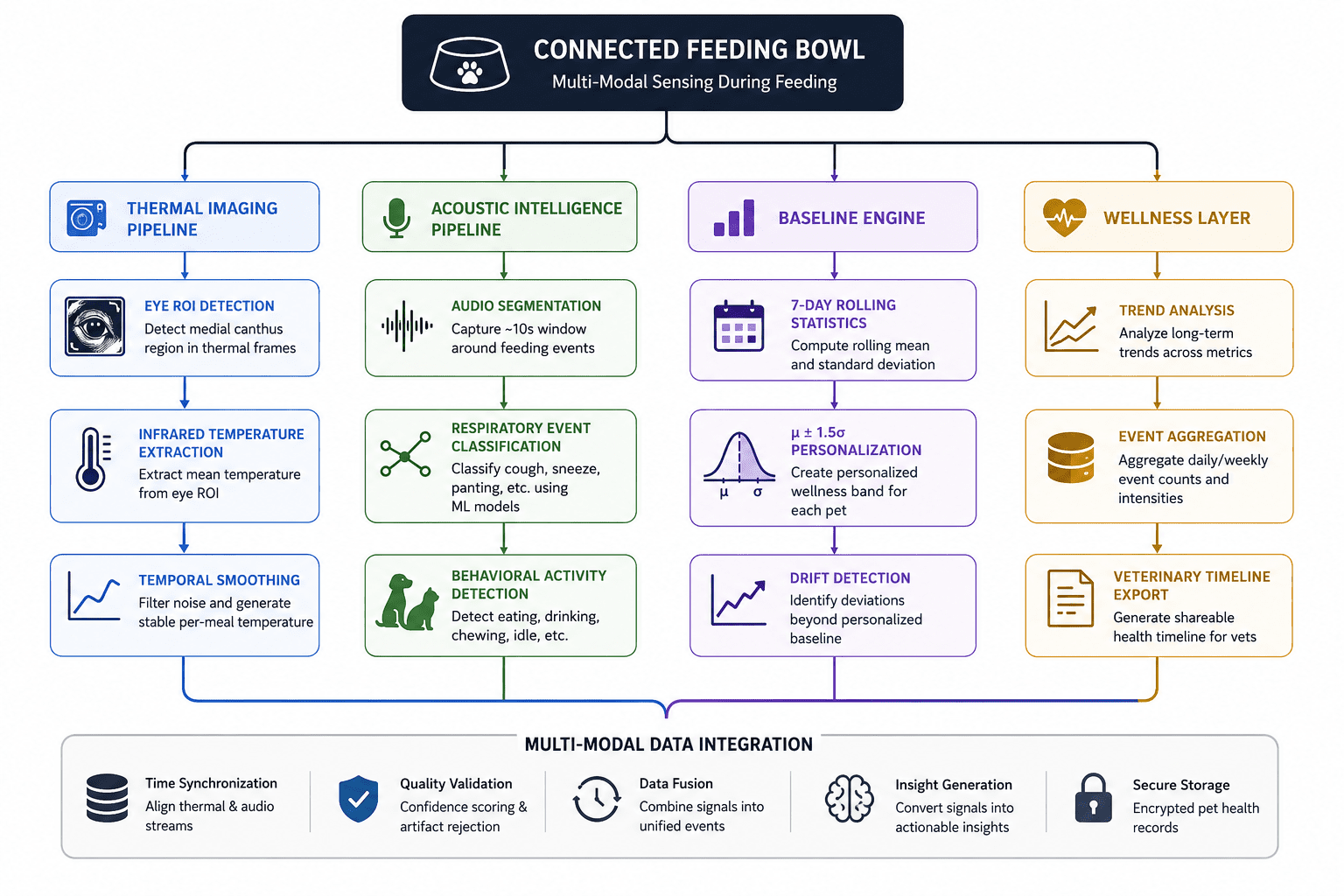
Skin temperature isn't identical to core body temperature, but under controlled observation, the relationship is consistent enough to be diagnostically useful. The engineering challenge is that pets are genuinely difficult thermal subjects: fur insulates, head motion is constant, and environmental heat sources add noise.
Instead of single-point thermometry, the system uses low-resolution thermal imaging to locate the medial canthus, the inner corner of the eye, which has strong vascular perfusion and almost no insulation. That region gives a much more stable read on physiological temperature than a fur-covered surface would. The goal isn't producing a clinical diagnosis, it's figuring out whether the pet is drifting away from its own historical thermal baseline.
Acoustic intelligence: listening for respiratory drift
Feeding windows also carry a dense set of acoustic markers. A short 10-second audio clip can include chewing cadence, drinking behavior, sneezing, coughing, panting, silence patterns, or respiratory irregularities. These get processed through an acoustic event-classification pipeline that can tell multiple behavioral and respiratory states apart.
The real engineering challenge sits downstream of classification, though. A single sneeze means very little on its own. Three days of elevated sneeze frequency might point to an environmental allergen, upper-respiratory irritation, or an infection starting to take hold. So the system leans on temporal aggregation, rolling trend analysis, and longitudinal behavioral drift rather than reacting to isolated events.
Why personalized baselines matter
One of the more important architectural calls here was rejecting static "healthy ranges" outright. Universal thresholds cause two problems: false alarms in naturally noisy pets, and missed signals in pets that are physiologically stable but sit outside the population norm.
Instead, the platform runs a dynamic baseline modeling layer that continuously learns each pet's physiological and behavioral signature over time. By aggregating longitudinal observations and tracking rolling distribution characteristics, it builds an adaptive wellness envelope that evolves with the individual animal rather than leaning on static population-level thresholds. That makes it possible to catch subtle deviations, trend inflections, and emerging behavioral drift that would otherwise stay hidden inside ordinary day-to-day variation, whether that's unusual thermal elevation, feeding irregularity, or respiratory drift, measured against the animal itself rather than a population average.
The difference is subtle but it matters: preventive care depends less on spotting "abnormal animals" and more on spotting "unusual change" in a specific, known animal.
Where this is headed
We believe preventive pet care starts with understanding the signals animals never verbalize. Our work is about turning everyday behaviors, eating, drinking, breathing, resting, into wellness intelligence that evolves with the individual animal over time. We're not trying to replace veterinary care. We're building the longitudinal context that makes veterinary care happen earlier, with better information, and more proactively, because the most important health signals are usually the quietest ones.
The future of pet care won't be built around occasional observations. It'll be built around continuous understanding. Combining thermal sensing, acoustic intelligence, and personalized behavioral baselines moves us closer to a point where subtle physiological drift gets caught long before visible symptoms show up, giving pets earlier care and owners more peace of mind.