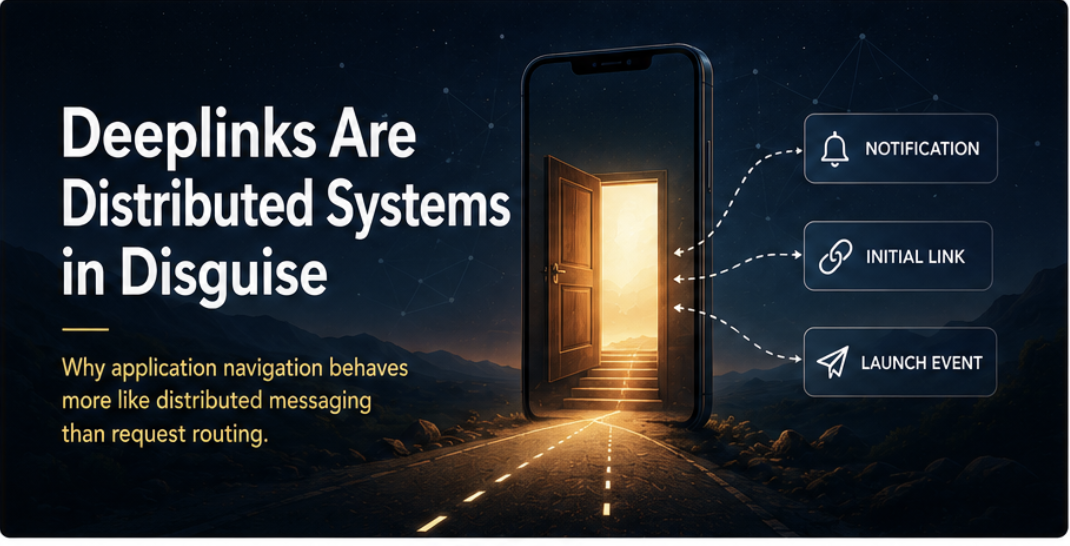
When Navigation Becomes a Distributed Systems Problem
Deeplinks Are Distributed Systems in Disguise
Why application navigation behaves more like distributed messaging than request routing.
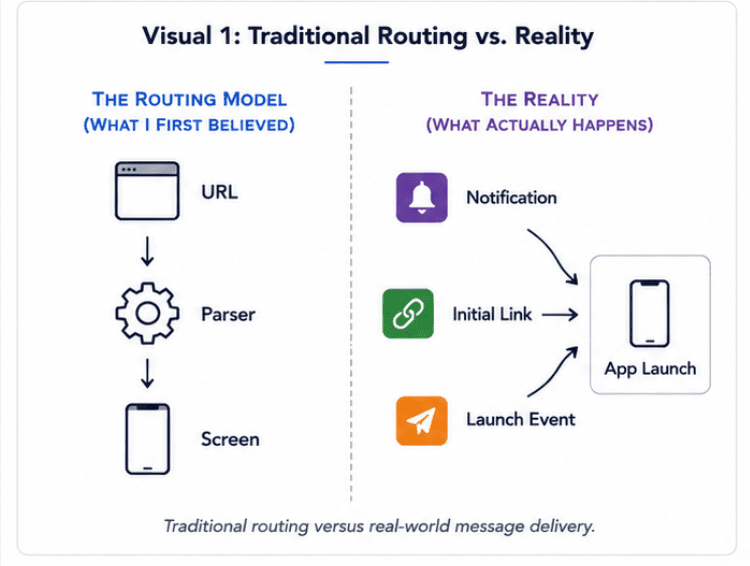
For years, I thought of deeplinks as a routing problem. A URL came in, it was parsed, and the application navigated to a screen. It felt deterministic—almost boring. That assumption lasted until the first production bug, where a perfectly valid sign-in link sent users back to the login screen instead of forward into the application.
Nothing about the URL was wrong. The parser worked. The destination existed. Yet the experience still failed.
What changed wasn't the implementation it was my mental model. I eventually realized that deeplinks aren't routing requests at all. They're messages arriving from external systems at unpredictable times into an application whose state I don't control.
WHY ROUTING WAS THE WRONG MENTAL MODEL
A deeplink isn't invoked from inside the application. It originates outside it. The operating system determines when it arrives, startup determines when the application is ready, and authentication influences whether the destination is valid. Those moving parts mean navigation is no longer a deterministic mapping from a URL to a screen.
AT-LEAST-ONCE DELIVERY
A single user action can arrive through multiple independent delivery channels. Reliable systems prefer delivering a message twice rather than losing it. Treating every arrival as a brand-new command inevitably creates duplicate navigation. Eventually I realized I wasn't writing routing code anymore—I was writing a message consumer.
COLD STARTS ARE DIFFERENT CONSISTENCY MODELS
Warm launches and cold launches are fundamentally different. During a warm launch, navigation is applied to a running application. During a cold launch, identity, configuration and startup are still converging. Processing a deeplink becomes a coordination problem rather than a routing problem.
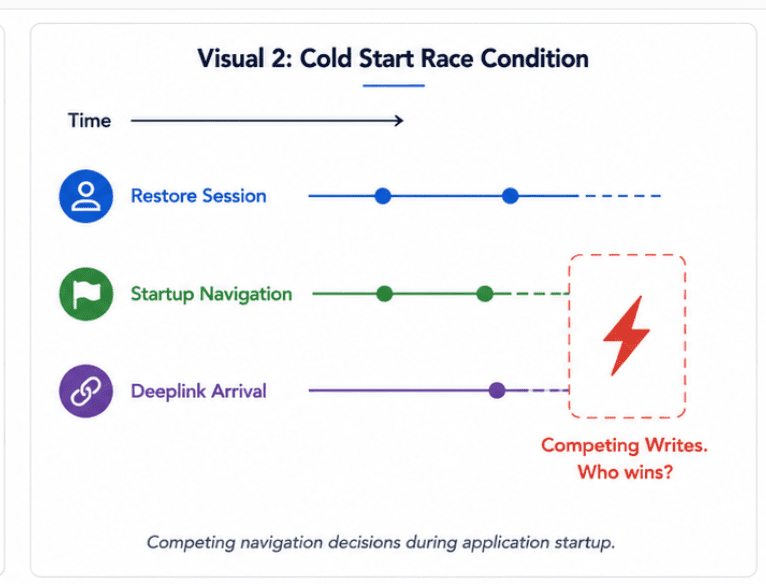
STARTUP RACES ARE CONCURRENCY PROBLEMS
The startup flow and the deeplink both want to decide the first screen. Individually both are correct. Together they create a race condition where whichever asynchronous task finishes first wins.
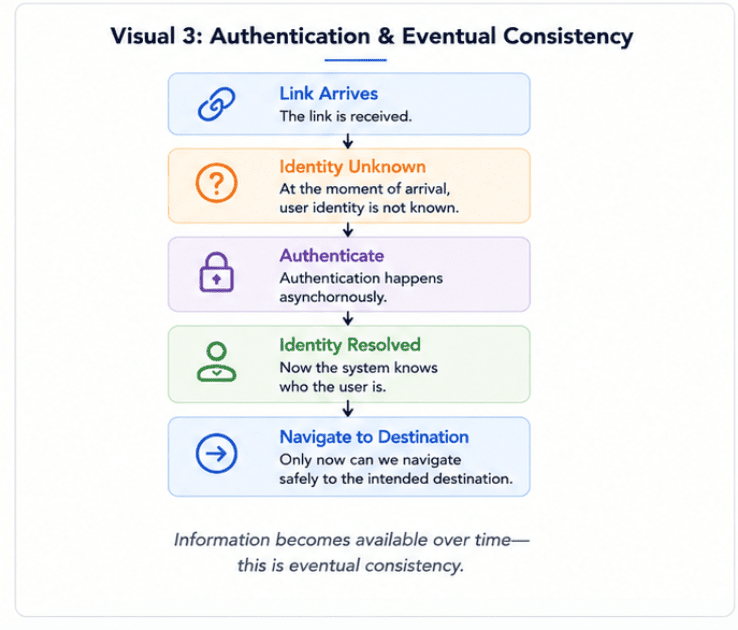
AUTHENTICATION IS EVENTUAL CONSISTENCY
Some destinations cannot be resolved until identity has been established. Ask too early and the answer is login. Ask later and the answer is the intended destination. The URL never changed; only the application's knowledge changed. That is eventual consistency.
WHAT CHANGED IN MY THINKING
Duplicate navigation isn't a parser bug. It's at-least-once delivery.
Startup flashes aren't bad redirects. They're race conditions.
Authentication delays aren't random. They're eventual consistency.
ENGINEERING AT HOOMANELY
At Hoomanely, we build experiences that remain reliable across asynchronous events, startup coordination and changing application state. Viewing deeplinks as distributed systems problems helps us design resilient user experiences instead of only optimizing the happy path.
KEY TAKEAWAYS
• Deeplinks behave like distributed messages.
• Duplicate navigation is an at-least-once delivery problem.
• Cold starts require different consistency models.
• Startup navigation is a concurrency problem.
• Authentication introduces eventual consistency.