Storage Wear and Tear

Why Thoughtful Write Strategies Keep Embedded Systems Alive
Flash memory doesn’t fail dramatically. It fades quietly. One block at a time.
In modern IoT devices—especially those that run nonstop, buffer telemetry, and handle intermittent connectivity—the way we write data often matters more than the data itself. Excessive or unstructured writes reduce flash longevity, complicate recovery, and amplify the cost of mistakes. As engineers building multi-device systems, we must treat storage as an actively managed resource, not a passive component.
This article takes a systems-level view of flash wear, explains why repeated writes cause degradation, and breaks down the patterns that reliably extend device lifetime: append-only logs, rolling windows, snapshotting, compression, and deferred writes. Each technique represents a trade-off between simplicity, durability, and recoverability.
Throughout, I’ll reference how we approach this at Hoomanely—where a pet’s home ecosystem is powered by SoM-based Trackers (sensing movement and environment), EverBowls (inferring behavior through temperature, sound, photos, and weight), and EverHubs (the edge gateway). Every device writes frequently, but each lives under different flash budgets, connection patterns, and uptime expectations. Good storage strategy makes the ecosystem resilient.
Problem: Flash Wears Out Quietly but Predictably
Flash memory isn’t like RAM or magnetic disks.
It has a finite program/erase (P/E) lifecycle, and every write brings it closer to its end. The mechanism is physical: writing charges microscopic floating gates, and repeated charge cycles degrade the cell’s ability to retain its state.
Embedded devices face unique patterns that accelerate wear:
- Telemetry buffering under bad networks
- Small but frequent config or state updates
- Ring-buffer logs rewritten every few seconds
- MCU flash reused as pseudo-database storage
- Gateway SSDs receiving bursts of intermediate files
The danger is subtle: you only notice failure when it’s too late—after corrupted sectors, missing logs, or silent reboots.
Why It Matters
1. Embedded devices rarely have luxury storage
MCUs, SoMs, and small compute nodes often rely on small onboard flash or eMMC. Storage is not expandable, and every write is precious.
2. Storage failures cascade across IoT systems
One worn block may break:
- boot config
- sensor calibration
- wifi/LoRa credentials
- local telemetry buffers
- OTA metadata
One corrupted write can isolate a device for days.
3. IoT devices write more than you think
Even a “light” system quietly produces:
- periodic health telemetry
- watchdog status
- time-sync adjustments
- sensor logs
- user interactions
- event triggers
Systems like Hoomanely’s EverHub ingest data from multiple peripherals, preprocess it, and persist it locally before uploading. With naive write patterns, that workload burns through flash quickly.
Architecture: Designing for Flash Longevity
The question isn’t “how do we write less?”
It’s “how do we write smarter?”
We’ll examine five architectural patterns:
- Append-only logs
- Snapshotting
- Rolling windows
- Compression at the edge
- Deferred writes
Each contributes a different kind of longevity.
1. Append-Only Logs: Treat Flash as a Journal
Append-only design is the simplest and most powerful form of wear mitigation.
Instead of rewriting records in place, we only add to the end of a log.
Why It Works
- Eliminates high-cost erase/rewrite of entire blocks
- Plays nicely with flash’s page-based structure
- Simplifies corruption recovery (just rewind to last valid entry)
Many MCU systems implement small, fixed-format records:
[Header] [Timestamp] [Payload] [CRC]
Gateways often use journaled files (like sqlite with WAL mode) to avoid rewriting main tables frequently.
Real-World Placement
Trackers collecting positional and motion data append events as they occur. EverBowls storing weight readings append every measurement rather than updating “current weight” in place.
2. Snapshotting: Periodic Full-State Captures
Where logs capture history, snapshots capture truth.
Instead of rewriting individual keys, we periodically write the full system state to a new location. Think of a resettable checkpoint.
Why It Works
- Minimizes random writes
- Enables clean rollback
- Integrates well with versioned config or calibration data
Snapshots shine in “small but important” state updates:
- Wi-Fi or LoRa config
- Sensor calibration
- Pet profile parameters
- OTA metadata
At Hoomanely, devices like EverHub periodically snapshot inference state, local models, or connection metadata.
Snapshot Lifecycle
- Produce a full state struct
- Write it to an unused flash block
- Mark it as “active”
- Retire the previous snapshot
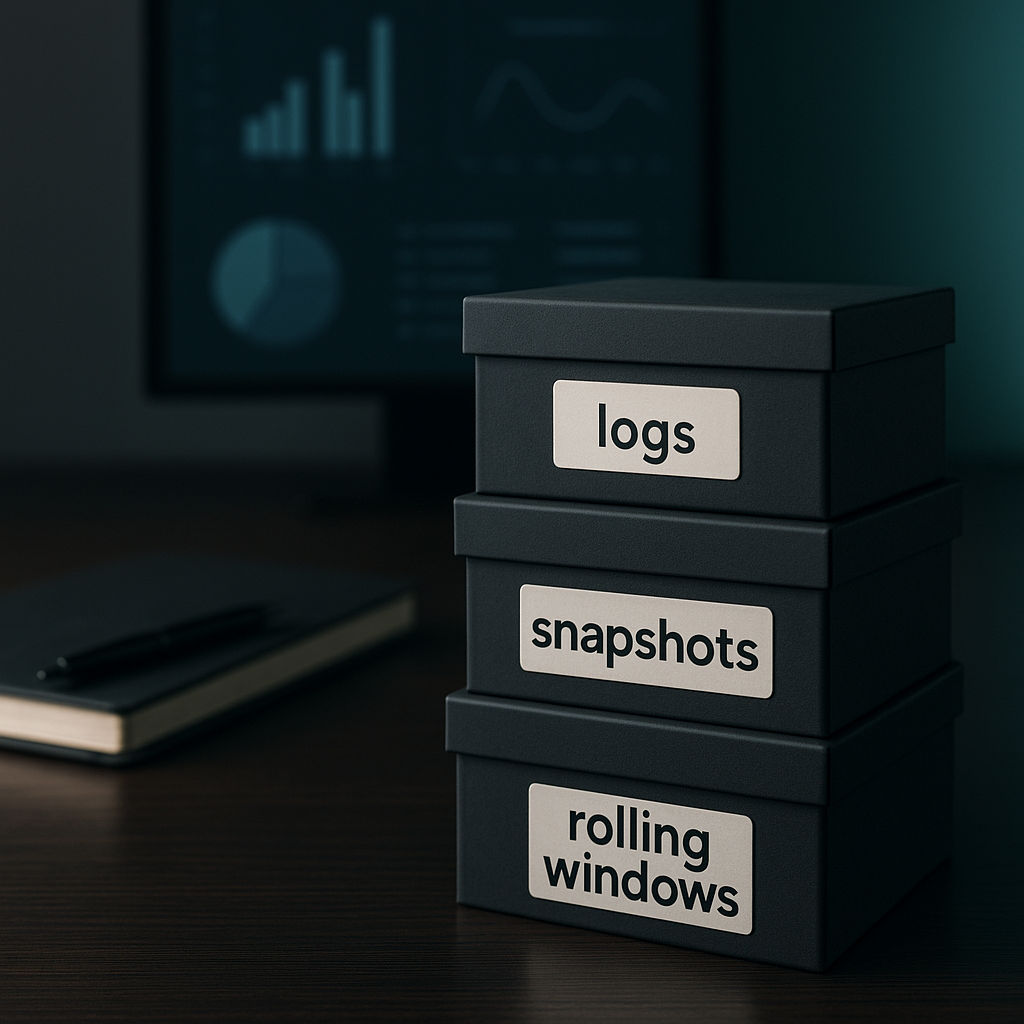
3. Rolling Windows: Constrain Growth Without Rewrites
A rolling window is a ring buffer that holds the last N entries. It works beautifully for:
- sensor readings
- short-term logs
- recent images
- local ML samples
- repeated weight measurements (EverBowl)
The trick is doing it without rewriting the same sector repeatedly, which would wear it prematurely.
Durable Rolling-Window Pattern
- Split flash into segments (seg0, seg1, …)
- Fill seg0 sequentially
- When full, move to seg1
- Only erase a segment when it is completely outside the window
This spreads wear evenly and uses flash the way it was intended—written sequentially and erased infrequently.
4. Compression: Reducing Writes by Reducing Data
Compression isn’t just for saving cloud bills.
It directly reduces flash wear by reducing the number of bytes written.
Lightweight MCU-Friendly Techniques
- Delta encoding (store change from previous value)
- Varint (encode small integers in fewer bytes)
- Simple RLE for repeated readings
- Bit-packing for periodic boolean or small-range sensors
Gateway-Grade Techniques
- LZ4 for high-speed buffering
- MessagePack/CBOR to serialize efficiently
- Rolling compression windows for batched uploads
In Hoomanely’s ecosystem, Trackers often compress sensor bursts; EverBowls compress weight/time series; EverHubs compress multi-device batches before uploading.
Even modest compression ratios translate directly into fewer flash writes and longer life.
5. Deferred Writes: Avoid Writing During High Churn
Some data fluctuates rapidly but is only important eventually:
- temperature updates
- moving averages
- motor current samples
- battery voltage jitter
- signal-strength fluctuations
Rather than writing each update, we defer writes until:
- a timeout elapses
- the value stabilizes
- the system becomes idle
- a batch threshold is reached
Deferred writes work great on MCUs with small wear budgets.
Example pattern:
if (value changed significantly):
    stage buffer in RAM
if (timer expired):
    commit staged entries as a batch
At Hoomanely, we defer certain high-rate sensor events in Trackers and accumulate weight deltas in EverBowls before persistence.
Implementation: Putting It All Together
Effective wear mitigation isn’t one technique—it’s a stack of them.
Below is a typical architecture for a multi-tier IoT system (like Hoomanely’s) that needs long-lived storage.
Layered Write Architecture
- In-Memory Staging (RAM)
- debouncing
- deduplication
- deferred write staging
- compression preprocessing
- Append-Only Flash Journals (MCU tier)
- sequential writes
- lightweight records
- simple corruption handling
- Segmented Rolling Buffers (MCU/SoM tier)
- used for high-rate telemetry
- maintains last N hours of data
- low erase frequency
- Periodic Snapshots (All devices)
- whole-state writing
- rollback-safe
- small, infrequent writes
- Edge Aggregation (Hub tier)
- database with WAL
- compression and batching
- adaptive flushing based on connectivity
- Cloud Upload + Garbage Collection
- retains only what’s necessary
- frees storage once uploaded
Real-World Usage: How Multi-Device Systems Stay Healthy
In real deployments, longevity comes from combining these patterns intentionally.
Trackers
- Compress burst telemetry
- Append-only logs for events
- Rolling windows for environmental samples
EverBowls
- High-rate weight + sound + image metadata
- Deferred commits for weight deltas
- Periodic calibration snapshots
EverHubs
- Heavy local buffering when offline
- WAL-based databases
- Large rolling telemetry windows
- Batch compression before cloud upload
Across all devices, wear-leveling is a shared architectural philosophy, not a feature bolted onto one component.
Takeaways
Flash wear is predictable your architecture should anticipate it.
Flash is consumable. Every design should treat it as a resource with a lifecycle.
Append-only logs should be your default pattern.
They align with flash behavior and simplify recovery.
Snapshots protect correctness and rollback.
Full-state snapshots avoid fragmentation and accumulated corruption.
Rolling windows help constrain growth without grinding the same sector.
Use multi-segment ring designs to spread wear.
Compression and deferred writes dramatically reduce write volume.
Even small savings have compounding benefits.
A multi-tier IoT ecosystem must unify storage strategy across devices.
Gateways and MCU nodes can’t use the same techniques—but must follow the same principles.
The goal isn’t to write less - it’s to write deliberately.
Longevity emerges from architectural reasoning, not clever hacks.