ToF Calibration Persistence: Dual-Bank Flash Redundancy
A time-of-flight proximity sensor's accuracy depends entirely on three calibrated numbers: an offset correction, a crosstalk coefficient, and a reference SPAD count. Without them, the sensor's distance readings carry systematic errors of tens of millimeters, enough to misfire a capture trigger or miss a detection event entirely. At Hoomanely, the challenge wasn't calibrating the sensor. The challenge was keeping that calibration alive across firmware updates. Our camera node uses dual-bank flash for live over-the-air firmware upgrades. After a bank swap, the logical address space flips. A naive calibration layout, one slot at a fixed address, gets silently invalidated when the active bank changes. We needed a storage architecture that would survive bank swaps, power failures mid-write, and layout migrations from older firmware versions.
The problem: three numbers that must survive everything
A time-of-flight proximity sensor measures distance by emitting infrared pulses and timing the round trip. Raw timing gives you a distance, but three systematic error sources corrupt that reading in every real deployment.
Offset error accumulates from the sensor's mechanical mounting, the physical distance between the emitter aperture and the mounting surface is never exactly zero. On our camera node, where the sensor operates with a narrow 4x4-zone field of view, even a 2 mm mounting offset translates to trigger misfires at the boundary of the capture window.
Crosstalk is infrared energy that bounces off the sensor's cover glass and returns to the detector without ever reaching the target. Every transparent or translucent cover introduces crosstalk. Uncorrected, it makes every measurement report shorter than the actual distance.
Reference SPAD calibration optimizes the single-photon avalanche diode array, selecting the best-performing photodetectors and setting their bias correctly. A sensor running on factory SPAD defaults has higher noise variance, which translates directly to jitter in successive distance readings.
All three parameters have to live in non-volatile memory, but our camera node's bootloader performs live OTA updates by swapping which flash bank the MCU executes from. After a firmware upgrade, the MCU may run from Bank 2 while Bank 1 becomes the inactive bank, or the reverse, depending on the SWAP_BANK option bit. Any calibration stored at a fixed logical address in Bank 1's tail could end up in the wrong physical bank after a swap, silently invalidated.
A second failure mode appeared early in development: an OTA sector reservation conflict. The bootloader reserves the last sector of each bank for OTA metadata. Our first calibration layout placed the backup slot at bank-end-minus-one, exactly overlapping the OTA reserved sector. A firmware update would silently zero the calibration alongside the old metadata. No error code, no log entry, just a device that boots with factory defaults and fires at the wrong distances.
The approach: four slots, one contract
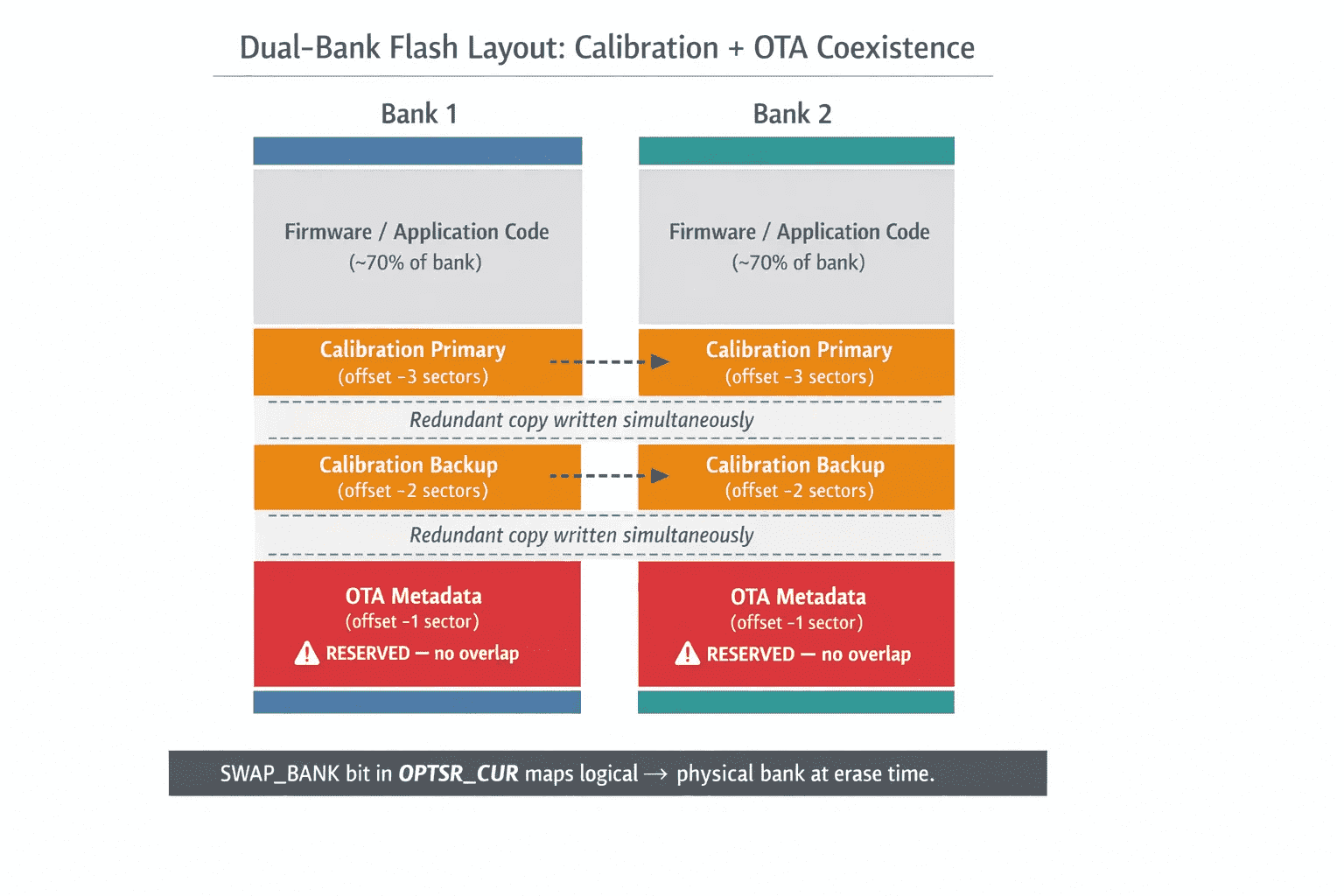
The design settled on four calibration slots: Bank1-Primary, Bank1-Backup, Bank2-Primary, and Bank2-Backup. Every calibration write touches all four simultaneously. Every boot reads from the first slot that passes validation and stops. The redundancy ensures that a power loss mid-write, a flash write failure on one sector, or a full bank swap cannot leave the device without valid calibration.
The address calculation is where correctness lives. With 1 MB per bank and 8 KB sectors, the OTA bootloader occupies the last sector. Calibration slots therefore land at offsets -3 and -2, never at -1:
/* Flash calibration layout — non-overlapping with OTA at -1 sector */
#define CAL_SECTOR_SIZE         8192UL          /* 8 KB per sector         */
#define CAL_BANK1_PRIMARY_ADDR  (BANK1_BASE + BANK_SIZE - (3 * CAL_SECTOR_SIZE))
#define CAL_BANK1_BACKUP_ADDR   (BANK1_BASE + BANK_SIZE - (2 * CAL_SECTOR_SIZE))
#define CAL_BANK2_PRIMARY_ADDR  (BANK2_BASE + BANK_SIZE - (3 * CAL_SECTOR_SIZE))
#define CAL_BANK2_BACKUP_ADDR   (BANK2_BASE + BANK_SIZE - (2 * CAL_SECTOR_SIZE))
The erase function must also handle bank swapping. Reading FLASH->OPTSR_CUR at erase time tells the driver whether Bank 1 or Bank 2 is the physical primary. A logical Bank 1 address maps to FLASH_BANK_2 when SWAP_BANK is set, and erasing the wrong physical bank silently preserves stale calibration data:
uint32_t optsr_cur   = FLASH->OPTSR_CUR;
bool     swap_bank   = (optsr_cur & FLASH_OPTSR_SWAP_BANK_Msk) != 0;
bool     is_logic_b1 = (sector_addr < BANK2_BASE);

uint32_t physical_bank = swap_bank
    ? (is_logic_b1 ? FLASH_BANK_2 : FLASH_BANK_1)
    : (is_logic_b1 ? FLASH_BANK_1 : FLASH_BANK_2);
The flash programming interface on this MCU requires 16-byte (128-bit) aligned writes, a quad-word programming granularity. Calibration data smaller than 16 bytes has to be padded to the next 16-byte boundary, with unused bytes initialized to 0xFF to match the erased flash state.
Load, validate, migrate, protect
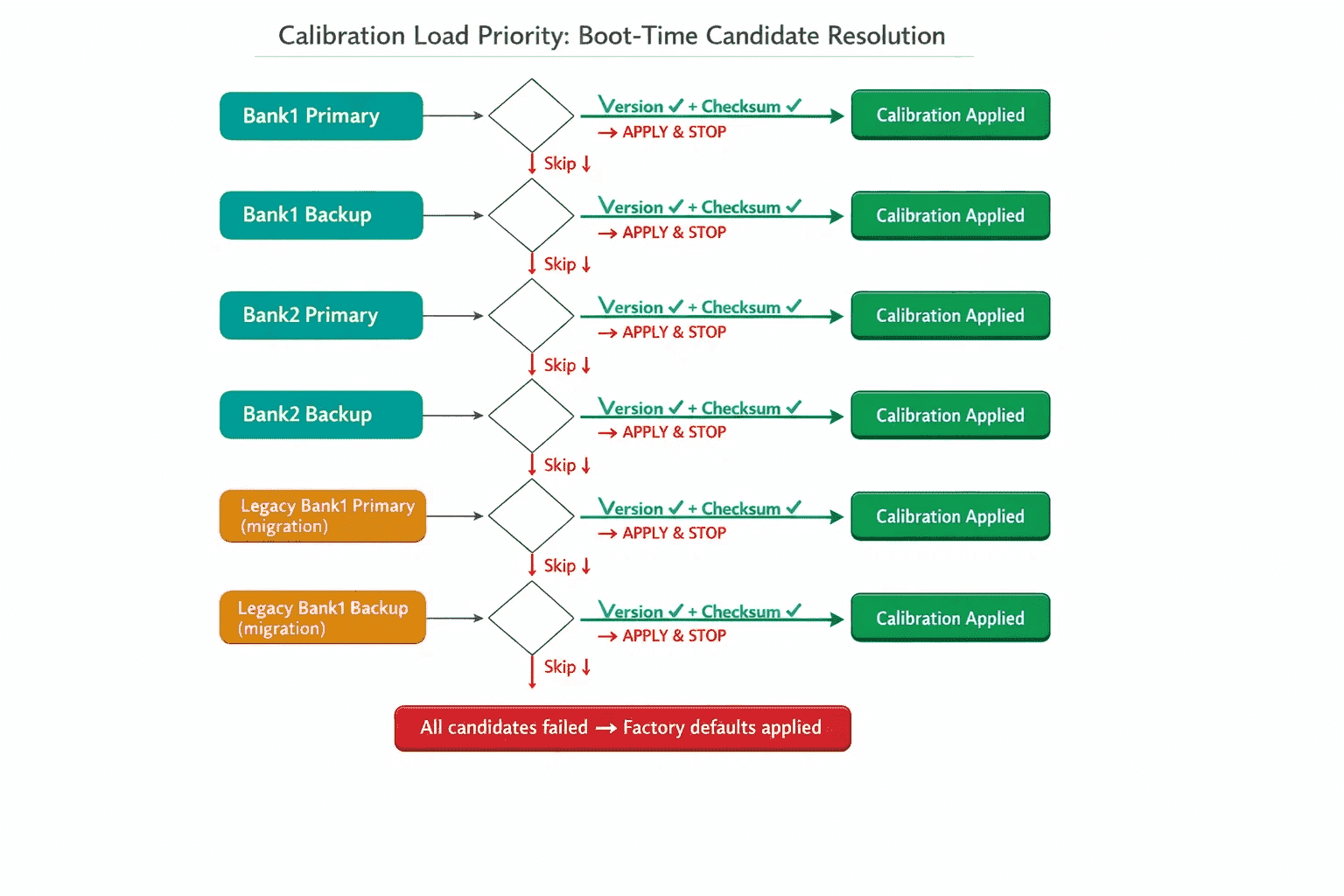
Loading at boot iterates six candidates in fixed priority order. For each address, the code checks whether the region is fully erased and skips it, then reads the raw bytes into a temporary struct and validates two fields: a format version constant and a 16-bit checksum computed over every field except the checksum itself. The first candidate that passes both checks is applied immediately:
for (size_t i = 0; i < ARRAY_SIZE(candidates); i++) {
    if (!is_valid_flash_address(candidates[i].addr))          continue;
    if (is_flash_erased(candidates[i].addr, sizeof(CalibData))) continue;

    memcpy(&calib, (void *)candidates[i].addr, sizeof(CalibData));

    if (calib.version   != CALIB_FORMAT_VERSION)              continue;
    if (compute_checksum(&calib) != calib.checksum)           continue;

    /* Valid — apply and return */
    apply_calibration(&calib);
    return CALIB_OK;
}
return CALIB_NOT_FOUND;
After loading, a migration check runs automatically. If the calibration came from a legacy slot (old firmware layout, single bank only), or if not all four new dual-bank slots contain valid data, the firmware promotes the loaded calibration to all four current slots. This happens once, silently, on the first boot that encounters the new firmware, no manual re-calibration is required in the field.
Sanity bounds are enforced on load: offset values outside plus or minus 100 mm and crosstalk values above 20,000 kcps are rejected as physically implausible and the device falls back to factory defaults with a warning log entry.
Storing calibration requires an explicit software unlock. A static boolean flag, calibration_write_enabled, defaults to false and acts as a write-protect gate. The flag must be set explicitly by calling enable_calibration_write() before any store attempt. After a successful four-slot write, the flag is automatically cleared, so an accidental subsequent call to the store function cannot overwrite good data even if the calling code forgets to re-enable protection.
Why it matters at Hoomanely
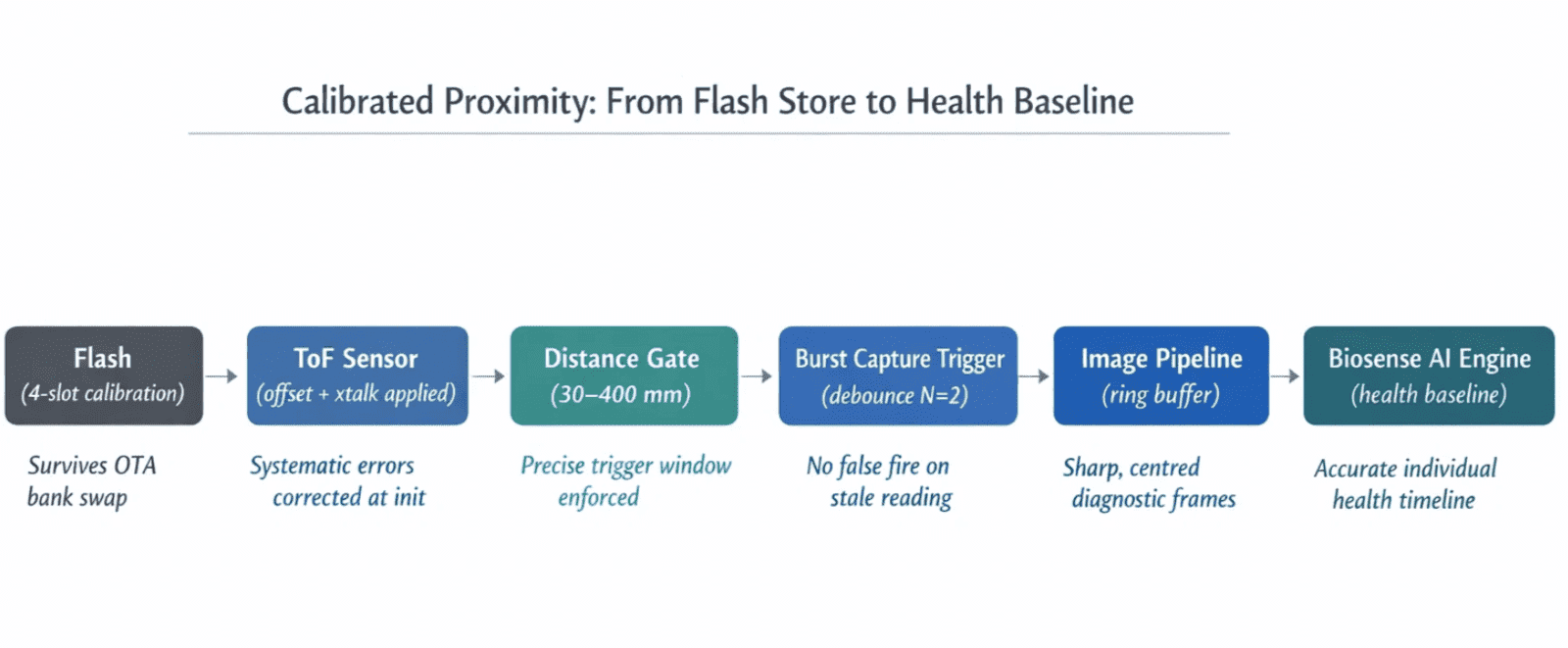
The camera node's detection window spans 30 mm to 400 mm. The calibration offset correction we apply is on the order of tens of millimeters. An uncalibrated sensor running on factory defaults fires at slightly wrong distances, triggering captures on reflections at the wrong range, or missing the pet's approach because their face sits just outside the corrected boundary. Neither failure produces a loud error, both produce a slow, silent degradation in capture quality.
Every image the Biosense AI Engine uses to build a pet's personalized health baseline began with the proximity sensor firing at the right distance. A calibration silently lost to a firmware update isn't a visible fault, it's weeks of subtly wrong capture statistics eroding the accuracy of the health model that acts as the animal's long-term clinical record.
Results
The calibration system has handled every OTA update shipped to production hardware without a calibration loss event. A boot after calibration finds Bank1-Primary valid and applies it in under 1 ms. A boot after a bank-swapping OTA update finds Bank2-Primary valid, same calibration values, different physical storage location, and applies them without any re-calibration required. A boot on a brand-new device finds all six candidates empty and applies factory defaults with a prominent log warning. The automatic legacy migration path promoted all pre-existing single-slot calibrations from earlier firmware versions into the full four-slot layout across two hardware revisions, with zero field re-calibration events and zero slot corruption reports since the architecture was deployed.
Key takeaways
Calibration storage must be OTA-aware, a fixed address in flash is not safe when dual-bank firmware updates can swap the logical memory map. Four copies cost almost nothing and recover everything, eight kilobytes of redundant calibration across two banks is negligible against the cost of degraded detection quality for weeks. Bank-swap-aware erase logic is non-optional, reading OPTSR_CUR before every erase is the only way to guarantee you're erasing the correct physical sector. Software write protection must auto-close, so the enable call opens and the successful write closes, not the caller. And silent degradation is worse than a crash, the redundancy architecture exists specifically to eliminate that class of failure.