Webhooks: What They Are & How We Use Them at Hoomanely

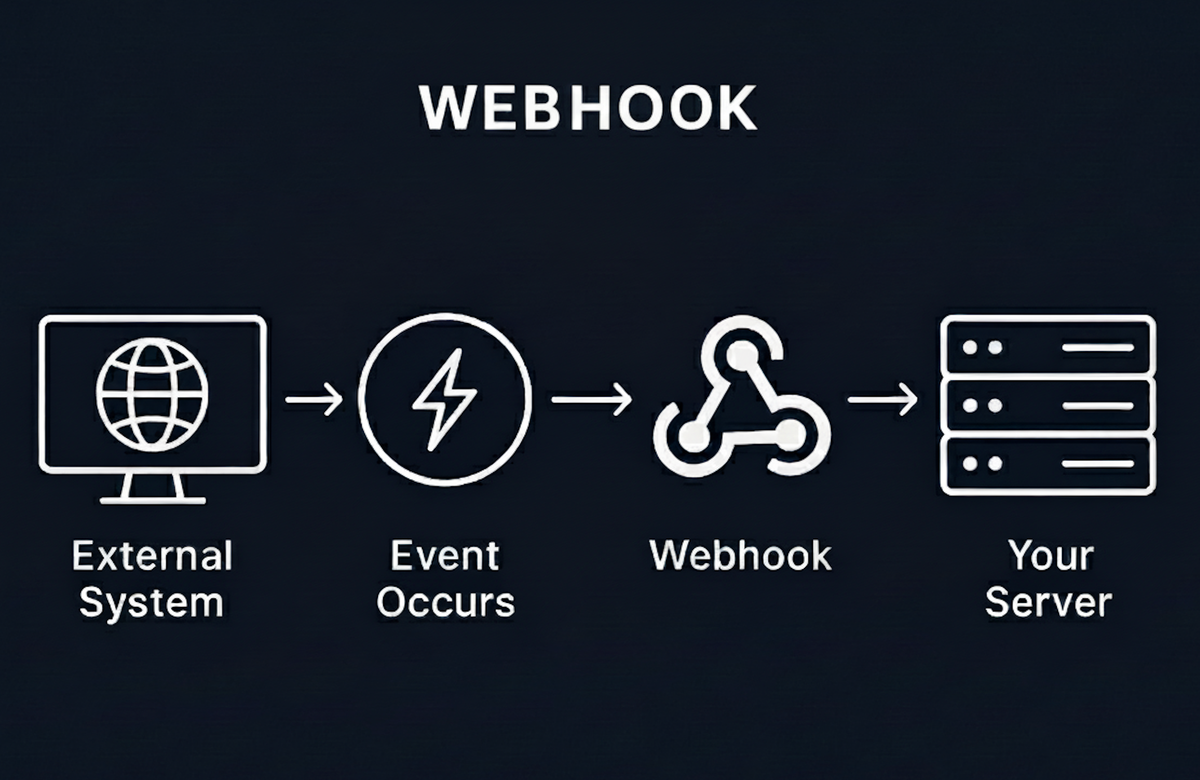
Modern apps depend on instant communication between systems — payment gateways, shipping partners, analytics tools, marketing automation, and your own backend. Webhooks are the invisible mechanism that makes all of this work in real time.
If APIs are pull-based (you ask for data), webhooks are push-based — the other system sends data to you automatically whenever something important happens.
This makes webhooks perfect for scenarios like:
- order updates
- payment success/failure
- shipping events
- email delivery status
- app install attribution
- IoT/device callbacks
In this blog, we'll break down what webhooks are, why they matter, and how we use them inside the Hoomanely ecosystem to run a smooth e-commerce + mobile app + pet-care platform.
1. What Exactly Is a Webhook?
A webhook is a server-to-server HTTP callback triggered when an event occurs.
Example: Customer completes payment → Razorpay instantly sends a POST request to your backend → you act on it.
Webhooks = Events → HTTP POST → Your Server
This makes them:
- real-time
- automated
- efficient
- perfect for integrations
Instead of asking "Has something changed?" every minute, the provider tells you instantly.
The Problem Webhooks Solve
Before webhooks, systems relied on polling — repeatedly checking if something changed. This meant:
- Wasted API calls (thousands of requests with no new data)
- Delays (you only check every X minutes)
- Server load (constant unnecessary traffic)
- Increased costs (more requests = higher bills)
Webhooks flip this model: the provider notifies you the moment something happens. This is why every modern SaaS platform offers webhooks.
2. API vs Webhook
| Feature | API | Webhook |
|---|---|---|
| Who starts it? | You (client) | External system |
| How often? | Whenever you call | Whenever event happens |
| Latency | Depends | Instant |
| Best for | fetching data | event notifications |
Use APIs when you need data, use webhooks when the system should notify you.
Real-World Analogy
API: You call the restaurant every 5 minutes asking, "Is my order ready?"
Webhook: The restaurant calls you once your order is ready.
Which one is smarter? Webhooks.
3. How a Webhook Works (Step-by-Step)
- An event occurs (e.g., payment success)
- Provider prepares event payload (JSON)
- Provider signs the request (HMAC or signature)
- Provider POSTs to your webhook URL
- Your server validates the signature
- Your server processes the event
- You respond with 200 OK
- Provider retries if your server is down
That's it — simple, powerful, reliable.
Example Webhook Payload (Razorpay Payment)
{
  "event": "payment.captured",
  "payload": {
    "payment": {
      "id": "pay_ABC123XYZ",
      "amount": 49900,
      "currency": "INR",
      "status": "captured",
      "order_id": "order_XYZ789",
      "email": "customer@example.com",
      "contact": "+919*********"
    }
  },
  "created_at": 1704067200
}
Your server receives this, validates it, and processes the order — all in milliseconds.
4. Securing a Webhook
Webhooks carry sensitive information. Good systems must verify:
✔ Signature (HMAC-SHA256)
Confirm the event actually came from the provider.
Why it matters: Anyone could POST fake data to your webhook URL. Signature verification ensures authenticity.
const crypto = require('crypto');

function verifyWebhook(payload, signature, secret) {
  const expectedSignature = crypto
    .createHmac('sha256', secret)
    .update(payload)
    .digest('hex');

  return signature === expectedSignature;
}
✔ Idempotency
Avoid double-processing events when retries happen.
Implementation: Store a unique event_id in your database. If you've already processed it, skip it.
✔ Rate limiting & throttling
Prevent spam or unexpected load.
✔ Logging & monitoring
Every webhook should be traceable.
Best practice: Log the raw payload, signature, timestamp, processing status, and any errors.
✔ IP whitelisting (if provided)
Accept requests only from official provider IPs.
✔ Use HTTPS Always
Never expose webhook endpoints over HTTP. Always use SSL/TLS encryption.
In short: never trust a webhook blindly.
5. Common Webhook Challenges & How to Handle Them
Challenge 1: Retries & Duplicate Events
Providers retry failed webhooks. Your system might receive the same event multiple times.
Solution: Use idempotency keys to track processed events.
Challenge 2: Out-of-Order Events
Events might arrive out of sequence (e.g., "shipped" arrives before "picked up").
Solution: Use timestamps and state machines to handle order logic correctly.
Challenge 3: Webhook Downtime
If your server is down, you miss events.
Solution: Providers usually retry for 24-72 hours. Have fallback polling for critical events.
Challenge 4: High Traffic Spikes
During flash sales, thousands of webhooks hit your server simultaneously.
Solution: Use message queues (SQS, RabbitMQ) to buffer and process asynchronously.
6. Webhooks in Action at Hoomanely
Hoomanely uses webhooks to connect payments, orders, shipping, marketing, attribution, and internal operations — making the whole system feel real-time and automated.
Here are the major real-life use cases.
6.1 Razorpay → Payment Confirmation Webhooks
When a customer pays:
- Razorpay sends a webhook to our backend
- We verify the signature
- Create/update the order
- Trigger Shopify draft order creation
- Update the app instantly
- Send confirmation email + push notification
This ensures payments are 100% verified and tamper-proof.
Why this matters: Without webhooks, we'd have to poll Razorpay every few seconds, creating delays and unnecessary load.
6.2 Shopify → Order & Fulfillment Webhooks
Shopify sends webhooks for:
- order created
- order paid
- order fulfilled
- order cancelled
- order refunded
- inventory updated
We use these events to:
- sync order status with the mobile app
- trigger shipping flows
- track customer lifecycle
- update analytics
- send notifications
- manage inventory
This ensures the app & dashboard always show accurate order status.
6.3 Shiprocket → Shipping Updates
Shiprocket sends event updates like:
- label generated
- pickup scheduled
- shipped
- in transit
- out for delivery
- delivered
- failed delivery
- returned
We process these via webhook → update internal databases.
Shipping feels real-time without us polling anything.
User experience impact: Customers see live tracking updates in the app without refreshing.
6.4 Customer.io → Email Status Webhooks
Customer.io sends:
- delivered
- opened
- clicked
- bounced
- unsubscribed
- spam reported
We use these events for:
- analytics
- campaign optimization
- user behavior mapping
- segmentation
- re-engagement triggers
This improves communication quality with users.
Business value: We can identify which emails drive conversions and optimize future campaigns.
6.5 AppsFlyer → Install Attribution Webhooks
AppsFlyer sends install attribution data via:
- install callbacks
- re-engagement callbacks
- in-app event callbacks
- uninstall callbacks
We sync this with:
- backend
- CRM
- analytics
- internal dashboards
This helps us understand which campaigns bring installs and revenue.
ROI tracking: Know exactly which ad spend drives actual purchases, not just installs.
6.6 Internal Webhooks → Slack Alerts
We also send outgoing webhooks to Slack when:
- Critical failures occur
- payments fail
- API errors spike
- Suspicious logs appear
- Lambda exceptions happen
- high-value orders complete
This keeps engineering & operations always informed.
Operational efficiency: No one needs to check dashboards constantly — alerts come to us.
6.7 Stripe/Payment Gateway Webhooks for Subscriptions
For subscription-based services (if applicable):
- subscription created
- payment succeeded
- payment failed
- subscription cancelled
- trial ending
- card expiring
Use case: Auto-renew pet care plans, notify users before renewal, handle failed payments gracefully.
7. Why Webhooks Matter for Hoomanely
Webhooks allow Hoomanely to operate like a fully connected real-time platform:
✔ Instant order updates in app
No refresh button needed.
✔ Real-time shipping notifications
Users always know their delivery status.
✔ Accurate payment verification
Prevents fraud & double-charging.
✔ Automated workflows
No one manually checks dashboards.
✔ Seamless e-commerce + app sync
Shopify ↔ Razorpay ↔ Shiprocket ↔ Backend ↔ App
✔ Advanced analytics
Install attribution, Email performance, Conversion insights
✔ Reduced engineering load
Systems talk to each other automatically.
✔ Better customer experience
Real-time updates create trust and transparency.
✔ Scalability
Handle 10x traffic without changing architecture.
Simply put:
Webhooks glue the entire Hoomanely ecosystem together.
8. Best Practices for Webhooks at Scale
Here are the rules we follow:
✔ Keep endpoints simple & fast
Return 200 OK quickly — heavy tasks go to a queue.
Target: Respond in under 100ms.
✔ Use queues (SQS, RabbitMQ)
Prevents failures during traffic spikes.
✔ Keep handlers idempotent
Repeat events must not break logic.
✔ Log everything
Every event has full traceability.
What to log: Raw payload, headers, signature, timestamp, processing result, errors.
✔ Set timeouts & retries
To handle provider retry behavior.
✔ Store raw payload
Useful for audits and debugging.
✔ Monitor failure rate
If retries spike → something is broken.
✔ Use environment-specific URLs
Separate webhook URLs for dev, staging, and production.
✔ Test webhooks thoroughly
Use provider test modes and webhook testing tools like webhook.site.
✔ Have fallback mechanisms
Combine webhooks with periodic polling for critical events (insurance against missed webhooks).
These practices make a webhook system production-ready.
9. Tools & Resources for Working with Webhooks
Testing & Debugging
- webhook. site — inspect incoming webhooks
- ngrok — expose local servers for testing
- Postman — simulate webhook calls
Monitoring
- Datadog, New Relic — track webhook performance
- Sentry — catch and debug errors
- CloudWatch Logs — AWS-based monitoring
Security
- Let's Encrypt — free SSL certificates
- AWS WAF — protect webhook endpoints
- Rate limiting middleware — prevent abuse
Conclusion
Webhooks are one of the simplest concepts in web development — yet they power some of the most critical workflows in modern apps.
From payments to shipping to marketing to analytics, Hoomanely uses webhooks to create a smooth, fully automated, connected experience across mobile, e-commerce, backend systems, and operations.
They help us:
- process events instantly
- sync multiple platforms
- automate repetitive tasks
- deliver real-time updates
- optimize user communication
- improve reliability & speed
- reduce infrastructure costs
- scale effortlessly
In today's world of fast-moving mobile ecosystems, webhooks are not just a feature — they are the backbone of modern system integration.
Whether you're building an e-commerce platform, a SaaS product, or a mobile app, understanding and implementing webhooks correctly is essential for creating seamless, real-time experiences that users expect.