
Who's at the Bowl? Teaching a Radar to Tell a Dog from a Human
Our smart bowl fires its camera whenever anything comes within 40 centimetres — a dog's nose, a human's ankle, a broom. That is by design: in the data-collection phase, every visitor is a labeled training sample. But the product question is sharper than the trigger: the bowl should notify you when your dog is eating, and stay quiet while you refill it. Somewhere in the sensor stack, something has to answer a question the proximity sensor cannot: who is standing here?
The sensor we asked first is the humblest one on the board, a 24 GHz presence radar. This post is about what it can see, what it deliberately throws away, and how far "dog vs human" can be pushed on the data it agrees to share.
A Radar That Reports in Rings
The LD2410C does not see a picture. It divides the space in front of it into nine concentric distance rings, called gates. In the default configuration each gate is 75 cm deep, so gate 0 is "0 to 0.75 m from the bowl," gate 1 is "0.75 to 1.5 m," and so on out to about 6 m. Everything the radar knows, it knows per gate: not where something is in the room, but which ring of distance it occupies.
There is one more resolution hiding in the firmware: the gates can be reconfigured to 20 cm each, trading maximum range (down to 1.8 m) for a much finer near-field picture. We ended up needing both modes — more on that later.
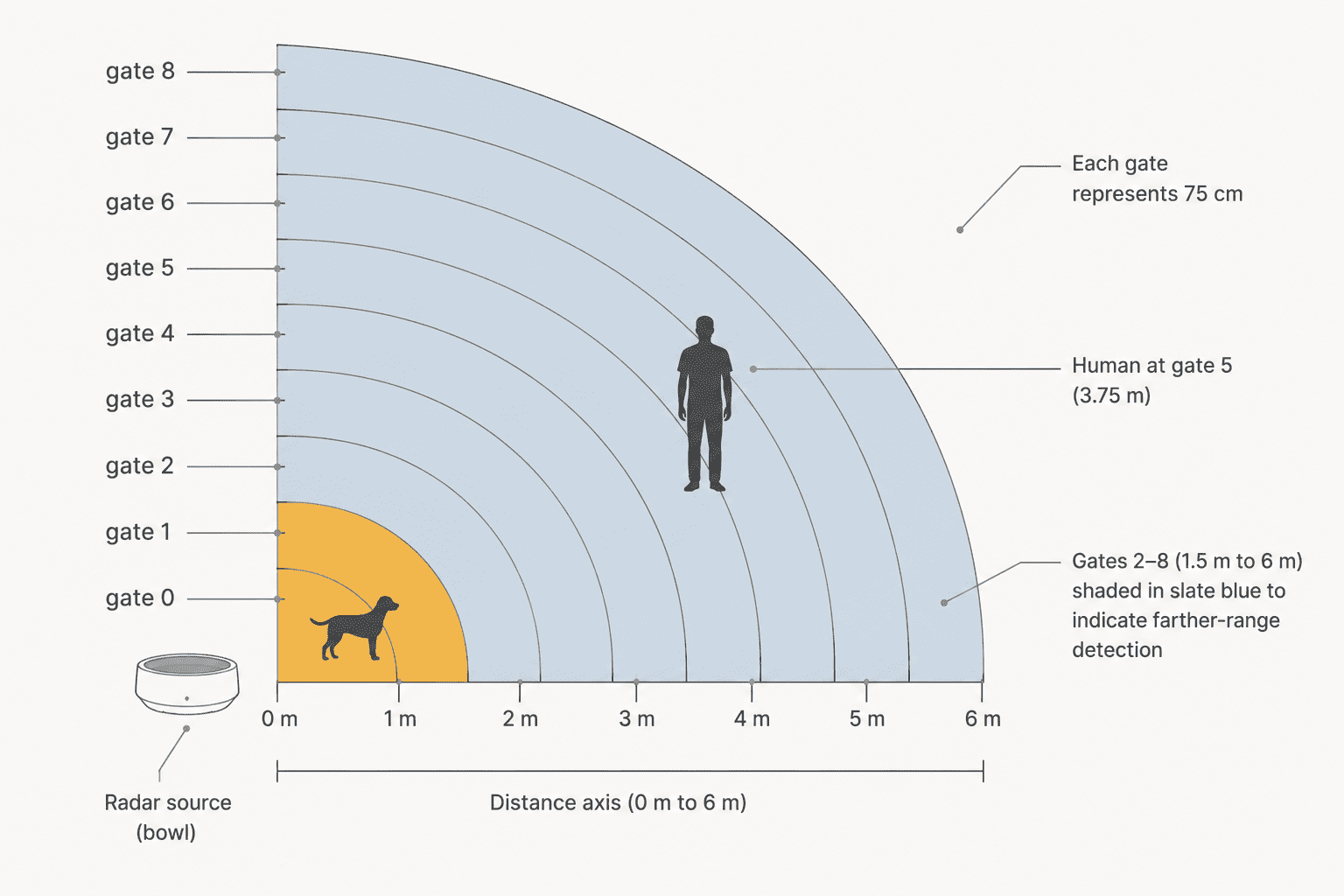
What the Sensor Actually Measures
Inside each gate, the radar watches one thing: the phase of the returning echo — effectively a ruler fine enough to notice a target moving by a millimetre. What it does with that phase is a three-way sort:
- Echoes whose phase never changes — walls, furniture, the bowl itself — are treated as background and subtracted entirely. A radar in front of a giant wall reports nothing.
- Echoes whose phase drifts slowly — a breathing chest, a body swaying millimetres per second — are routed to the static channel.
- Echoes whose phase spins fast — a walking leg, an approaching dog — are routed to the moving channel.
What gets reported for each channel, in each gate, is a single number: the amplitude of the reflection that landed there — how much reflecting surface is doing that kind of motion. The number is normalized to a 0–100 scale and clipped at 100. The rate of the motion is used only for sorting and is never output. Ten times a second, the module hands over these eighteen numbers, and that is the entire interface.
This design has a consequence that shaped our whole investigation: the LD2410C reports its conclusions, not its evidence. Amplitude, yes — but pre-normalized, saturating, and blind to everything above the clip point.
Reading Signatures Across the Gates
We recorded the radar stream continuously for a week next to the existing camera-and-thermal capture pipeline, then labeled events by looking at the images: this burst was the dog, that one was a person's legs, that stretch was an empty room. Around 5,700 labeled radar frames later, three signatures emerged.
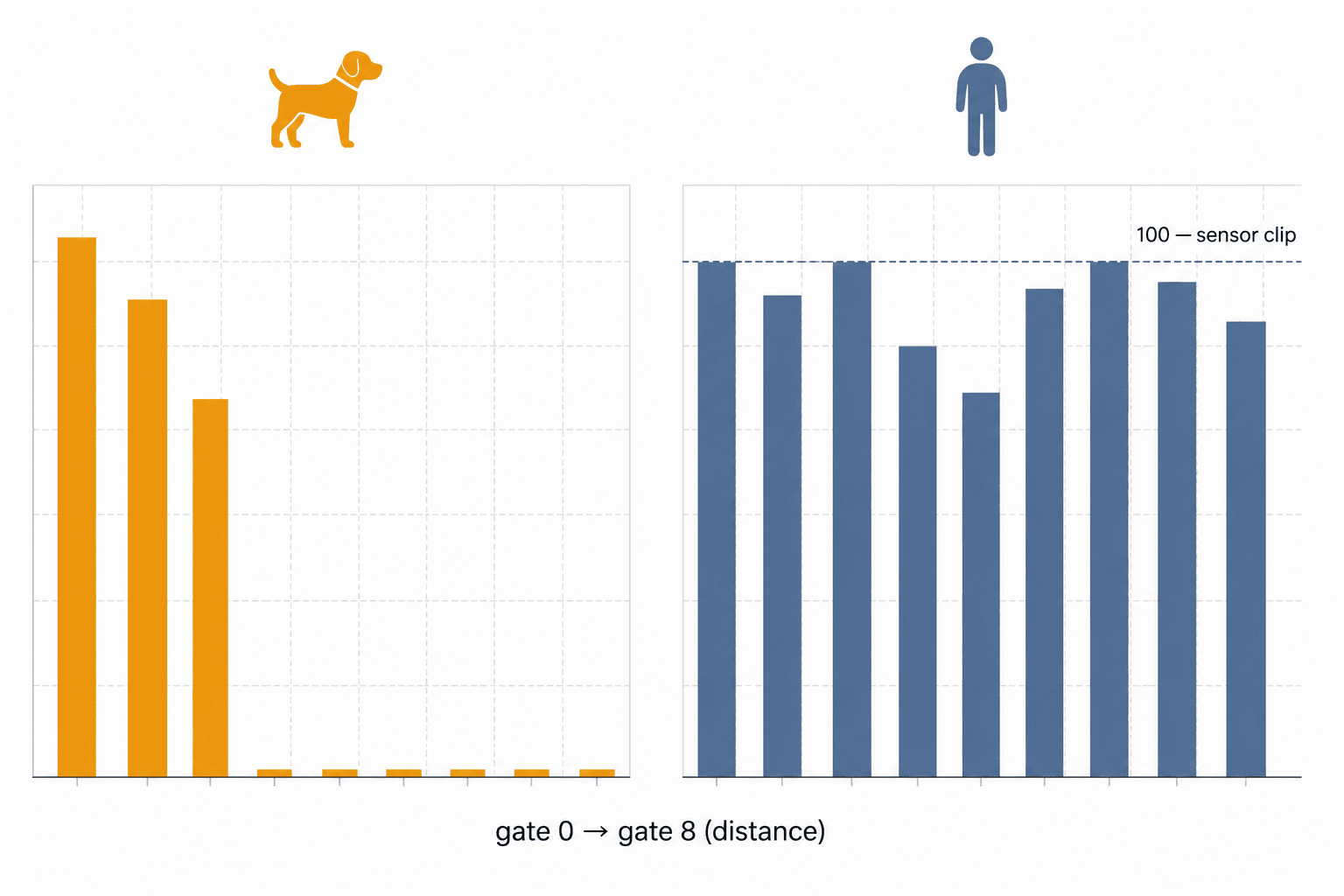
The dog is a compact, close blob. At the bowl, the dog's moving energy pins to a target 30–60 cm away and occupies two, at most three, adjacent gates. Beyond gate 2 — past about 2.25 m — the dog's echo simply dies: across every labeled dog window we found zero moving detections at gate 3 and only noise-level energy farther out. A dog is a small reflector, low to a floor the radar looks down at.
The human is a wall of echo. A person walking through the room saturates the static channel across gates 2 through 8 simultaneously — the entire 1.5–6 m range lit at 100 — while their moving energy stays measurable all the way to 6 m. Where the dog's signature falls off a cliff after two gates, the human's persists across the whole field.
And amplitude, at matched distance, separates nothing. This was the humbling result. After subtracting the empty-room baseline and comparing only unclipped frames, a dog and a human at the same gate return essentially the same excess energy — ratios between 0.96 and 1.15 across every gate where both classes had samples. At 24 GHz, dry fur is nearly transparent; the echo comes from the body underneath, and at bowl distance both bodies overwhelm the gate. The discriminating feature is not how strongly something reflects. It is how far across the gates the reflection survives.
Shrinking the Rings
The coarse mode hid one class entirely: a person standing still at the bowl often read as a static target at 2.5–6 m with zero moving energy — the radar looked straight past their legs and locked onto the room behind. So we switched the gates to 20 cm.
The legs appeared immediately. Every standing-human frame became a strong moving target at 25–120 cm, with energy saturating four to six consecutive 20 cm gates — two legs at slightly different ranges plus the body above them, a swath some 80–120 cm deep. The working hypothesis for fine mode mirrors the coarse-mode finding: a dog's head and chest at the bowl should occupy a 40–60 cm swath, roughly half as wide. The signature moves from "does the echo survive past 2 m?" to "how many rings does the body fill?" — same physics, finer ruler.
Where the Picture Blurs
Honesty section. Three things this sensor cannot do, no matter how cleverly we read it.
It integrates over a 110° cone: every gate value is the sum of everyone standing in that ring, anywhere in the beam. A dog eating while a person stands two metres behind produces one merged profile that belongs to neither class. It clips at 100: the difference between a strong echo and an overwhelming one — likely the actual dog-coat-vs-human difference — is discarded at the exact ranges we care about. And it never outputs the phase itself, so breathing rate — a genuinely species-distinctive rhythm, especially a panting dog at several breaths per second — is measured internally and summarized down to a single clipped number before we ever see it.
The next experiment writes itself: a radar that exports raw IQ samples , with three receive antennas for angle, records the evidence the current system withholds — unclipped amplitude, chest-motion waveforms, and enough angular resolution to separate the dog at the bowl from the person behind it.
The Pattern Underneath
Every sensor is an opinion about what will matter. The radar's opinion — "you will only ever want to know if a person is present" — is baked into its silicon, its normalization, its clipped scale. Most of the time it is even right. Our job was to find the residue of information its opinion left behind: not the strength of a reflection, but the shape of its survival across distance. A dog is two bright rings that go dark. A human is a corridor of light. The sensor never intended to tell us that — but it couldn't help leaving the pattern in the data.