llms.txt, XML sitemaps, heading hierarchy, and clean URLs—the technical SEO foundations that help search engines and AI crawlers discover, understand, and trust your content.Is Your Site Actually Readable to Search Engines - or Just Visible?
Most SEO conversations start and end with content - better keywords, longer articles, more backlinks. That's a real part of the picture, but it quietly assumes something worth actually verifying: that search engines, and increasingly AI answer engines, can find your pages, read them correctly, and trust what they find. Get that foundation wrong, and no amount of good content fixes it.
Two things make or break that foundation more than most teams realize: whether crawlers - human search and AI systems alike - have an actual map of your site, and whether the structure underneath your pages, from headings to URLs, is something a machine can parse with confidence. Here's how we think about both
Give crawlers an actual map of your site, not just permission to wander it
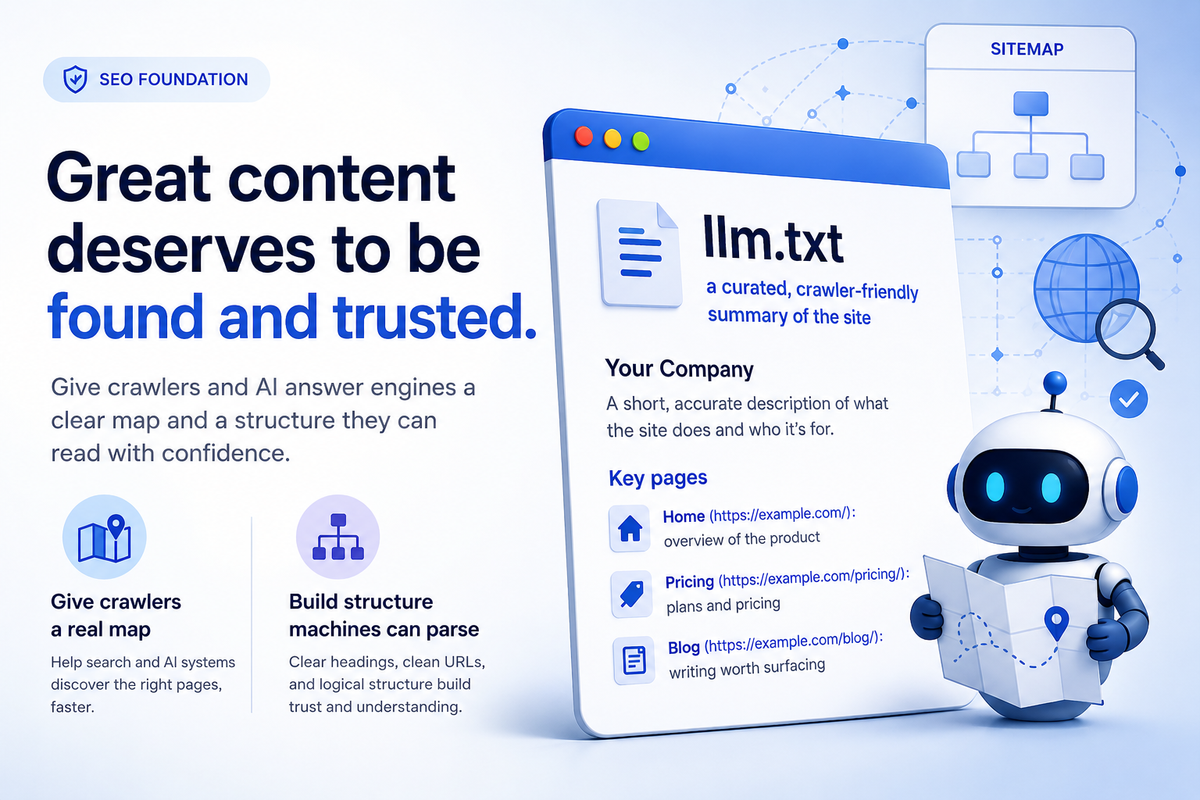
Llm.txt is a newer idea, but the logic behind it isn't unfamiliar: it's a plain-text manifest that gives AI systems and crawlers a clean, curated map of what your site actually is - the pages that matter, described in plain language, without asking a language model to fight through navigation bars, cookie banners, and client-side rendering just to figure that out for itself.
A good one is short and honest: a plain description of what the site does, followed by a curated list of the pages actually worth surfacing. The part that matters most is what you leave out - non-indexable pages, redirects, anything that would send a crawler down a dead end.
llm.txt — a curated, crawler-friendly summary of the site
Your Company

A short, accurate description of what the site does and who it's for.

Key pages
Home (https://example.com/): overview of the product
Pricing (https://example.com/pricing/): plans and pricing
Blog (https://example.com/blog/): writing worth surfacing

Notes for crawlers
All linked pages return 200 and are canonical.
No non-indexable, redirected, or error pages are listed here.
Sitemaps fail in a quieter way. The XML itself can be perfectly valid and still undermine you if the URL it declares doesn't exactly match what's submitted to Search Console and referenced anywhere else it's linked from. That mismatch sounds cosmetic until you think about what it's actually telling a crawler: here are two slightly different addresses for the same source of truth — you decide which one's authoritative. Every reference to your sitemap, wherever it's declared and wherever it's submitted, should point at the exact same canonical URL, character for character.
Neither of these is glamorous work. It doesn't move a single word of copy. But it's the layer everything else sits on top of - if a crawler can't confidently establish what your site is and where its real pages live, it doesn't matter how good the content behind them is.
Get your heading hierarchy and URL structure right
A page should have exactly one H1 describing what it's about, followed by a logical, sequential nesting of H2s and H3s underneath it. In practice, this breaks in a few predictable ways: pages missing an H1 entirely, pages with two or three competing H1s, headings duplicated near-identically across unrelated templates, and heading levels that jump around out of order - an H3 showing up before the H2 it's supposed to sit under. Individually small. Sitewide, it adds up to a document outline that neither a search engine nor an AI summarizer can parse with much confidence about what actually matters on the page.
One common culprit is the logo itself accidentally claiming the H1:
Before: the logo image is marked up as the page's H1
<h1><img src="/logo.svg" alt="Company" /></h1>
<h2>What the page is actually about</h2>
After: the logo is just a link, the real page heading owns the H1
<a href="/" aria-label="Company">
<img src="/logo.svg" alt="Company" />
</a>
<h1>What the page is actually about</h1>Multiply that pattern across templates, and duplicate or missing H1s stop being an edge case and start being a sitewide pattern - which is exactly how a crawler will read it too.
The other recurring mistake is underscores in URLs. It's subtle: search engines generally treat a hyphen as a word separator but an underscore as a literal joining character. Employee_wellness_tips doesn't reliably parse into three distinct keyword tokens the way employee-wellness-tips does to a crawler, the underscored version can read closer to one long, opaque word. The fix is a straightforward slug migration to hyphens, with permanent redirects in place so existing links and rankings carry over instead of resetting to zero:
// next.config.js
module.exports = {
async redirects() {
return [
{
source: '/blog/employee_wellness_tips',
destination: '/blog/employee-wellness-tips',
permanent: true,
},
// ...mapped for every affected URL sitewide
]
},
}
Neither fix is exciting. But get either one wrong even slightly - a missed redirect, a heading left out of order - and it costs you rankings quietly, with no error message to tell you why.
None of this is about chasing an algorithm. It's about giving anyone reading on your behalf — human or machine — a version of your site that says exactly what it means, with nothing left for them to guess at.
Costume preparation becomes easier when measurements, fabric and accessories are reviewed together. Decorative parts may require different care from the main fabric. For a closer costume review, Rem cosplay costume(レム コスプレ衣装) identifies the matching character outfit. It can be evaluated for movement, changing and storage needs. Comfort, movement and fabric care are as important as the visual design. A short fitting test can reveal adjustments needed before the event.
It all comes down to the same thing: making your site legible to whoever - or whatever - is trying to read it.
Good technical SEO is invisible by design. Nobody reads a page and thinks "great sitemap." When it's working, people just find you - and increasingly, so do the AI systems answering questions on their behalf.