Top-K in RAG: Why Retrieving More Documents Doesn't Always Help
Every RAG tutorial follows almost the same flow: convert the user's query into an embedding, retrieve the Top-K most similar documents, and pass them to the LLM.
The part that's usually skipped is a simple question:
Why K?
Why retrieve 3 documents instead of 1? Why not 10? Or even 20?
When I first started working with vector search, I assumed there must be a recommended value. But the more I worked with retrieval systems, the more I realized that Top-K isn't just another configuration value - it's one of the biggest decisions in a RAG pipeline.
It directly affects retrieval quality, response time, token usage, and ultimately whether your chatbot gives the correct answer.
What Does Top-K Actually Mean?
When a user asks a question, the query is converted into an embedding. OpenSearch then compares that embedding with the embeddings stored in the vector index and assigns each document a similarity score.
The documents are sorted from most similar to least similar.
Top-K simply means returning the first K documents from that ranked list.
If K is 3, OpenSearch returns the three most similar documents.
If K is 10, it returns the ten most similar documents.
That's all Top-K does.
The difficult part isn't retrieving documents - it's deciding how many documents are actually useful.
Why Choosing K Is a Trade-off
At first glance, the answer seems obvious.
If retrieving three documents is good, retrieving ten should be even better because the LLM gets more information.
Unfortunately, that's rarely how it works.
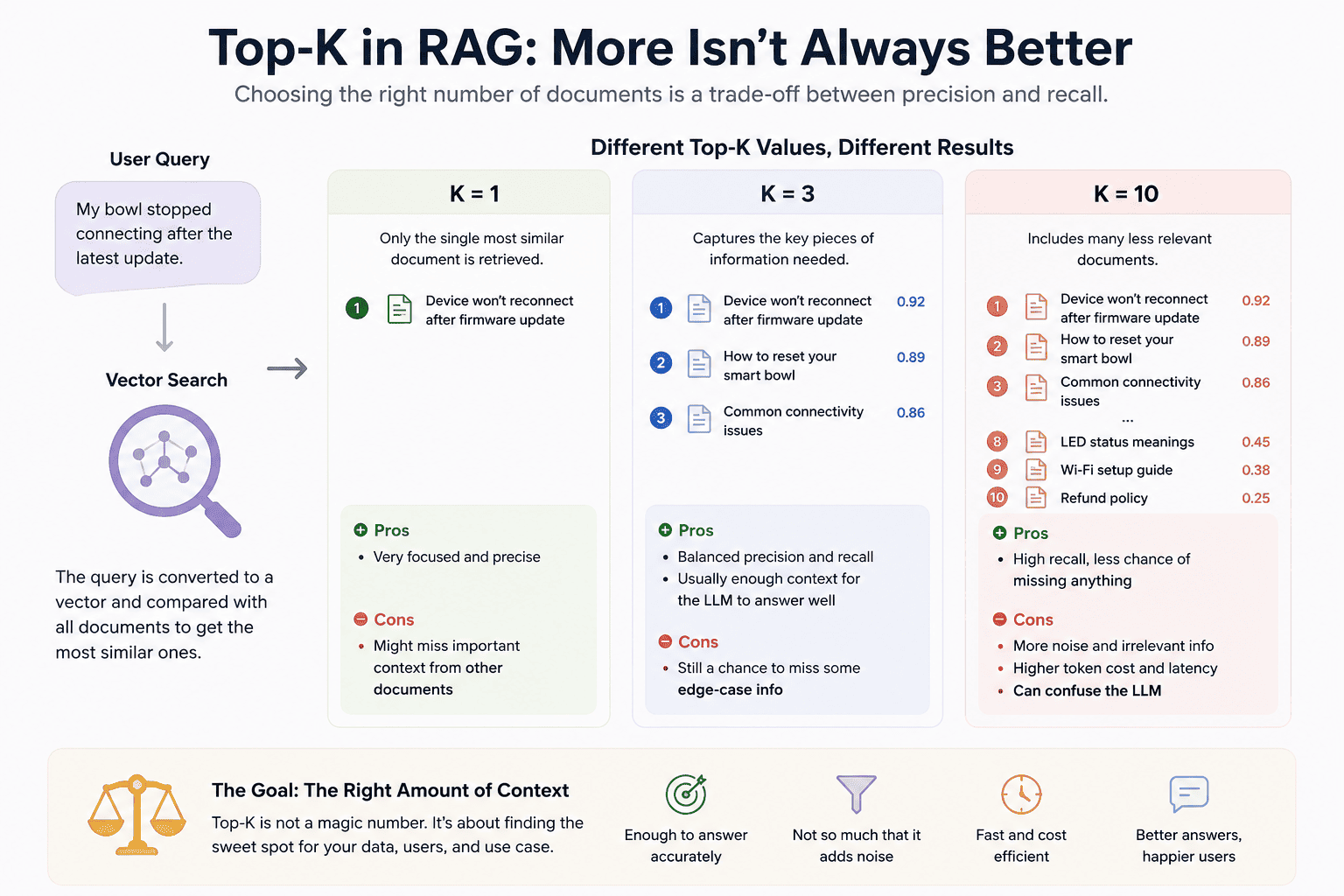
A small K gives the model only the most relevant documents, making the prompt cleaner and faster to process. The downside is that you might miss an important piece of context.
A large K improves the chances of finding every relevant document, but it also introduces unrelated information. The LLM now has to figure out which documents actually matter, and that isn't always easy.
In other words, choosing Top-K is a balance between precision and recall.
A Simple Example
Imagine you've built a support chatbot for a smart pet bowl.
A customer asks:
"My bowl stopped connecting after the latest update."
Your knowledge base contains these articles:
- Device won't reconnect after firmware update
- How to reset your smart bowl
- Common connectivity issues
- Wi-Fi setup guide
- LED status meanings
- Refund policy
If K = 1, only the firmware update article is retrieved. That's probably the best match, but if the reset instructions are stored in another document, the model may give an incomplete answer.
If K = 3, the model receives the firmware guide, reset instructions, and connectivity troubleshooting article. Together, they provide enough context to answer the user's question accurately.
Now imagine K = 10.
Along with the useful articles, the prompt also includes Wi-Fi setup, LED indicators, and even unrelated documents like the refund policy. None of them are wrong, but they don't help answer the user's question.
Instead of helping the LLM, you've now given it extra information that it needs to filter out.
Sometimes, more context actually makes the answer worse.
The Hidden Cost of a Larger K
Increasing K doesn't just affect retrieval.
Every retrieved document becomes part of the LLM's prompt.
That means:
- More input tokens
- Higher API costs
- Longer response times
- More irrelevant context for the model to process
There's another problem that's easy to overlook.
Suppose two retrieved documents contain conflicting information because one of them is outdated.
With a smaller K, only the latest document might be retrieved.
With a larger K, both versions end up in the prompt, forcing the LLM to decide which one is correct.
The more unnecessary context you provide, the harder that job becomes.
Is There a Perfect Value for K?
The short answer is no.
The ideal value depends entirely on your application.
A FAQ chatbot usually works well with a small K because the answers are short and focused.
Legal or research applications often retrieve more documents because important information may be spread across multiple sources.
Code search typically prefers high precision, so retrieving only a few highly relevant snippets often works better.
There isn't a magic number that works for every system.
The right value comes from testing your own data.
What Production Systems Usually Do
Most production RAG systems don't rely only on Top-K.
A common approach is to retrieve a larger set of candidate documents and then use a reranking model to select the best few before sending them to the LLM.
Another common technique is using a similarity threshold.
Instead of blindly returning the top five documents, the system ignores results whose similarity score is too low. This prevents weak or irrelevant matches from reaching the LLM.
Many systems also combine vector search with traditional keyword search to improve retrieval quality.
These techniques don't replace Top-K, but they make it much more effective.
Final Thoughts
Top-K looks like a small configuration setting, but it influences almost every part of a RAG system.
Set it too low, and you risk missing important context.
Set it too high, and you increase latency, token costs, and the chances of confusing the LLM with irrelevant information.
There isn't a universal value for Top-K. The right choice depends on your data, your users, and your application.
The goal isn't to retrieve more documents - it is to retrieve the right amount of relevant context for the LLM to answer accurately.