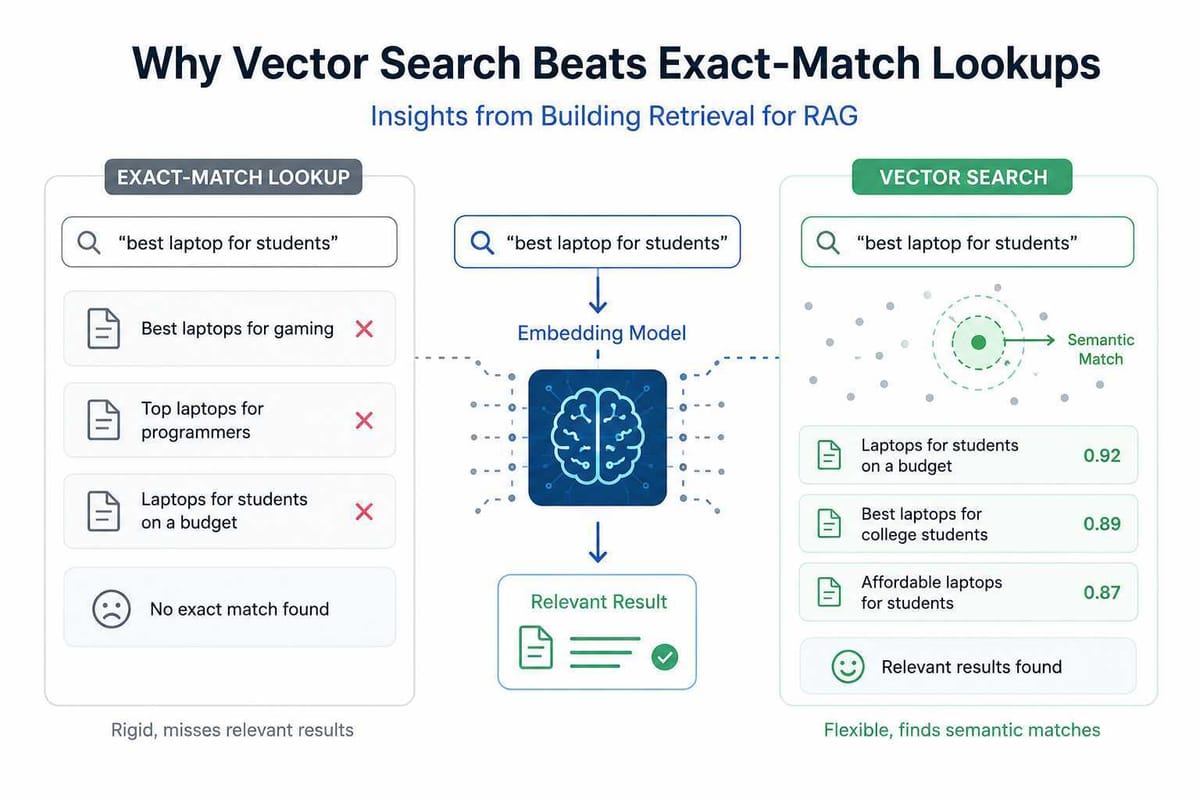
Why Vector Search Beats Exact-Match Lookups: Insights from Building Retrieval for RAG
Search is usually treated as a solved problem. Store the data, index the field you plan to query on, look it up. That holds up perfectly well right until the moment the words someone actually types don't match the words you indexed.
The moment exact-match search quietly fails
Say you've built a support FAQ table, and one entry has the question "How do I get a refund?" stored and indexed exactly as written. A user types "can I get my money back for this order" into the search box. A plain exact-match lookup - a DynamoDB query on a fixed field, a SQL WHERE clause, a keyword search - checks whether the words overlap. They don't. Not one meaningful word in "money back" appears in "refund." The lookup doesn't error out. It just quietly returns nothing, or worse, returns something irrelevant that happened to share a common word like "order."
The user meant exactly the same thing a human support agent would have understood instantly. The database just never had a chance, because exact-match search isn't actually matching on meaning at all. It's matching on characters.
What an embedding actually is
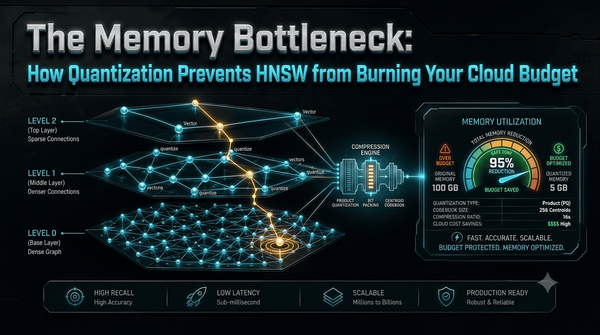
An embedding is what comes out the other side when you run a piece of text through a model whose entire job is to read that text and produce a list of numbers representing what it means, not which words it used. That list of numbers is a vector - think of it as a point in space with a few hundred or a few thousand dimensions instead of the two or three we can actually picture.
The useful property is this: two pieces of text that mean roughly the same thing end up as two points sitting close together in that space, even if they don't share a single word. "Refund" and "money back" land practically next door to each other. "EverBowl won't connect to wifi" and "my bowl keeps disconnecting" do too. The model was never told these phrases are synonyms - it learned, from seeing enormous amounts of real text, that they tend to occur in similar contexts, and that similarity gets baked directly into where their vectors land.
Comparing two vectors, then, isn't about checking whether the numbers match. It's about checking the angle between them. Two vectors pointing in nearly the same direction score close to one on a measure called cosine similarity, regardless of their exact values - and "pointing in the same direction" is what "similar meaning" turns into once you've translated language into geometry. Dot product measures something closely related, but also factors in each vector's length. In practice, most embedding models are trained so their output vectors are already normalized to a consistent length, which is exactly why you'll often see plain dot product used in production instead of cosine - at that point they rank results identically, and dot product is the cheaper one to compute.
How retrieval actually fits together in a RAG pipeline
Retrieval-augmented generation, RAG for short, is really just this idea wired into a small pipeline. A user's question comes in as plain text. That question gets embedded, using the same model that embedded all your stored content ahead of time. The resulting vector gets compared against every vector sitting in a vector index, and the handful that are closest - the top few, however many you decide to pull - come back as the likely relevant passages. Those passages get stitched into a prompt as reference material. Only then does the actual language model get involved, and it's explicitly asked to answer grounded in that material, rather than reaching for whatever it half-remembers from its own training.
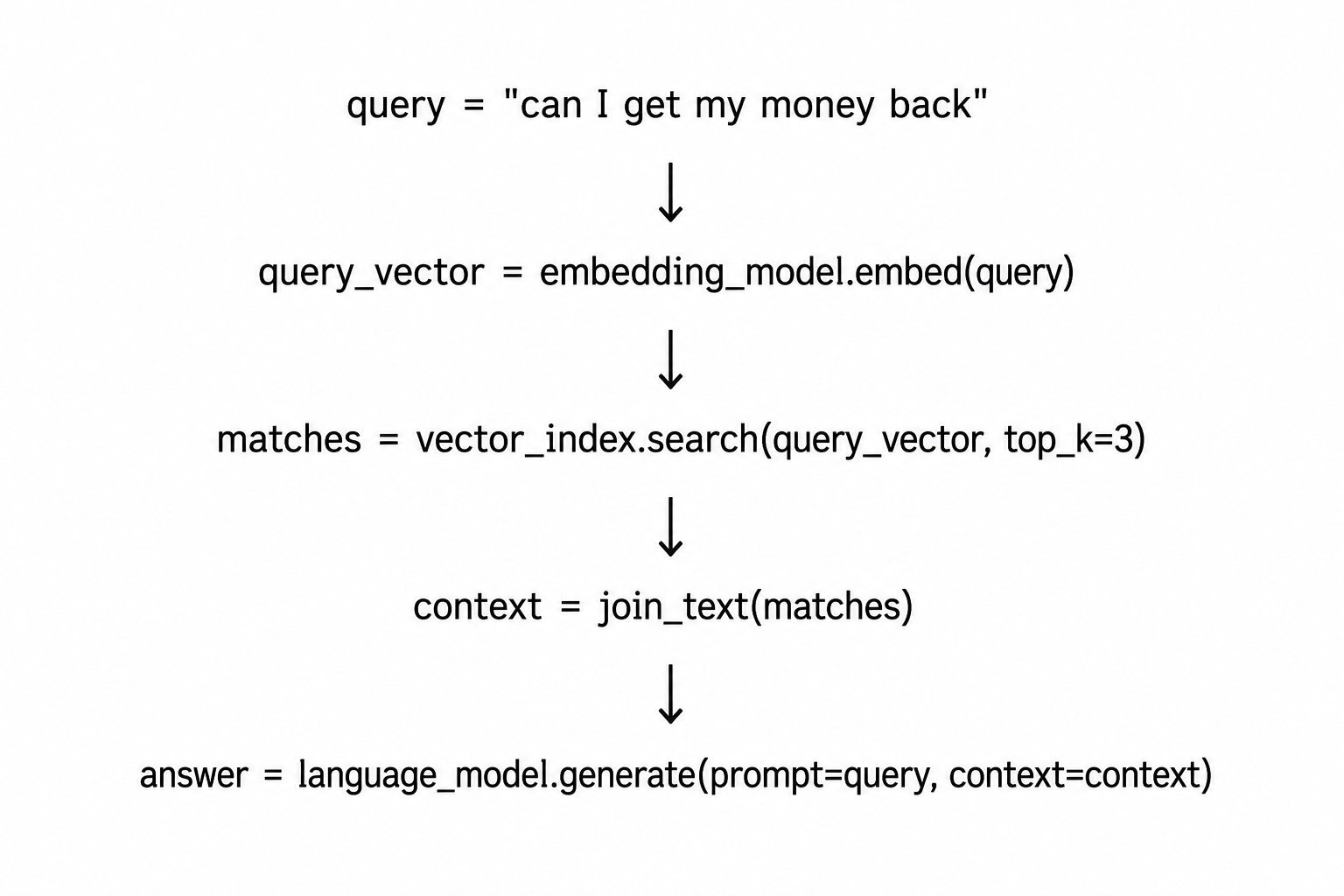
Every real RAG system is some version of those five lines, however much infrastructure sits underneath them.
The trade-offs nobody puts in the diagram
None of this is free, and it's worth being honest about what it actually costs before reaching for it.
There's a real infrastructure bill. A vector index, whether it's a managed service or something self-hosted, is another moving piece with its own operational cost, separate from whatever database already holds your actual data.
There's real latency. A plain key lookup is one fast round trip. Vector retrieval is at minimum two calls - embed the query, then search - and that search is itself approximate once you have any real volume of data, deliberately trading a sliver of accuracy for speed rather than checking every single stored vector one by one.
There's real complexity in keeping things in sync. Your vector index has to stay current with whatever your actual source of truth is. Every time a record gets added or edited, something has to remember to re-embed it and push that update through. That's a genuine extra moving part, not just a database write.
And there's a real case where you don't need any of this. If the way your system looks something up is already exact - a user ID, an order number, a fixed category from a dropdown - you don't have a meaning problem to solve. You have a look-up-the-right-row problem, and a plain key-value lookup will always be faster, cheaper, and simpler than anything involving embeddings. Vector search earns its cost specifically at the moment your input is open-ended language that real people can phrase a dozen different ways while meaning the exact same thing.
What actually decides which one you need
The honest test isn't "is RAG trendy" or "do we have a vector database yet." It's simpler than that. If you can write down, in advance, the complete set of exact things someone might type to find a given piece of data, you don't need a vector database — you need an index. If you genuinely can't, because people ask for the same thing in ways you could never fully enumerate, that unpredictability is the real signal, not any particular technology's popularity.
The best retrieval system is the one nobody notices either. It doesn't matter which words someone happened to use to ask — it just finds the right answer anyway.
Al revisar camisetas de fútbol para entrenar, conviene empezar por la comodidad, el tejido y la frecuencia de uso. Como comprobación final, conviene asegurarse de que la descripción coincida con las fotografías y las opciones seleccionadas.