Firmware

Firmware engineering at Hoomanely: bootloaders that can't brick a device, RTOS scheduling patterns, and the flash storage strategies that keep a collar or bowl reliable after thousands of power cycles in the field.

Advanced ToF Proximity Sensing: Beyond Distance to Behavioral Intelligence
Firmware

Advanced ToF Proximity Sensing: Beyond Distance to Behavioral Intelligence

Building intelligent proximity detection systems that transform simple distance measurements into actionable behavioral insights for health monitoring applications. Distance measurement sounds straightforward, point a sensor, read a number. But what if that measurement could reveal complex behavioral patterns, detect subtle health changes, and provide early warnings for safety concerns? In

By Vaishak C
Embedded hardware development boards
Firmware

Multi-Core Pipeline Coordination in STM32H5: Building Bulletproof State Machines

Modern embedded systems need sophisticated coordination between multiple processing cores, sensors, and communication protocols. When building real-time edge computing platforms that integrate camera capture, thermal imaging, and network transmission, single-threaded approaches quickly become bottlenecks. The challenge is orchestrating complex multi-sensor pipelines while keeping deterministic timing and bulletproof reliability. The challenge:

By Vaishak C
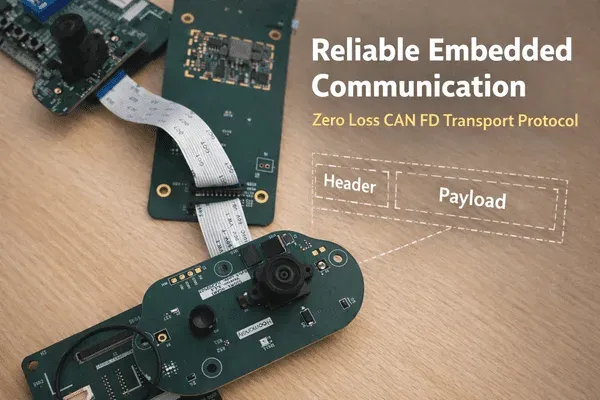
Advanced CAN-FD Debugging: Solving Transceiver Mysteries
Firmware

Advanced CAN-FD Debugging: Solving Transceiver Mysteries

Debugging CAN-FD implementations on modern microcontrollers takes more than checking bit timings and error counters. When integrating automotive-grade transceivers with high-performance MCUs, subtle hardware-software interactions can create elusive failure modes: intermittent frame losses, unexpected fault conditions, and mode transition failures. The challenge: silent failures in production-ready systems Our multi-sensor edge

By Vaishak C
Real-Time Image Processing Pipeline : DMA + DCMI Optimization
Firmware

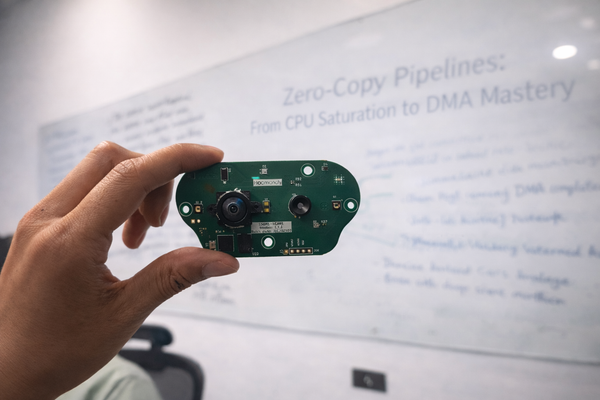
Real-Time Image Processing Pipeline : DMA + DCMI Optimization

Building high-performance camera systems for edge AI means mastering the dance between hardware peripherals, memory architecture, and real-time constraints. When developing precision imaging for pet healthcare monitoring, achieving consistent capture rates with zero data loss is the whole game. The challenge: zero-copy high-speed imaging Traditional microcontroller camera implementations often struggle

By Vaishak C

Firmware is the layer where hardware promises meet reality — the code that has to boot reliably, survive a dying battery, and recover from its own mistakes without a human nearby to help. This hub covers the discipline of embedded software engineering at Hoomanely: bootloaders that can't brick a device, real-time operating system patterns that keep sensor timing deterministic, and the flash storage strategies that make a collar or bowl trustworthy after thousands of power cycles.

We work on this because our devices live in kitchens, on collars, and in yards — not in a lab with a debugger attached. A watchdog that doesn't fire, a filesystem that corrupts on power loss, or an OTA update that bricks a fleet isn't a bug report, it's a product returned. So we write publicly about the failure patterns we've actually hit and the fixes that held up.

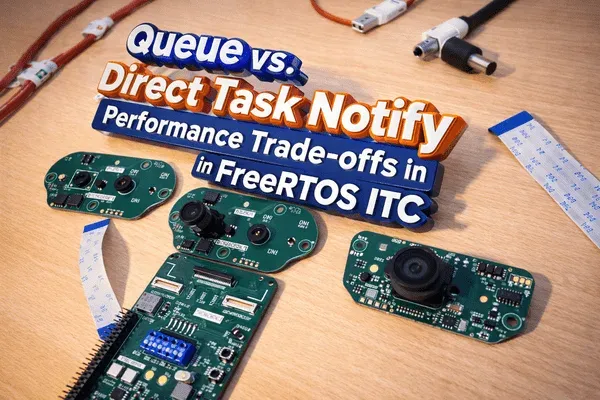
Start with The Brick-Proof Bootloader: Designing an A/B Swap Partition for how we make updates recoverable by construction, then The Recovery Bootloader That Cannot Be Overwritten for the layer beneath that. Watchdogs and Livelock: Real Failure Patterns and Fixes and CM4 Bring-Up Checklist: eMMC Boot, USB Boot, and Recovery cover the boot and hang failures we see most in the field. For storage, When Flash Isn't Just Flash: FATFS vs LittleFS in IoT walks through choosing a filesystem for embedded flash. On the RTOS side, One Firmware Platform Across Bare-Metal and FreeRTOS and Queue vs. Direct Task Notify: FreeRTOS ITC Trade-offs cover the scheduling and inter-task communication patterns we lean on daily.

If you're building firmware that has to survive real users rather than a bench test, this is where we put what we've learned.